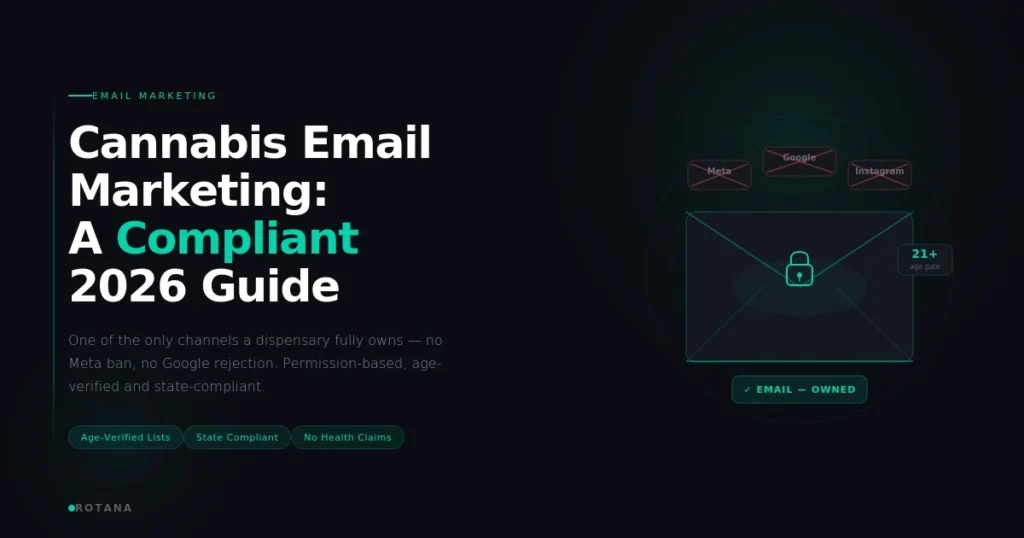
Cannabis email marketing is the use of permission-based, age-verified email to keep dispensary customers coming back and to promote products inside a maze of federal, state and platform rules. For a cannabis business it is not just another channel. It is one of the few you actually own. Meta and Google will not run your ads, so the email list you build is among the most valuable marketing assets your dispensary has.
I have run email programs in heavily regulated spaces. Cannabis is the strictest I have seen, and the gap between what works and what is legal is wide. The tactics that grow a list are the same everywhere, but a dispensary carries a compliance burden no generic email guide will touch. Get it wrong and you face fines, account bans or worse. This guide covers both halves: what brings customers back, and what keeps you legal in 2026.
Why email is the channel cannabis brands own
The platforms that lock you out
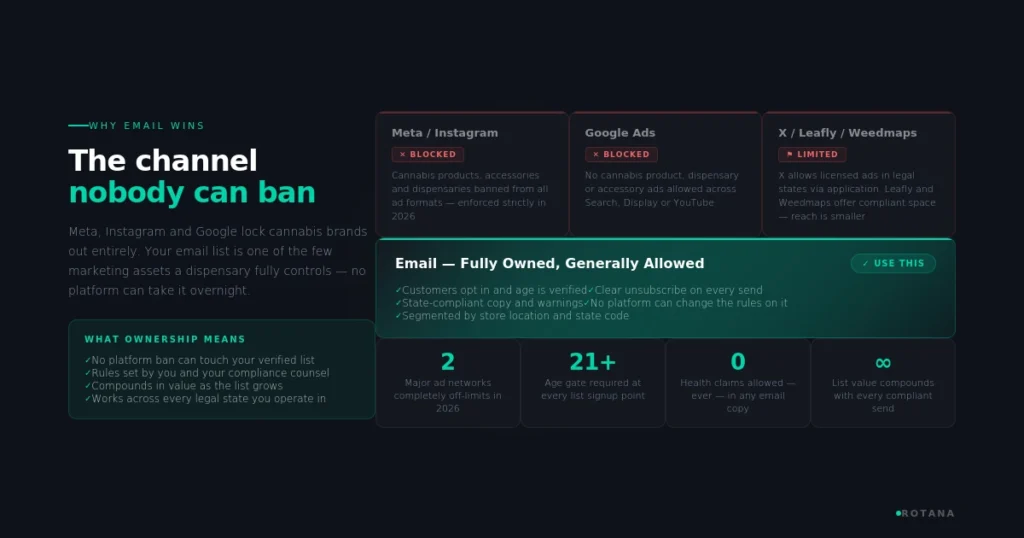
Start with the hard reality. As of 2026 you cannot advertise cannabis products, accessories or dispensaries on Instagram or Facebook, and they enforce it strictly. Google does not allow cannabis ads either. That locks most brands out of the two biggest ad channels on the internet. X is the most permissive major platform and allows licensed cannabis ads in legal states through an application process, and industry platforms like Leafly and Weedmaps offer compliant ad space, but reach is limited.
Why an owned list wins
Email and SMS are different. They are generally allowed when people opt in, you verify ages and you give a clear way to unsubscribe. That makes your email list one of the only channels a cannabis brand fully controls. No platform can ban your list or change the rules on it overnight. For an industry shut out of paid social, that ownership is worth more than it would be in any other business.
The triple compliance layer you cannot skip
This is what makes cannabis email different from every other industry. You are tracking compliance on three levels at once: federal, state and platform. Miss any one and a campaign can derail and put the business at risk.
Federal and state: a patchwork, not a rulebook
Because cannabis is still federally restricted, each state enforces its own advertising code, and they conflict. A message promoting a discount can be legal in one state and banned in the next. Copy-pasting one campaign across states is no longer viable. Many states require specific warning language, things like a notice not to use if under 21 and to keep the product away from children, and some require you to identify the licensed business by name and license number. California and New York run the strictest regimes. Colorado, Washington and Oregon are more relaxed. Always check your own state before you send.
Age verification is mandatory
Every direct, dialogue-based message generally must confirm the recipient is 21 or older. For email that means age-gating at signup and keeping records of how you verified. Test your age gate regularly using different ages, locations and devices, and document the results, because a system that lets minors through is one of the fastest ways to draw a penalty.
The claims that get you fined
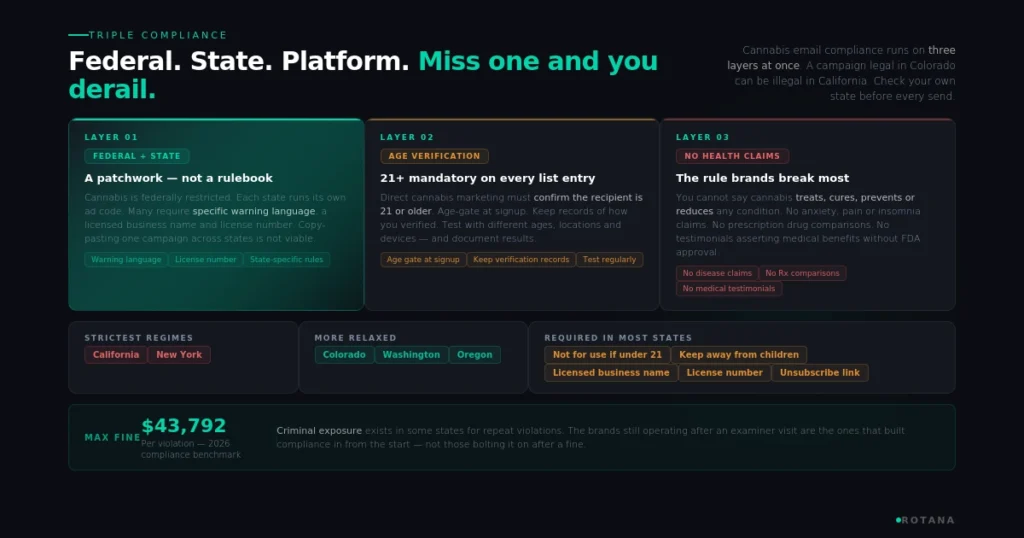
You cannot say cannabis treats, cures, prevents or reduces any disease or condition. No claims about anxiety, pain or insomnia, no comparisons to prescription drugs and no testimonials that assert medical benefits without FDA approval. These are the rules brands break most often. Penalties are steep: one 2026 compliance guide put the maximum at $43,792 per violation, with criminal exposure in some cases. Keep your email copy free of health claims, full stop.
One caveat for this section. I am a marketer, not a cannabis-compliance attorney. Treat this as the map, then run your program past counsel who knows your state’s code before you send. The brands that build compliance in from the start are the ones still standing when an examiner calls.
Build the list the right way
Capture opt-in and age at the same moment
Permission is the foundation, and for a dispensary it is also a legal safeguard. Capture both the email opt-in and age verification at the same point: in-store at checkout, on your age-gated website, at events. Use a digital form that records consent and the age check together, so you hold the proof if a regulator asks. Past customers are your highest-value segment because they already cleared age verification and already buy.
Never buy a cannabis list
Buying a list is worse here than in any other industry. It wrecks deliverability, breaks platform terms, and hands you contacts with no verified age and no consent, which is a direct compliance failure. Build the list slowly from your own verified customers and protect it.
The email campaigns that bring customers back
A dispensary email program runs on a few dependable campaigns rather than scattered blasts.
The welcome and first-purchase series
A welcome series greets new subscribers once they clear age verification. Introduce the brand, set expectations for what you will send, and offer a compliant first-visit incentive where your state allows it. This is where a new signup becomes a repeat customer.
The product and education newsletter
A regular newsletter keeps you in mind between visits. Lead with what is useful and compliant: new arrivals, general education about product types, store news. Keep it free of medical claims and you sidestep the rule brands break most. Education sells in this industry precisely because customers cannot get it from banned ad channels.
Win-back and loyalty
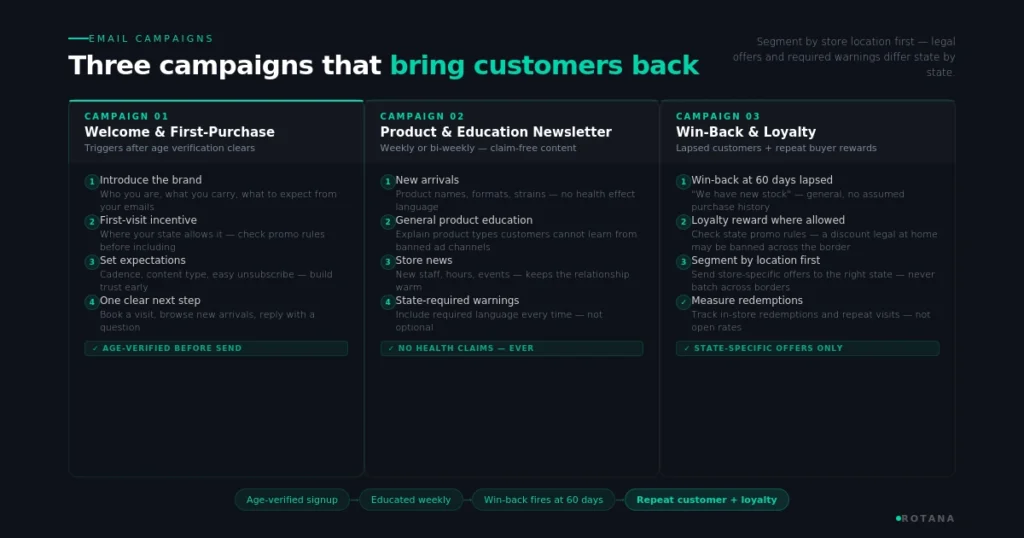
Win-back messages recover lapsed customers, and loyalty emails reward repeat buyers where your state permits promotions. Both work hard because your list is already verified and already interested. Keep promotional rules state-specific, since a discount offer legal at home may be banned across the line.
Write cannabis emails that convert and comply
Segment by store and state
If you operate in more than one state, segment by location first, because the rules and the legal offers differ. Then segment by product interest and purchase history. Location-aware sending is not just better marketing here, it is how you keep each message legal for the person receiving it.
Keep copy clean and claim-free
Short subject lines, one clear idea, one next step, and required warning language where your state mandates it. Strip out anything that reads as a health claim. Plain product and brand messaging converts and keeps you compliant at the same time.
Measure what reflects revenue
Open rates are a soft signal since Apple’s Mail Privacy Protection inflates them. Track click-through rate, redemptions and repeat visits. A dispensary that drives forty in-store redemptions from one email has a better program than one chasing opens.
What I would do first
If you run a dispensary and you are starting fresh, do three things this month. Set up an email platform with a real age gate and capture opt-in plus age verification together at checkout. Build a welcome series and a claim-free product newsletter, segmented by store location. Send them, then watch redemptions and clicks rather than opens.
Email rewards consistency more than cleverness, and in cannabis it rewards compliance most of all. The brand that sends one useful, legal email every week to a verified list builds something no banned ad platform can take away. If you want help building that system, including the compliant setup and the campaigns, that is the kind of work I do at Rotana through our cold email and drip campaign service. You can book a call through the link on the site. Email marketing is is a good option for dentist, lawyers and financial advisors as well.
Frequently asked questions
Is email marketing legal for cannabis dispensaries?
Yes, in legal states, when done correctly. Email and SMS are generally allowed where customers opt in, you verify they are 21 or older and you provide a clear unsubscribe option. This stands in contrast to Meta and Google, which do not allow cannabis ads at all as of 2026, which is why email is one of the few channels a dispensary fully owns. You still must follow your state’s advertising code.
Do cannabis emails require age verification?
Yes. Direct, dialogue-based cannabis marketing generally must confirm the recipient is 21 or older, so email programs need age-gating at signup and records of how age was verified. Test the age gate regularly with different ages, locations and devices, and keep the results, since a gate that lets minors through is among the fastest ways to trigger a penalty.
What can you not say in a cannabis marketing email?
You cannot claim cannabis treats, cures, prevents or reduces any disease or condition, cannot reference anxiety, pain or insomnia as benefits, cannot compare it to prescription drugs and cannot use testimonials asserting medical benefits without FDA approval. Health claims are the most common violation. Keep copy to product, brand and general education, and include any warning language your state requires.
Why can’t cannabis brands advertise on Facebook or Google?
Because cannabis remains federally restricted, and both platforms prohibit cannabis product, accessory and dispensary advertising as a matter of policy, enforced strictly in 2026. That exclusion from the two largest ad networks is exactly why owned channels like email carry so much weight for cannabis brands. X allows licensed cannabis ads in legal states through an application, and Leafly and Weedmaps offer compliant ad space, but reach is smaller.
How often should a dispensary send marketing emails?
A weekly or bi-weekly cadence suits most dispensaries, since customers buy more frequently than in many industries and respond to new arrivals and offers. Pair a regular newsletter with welcome, win-back and loyalty flows. Keep every send claim-free and state-appropriate, and prioritize consistency, because a steady verified list compounds in value over time.