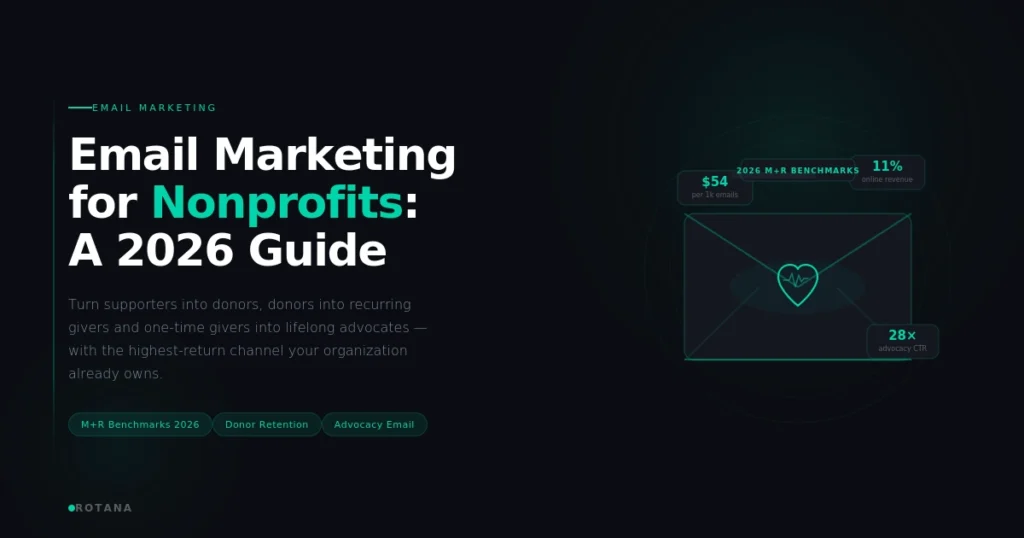
Email marketing for nonprofits is the use of permission-based email to turn supporters into donors, donors into recurring givers and one-time givers into lifelong advocates. It is the highest-return channel most nonprofits have. The 2026 M+R Benchmarks, the sector’s most-cited study, found email accounted for 11% of all online revenue across nonprofits, and email-sourced revenue rose 16% in 2025. For an organization watching every dollar, the channel you already own is the one to master first.
I have built email programs across many industries, and the nonprofit version has a twist most guides miss. Your “sale” is a donation, your “customer” is a donor you need to keep for years, and your most powerful email might not ask for money at all. This guide uses the 2026 benchmark data to show what actually works, not what sounds nice in a board meeting.
Why email still beats every other nonprofit channel
The revenue the data shows
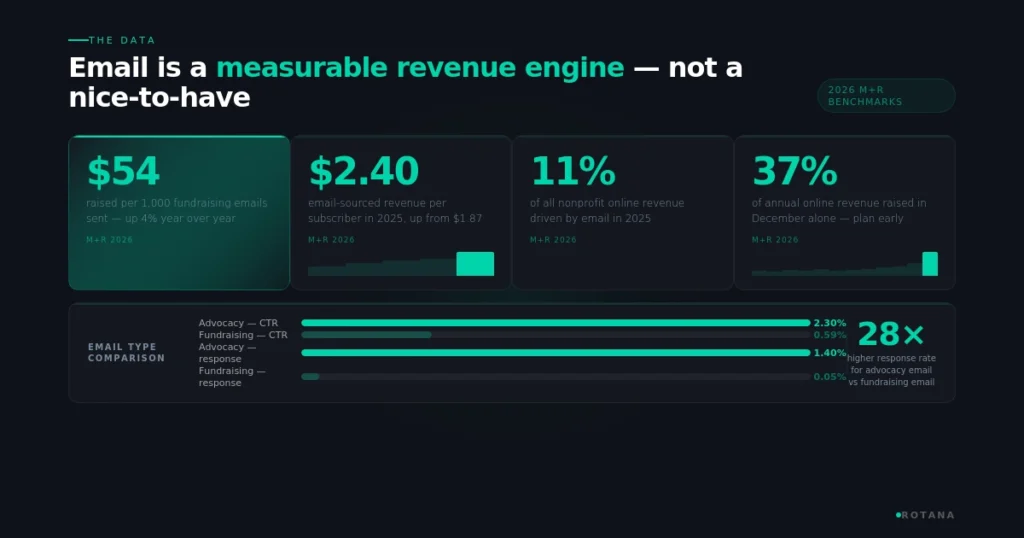
Email pulls its weight. The 2026 M+R Benchmarks reported nonprofits raised an average of $54 for every 1,000 fundraising emails sent, a 4% rise on the prior year, and email-sourced revenue reached $2.40 per subscriber in 2025, up from $1.87. Across the wider sector, December alone drove 37% of annual online revenue, which tells you where the calendar’s weight sits. Email is not a nice-to-have. It is a measurable revenue engine.
An owned list you control
Social reach is rented and shrinking. Your email list is yours, the one audience no platform can throttle or take away. That ownership matters more for a nonprofit than almost any business, because your relationships span years and your retention depends on staying in touch between gifts. The same logic drives the other vertical email guides I have written, like email marketing for financial advisors, where long relationships also make the owned channel the most valuable one.
The insight most nonprofits miss: advocacy beats the ask
The 28x gap in the data
Here is the finding that should change how you send. In 2026 the M+R data showed advocacy emails generated a 2.3% click-through rate and a 1.4% response rate, while fundraising emails managed 0.59% and 0.05%. The advocacy response rate runs about 28 times higher than the fundraising rate. Most nonprofits still treat advocacy as secondary. The data says it is your most engaging content.
Why advocacy also raises money
Asking people to act, not just give, builds the relationship that giving depends on. And advocacy creates a path to donation: about 0.34% of subscribers who took an advocacy action went on to donate on the page that followed. A welcome series performs in the same spirit, pulling a 1.6% click-through rate, nearly three times the standard fundraising email. The lesson is to lead with action and identity, then invite the gift.
The retention crisis you have to plan around
The number that should worry you
Acquisition gets attention, but retention keeps the lights on. The benchmark studies put first-time donor retention below 20%, meaning fewer than one in five first-time donors ever give again. One-time giving grew 17% in 2025, outpacing monthly giving, which means a wave of new one-time donors is now at high risk of lapsing in 2026 unless you nurture them. Email is the cheapest tool you have to fight that drop.
How email closes the gap
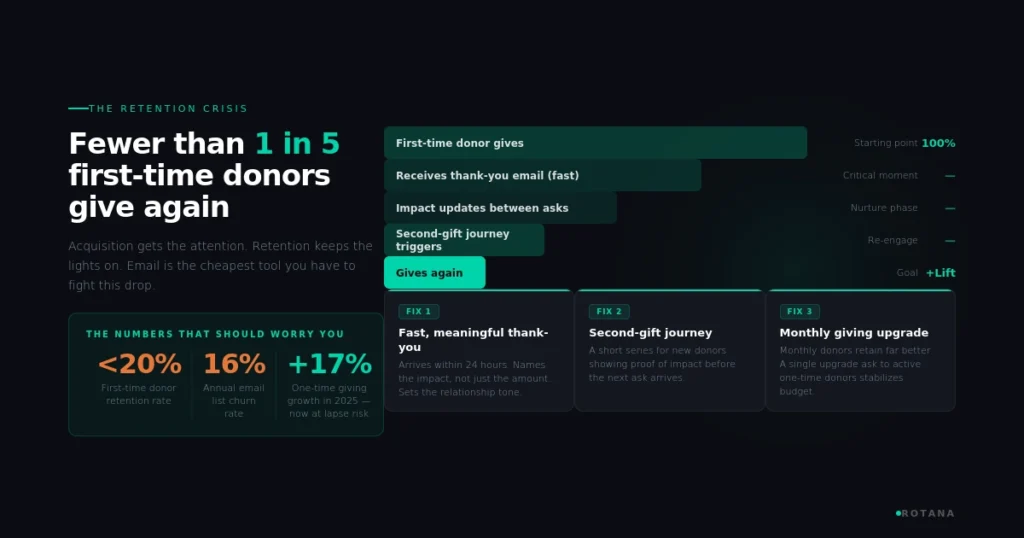
A second-gift journey for new donors, a thank-you that arrives fast and means it, and a steady stream of impact updates between asks all lift retention. Treat a first gift as the start of a relationship, not the finish line. The organizations that turn one-time emergency donors into sustainers are the ones still funded a year later.
Build the list the right way
Where good supporters come from
Permission is the foundation. Your strongest list grows from people who already care: event attendees, petition signers, volunteers, past donors. Add an opt-in to every donation form, petition and signup. Offer something worth the address, an impact report or a campaign update. Personalization pays here, since 63% of nonprofits personalize email and personalized subject lines are measurably more likely to be opened.
Why bought lists fail nonprofits
Buying a list wrecks deliverability, breaks platform terms and fills your file with people who never chose your cause. A nonprofit runs on genuine affinity, and a cold purchased list has none. Grow slowly from real supporters and keep the list clean, because a 16% annual churn already means you must grow just to stay flat.
The email programs that fund the mission
A nonprofit email program runs on a few dependable journeys rather than scattered blasts.
The welcome series
A welcome series greets new subscribers and converts interest into a first action. Introduce the mission, share one piece of proof that you deliver impact, and offer an easy first step, an advocacy action or a small gift. This sequence outperforms standard appeals and sets the retention relationship from day one.
The advocacy and engagement stream
Given the data, an advocacy stream deserves real priority. Invite supporters to sign, share or act, then offer a giving path on the follow-up page. This stream builds the engaged base that later fundraising depends on, and it is the most underused opportunity in the sector.
The year-end and recurring-giving push
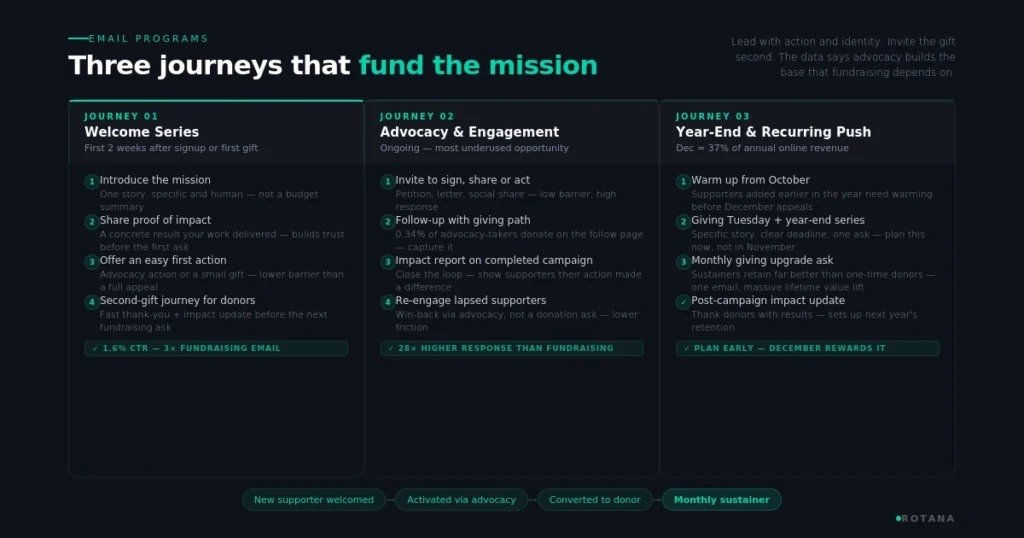
With December driving more than a third of annual online revenue, a planned year-end series is non-negotiable, ideally warming new supporters added earlier in the year. Pair it with a recurring-giving ask, since monthly donors retain far better than one-time givers and stabilize your budget.
Write nonprofit emails that move people
Segment by relationship
A first-time donor, a lapsed donor and a monthly sustainer need different emails. Segmenting by giving history and engagement lifts results and lets you send the second-gift journey, the win-back and the upgrade ask to the right people. Generic blasts to the whole list waste your most valuable asset.
Lead with story, then the ask
People give to people, not to budgets. Open with a specific story or a clear stake, make one ask, and show the donor the difference their gift makes. Keep it human and concrete. The same plain, direct style works in regulated verticals too, like email marketing for lawyers, where trust is built one useful message at a time.
Measure revenue and actions, not opens
Open rates are a soft signal since Apple’s Mail Privacy Protection inflates them. Track click-through rate, advocacy actions, donations and second-gift conversion. A nonprofit that converts forty advocacy-takers into donors has a better program than one celebrating a high open rate.
What I would do first
If you run a nonprofit and you are starting fresh, do three things this quarter. Build a welcome series and a second-gift journey for new donors, since retention is where the money leaks. Add an advocacy stream and measure how many takers convert to donors. Plan your year-end series now, while there is time to warm new supporters before December.
Email rewards consistency and relationship over volume. The organization that treats its list as a years-long relationship, not a donation machine, is the one that retains donors and funds its mission. If you want help building that system, including the journeys and the year-end plan, that is the kind of work I do at Rotana through our cold email and drip campaign service. You can book a call through the link on the site.
Frequently asked questions
Is email marketing effective for nonprofits?
Yes, it is one of the highest-return channels nonprofits have. The 2026 M+R Benchmarks found email drove 11% of all online revenue and email-sourced revenue rose 16% in 2025, reaching $2.40 per subscriber. Because the list is owned rather than rented, email also supports the long donor relationships that fundraising depends on, which makes it a measurable revenue engine rather than a nice-to-have.
What type of email gets the most engagement for nonprofits?
Advocacy email, by a wide margin. The 2026 benchmark data showed advocacy emails generated a 2.3% click-through rate and a 1.4% response rate, against 0.59% and 0.05% for fundraising emails, roughly 28 times higher engagement. Advocacy also creates a giving path, since a share of action-takers donate on the page that follows, which is why it deserves more priority than most nonprofits give it.
How often should a nonprofit send marketing emails?
Nonprofits sent an average of 50 email messages per subscriber in 2025, with fundraising making up about 31 of those. Most send newsletters monthly, though cadence should follow the journey: a timed welcome series, regular advocacy and impact updates, and a heavier year-end push. The goal is a consistent relationship, not a fixed number, since December alone drives over a third of annual online revenue.
Why do nonprofits lose so many donors?
First-time donor retention sits below 20%, so fewer than one in five first-time donors give again, and annual list churn runs around 16%. One-time giving grew faster than monthly giving in 2025, which means many new donors are at high risk of lapsing unless nurtured. A second-gift journey, fast meaningful thank-yous and steady impact updates are the email tools that fight this drop.
What email platform is best for nonprofits?
The best platform is one that supports segmentation, automated journeys and donation or advocacy integrations, and many providers offer nonprofit pricing or free tiers for smaller lists. Rather than the brand, focus on whether the tool lets you run a welcome series, segment by giving history and track revenue per email. Those capabilities matter more than any single product name.