Email marketing for lawyers is the practice of using permission-based email to stay in front of past clients, nurture referral sources and convert inquiries into retained matters. It works for law firms because legal buying cycles are long and trust-driven. Someone who reads your newsletter for eight months is the person who calls you the day they get hurt, get sued or decide to write a will.
I have run email programs across several industries. The pattern in legal is consistent: small lists, high intent, and a compliance layer most marketing guides ignore. That last part matters. A lawyer can lose more than a campaign by getting email wrong. This guide covers what works, what the numbers actually say, and the ethics rules you cannot skip.
Why email beats most channels for law firms
How email compares to paid search for law firms
Most firms underuse it. Practice Proof’s 2026 benchmark report found that only 40% of law firms use email as part of their marketing, which they describe as a significant missed opportunity given email’s returns. That gap is your opening. While competitors pour budget into paid search, the same report notes that 78% of firms run paid search yet 82% are unhappy with the ROI, citing CallRail’s data.
For practice areas with urgent needs like criminal defense, combining email with strong paid channels is especially powerful — see our guide to Criminal Defense Marketing.
What the benchmarks actually say
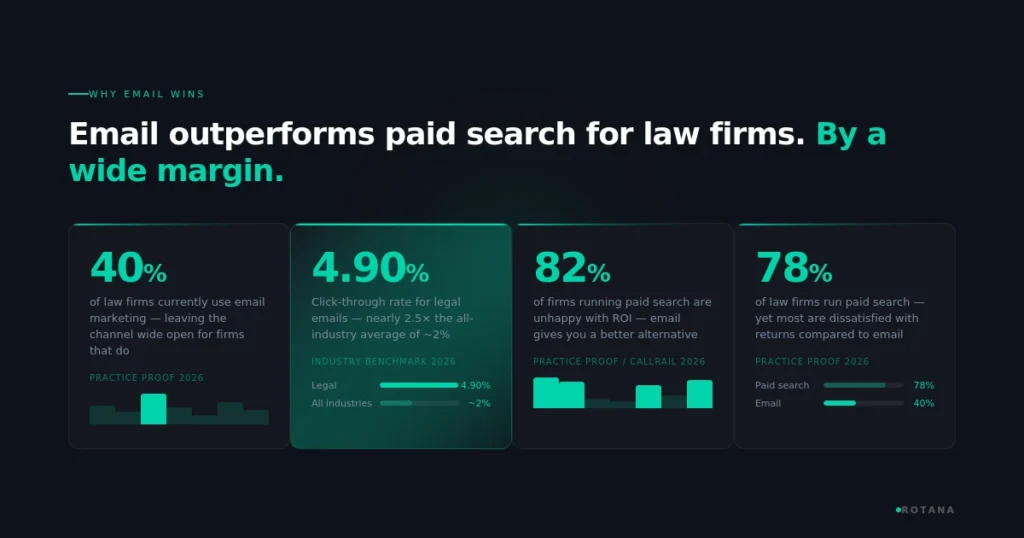
Email sits at the other end of that trade. Across industries, email marketing is repeatedly measured as one of the highest-ROI channels available. Legal specifically tends to land at the strong end of engagement benchmarks because law firm lists are usually built from real clients and consultations, not cold purchases. One 2026 industry benchmark put legal at the top of click-through performance among tracked industries at 4.90%, against an all-industry average near 2%.
Treat those figures as directional, not gospel. Benchmark sources disagree, and Apple’s Mail Privacy Protection has made open rates unreliable since it inflates them automatically. The takeaway holds regardless of which source you trust: a clean legal list with relevant messages outperforms most other marketing a firm can buy.
The compliance layer you cannot skip
Here is what separates legal email from every other industry. Lawyer advertising is regulated by your state bar, and email falls under it.
The three ABA rules that apply to email
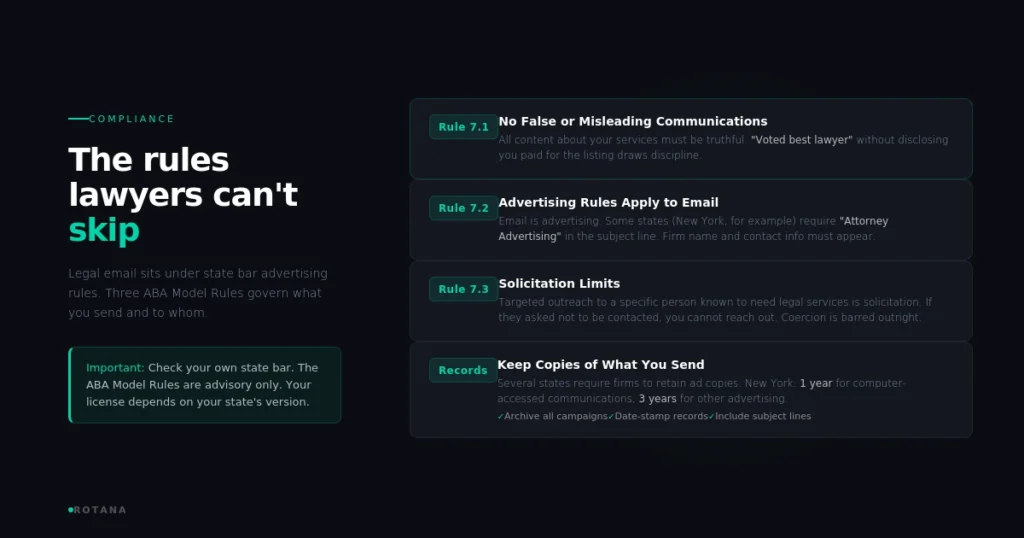
The ABA Model Rules are the common reference point, though your license depends on your own state’s version. Three rules govern this. Rule 7.1 prohibits false or misleading communications about your services. Rule 7.2 covers advertising generally. Rule 7.3 governs solicitation, meaning communication directed at a specific person known to need legal services, when your motive is financial gain.
Email requirements you must follow
A few requirements that touch email directly:
- Identification. Attorney advertising generally must include the name and contact information of at least one lawyer or firm responsible for the content. Some states, New York among them, require the words “Attorney Advertising” in the subject line of a qualifying email.
- Solicitation limits. If a recipient has told you they do not want to be contacted, Rule 7.3 bars you from soliciting them. Coercion, duress and harassment are prohibited outright.
- Record retention. Several states require firms to keep copies of advertisements for a set period. New York’s rule sets one year for computer-accessed communications and three years for other advertising.
- No misleading claims. “Voted best lawyer” without disclosing you paid for the listing is the kind of statement that draws discipline.
None of this makes email off-limits. Marketing to your existing clients and people who opted in is standard and accepted. The point is to know which rule applies before you hit send, and to check your own state bar rather than relying on the model rules, which are advisory only.
Build the list the right way
Where to capture email in your practice
Permission is the foundation. For a law firm it is also a compliance safeguard, because an opt-in list of existing and former clients sidesteps most solicitation concerns.
Capture email at the moments that already exist in your practice. Add a checkbox to your intake forms. Offer a genuinely useful download on your site, a “what to do after a car accident” checklist for a personal injury firm or an estate-planning questionnaire for a wills practice. Collect addresses at consultations. Past clients are your highest-value segment because they already trust you and they refer.
Why you should never buy a list
Buying lists is the opposite of this. It violates most email platform terms, wrecks deliverability and walks straight into the solicitation rules. Skip it.
The sequences that do the work
A law firm email program runs on a few repeatable flows rather than one-off blasts.
The welcome series
The welcome series matters most. When someone joins your list or finishes a consultation, a short sequence over the first two weeks sets the relationship. Introduce the firm, explain how you help, share one useful resource, and make it easy to reply. This is the sequence that converts a curious subscriber into a client.
The ongoing newsletter
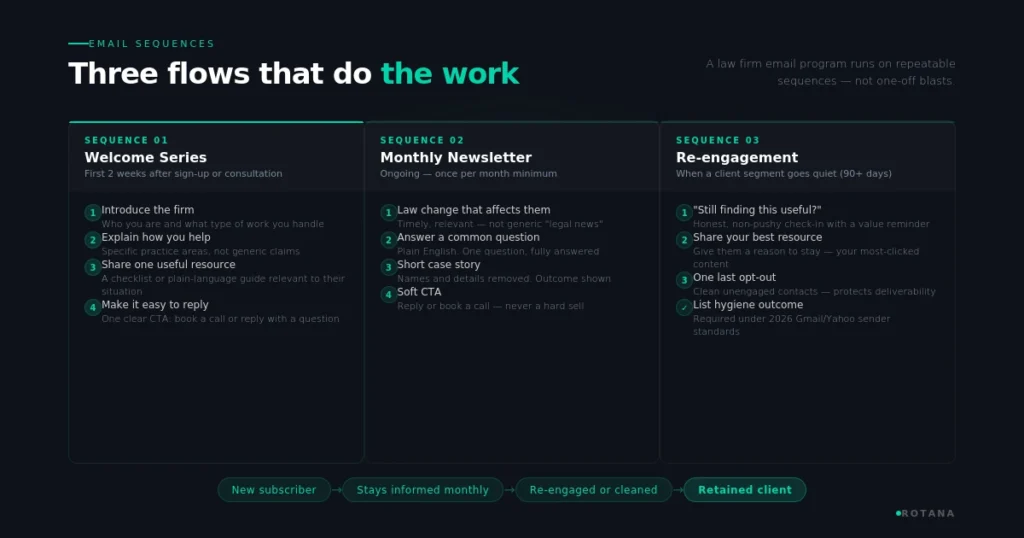
The ongoing newsletter keeps you top of mind across the long legal buying cycle. Monthly is enough. Lead with something the reader can use: a law change that affects them, a plain-language answer to a question you hear constantly, a short case story with names and details removed. The goal is to be the lawyer they already feel they know when the need arises.
Re-engagement emails
Re-engagement matters for client-based lists that go quiet. A simple “are you still finding this useful?” email cleans your list and protects deliverability, which under the 2026 Gmail and Yahoo sender requirements is no longer optional.
Write emails people open and act on
Segment before you send
Segment first. A personal injury inquiry and an estate-planning past client need different messages. Even basic segmentation by practice area and client status lifts results, and it keeps your content relevant enough to stay compliant with the truthful-communication rules.
Keep the writing plain
Keep the writing plain. You are a lawyer, but your subscribers are not. Short subject lines, one clear idea per email, one obvious next step. The next step is usually a reply or a call, not a hard sell.
Measure what survives privacy changes
Measure what survives privacy changes. Open rates are now a soft signal because Apple inflates them. Track click-through rate, click-to-open rate, unsubscribes and how many replies and consultations an email drives. Those reflect real behavior. A firm that books three consultations from one newsletter has a better email program than one chasing a high open rate.
What I would do first
If you run a firm and you are starting from nothing, do three things this month. Turn your past-client list into an actual email list with their permission. Write a five-email welcome series for new subscribers. Send one useful newsletter and watch the clicks and replies, not the opens.
Email rewards consistency more than cleverness. The firm that sends a useful email every month for a year builds something no single ad campaign matches. If you want help building that system, including the compliance review and the sequences, that is the kind of work I do at Rotana. You can book a call through the link on the site.
Frequently asked questions
Is email marketing allowed for lawyers?
Yes. Email marketing to existing clients and people who have opted in is standard and accepted for law firms. The limits come from solicitation rules like ABA Model Rule 7.3, which restrict targeting a specific person known to need legal services for financial gain, and from state bar requirements your license depends on. Marketing to a permission-based list stays well inside those rules.
How often should a law firm send marketing emails?
A monthly newsletter is enough for most firms. Legal buying cycles are long, so the goal is steady presence rather than volume. One useful, well-written email a month keeps you top of mind without straining your list or your time, and it outperforms sporadic bursts of activity.
Do law firm emails need an “Attorney Advertising” label?
It depends on your state. Some states, including New York, require qualifying attorney advertising emails to carry the words “Attorney Advertising” in the subject line. Attorney advertising also generally must identify a responsible lawyer or firm with contact information. Check your own state bar rules, since the ABA Model Rules are advisory and each state sets its own requirements.
What is a good open rate for law firm emails?
Legal tends to sit at the strong end of email engagement benchmarks because firm lists are built from real clients rather than cold purchases. Exact figures vary by source and are now unreliable since Apple’s Mail Privacy Protection inflates open rates automatically. Track click-through rate, replies and booked consultations instead, because those reflect what subscribers actually do.
What is the best first email sequence for a law firm?
A welcome series is the highest-impact place to start. When someone joins your list or finishes a consultation, send a short sequence over the first two weeks that introduces the firm, explains how you help, shares one useful resource and invites a reply. This sequence converts a curious subscriber into a client more reliably than any single broadcast email.