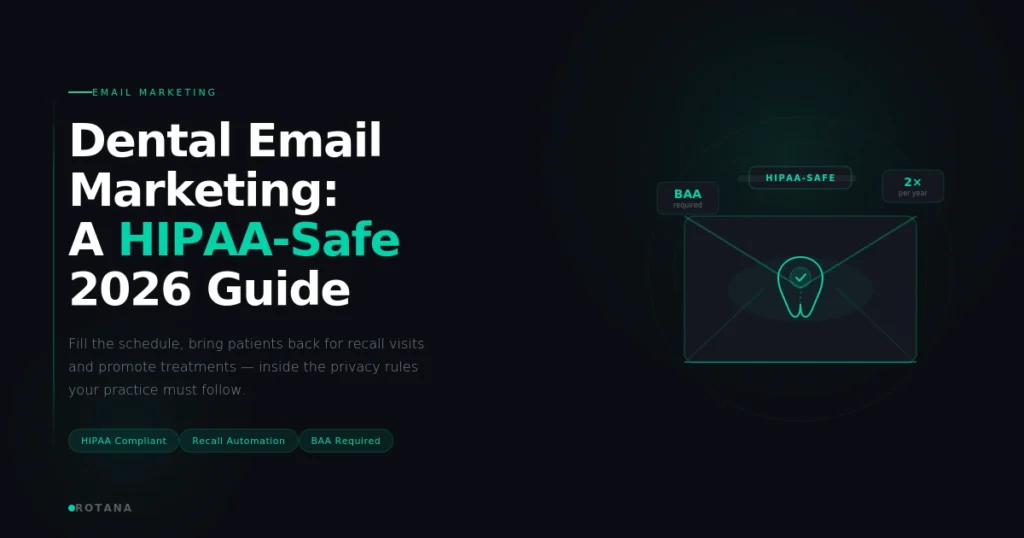
Dental email marketing is the use of permission-based email to fill the schedule, bring patients back for recall visits and promote treatments, done inside the privacy rules that govern every dental practice. It works because a dental practice has something most businesses would envy: a list of people who already trust you with their health and need to come back twice a year. Email is how you keep that relationship warm between visits.
I have built email programs across regulated and unregulated industries. Dentistry sits firmly in the regulated camp. The growth tactics are the same ones that work anywhere, but a dental practice carries a privacy layer that a generic email guide will never mention. Send the wrong email the wrong way and the cost is a HIPAA penalty, not a low open rate. This guide covers both: what fills the chairs, and what keeps you compliant in 2026.
Why email works so well for dental practices
The recall problem email solves
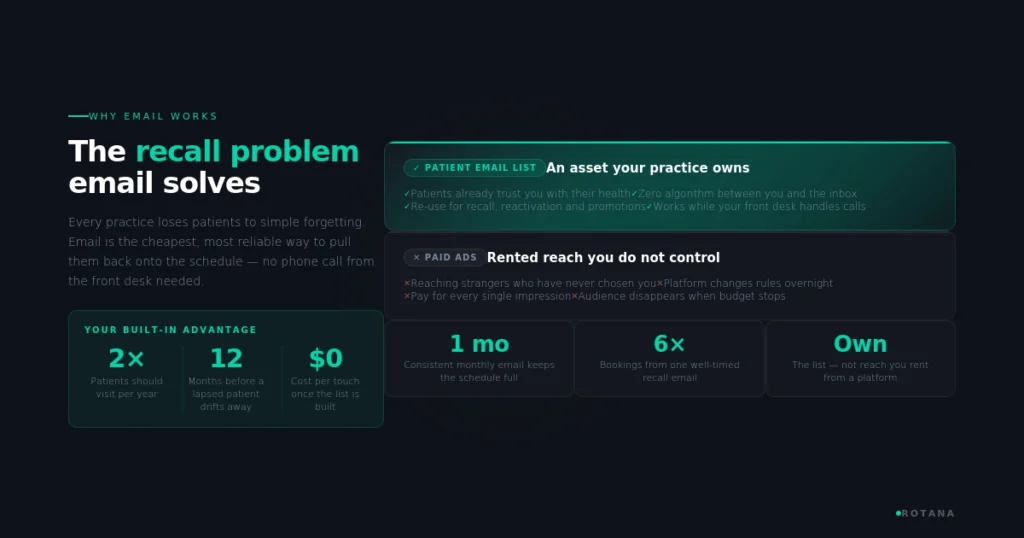
Every practice loses patients to simple forgetting. Someone means to book their cleaning, life gets busy, and a year passes. Email is the cheapest, most reliable way to close that gap. A recall reminder, a birthday note, a short message tied to the last visit, these quietly pull patients back onto the schedule without a phone call from your front desk.
Why a patient list beats paid ads
Paid ads rent attention from people who do not know you. Your email list is made of patients who already chose you. For a practice built on long relationships and word of mouth, nurturing the patients you already have returns more than chasing strangers. The list is an asset you own, not reach you rent.
The HIPAA layer you cannot ignore
This is what makes dental email different from every other industry. If your practice transmits health information electronically for things like insurance claims or eligibility checks, you are a HIPAA covered entity, and your patient communications fall under the rules.
Is your practice a covered entity?
Almost certainly yes. Any dental practice that sends health information electronically in connection with HIPAA-covered transactions, which includes insurance claims, eligibility checks and referrals, qualifies as a covered entity. A few practices that never transmit electronically may not, but most do, so treat yourself as covered unless you have confirmed otherwise.
Can you email patients at all?
Yes. HIPAA does not prohibit emailing patient information, even unencrypted, but a covered practice has to meet conditions first. The American Dental Association lays them out: include email in your written security risk analysis, keep reasonable safeguards to protect the information, send breach notification if an email is compromised and honor patient requests about how they want to be contacted. If a patient asks you to email them and accepts the risk, you may need to comply. If a patient asks you not to, you must respect that.
What the 2026 Security Rule changes
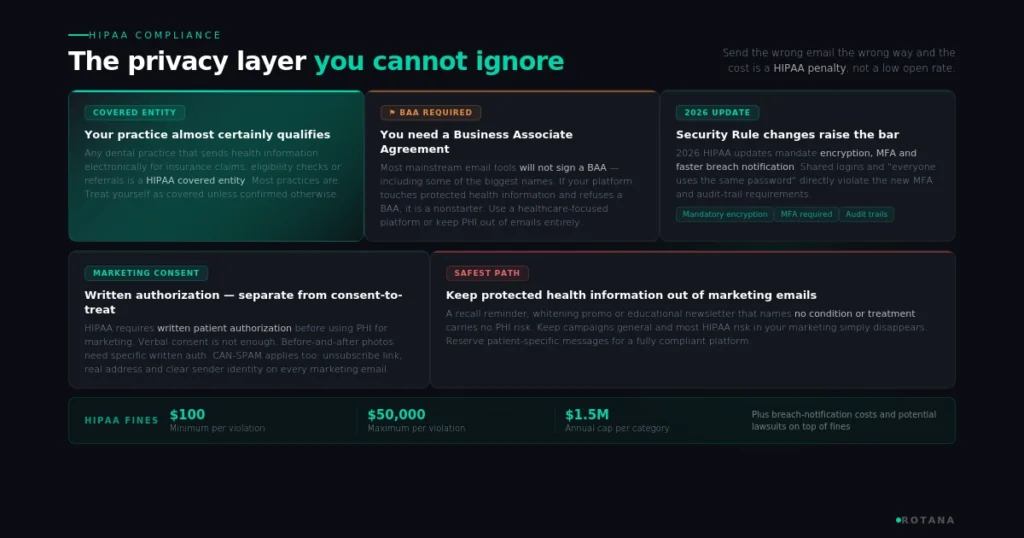
The bar moved up this year. The 2026 HIPAA Security Rule updates bring mandatory encryption, multi-factor authentication and faster breach notification to every practice. Shared logins, the “everyone uses the same password” habit common in dental offices, now directly undermine the MFA mandate and break the audit-trail requirement. Penalties are not trivial: HIPAA fines run from $100 to $50,000 per violation, with annual maximums reaching $1.5 million per violation category, on top of breach-notification costs and possible lawsuits.
The platform trap: you need a BAA
Here is the mistake that catches well-meaning practices. Most mainstream email tools will not sign a Business Associate Agreement, and several may not meet HIPAA requirements for handling patient data. That includes some of the biggest names. If your email platform touches protected health information and will not sign a BAA, it is a nonstarter for a covered practice. Use a platform built for healthcare, or keep protected health information out of your emails entirely.
Marketing emails have their own rules
HIPAA generally requires written patient authorization before you use protected health information for marketing, and that authorization is separate from the consent-to-treat form. Before-and-after photos are a common trap: using patient images for marketing needs specific written authorization. CAN-SPAM applies too, so every marketing email needs a clear sender identity, a real mailing address and a working unsubscribe link. One more line that surprises people: email lives mostly under HIPAA, but the moment you convert a message to SMS, TCPA rules kick in, with their own consent and opt-out demands.
One caveat for this whole section. I am a marketer, not a compliance attorney. Treat this as the map, then run your setup past someone who handles your HIPAA compliance before you send. Practices that build compliance in from the start avoid the penalties that catch the ones bolting it on later.
The simplest way to stay safe: keep PHI out
Write to the inbox, not the chart
The cleanest path through all of this is to keep protected health information out of your marketing emails entirely. A newsletter about flossing technique, a whitening promotion, a general “time for your checkup” reminder that names no condition or treatment, none of these expose patient health data. Keep campaigns educational and general, and most of the HIPAA risk in your marketing simply disappears.
Where patient-specific email still needs care
Some messages are genuinely patient-specific: a post-treatment follow-up, anything referencing a procedure or condition. Those carry protected health information and need the full safeguards, a compliant platform and proper authorization. Separate these from your general marketing in your own mind and your tooling, so the two never get mixed.
Build the list the right way
Capture consent at the moments you already have
Permission is the foundation, and for a practice it doubles as a compliance safeguard. Capture email and marketing consent through a digital form at intake, not a verbal “sure.” Verbal consent is not enough, and a digital form stores the record you may later need to prove. Add the opt-in to new-patient paperwork and to your online booking.
Never buy a patient list
Buying a list is worse for a dental practice than for most businesses. It wrecks deliverability, violates platform terms, and points you at people who never consented, which collides with both HIPAA and CAN-SPAM. Grow the list from your own patients and keep it clean.
The email campaigns that fill the schedule
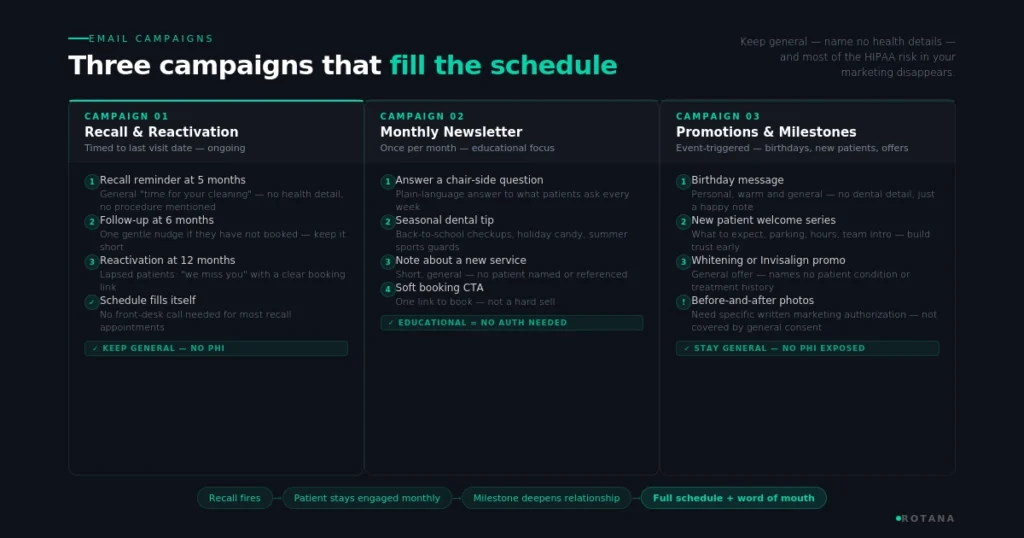
A dental email program runs on a few dependable campaigns rather than random blasts.
Recall and reactivation
Recall is the workhorse. A reminder timed to the last visit brings patients back for cleanings, and a reactivation message to patients who have lapsed for a year recovers revenue you already earned once. Keep the wording general so no health detail appears, and the schedule fills itself.
The monthly patient newsletter
A monthly newsletter keeps you present between visits. Lead with something useful: a plain-language answer to a question you hear at the chair, a seasonal reminder, a short note about a new service. Educational content builds trust and sidesteps the marketing-authorization rules, since it names no individual patient.
Promotions and milestone emails
Promotions and milestones do steady work. A whitening or Invisalign offer, a birthday message, a welcome note for new patients. These feel personal and prompt bookings without touching protected health information, as long as they stay general and carry the required unsubscribe link.
Write dental emails that get opened
Segment by visit and interest
Group patients by last visit, age or interest. A family overdue for cleanings and a patient who asked about cosmetic work need different messages. Basic segmentation lifts engagement and keeps each email relevant, while staying clear of any health-specific detail.
Keep it short and clear
Patients are not reading a brochure. Short subject lines, one idea per email, one obvious next step, usually “book your visit.” Plain language beats clinical language every time.
Measure what reflects bookings
Open rates are now a soft signal since Apple’s Mail Privacy Protection inflates them. Track click-through rate, appointments booked and reactivated patients. A practice that books six cleanings from one recall email has a better program than one chasing opens.
What I would do first
If you run a practice and you are starting fresh, do three things this month. Move to an email platform that will sign a BAA, and capture marketing consent on a digital intake form. Build a recall reminder and a monthly general newsletter that name no health details. Send them, then watch bookings and clicks rather than opens.
Email rewards consistency more than cleverness. The practice that sends one useful, compliant email every month builds a recall engine no ad campaign matches. If you want help building that system, including the compliant setup and the campaigns, that is the kind of work I do at Rotana through our cold email and drip campaign service. You can book a call through the link on the site.
Frequently asked questions
Is email marketing HIPAA compliant for dentists?
It can be, when done correctly. HIPAA does not ban emailing patients, but a covered dental practice must include email in its security risk analysis, keep reasonable safeguards, honor patient contact preferences and use a platform that will sign a Business Associate Agreement if the email touches protected health information. The simplest safe approach is to keep health details out of marketing emails entirely and stay general.
Do dentists need patient consent to send marketing emails?
Yes. HIPAA generally requires written authorization before using protected health information for marketing, separate from the consent-to-treat form, and verbal consent is not enough. CAN-SPAM also requires a working unsubscribe link, a real mailing address and a clear sender identity on every marketing email. Capture consent on a digital intake form so you have a stored record.
Can I use patient before-and-after photos in dental emails?
Only with specific written authorization. Before-and-after images are protected health information, and using them for marketing requires authorization separate from general treatment consent. Many practices post patient photos without it, creating both HIPAA and legal liability. Get signed, marketing-specific authorization before any patient image goes into an email or onto social media.
What email platforms are HIPAA compliant for dental practices?
Any platform that will sign a Business Associate Agreement and meets HIPAA’s security requirements. Several mainstream email tools will not sign a BAA, which makes them a nonstarter for emails that handle patient data. Use a healthcare-focused platform for anything patient-specific, or keep protected health information out of your campaigns and stay with general educational content.
How often should a dental practice send marketing emails?
Monthly or bi-weekly works well for most practices. The goal is steady presence rather than volume, so a monthly general newsletter plus timely recall and reactivation reminders keeps you in front of patients without crowding their inbox. The process will remain same whatever you do email marketing for lawyers or financial advisors. Consistency over a year matters more than any single send.