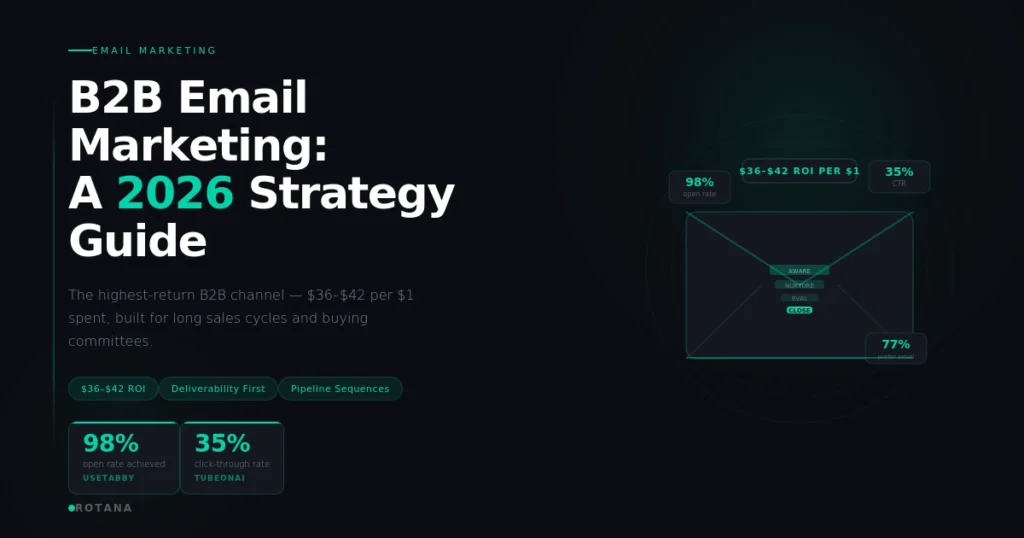
B2B email marketing is the use of permission-based email to reach business buyers, nurture them through a long buying cycle and turn them into customers. It remains the highest-return channel in B2B. Industry reports for 2026 converge on an average return of $36 to $42 for every $1 spent, the best of any digital channel. The reason is simple. Business deals take months and involve several people. Email is the only channel cheap enough to stay present through that entire stretch.
I have run B2B email programs first-hand. For UseTabby I built a campaign that reached a 98% open rate. For TubeOnAI I ran sequences that hit a 35% click-through rate. Those numbers are far above benchmark, so I want to be clear about why. They came from tight targeting, real deliverability work and messages written for one specific buyer. This guide lays out the system behind results like that, grounded in what the 2026 data actually shows.
Why B2B email outperforms other channels
The ROI the data shows
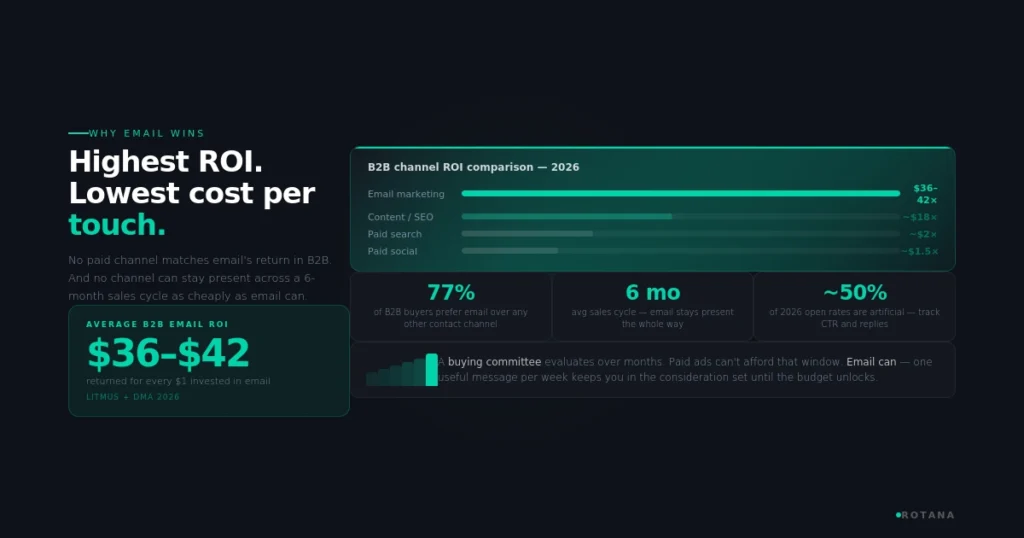
Email leads B2B on return. Multiple 2026 reports from Litmus and the DMA put the figure at $36 to $42 per $1 invested. About 77% of business buyers say they prefer to be contacted by email. No paid channel matches that combination of low cost and buyer preference. For a B2B team watching cost per acquisition, email is the engine to master first.
The long sales cycle email is built for
A B2B purchase is rarely one decision by one person. It is a committee, a budget cycle and months of evaluation. Paid ads cannot affordably stay in front of a buyer for that long. Email can. A useful message every week keeps you in the consideration set until the buying window opens. This is the same logic that makes the channel valuable in trust-led verticals like email marketing for financial advisors, where decisions also unfold over months.
Deliverability is the foundation, not a footnote
Here is the part most B2B guides skip. None of your strategy matters if the email lands in spam. In 2026 deliverability is infrastructure. It is also where the 2024 Gmail and Yahoo rules turned best practice into a requirement.
The sender rules you have to meet
Google now requires bulk senders over 5,000 messages a day to authenticate with SPF, DKIM and DMARC. Gmail and Yahoo require one-click unsubscribe processing within two days for marketing email. Your spam complaint rate has to stay below 0.10%, which is one complaint per thousand sends. Cross 0.30% consistently and your domain can be blacklisted. These are not suggestions. They are the price of reaching the inbox at all.
List hygiene protects everything
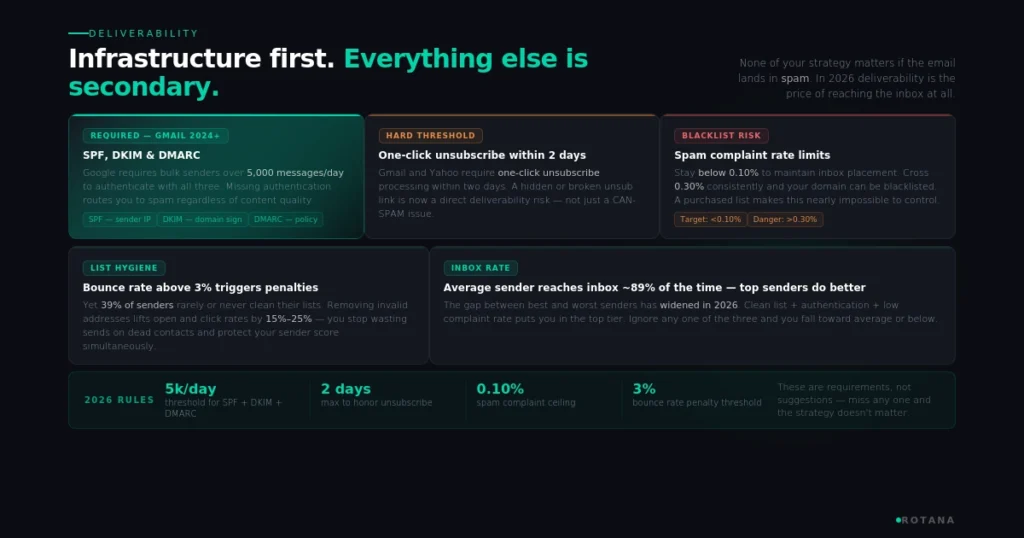
Bounce rate above 3% triggers deliverability penalties from the major providers. Yet 39% of senders rarely or never clean their lists. Removing invalid addresses at the point of capture and on a schedule lifts open and click rates by 15% to 25%, because you stop wasting sends on dead contacts. The average commercial program now reaches the inbox about 89% of the time, but the gap between the best and worst senders has widened. List hygiene decides which side you land on.
Build the B2B list the right way
Where qualified subscribers come from
Permission is the foundation. The strongest B2B list grows from people who showed intent: a content download, a webinar signup, a demo request, a conversation at an event. Add a clear opt-in to each one. Double opt-in remains one of the best ways to build an engaged list at scale, because it confirms the address and the interest in a single step.
The truth about buying lists
Buying a list is a fast way to wreck a sending domain. Purchased contacts never consented, so complaints spike and bounces climb past the thresholds that get you blocked. One spam-trap hit can damage your domain reputation for months. Build the list from real intent. A smaller engaged list beats a large cold one on every metric that matters.
The sequences that move B2B deals
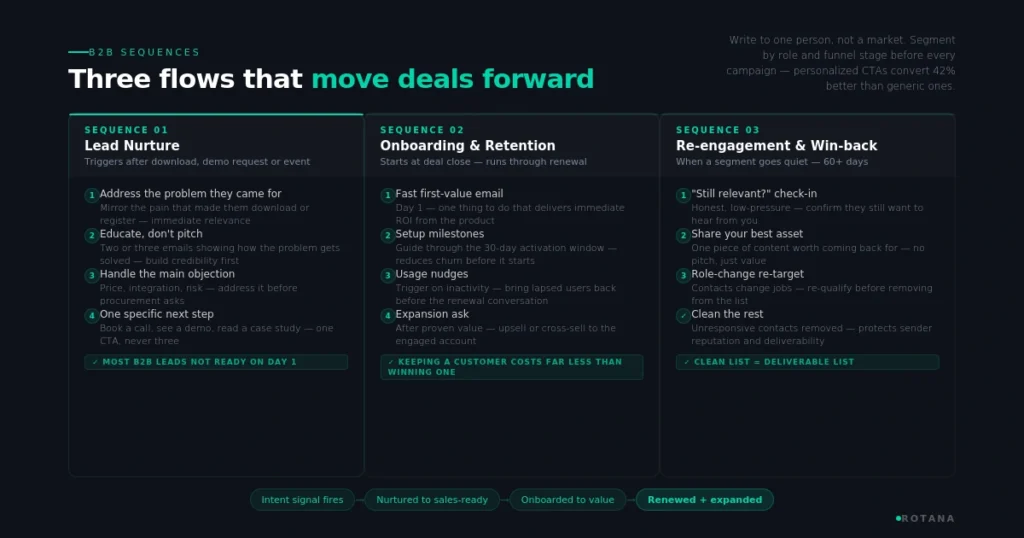
A B2B email program runs on a few dependable flows rather than scattered broadcasts.
The lead-nurture sequence
Nurture is the core B2B flow. When a lead downloads something or requests a demo, a sequence over the following weeks educates them, addresses objections and moves them toward a sales conversation. Most B2B leads are not ready to buy on day one. Nurture is how you stay useful until they are.
The onboarding and retention flow
Winning the deal is the start, not the finish. An onboarding sequence helps a new customer reach value fast, which protects the renewal. Retention email keeps existing accounts engaged and primed for expansion. In B2B, where keeping a customer costs far less than winning one, this flow pays back the longest.
Re-engagement and win-back
Lists decay as people change roles and lose interest. A re-engagement flow asks quiet subscribers whether they still want to hear from you. It revives some, removes the rest and protects your sender reputation in the process. A clean list is a deliverable list.
Write B2B emails that get replies
Segment by role and stage
A B2B buying committee holds different people with different questions. A technical evaluator and a budget owner need different emails. Segmenting by role, industry and funnel stage lifts engagement sharply. Personalized calls to action convert 42% better than generic ones, so relevance is not a nicety. It is the difference between a reply and a delete.
Write to one person, not a market
The best B2B email reads like a note from one human to another. Short subject lines. One clear idea. One specific next step. Drop the jargon and the feature lists. The same plain, direct style works in regulated fields too, as I covered in email marketing for lawyers, where trust gets built one useful message at a time.
Measure what reflects pipeline
Open rate is now a soft signal. Apple’s Mail Privacy Protection inflates it, so roughly half of reported opens in 2026 are artificial. Track click-through rate, click-to-open rate, replies and meetings booked. A program that books ten sales conversations from one sequence beats one chasing a high open rate. Build your reporting around behavior that maps to revenue.
What I would do first
If you run B2B and you are starting fresh, fix three things this month. Authenticate your domain with SPF, DKIM and DMARC, then clean your list so bounces sit under 2%. Build one lead-nurture sequence for your highest-intent signup. Segment by role before you send another campaign. Watch replies and meetings, not opens.
Email rewards precision over volume in B2B. The team that treats email as a precision instrument, not a broadcast, captures the outsized returns. That is exactly how I produced a 98% open rate for UseTabby and a 35% click-through rate for TubeOnAI. If you want a system like that built for your pipeline, that is the work I do at Rotana through our cold email and drip campaign service. You can book a call through the link on the site.
Frequently asked questions
What is B2B email marketing?
B2B email marketing is the practice of using permission-based email to reach business buyers, nurture them through a long purchase cycle and convert them into customers. It differs from B2C in that the audience is a buying committee rather than an individual. The sales cycle also runs for months. It remains the highest-return B2B channel, with 2026 reports putting the average return at $36 to $42 per $1 spent.
What is a good open rate for B2B email in 2026?
Cross-industry open rates sit around 38% to 44% in 2026, but that figure is unreliable because Apple’s Mail Privacy Protection inflates roughly half of reported opens. Click rates have stayed flat near 2% to 2.5%, which is the more honest gauge. Track click-through rate, click-to-open rate, replies and booked meetings instead, since those reflect real buyer behavior rather than prefetched pixel loads.
How do I keep B2B emails out of spam?
Authenticate your sending domain with SPF, DKIM and DMARC, which Google now requires for bulk senders over 5,000 messages a day. Keep your spam complaint rate below 0.10% and your bounce rate under the 3% penalty threshold by cleaning your list regularly. Offer one-click unsubscribe and honor it within two days, as Gmail and Yahoo require. Deliverability is infrastructure, not an afterthought.
How often should you send B2B marketing emails?
Frequency should follow the buyer journey rather than a fixed rule. A nurture sequence might send several emails over a few weeks, while a general newsletter often runs weekly or monthly. The real constraint is engagement: if unsubscribes or spam complaints rise, you are sending too often or to the wrong segment. Consistency and relevance matter more than raw volume.
Does buying an email list work for B2B?
No. Purchased lists damage your sender reputation because the contacts never opted in, which drives spam complaints and bounces past the thresholds that get a domain blocked. A single spam-trap hit can harm deliverability for months. Build your list from real intent signals like downloads, demos and event signups. A smaller engaged list outperforms a large cold one on every meaningful metric.