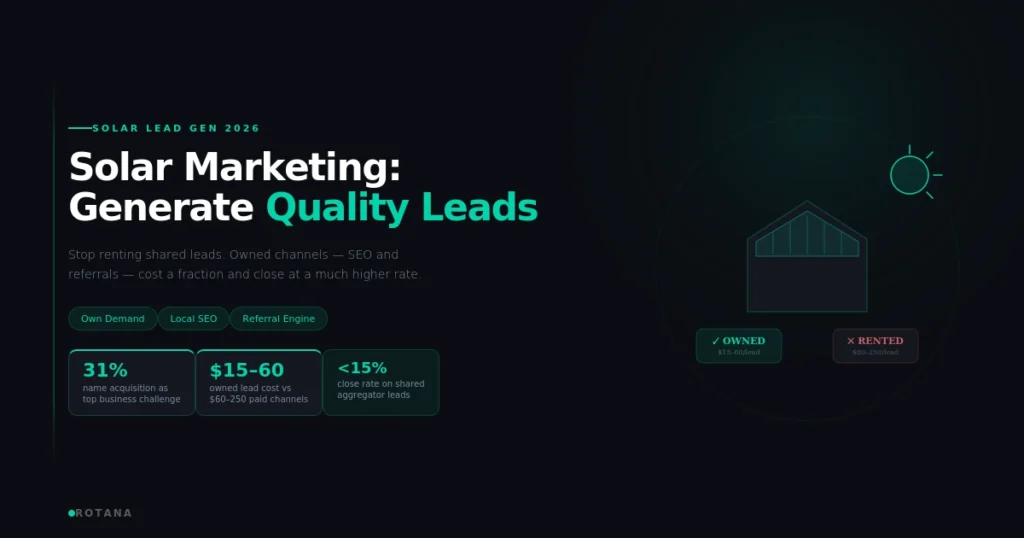
Solar marketing is the work of attracting homeowners and businesses researching solar, then qualifying and converting them into installations. It is a high-value, high-consideration sale. A homeowner spends weeks or months researching panels, costs, incentives and installers before they contact anyone. That long, careful journey makes solar marketing less about quick wins and more about building trust and visibility across the whole research period. Customer acquisition is the hard part: about 31% of solar companies named it a top business challenge.
I run an SEO-led growth agency, so I hear it constantly: the solar installers I talk to fall into two camps. Some drown in leads but cannot qualify or convert them. Others starve, spending too much on leads that go nowhere. The difference is rarely budget. It is whether they built a system or are doing random acts of marketing. With solar making up a record share of new electric capacity, demand is strong. This guide lays out how to capture it with owned, qualified pipeline rather than expensive, recycled leads.
Why solar marketing is its own challenge
A long, high-consideration decision
Solar is one of the largest discretionary purchases a homeowner makes, so the decision is slow and research-heavy. People compare multiple installers, weigh financing, study incentives and read reviews before committing. Your marketing has to be present and helpful across that entire window, not just at the moment of inquiry. The installer who educates patiently through the research phase is the one who gets the call when the homeowner is finally ready.
Three segments that behave differently
Solar buyers split into three groups with different logic. Residential decisions are emotional and price-sensitive. Commercial decisions are ROI-driven and run through procurement. Institutional decisions follow incentive cycles and budgets. Each needs its own message and its own funnel. Treating a homeowner and a facilities procurement lead the same way wastes effort on both. Segment first, then tailor.
Stop renting shared leads, start owning demand

The problem with aggregator leads
Many installers lean on third-party lead vendors. It quietly bleeds them. Aggregators often sell the same lead to several installers at once, which causes lower answer rates, faster lead fatigue, lower close rates and rising prices as everyone competes for the same contact. Purchased leads commonly run $80 to $250 each with close rates under 15%. Build your pipeline only on bought leads and you are building on sand, since one price hike or one algorithm change dries it up.
The case for owned channels
Owned channels flip the economics. Leads from SEO and referrals typically cost a fraction of paid ones, often $15 to $60 against $60 to $250 on paid channels for residential. More importantly, an owned lead found you on purpose, so it is warmer and more exclusive. A well-executed SEO and referral engine turns your website into a lead source that keeps producing without per-lead fees. That shift from renting leads to owning demand is the single biggest lever in solar marketing.
The channels that generate qualified solar leads
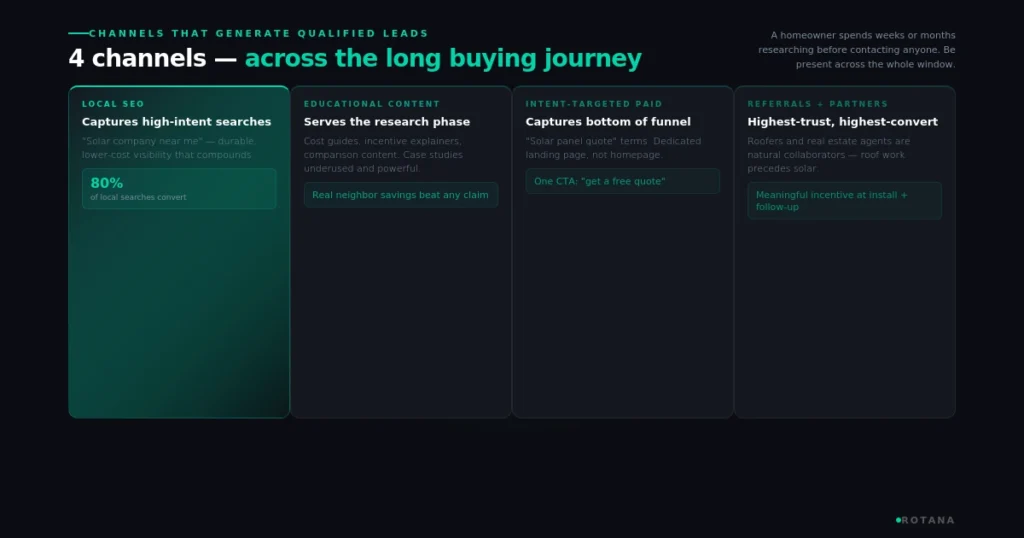
Strong solar lead generation combines several channels rather than betting on one. Each plays a role across the long buying journey.
Local SEO captures high-intent searches
Local SEO captures the roughly 80% of local searches that convert, by optimizing your Google Business Profile, building location-specific pages and managing reviews. When a homeowner searches “solar company near me” or “solar installation in [city],” you want to be the credible local result. This is durable, lower-cost visibility that compounds, which is the model I focus on through our SEO consultancy service.
Educational content for the research phase
Because buyers research for months, content is your most powerful tool. The pieces that work are local cost guides like “how much does solar cost in [state],” comparison content on panel types, incentive explainers covering federal and state tax credits, plus case studies featuring real customer savings. Case studies are where most installers leave money on the table. Showing a neighbor’s real numbers reassures a cautious buyer better than any claim.
Intent-targeted paid search
Paid search captures buyers at the bottom of the funnel. Bid on high-intent terms like “solar panel quote” or “solar installation in [city],” then send clicks to a focused landing page rather than your homepage, with reviews, clear pricing context and a single call to action like “get a free quote.” A well-structured Google Ads budget can produce qualified leads quickly, but poor targeting or weak pages waste it fast.
Referrals and partnerships
Referrals are the highest-trust, highest-converting solar leads. A structured referral program with a meaningful incentive, handed to customers at installation and followed up by email, turns happy customers into a steady source. Partnerships extend that further. Roofers are natural collaborators, since roof work often precedes solar. Real estate agents regularly advise homeowners weighing long-term energy costs. Both feed warm, local leads.
Speed and qualification decide close rates

Respond first, win the lead
Solar buyers compare multiple installers. They reward the first company to respond effectively. A lead that waits gets claimed by a faster competitor, especially when that same lead was sold to several installers. Fast and organized follow-up is not a nicety. It is often the difference between closing and losing. Pair speed with marketing automation that nurtures undecided prospects through the long decision with timed, relevant follow-up.
Qualify so reps work real buyers
Volume without qualification just burns your sales team. Qualify leads on property ownership, intent, budget and timeline so reps spend their hours only on prospects who are ready, willing and able to buy. A structured qualification step turns a messy pile of inquiries into a focused pipeline, which lifts close rates and morale at once. The broader system sits in my guide to email marketing lead generation.
Measure cost per qualified lead, not raw leads
Raw lead volume is a vanity number in solar. Track cost per qualified lead by channel, close rate, customer acquisition cost and the lifetime value of an install. Compare owned channels against paid ones honestly, since an SEO lead at a fraction of the cost that closes more often is worth far more than a cheap-looking shared lead that never answers. The contractors who track these numbers shift budget steadily toward the channels that produce real installs, which is how the system compounds.
Build trust signals for a high-stakes purchase
Reviews and social proof reduce risk
Solar is a large, irreversible purchase, so buyers are anxious about choosing the wrong installer. Social proof is what lowers that fear. A company with a deep bank of strong, recent reviews outperforms a competitor with few at every stage of the funnel. Automate review requests by text or email right after each installation, when satisfaction peaks, then showcase that proof on your site and your Google Business Profile. Reviews are both a ranking factor in local search and a direct trust signal at the moment of decision.
Transparency wins the wary buyer
Solar has a reputation problem in some markets thanks to aggressive, opaque sales tactics. You can turn that into an advantage by being the transparent installer. Clear pricing context, honest timelines, plain explanations of incentives and real customer savings numbers all reduce the hesitation that kills high-consideration deals. A landing page that answers price, performance and warranty questions directly dissolves doubt faster than any high-pressure pitch.
Local authority compounds over time
The installers who dominate a market build local authority that paid leads can never buy. Neighborhood-level content, real local case studies and a visible presence after each install create a flywheel: customers who saw your panels next door, then found your cost guide, then read your reviews are far more likely to call. That compounding local trust is the durable asset that outlasts any single ad budget.
What I would do first
If you run a solar company and want better pipeline, start in this order. Optimize your Google Business Profile and build location pages so you capture local searches. Publish a local cost guide, an incentive explainer and two real case studies to serve the research phase. Launch a structured referral program and approach local roofers for partnerships. Add intent-targeted paid search to dedicated landing pages. Then fix response speed and qualification, then measure cost per qualified lead rather than raw volume.
Solar marketing rewards the installer who educates patiently, owns demand rather than renting it and responds first. The system beats the spend. Owned channels beat shared leads over time. If you want that system built, that is the work I do at Rotana. The same local-and-lead-gen playbook drives my guide to digital marketing for contractors, a neighboring home-services field. Book a call through the link on the site.
Frequently asked questions
How do solar companies generate leads in 2026?
The most effective approach combines channels: local SEO to capture high-intent “solar near me” searches, educational content like cost guides and incentive explainers for the long research phase, intent-targeted paid search to dedicated landing pages, plus referral programs and local partnerships. Because buyers research for weeks or months, the goal is visibility and trust across the whole journey. Owned channels like SEO and referrals produce warmer, lower-cost leads than third-party aggregators.
Are paid solar leads from aggregators worth it?
They can fill a pipeline quickly, but they come with real drawbacks. Aggregators often sell the same lead to several installers, which lowers answer rates, accelerates lead fatigue and pushes close rates under 15%, while prices commonly run $80 to $250 per lead. Relying solely on bought leads is risky, since one price increase can break your pipeline. Most successful installers use them as one layer while building owned channels that produce cheaper, more exclusive leads.
What content works best for solar marketing?
Education wins, because buyers research extensively before committing. The highest-performing content includes local cost guides such as “how much does solar cost in [state],” comparison pieces on panel types, incentive explainers covering federal and state tax credits, plus case studies featuring real customer savings numbers. Case studies are especially underused and powerful, since showing a real neighbor’s results reassures a cautious buyer far more effectively than marketing claims.
Why is speed to lead so important in solar?
Because solar buyers compare multiple installers and reward whoever responds first and most helpfully. When the same lead is sold to several companies, the slow responder loses by default. Fast and organized follow-up paired with automated nurture for undecided prospects keeps you in the running through a months-long decision. Speed combined with proper qualification, checking ownership, intent, budget and timeline, is what turns inquiries into closed installations.
How much do solar leads cost?
It varies widely by channel, market and segment. In the U.S. residential market, qualified leads typically run $60 to $250 on paid channels and a much lower $15 to $60 on owned channels like SEO and referrals. Commercial leads cost several times more because the buying group is larger and qualification is harder. The more useful metric is cost per qualified lead and close rate by channel, since a slightly pricier lead that closes more often is worth more.