

Family law marketing is the work of getting your firm in front of people facing divorce, custody or support matters, earning their trust through an emotionally charged decision, then converting that trust into a signed case. It is unlike most legal marketing. The client is frightened, the matter is personal and the choice of attorney is driven as much by trust and empathy as by credentials. Roughly 70% of law firms say SEO brings in their highest-quality cases and most family law clients now start with a search like “divorce lawyer near me” before they ever ask a friend.
I run an SEO-led growth agency, so I see the gap between firms that capture these clients and firms that watch them choose a competitor. It is rarely about who is the better lawyer. It is about who is visible, who feels trustworthy in the first ten seconds and who responds with empathy when a scared person reaches out. This guide covers the full system: local visibility, a website built for trust, content that meets clients at every stage, the ethics rules you must respect and the intake that turns an anxious inquiry into a client.
Why family law marketing is different
The client is emotional, not transactional
A business hiring corporate counsel compares firms coolly. A parent facing a custody fight does not. In family law, trust is the deciding factor. A potential client will choose the attorney who feels more credible and more understanding, even over one who is more qualified on paper. That single truth shapes every decision below. Your marketing has to lead with empathy and reassurance, not just experience and case results.
High-consideration, but still urgent

Family law sits in an unusual spot. The decision is high-consideration, since people often research for days or weeks before they call. Yet it is also urgent, because a person ready to file wants help now and a slow response loses them. You have to be present during the long research phase and fast when they finally reach out. That combination of patience and speed is what most firms get wrong.
It is hyper-local
Family law is governed by state statutes and local courts, so clients want a local advocate who knows their county’s judges and procedures. Google’s algorithm rewards that, weighing proximity and local relevance heavily. A guide to alimony in Texas is useless to someone in Florida. Winning here means owning your local market, not competing nationally.
Local visibility: the foundation
Win the Google Map Pack
The local Map Pack, the three listings that appear above the regular results with a map, captures the majority of clicks for searches like “divorce lawyer near me.” If your firm is not there, you are losing a large share of your local market to the firm down the street. Your Google Business Profile is the engine. Use a specific primary category like “Divorce Lawyer” rather than just “Lawyer,” keep your name, address and phone identical everywhere, post regular updates and keep the profile active. Proximity and entity trust are primary ranking factors in 2026.
Local SEO and content depth
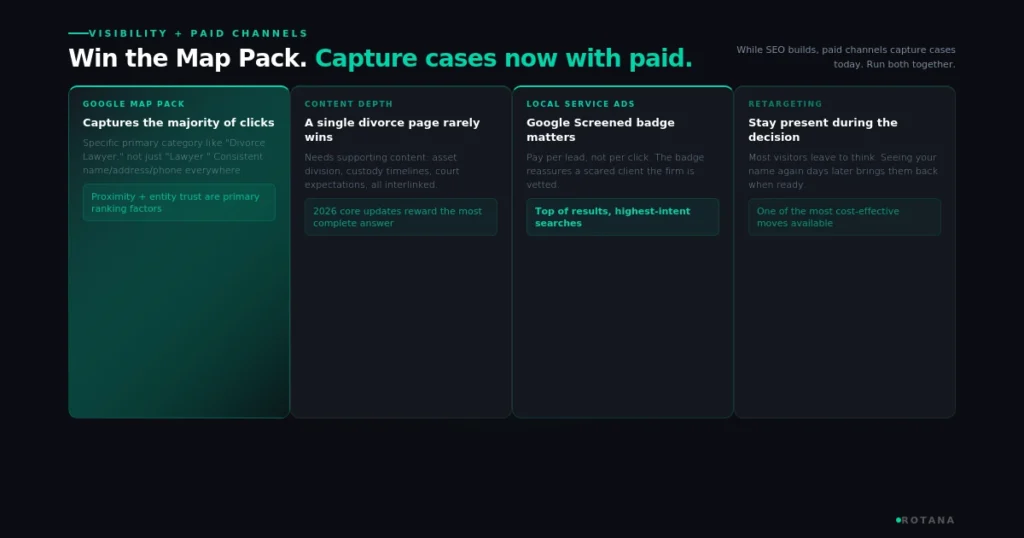
Below the map sit organic rankings, which go to firms with genuine topical depth, not thin service pages. A single divorce page rarely competes. It needs supporting content on asset division, custody timelines, court expectations and financial implications, all interlinked. The 2026 Google core updates reward pages that provide the most helpful, complete answer compared to competitors, which means rankings can shift even if your site has not changed. Building that content cluster is the durable, lower-cost engine and it is the work I focus on through our SEO consultancy service.
Legal directories
Directories like Avvo, Justia, Super Lawyers and Martindale add credibility and feed local SEO through consistent citations and professional profiles. Keep your listings complete and your name, address and phone consistent across all of them. These profiles also rank on their own, so a presence there means more of the first page belongs to your firm.
Paid channels for immediate cases
Local Service Ads and Google Ads
While SEO builds, paid channels capture cases now. Google Local Service Ads sit at the very top with a Google Screened badge and charge per lead rather than per click, which makes them efficient for high-intent searches. The badge matters in family law, where a scared client wants reassurance that your firm is vetted. Google Ads complements this for transactional searches like “high-net-worth divorce lawyer,” with tight geographic targeting and negative keyword lists so budget is not wasted on people researching how to file themselves.
Retargeting for the long decision
Most prospective clients visit a website, then leave to think. Retargeting ads keep your firm visible during the days or weeks they spend deciding, which fits the high-consideration nature of family law perfectly. A person who saw your site, then sees your name again over the following week, is far more likely to come back when they are ready. This is one of the most cost-effective moves in family law paid media.
A website built for trust
Lead with empathy, then credentials
Your website is where every other effort lands, so it has to convert. In family law that means leading with understanding. Use headlines that acknowledge the client’s emotional and practical fears, then show you can help. Detailed attorney bios with credentials and approachable personal insight build rapport. Professional headshots and a short introductory video let a client emotionally connect before they ever call. Prominent testimonials and clear case results, presented compliantly, establish trust fast.
Make action easy and discreet
A family law site needs a clean, mobile-friendly design with obvious, discreet ways to make contact. Short intake forms, clear calls to action, click-to-call and often 24/7 chat all lift the share of visitors who become consultations. Discretion matters here, since the subject is private. A conversion-focused site means your ad spend, SEO work and reputation are not all working harder than they should.
Content that meets clients at every stage
Map content to the stages of the decision
The strongest family law content strategy mirrors the psychological journey of a divorce or custody matter. Early on, a person seeks clarity and validation, searching things like signs you need a divorce or mediation versus litigation. In the middle, they compare options and calculate risk, reading about how custody is decided or how to protect assets. At the decision stage, they evaluate attorneys, looking for what to ask at a consultation. Build content for each stage, since answering early questions earns trust long before the person is ready to hire. When they are ready, your firm is the logical choice because you already provided the most value.
Video as a trust accelerator
Video is the fastest way to build trust in 2026. A prospective client who watches you calmly explain a complex topic feels a connection before meeting you. Keep videos short, 60 to 90 seconds answering one common question, with a calm, empathetic tone that acknowledges the stress. Embed them on relevant pages and use video schema so they can appear in search. For an emotional decision, seeing a real human is worth more than any block of text.
Email and referrals keep you connected
Email is a low-cost way to stay connected with past clients and referral sources, which keeps your firm top of mind long after a case closes. Past clients and the professionals around them, such as financial advisors and therapists, are a strong referral source. A simple, occasional update maintains those relationships and prompts referrals when someone in their circle needs help.
The ethics rules you cannot ignore

No guarantees, honest claims
Family law marketing operates under state bar advertising rules. Most bars prohibit guaranteeing outcomes, making misleading claims or using testimonials that could deceive a prospect about likely results. You can present your experience, education and approach. You cannot promise to win a custody case. Confirm your own state’s rules, since they vary and when in doubt run your campaigns past counsel who knows your jurisdiction.
Protect client privacy in case stories
Case stories are persuasive, but family matters are deeply private. Never use real names or identifying case numbers. Change minor details that do not affect the legal lesson so the client stays anonymous. Present results factually, such as a custody arrangement reached or assets protected, without exposing anyone. This keeps your proof compelling while respecting both ethics and the client’s dignity.
Intake: where empathy converts
Respond fast, respond human
Marketing makes the phone ring. Intake decides whether a frightened person becomes a client. For family law clients, a delayed or cold response can mean a lost case, since they are anxious and will call the next firm. Answer quickly and answer with warmth. The first human contact sets the tone for the whole relationship, so the person who picks up should be reassuring, not transactional.
Align the promise with the experience
When your marketing promises empathy and your intake feels like a sales script, trust collapses. Align your messaging with your intake so a prospect who arrives expecting a compassionate, knowledgeable firm reaches exactly that. Many firms blame marketing for weak conversion when the real gap is an intake process that does not match the empathy the marketing promised. Fixing that alignment often lifts results more than any new ad.
Measure signed cases, not clicks
The goal is signed cases of the right type, so measure what maps to them. Track cost per signed case by channel, consultation booking rate, consultation-to-retainer conversion and the value of cases each channel produces. Targeted positioning also filters in ideal clients and filters out poor fits, such as people with unrealistic budget expectations, before they ever reach you. A firm that owns “child custody attorney in [city]” through focused SEO and content can outrank larger general-practice firms, because relevance beats size in local search. Watch which channels bring the cases you actually want, then invest there.
What I would do first
If you run a family law firm and want more of the right cases, start in this order. Claim and fully optimize your Google Business Profile to compete for the Map Pack, then build a steady, ethical review habit. Rebuild your website to lead with empathy, strong bios and video. Launch Local Service Ads and tightly targeted Google Ads for immediate cases, with retargeting for the long decision. Build a content cluster around your core practice areas mapped to the client journey. Fix intake so every inquiry gets a fast, warm response. Then measure signed cases, not clicks.
Family law marketing rewards the firm that is visible locally, feels trustworthy instantly and responds with genuine empathy. The system matters more than the budget. If you want that system built and tuned to your market, that is the work I do at Rotana. The same urgency-and-local discipline drives my guide to criminal defense marketing and the relationship side sits in my guide to email marketing for lawyers. Book a call through the link on the site.
Frequently asked questions
What is the best marketing strategy for family law firms?
The strongest approach combines local SEO to win the Google Map Pack, a content cluster mapped to the client’s decision journey and an empathetic, conversion-focused website, with Local Service Ads and Google Ads added for immediate cases. Because family law clients choose largely on trust, reviews, attorney bios and video matter as much as rankings. No single tactic wins. The firms that grow run these channels as one system and respond to inquiries fast and with empathy.
How do family lawyers get more clients online?
They get found and they earn trust. Being found means ranking in local search and the Map Pack through an optimized Google Business Profile, local content and reviews, plus paid channels like Local Service Ads for immediate visibility. Earning trust means an empathetic website with strong attorney bios, video, testimonials and content that answers real client questions. Fast, warm intake then converts those inquiries, since family law clients are anxious and will move on if a firm responds slowly.
How long does SEO take for a family law firm?
Google Ads can generate leads within days, while SEO typically takes three to six months to produce significant organic results, longer in competitive markets. Local SEO through an optimized Google Business Profile can show earlier movement. Because SEO compounds over time, most firms pair it with paid channels for immediate cases, then lean more on organic search and content as rankings strengthen. Content marketing is the long game, but it builds the most sustainable lead engine in family law.
What can family law firms not say in their marketing?
State bar advertising rules generally prohibit guaranteeing case outcomes, making misleading or deceptive claims and using testimonials that could mislead prospects about likely results. You can describe your experience, education and approach and you can present case results, but only anonymized, with no real names or identifying details. Rules vary by state, so confirm your own jurisdiction’s requirements and, when in doubt, have counsel review your marketing before it goes live.
Are Google Local Service Ads worth it for family lawyers?
For many family law firms, yes. They charge per lead rather than per click and place your firm at the very top of results with a Google Screened badge, which reassures anxious clients that your firm is vetted. Because searches like “divorce lawyer near me” carry high intent, the leads tend to convert well when intake is fast and empathetic. Treat them as one layer alongside local SEO and Google Ads rather than a standalone solution, since paid leads stop when you stop paying.