

A financial services marketing agency helps banks, credit unions, wealth managers, insurers and fintechs win and keep customers. The work looks like ordinary marketing on the surface. Underneath, it is shaped by one thing most industries never deal with: heavy regulation. Every ad, email and landing page can face compliance review before it goes live. That single constraint is why financial marketing is a specialty and why the right agency matters more here than in most fields.
I run an SEO-led growth agency and I am not a financial-services specialist, so I will give you the honest version. This guide explains what these agencies do, why compliance defines the whole category, how the sub-sectors differ, what to look for and what it costs. At the end I will say plainly when you need a specialist and when a generalist growth partner is the smarter choice. One note first, since money is a your-money-or-your-life topic. Everything here is about marketing and compliance, never financial advice.
What a financial services marketing agency does
A good agency covers the full marketing function, adapted to financial rules. The typical scope includes:
- Strategy and positioning, defining your audience, your message and how marketing ties to growth.
- Compliant content and SEO, since financial buyers research heavily and search visibility drives trust.
- Paid media, run within the ad rules that govern financial products.
- Brand and PR, because credibility is decisive when people choose who to trust with money.
- Web, email and reputation, the channels that convert research into accounts and keep customers.
But the real value is not just doing this work. It is doing it in a way that clears compliance and still performs. That balance is harder than it sounds and it is what separates a financial specialist from a generalist.
Why compliance defines the whole category
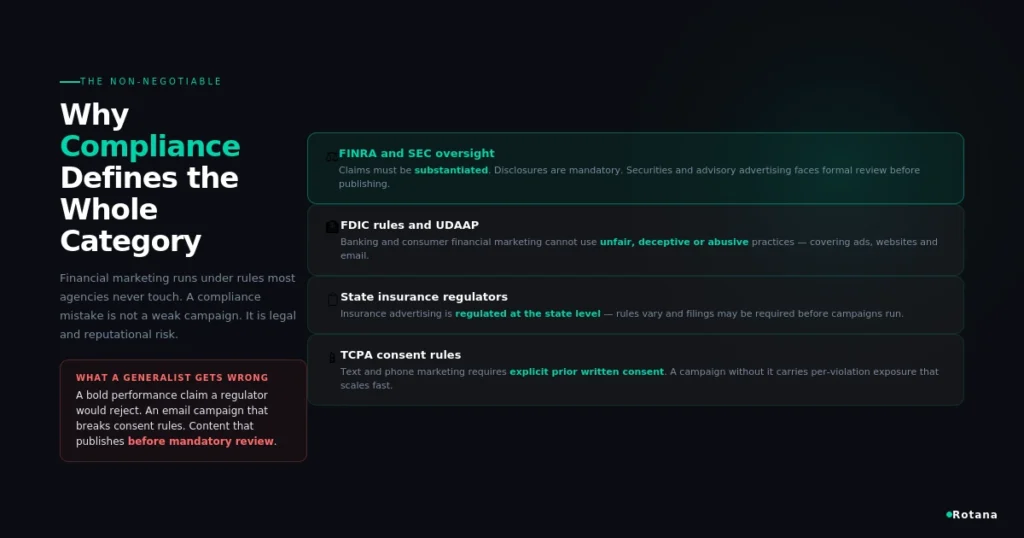
Financial marketing runs under rules that most agencies never touch. Depending on the sub-sector, that can mean FINRA and SEC oversight, FDIC rules, state insurance regulators and laws like TCPA and UDAAP. So claims must be substantiated. Disclosures are also often mandatory. And some content needs formal review before it publishes.
So this changes how marketing gets made. A generalist agency might write a bold performance claim that a regulator would reject. It might run an email campaign that breaks consent rules. A financial specialist builds compliance into the process from the start, so campaigns launch fast and stay safe. That is the core reason specialization matters more in this field than in almost any other. The cost of a compliance mistake is not a weak campaign. It is legal and reputational risk.
Financial services is not one market
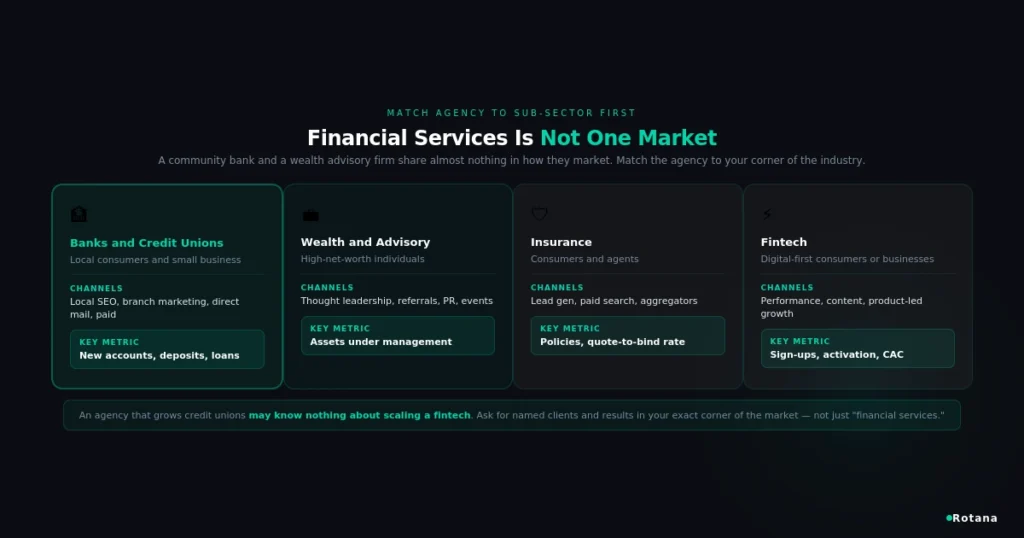
Here is the distinction most agency lists blur. “Financial services” covers several very different businesses. A community bank and a wealth advisory firm share almost nothing in how they market. Each sub-sector has its own buyer, channels, regulator and success metric. A strong agency specializes within financial services, not just around it.
| Sub-sector | Core buyer | Primary channels | Key metric |
|---|---|---|---|
| Banks and credit unions | Local consumers and small business | Local SEO, branch marketing, direct mail, paid | New accounts, deposits, loans |
| Wealth and advisory | High-net-worth individuals | Thought leadership, referrals, PR, events | Assets under management |
| Insurance | Consumers and agents | Lead generation, paid search, aggregators | Policies, quote-to-bind rate |
| Fintech | Digital-first consumers or businesses | Performance, content, product-led growth | Sign-ups, activation, CAC |
So match the agency to your sub-sector first. A firm that grows credit unions may know nothing about scaling a fintech. So ask for named clients and results in your exact corner of the market.
What to look for in a financial services marketing agency
Once you know your sub-sector, judge agencies on a few things that matter more than a polished pitch:
- Compliance fluency. Ask how they keep campaigns compliant and how they stay current on rule changes. This is the non-negotiable.
- Proven financial experience. Look for named clients and case studies in your sub-sector and ask to speak to a reference.
- Results tied to business outcomes. They should measure accounts, funded loans, assets or policies, not just leads or traffic.
- Channel strength where you need it. Some agencies go deep on one channel, others are full-service. Match that to your gap.
- Transparent reporting. You should see clear metrics and honest ROI, with no vanity numbers hiding weak performance.
What it costs
Pricing varies with scope and sub-sector. Many financial marketing engagements run between $1,000 and $10,000 a month and enterprise or highly regulated work goes higher. Agencies may also charge a management fee on paid media, usually a share of ad spend. The number that matters more than the retainer is what a client is worth to you. Because a wealth client can pay fees for decades. A bank customer can hold deposits and loans for life. So judge the spend against lifetime value and cost per acquired client, not cost per lead.
Measure clients and lifetime value, not leads
Lead counts flatter financial marketing and hide the truth. What matters is funded accounts, assets gained, policies bound and the lifetime value behind them. Financial customers have unusually high lifetime value, so a slightly higher acquisition cost can still be a bargain. Track cost per acquired client against that value. So watch the long relationship, not the first click. An agency that reports funded accounts and assets under management understands the business. One that reports only clicks does not.
When you need a specialist versus a generalist partner
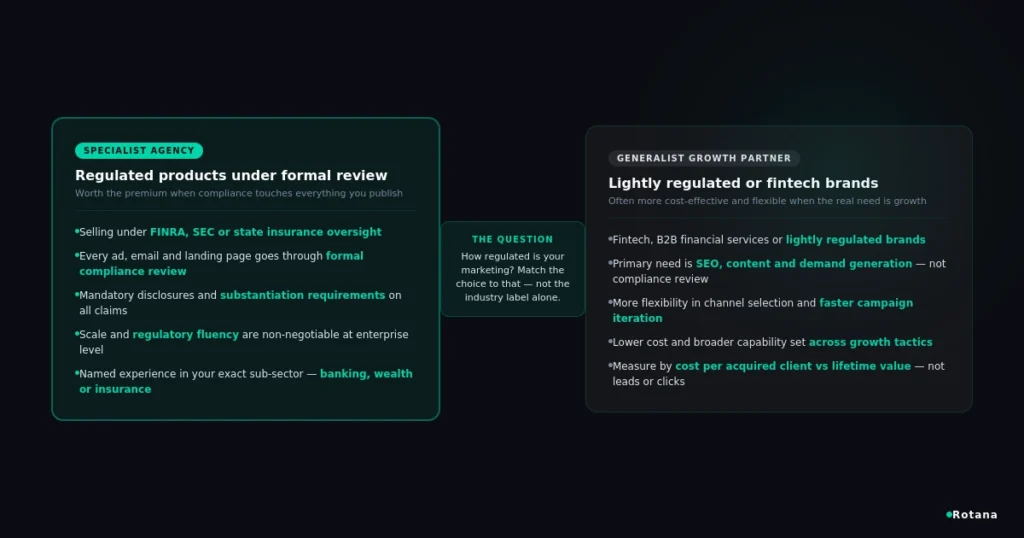
Here is the honest guidance. A financial specialist is clearly worth it when you sell regulated products under FINRA, SEC or insurance oversight or when compliance review touches everything you publish. So the specialists earn their premium there. But not every financial-adjacent company needs one. A fintech, a B2B financial service or a lightly regulated brand may care most about SEO, content and demand generation. In that case a strong generalist growth partner often works better, at a lower cost and with more flexibility.
That is where my agency, Rotana, fits. We are an SEO-led growth partner, not a regulated-finance specialist and we say so plainly. For securities or insurance marketing under heavy review, hire one of the specialists. For SEO, content and demand generation for a fintech or B2B financial brand, that is our work and it starts with our content strategy service. The email side connects to my guide on email marketing for financial advisors. For the broader hiring decision, see my guides to the integrated marketing agency model, the marketing management service option and fractional marketing services. Book a call through the link on the site.
Frequently asked questions
What is a financial services marketing agency?
A financial services marketing agency is a firm that markets banks, credit unions, wealth managers, insurers and fintechs. It handles strategy, content, SEO, paid media, brand, PR and web, all built to work within financial regulation. Its defining feature is compliance fluency, since financial marketing faces oversight from bodies like FINRA, the SEC, FDIC and state insurance regulators. The agency’s job is to produce marketing that both performs and clears compliance, which is why specialization matters far more in this field than in most others.
What does a financial services marketing agency do?
It runs the marketing function for a financial firm, adapted to strict rules. That includes strategy and positioning, compliant content and SEO, paid media within advertising regulations, brand building and PR, plus web, email and reputation work. The goal is to acquire and keep customers while every asset stays compliant. Strong agencies also measure results in financial terms, such as funded accounts, assets under management or policies bound. The core value is effective marketing that clears compliance review, not just creative campaigns.
How much does a financial services marketing agency cost?
Most engagements run between $1,000 and $10,000 a month, with enterprise and heavily regulated work costing more. Agencies often add a management fee on paid media, typically a percentage of ad spend. Pricing also depends on scope, sub-sector and how much execution the agency handles. The figure that matters more than the retainer is lifetime value, since financial customers stay for years. Judge the cost against cost per acquired client and the value that client brings, rather than against cost per lead or monthly hours.
How do I choose a financial services marketing agency?
Start with compliance fluency, since it is the non-negotiable in this field. Then confirm proven experience in your exact sub-sector, whether banking, wealth, insurance or fintech, with named clients and references. Check that they measure real business outcomes like accounts, assets or policies rather than traffic. Match their channel strengths to your gap and insist on transparent reporting. Finally, match your sub-sector first, because an agency that grows credit unions may not know how to scale a fintech and the reverse is equally true.
Do I need a financial-specialized agency or a general one?
It depends on your regulatory exposure. If you sell regulated products under FINRA, SEC or insurance oversight or if compliance review touches everything you publish, a financial specialist is worth the premium. If you are a fintech, a B2B financial service or a lightly regulated brand whose main need is SEO, content and demand generation, a strong generalist growth partner is often more cost-effective and flexible. Match the choice to how regulated your marketing genuinely is, not to the industry label alone.