
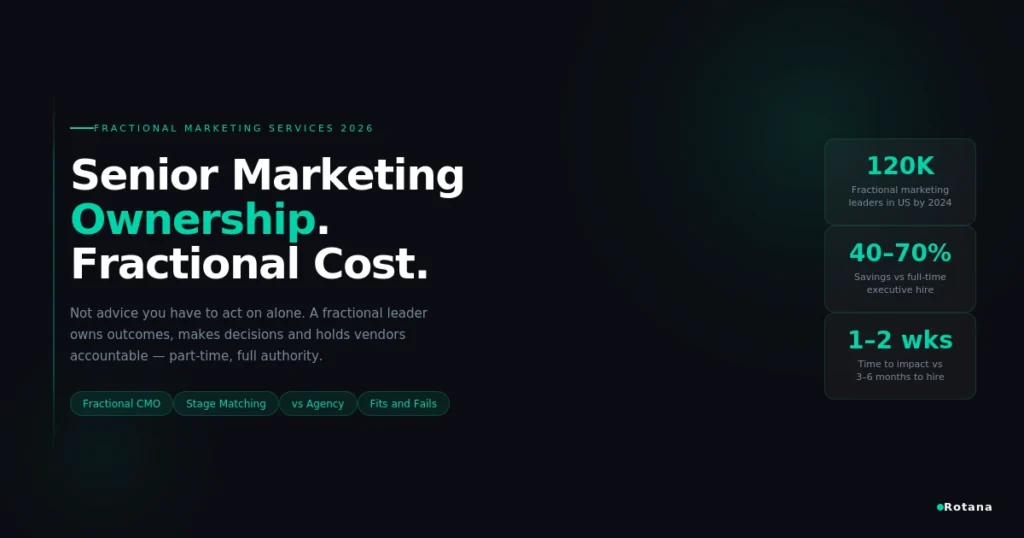
Fractional marketing services give you a senior marketing leader embedded in your business part-time, usually 10 to 20 hours a week, with the authority and accountability of a full executive but a fraction of the cost. The word that matters is ownership. A fractional leader does not just advise, they own outcomes like pipeline, acquisition cost and revenue, make decisions, manage budgets and hold vendors accountable. That is what separates fractional marketing from a consultant who hands you recommendations and leaves you to act on them alone. The model exists to close a specific gap: the point where a business needs real marketing leadership but cannot yet justify a full-time executive who costs $270,000 to $320,000 a year once benefits and recruiting are counted.
I run a growth agency, so I will be straight about where this model wins and where it quietly fails, because it is easy to buy the wrong thing. Fractional leadership has become mainstream fast. The number of fractional marketing leaders in the US roughly doubled to about 120,000 between 2022 and 2024 and Gartner projects that by 2027 nearly a third of midsize enterprises will use at least one fractional executive. This guide covers what fractional marketing services are, how to match the level to your stage, how they compare to an agency or a full-time hire, when they fit, when they do not and what they cost.
What are fractional marketing services?
A fractional marketing hire is a senior marketing professional, most often a fractional CMO, VP or marketing director, who serves your company on an ongoing part-time basis with the same authority as a full-time leader. They embed in your leadership team, typically report to the CEO and are on the hook for measurable results rather than observing from the sidelines. Because they usually work with several companies at once, they bring pattern recognition an internal first hire cannot: someone who has built marketing at 15 or 20 businesses carries playbooks and hard-won judgment about what works. Fractional services come in three main shapes:
- Fractional marketing director, weighted toward execution and running the day-to-day, which suits earlier-stage companies.
- Fractional CMO, weighted toward strategy, positioning, channel choices and building the team, which suits companies ready to scale.
- Fractional marketing team, a senior leader paired with execution specialists, for companies that need both direction and hands.
Match the level to your stage
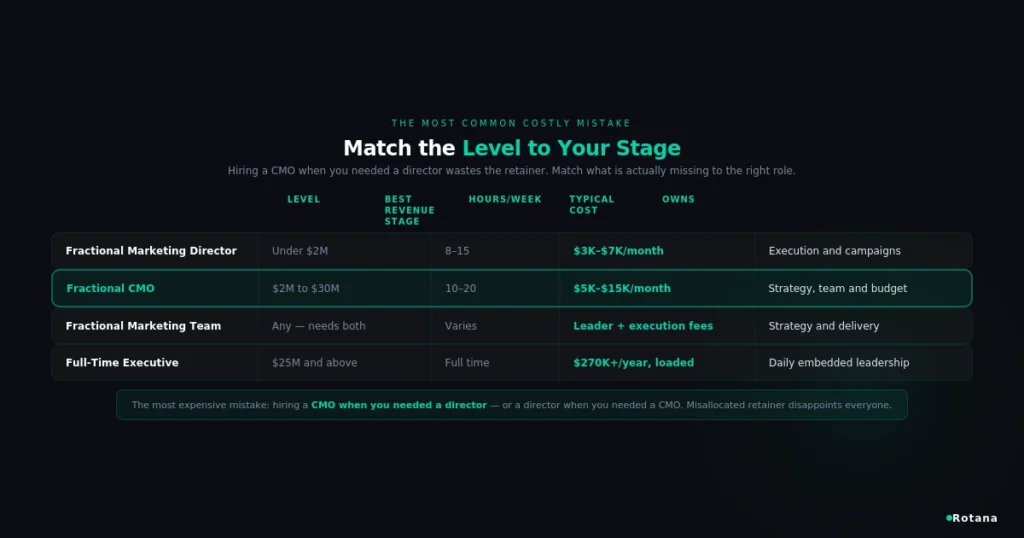
The most common and costly mistake is hiring the wrong level: a CMO when you needed a director or a director when you needed a CMO. That misallocates the retainer and disappoints everyone. Match the level to your revenue stage and what is actually missing.
| Level | Best revenue stage | Hours per week | Typical cost | Owns |
|---|---|---|---|---|
| Fractional marketing director | Under $2M | 8 to 15 | $3,000 to $7,000 a month | Execution and campaigns |
| Fractional CMO | $2M to $30M | 10 to 20 | $5,000 to $15,000 a month | Strategy, team and budget |
| Fractional marketing team | Any, needs both | Varies | Leader plus execution fees | Strategy and delivery |
| Full-time hire | $25M and above | Full time | $270,000 a year and up, loaded | Daily embedded leadership |
That pattern is simple. Pre-$2M companies usually need execution capacity and a director-level hand. Companies between roughly $2M and $30M get the most from a fractional CMO who builds strategy and the team. Past about $25M to $50M, when marketing needs embedded daily leadership and investor optics want a named executive, a full-time hire starts to make sense.
Fractional versus agency, consultant and full-time
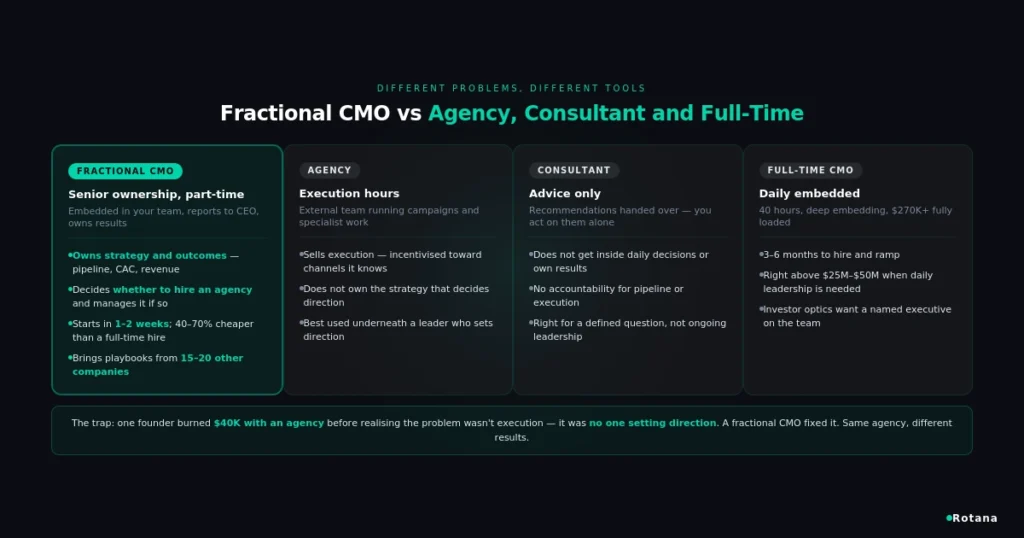
These options solve different problems and confusing them is where money gets wasted. An agency sells execution hours and specialist delivery and it has a structural incentive to recommend the channels it happens to be good at. A consultant gives advice but does not get inside daily decisions or own the results. A full-time executive gives you 40 hours and deep embedding, but costs the full salary and takes three to six months to ramp. A fractional leader sits between them: senior ownership on a part-time basis, starting in one to two weeks, at 40% to 70% less than a comparable full-time hire.
The sharpest way to see the difference is this. A fractional CMO owns the strategy that decides whether you should hire an agency at all and then manages that agency if you do. Many businesses find the best value in a hybrid: a fractional leader setting direction on top, with an agency or execution team carrying it out underneath. One founder’s story captures the trap of getting this backwards, burning $40,000 with an agency before realizing the problem was not execution but the absence of anyone setting strategic direction. Once a fractional leader took the wheel, the same agency started producing results. For the wider view of every model side by side, see my guide to marketing management service.
When fractional marketing fits and when it fails
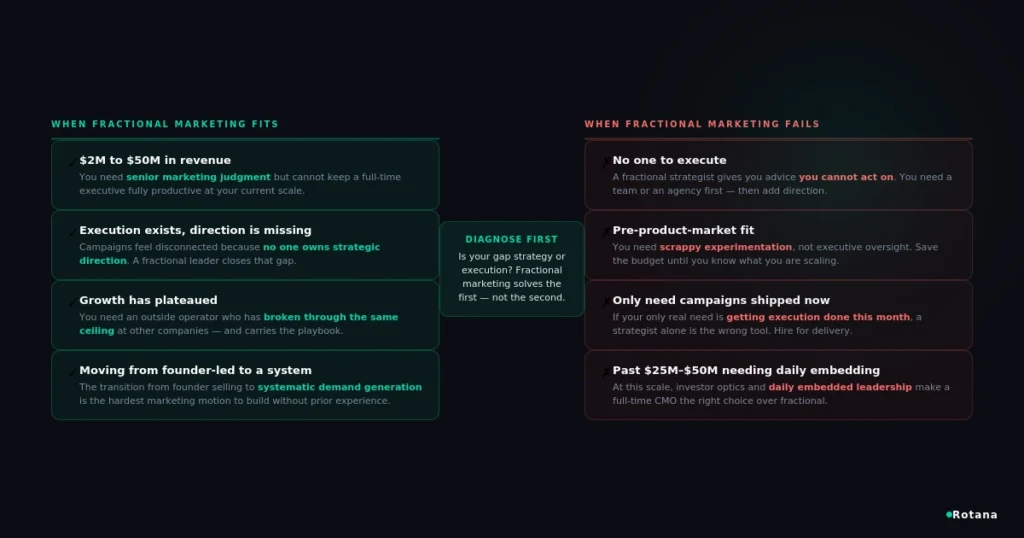
This is the part the providers selling it tend to skip. Fractional marketing is a strong answer to a leadership gap, not a cure-all. It fits when:
- You are roughly between $2M and $50M in revenue, needing senior judgment but unable to keep a full-time executive fully productive.
- You have execution capacity but no one owning strategic direction, so campaigns feel disconnected.
- Growth has plateaued and you need an outside operator who has broken through the same ceiling before.
- You are moving from founder-led marketing to a system that scales.
It fails, predictably, in a few situations. If you have no one to execute, a fractional strategist gives you advice you cannot act on and you need a team or an agency first. If you are pre-product-market-fit, you need scrappy experimentation more than executive oversight, so save the budget. And if your only real need is getting campaigns shipped this month, a strategist alone is the wrong tool. Diagnose whether your gap is strategy or execution before you hire, because fractional marketing solves the first and not the second.
What fractional marketing services cost
Pricing runs along seniority, scope and hours. Most fractional engagements land between $3,000 and $15,000 a month on a retainer, with deep-expertise executives and broad remits reaching $18,000 to $22,000. Below about $3,000 a month you are usually buying advisory consulting rather than hands-on leadership and above roughly $15,000 to $22,000 a full-time hire starts to make financial sense. Most fractional leaders work 10 to 20 hours a week and serve two to four clients at once. Against a full-time leader costing $270,000 or more fully loaded, plus a three-to-six-month ramp, a fractional engagement saves 40% to 70% and delivers impact in weeks. The right way to read the price is as an investment in a marketing system and senior judgment, not as hours purchased.
How to choose a fractional marketing partner
Once you know fractional fits, choose well with these checks:
- Hire the right level. Match director, CMO or team to your revenue stage and whether your gap is execution or strategy.
- Insist on ownership. Confirm they own measurable outcomes like pipeline or acquisition cost, not just deliver advice.
- Check for execution underneath. Make sure there is a team, agency or specialists to carry out the strategy the leader sets.
- Test fit with a project first. Start with a diagnostic or go-to-market plan at a capped cost, then convert to a retainer if judgment and chemistry prove out.
- Agree an operating rhythm. Set the hours, cadence and reporting in writing, since the top risks with fractional are communication consistency and team integration.
These services are worth it when you need senior marketing ownership without the cost or commitment of a full-time executive and when your real gap is direction rather than hands. Ownership beats advice. At Rotana we work as a growth partner across strategy and execution and we will tell you honestly whether you need a fractional leader, an agency or simply a team to execute a plan you already have. If that is the help you want, start with our content strategy service. For related decisions, see my guides to the small business marketing consultant option and marketing operations consulting. Book a call through the link on the site.
Frequently asked questions
What are fractional marketing services?
Fractional marketing services provide a senior marketing leader on a part-time, ongoing basis, typically 10 to 20 hours a week, with the authority and accountability of a full-time executive at a fraction of the cost. Unlike a consultant who only advises, a fractional leader owns outcomes such as pipeline and acquisition cost, makes decisions, manages budgets and holds vendors accountable. The services come as a fractional marketing director for execution-heavy needs, a fractional CMO for strategy and team building or a fractional team that pairs a leader with execution specialists.
How much do fractional marketing services cost?
Most fractional engagements cost $3,000 to $15,000 a month on a retainer, with senior executives holding broad remits reaching $18,000 to $22,000. Below about $3,000 you are usually buying advisory consulting rather than hands-on leadership and above roughly $15,000 to $22,000 a full-time hire begins to make financial sense. Fractional leaders typically work 10 to 20 hours a week across two to four clients. Compared with a full-time leader costing $270,000 or more fully loaded, a fractional engagement saves 40% to 70% and delivers impact in weeks rather than months.
What is the difference between a fractional CMO and an agency?
A fractional CMO is a senior leader who owns your marketing strategy and outcomes on a part-time basis, while an agency is an external team that executes campaigns and specialist work. The key difference is ownership and incentive: an agency sells execution hours and tends to recommend the channels it is good at, whereas a fractional CMO owns the strategy that decides whether to hire an agency at all. Many businesses combine the two, with a fractional leader setting direction and an agency carrying out the work underneath.
When should a company use fractional marketing services?
They fit best when a company, roughly between $2M and $50M in revenue, needs senior marketing judgment but cannot justify a full-time executive, has execution capacity but no one owning strategy, has plateaued or is moving from founder-led marketing to a scalable system. They fail when you have no one to execute, since a strategist then gives advice you cannot act on, when you are pre-product-market-fit and need experimentation over oversight or when your only need is shipping campaigns immediately. Diagnose whether your gap is strategy or execution first.
Is a fractional CMO better than a full-time hire?
It depends on your stage. A fractional CMO is usually better for companies under roughly $25M to $50M in revenue, delivering senior expertise at 40% to 70% less than a full-time hire, starting in weeks rather than months and bringing patterns from many companies. A full-time CMO becomes the better choice when marketing needs embedded daily leadership, a large team to manage and the investor optics of a named executive, which typically arrives past that revenue band. Match the model to what your marketing genuinely requires right now and revisit it as you grow.