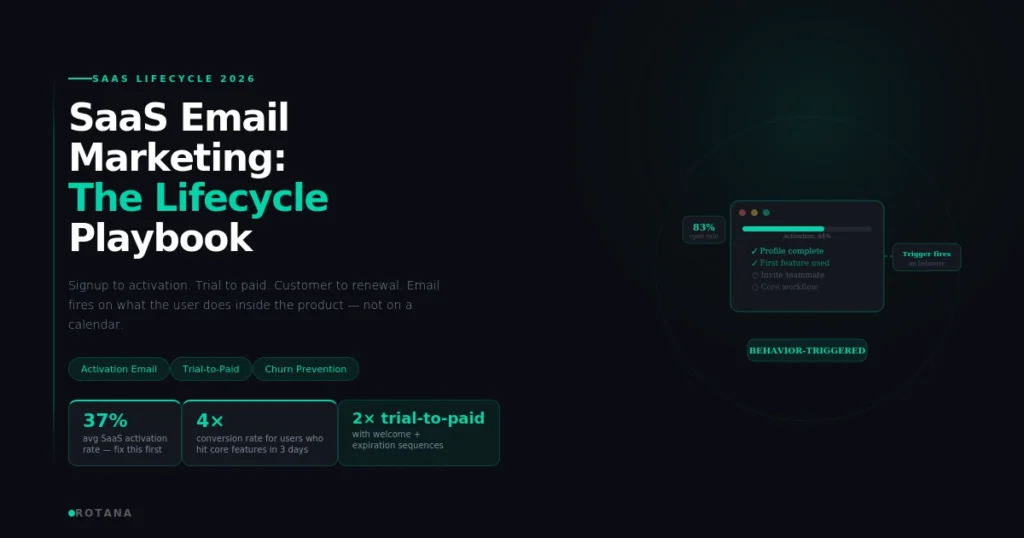
SaaS email marketing is the use of behavior-triggered email to move a user from signup to activation, from trial to paid, then from customer to renewal. It is different from every other kind of email. In SaaS the message fires on what the user does inside the product, not on a calendar. Get the lifecycle right and email becomes the engine behind trial conversion and retention. Get it wrong and users sign up, drift and churn before they ever see the value.
I build email as a revenue system. SaaS is where that idea bites hardest. Your real metric is not opens. It is activation, trial-to-paid and net revenue retention. This guide lays out the lifecycle sequences that move those numbers, anchored in 2026 benchmark data.
Why SaaS email is a lifecycle problem
Activation decides everything
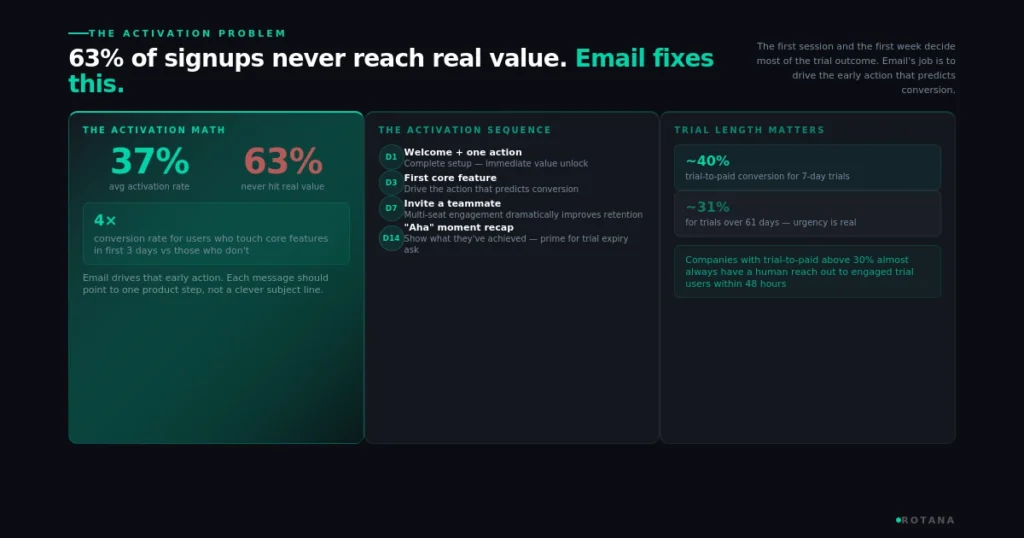
Most signups never reach the moment your product pays off. The average SaaS activation rate sits around 37%, which means roughly two in three users never hit real value. Users who touch core features in their first three days convert at about four times the rate of those who do not. The first session and the first week decide most of the outcome. Email’s job is to drive that early action.
Onboarding and retention are different jobs
A useful counter-intuitive finding: activation and retention are not the same task. Product-led companies sometimes activate fewer users yet retain more of them at one month than sales-led ones. The takeaway is to build separate email tracks. One drives the first win. Another keeps users engaged long after it.
The core SaaS lifecycle sequences
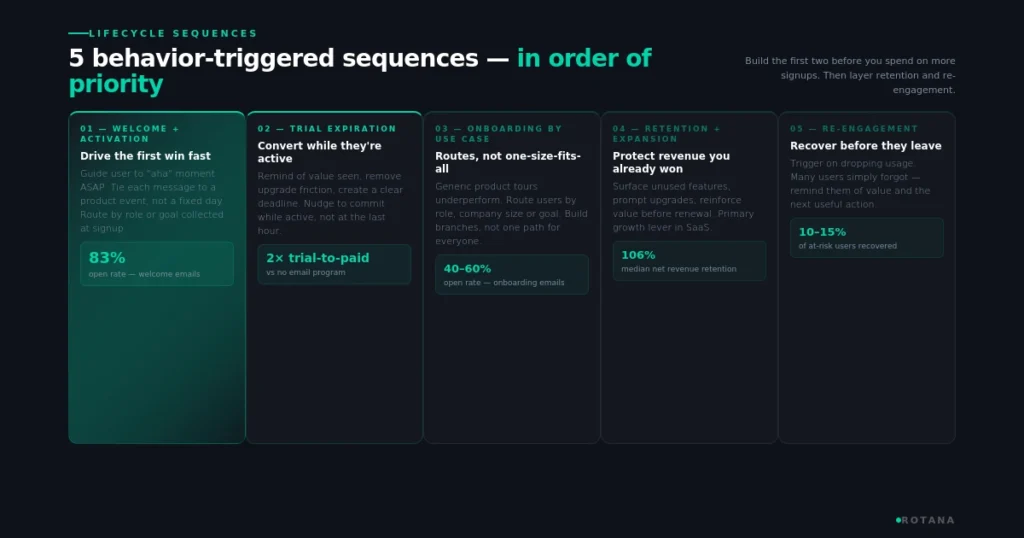
A SaaS program runs on a few behavior-triggered sequences rather than a newsletter.
The welcome and activation sequence
This is the highest-impact sequence to build first. It guides a new user to their first real outcome, the “aha” moment, as fast as possible. Welcome emails earn exceptional engagement, around 83% open rates in 2026 data. Tie each message to a product event rather than a fixed day. Route users to a path based on their role or stated goal collected at signup, since personalized onboarding lifts conversion.
The trial expiration sequence
A welcome sequence plus a trial-expiration sequence are the two you need before you drive a single signup. Together they can roughly double trial-to-paid conversion compared to no email program. The expiration sequence reminds the user of the value they have seen, removes friction to upgrade, then creates a clear deadline. Early conversion signals genuine fit, so nudge users to commit while they are active rather than at the last hour.
The onboarding-by-use-case track
Generic product tours underperform. Top-converting companies route users into tailored activation paths by role, company size or goal. Onboarding and trial emails reach far higher open rates, often 40% to 60%, because they are relevant and timely. Build branches, not one path for everyone.
The retention and expansion sequence
Retention is the primary growth lever in SaaS. Median net revenue retention across B2B SaaS sits around 106%, with top performers above 120%. Expansion email surfaces features a customer has not adopted, prompts upgrades and reinforces value before renewal. This is where email protects revenue you already won.
The re-engagement sequence
A re-engagement campaign can recover 10% to 15% of users who would otherwise churn, since many simply forgot about the product rather than deciding to leave. Trigger it on dropping usage, then remind them of the value and the next useful action.
The benchmarks to measure against
Numbers worth holding
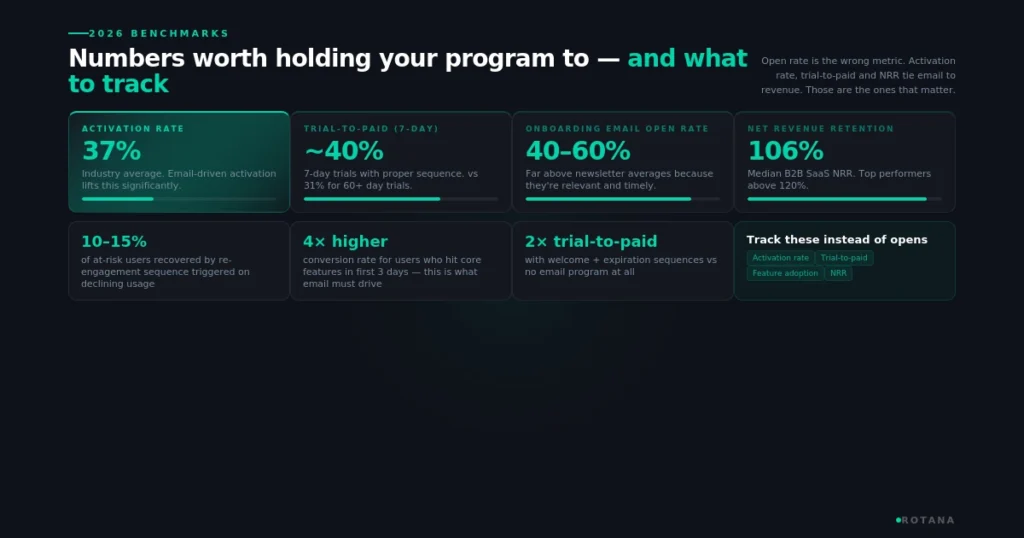
Anchor on real figures. SaaS activation averages around 37%. Trial length matters, with 7-day trials converting near 40% against roughly 31% for trials over 61 days. Onboarding emails reach 40% to 60% open rates. Re-engagement recovers 10% to 15% of at-risk users. Treat these as directional, since methodologies differ, but use them to set expectations.
Measure activation, not opens
Open rate is inflated by Apple’s Mail Privacy Protection, so it is the wrong target. Track activation rate, trial-to-paid conversion, feature adoption and net revenue retention. Those tie email to revenue. The same logic of measuring behavior over vanity metrics runs through my guide to B2B email marketing.
Build the list and data the right way
Collect the right signals at signup
SaaS email runs on product data, so capture the inputs that let you personalize. Ask for role or goal at signup. Connect your email tool to product events so messages fire on behavior. The richer the signal, the sharper the sequence.
Keep humans in the loop for high-value trials
Automation is efficient. Human touch is effective. Companies with trial-to-paid rates above 30% almost always have a person reach out to engaged trial users within the first 48 hours. Use email to scale, then add a human touchpoint for high-value accounts.
Write SaaS emails that get action
One email, one action
Every lifecycle email should drive one product action: complete setup, invite a teammate, try a core feature. Short copy, one clear button, no clutter. The goal is the next step in the product, not a clever subject line.
Speak to the outcome, not the feature
Users do not care about features. They care about the result. Frame each message around the win the user gets, then point them to the feature that delivers it. The plain, direct style I use across regulated fields like email marketing for financial advisors works just as well here.
What I would do first
If you run a SaaS product with no real lifecycle email, build two sequences this month. Ship a welcome and activation sequence that drives users to their first win. Add a trial-expiration sequence before you spend on more signups. Then track activation and trial-to-paid, not opens. Layer the retention and re-engagement tracks once trial volume passes 50 signups a month.
SaaS email rewards relevance and timing over volume. The product that fires the right message on the right behavior converts more trials and keeps more customers than any broadcast. If you want that lifecycle system built, that is the work I do at Rotana through our cold email and drip campaign service. Book a call through the link on the site.
Frequently asked questions
What is SaaS email marketing?
SaaS email marketing is the use of behavior-triggered email to guide users through the product lifecycle: onboarding to activation, trial to paid, then customer to renewal and expansion. Unlike calendar-based newsletters, the most effective SaaS email fires on product events such as completing setup or trying a core feature. Its goal is to drive activation and retention, the metrics that decide SaaS growth.
Which email sequences matter most for SaaS?
Start with two: a welcome and activation sequence that drives the first product win, plus a trial-expiration sequence that converts trials to paid. Together they can roughly double trial-to-paid conversion compared to no email. Add onboarding-by-use-case branches, a retention and expansion track, then a re-engagement sequence as you scale.
How can email improve trial-to-paid conversion?
Email drives the early product actions that predict conversion. Users who reach core features in their first three days convert at roughly four times the rate of those who do not, so onboarding email focused on the first win matters most. A welcome sequence plus a trial-expiration sequence can roughly double trial-to-paid versus sending nothing. Personalizing the path by role lifts results further.
What open rate should SaaS onboarding emails get?
Onboarding and trial-related emails commonly reach 40% to 60% open rates, far above the 21% to 25% typical of cold or newsletter sends, because they are relevant and timely. Welcome emails specifically can hit around 83%. Treat open rate as directional, though, since Apple Mail Privacy Protection inflates it. Activation and trial-to-paid conversion are the metrics that matter.
Can email marketing reduce SaaS churn?
Yes. A re-engagement sequence triggered by declining usage can recover 10% to 15% of users who would otherwise churn, since many simply forgot about the product. Retention and expansion email also surfaces unused features and reinforces value before renewal. Since median net revenue retention sits around 106%, lifecycle email aimed at existing customers is one of the strongest growth levers in SaaS.