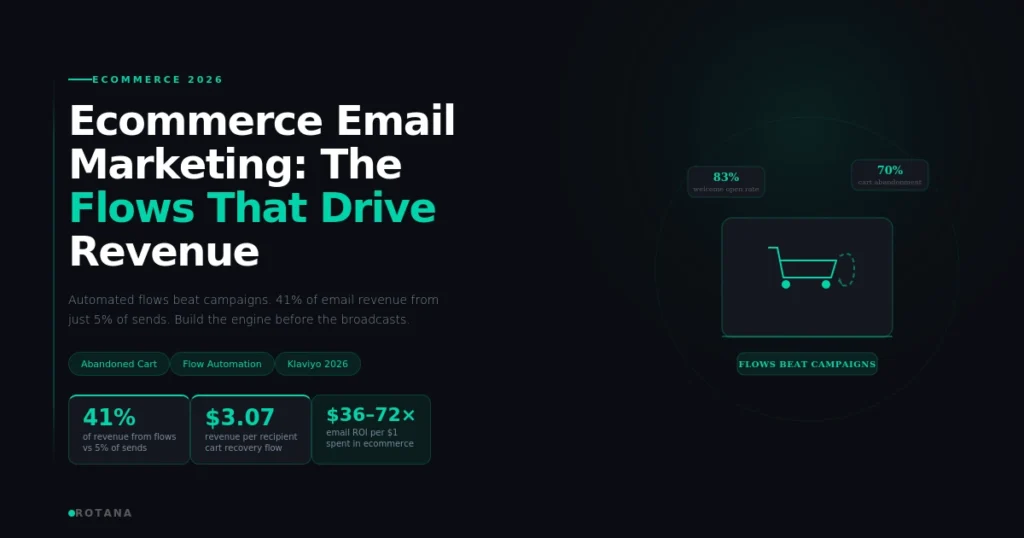
Ecommerce email marketing is the use of automated flows and targeted campaigns to turn store visitors into buyers, then buyers into repeat customers. It is the most profitable channel in ecommerce. Email returns between $36 and $72 per dollar spent depending on platform. Automated flows drive around 30% of email revenue from just 2% of sends. If you run a store and your email is a weekly newsletter, you are leaving most of that money on the table.
I build email programs as revenue systems. In ecommerce the lever is clear: flows beat broadcasts. The brands that win treat email as automated infrastructure that recovers carts, welcomes buyers and brings them back, not as a Friday promo blast. This guide covers the flows that matter, the 2026 benchmarks to measure against and how to build the system.
Why flows beat campaigns in ecommerce
The revenue split
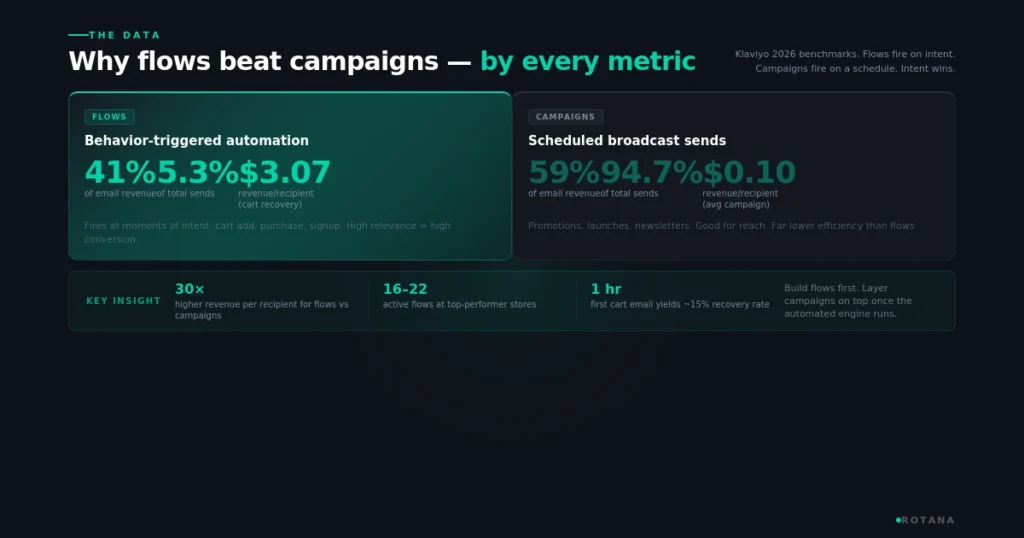
Campaigns and flows do different jobs. A campaign is a one-time send to many people. A flow is an automated sequence triggered by behavior. The data is stark on which pays. Klaviyo’s 2026 benchmarks show email flows generating close to 41% of email revenue from only 5.3% of sends. Average revenue per recipient for abandoned cart flows runs around $3.07 against roughly $0.10 for campaigns. Flows are where the money sleeps.
Why high intent wins
Flows fire at the moment of intent. Someone abandons a cart, finishes a purchase or joins your list. Reaching them right then converts far better than a scheduled blast that lands whenever. Build the flows first. Layer campaigns on top once the automated engine runs.
The core flows every store needs
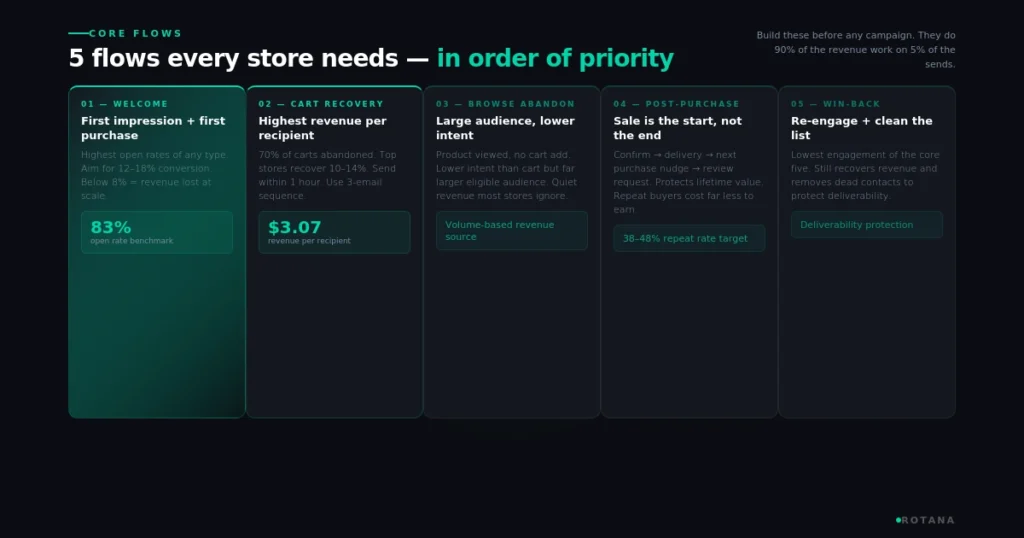
A handful of flows do most of the work. Build these before anything else.
The welcome flow
The welcome flow is your highest-volume entry point. It greets new subscribers, sets expectations and converts that first burst of interest. Welcome emails hit the highest open rates of any automated type, around 83% on Klaviyo’s data. Aim for a welcome conversion above the 12% to 18% top-performer band. Below 8% conversion means you are losing first-purchase revenue at scale.
The abandoned cart flow
Cart abandonment is your highest revenue-per-recipient flow because the intent is already there. Global cart abandonment sits near 70%, so even small recovery gains move real money. Most stores recover only 3% to 5% of carts. Top performers reach 10% to 14%. Two rules drive the gap. Send the first email within an hour, since fast recovery yields roughly a 15% rate. Use a multi-step sequence, since three-email sequences vastly outperform single sends in Klaviyo’s data.
The browse abandonment flow
Browse abandonment reaches people who viewed a product then left without adding to cart. Intent is lower than a cart abandon, but the eligible audience is far larger. That volume makes it a quiet revenue source most stores ignore.
The post-purchase flow
The sale is the start of the relationship. A post-purchase flow confirms the order, sets delivery expectations, then nudges the next purchase or a review. Repeat buyers are cheaper than new ones, so this flow protects lifetime value.
The win-back flow
The win-back flow re-engages customers who have gone quiet. It has the lowest engagement of the core flows, since you are reaching people who already drifted. It still recovers revenue you would otherwise lose, plus it cleans your list to protect deliverability.
The 2026 benchmarks to measure against
Flow targets
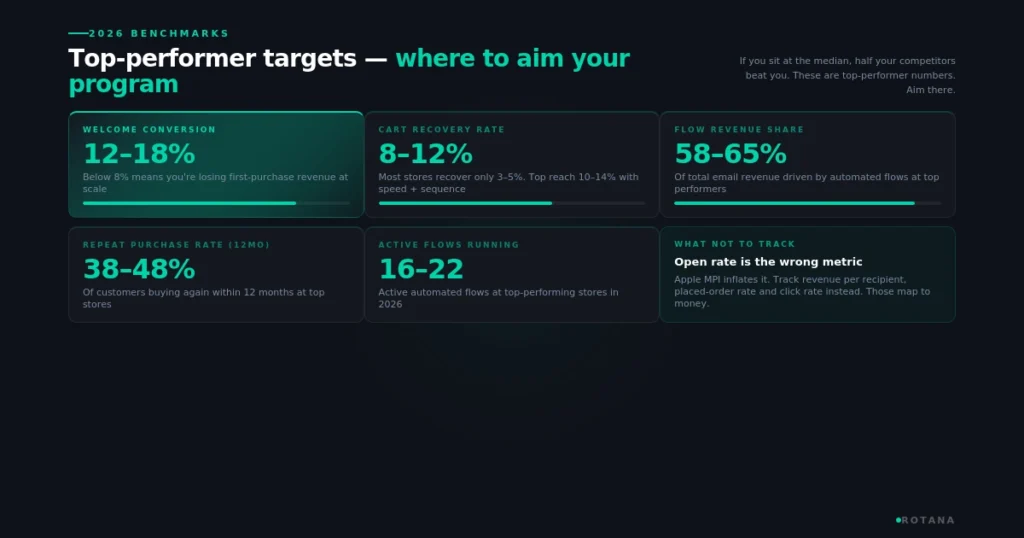
Hold your program to real numbers. Top-performer 2026 benchmarks put welcome flow conversion at 12% to 18%, cart recovery at 8% to 12%, flow revenue at 58% to 65% of email revenue, repeat purchase rate over twelve months at 38% to 48% and active flows at 16 to 22. If you sit at the median, half your competitors beat you. Aim higher.
Why open rate is the wrong target
Open rate is now a soft signal. Apple’s Mail Privacy Protection inflates it, so chase revenue per recipient, click rate and placed-order rate instead. A store that recovers more carts has a better program than one with a prettier open rate. The same deliverability-first thinking runs through my guide to B2B email marketing.
Build the list the right way
Convert visitors to subscribers
Permission powers every flow. Capture email with a clear signup offer, a first-order discount or early access, tied to the source so you can tailor the welcome. A shopper who joins through a 10% popup has different intent from one who subscribes at checkout. Segment the welcome accordingly.
Protect deliverability
Flows only work if they reach the inbox. Authenticate your domain, clean your list on a schedule and remove dead addresses. Elite cart flows earn far higher revenue per recipient partly because their email actually lands. Deliverability is the multiplier on every flow you build.
Write ecommerce emails that convert
Segment beyond the blast
Segmented campaigns generate far more revenue than batch sends. Group by purchase history, product category and engagement, then match the message. A first-time buyer and a VIP repeat customer need different emails. Relevance is the whole game.
Use dynamic, specific content
Show the exact items left in the cart with images and pricing. Add reviews or user content for social proof. Specific beats generic every time, because it removes friction between the click and the purchase.
Measure what maps to sales
Track revenue per recipient, placed-order rate, click rate and repeat purchase rate. Those map to money. A flow that lifts placed orders beats one that lifts opens, every time.
What I would do first
If you run a store with no real flows, build three this month. Set up a welcome flow with a first-order offer. Build a three-email abandoned cart sequence that fires within the hour. Add a post-purchase flow to drive the second order. Then watch revenue per recipient, not opens.
Email is the cheapest revenue you will find in ecommerce, but only if the flows exist. The store that runs 16-plus active flows on a clean, well-segmented list builds retention no ad spend matches. If you want that system built, that is the work I do at Rotana through our cold email and drip campaign service. The agencies I rate for this are in my guide to the best email marketing agencies. Book a call through the link on the site.
Frequently asked questions
How much revenue should email drive for an ecommerce store?
For strong performers in 2026, email and SMS together drive roughly 38% to 45% of total store revenue, with automated flows producing 58% to 65% of the email portion. If email is contributing far less, the gap is usually missing flows rather than weak campaigns. Building the core automated sequences is the fastest way to close it.
What email flows does an ecommerce store need first?
Start with three: a welcome flow for new subscribers, a multi-step abandoned cart flow and a post-purchase flow. These capture the highest-intent moments in the customer journey. Add browse abandonment and win-back flows next. Top stores run 16 to 22 active flows, but the first three deliver most of the early revenue.
What is a good abandoned cart recovery rate?
Most stores recover only 3% to 5% of abandoned carts, while top performers reach 10% to 14%. The biggest levers are speed and sequence length. Sending the first email within an hour yields around a 15% recovery rate. Three-email sequences vastly outperform single reminders. Deliverability also matters, since a recovery email only works if it reaches the inbox.
Are email campaigns or flows more important for ecommerce?
Flows are more important for revenue efficiency. Klaviyo’s 2026 data shows flows generating close to 41% of email revenue from just over 5% of sends, with far higher revenue per recipient than campaigns. Campaigns still drive timely, collective action around launches and promotions, so the answer is both, but build your flows first.
How often should an ecommerce store send marketing emails?
Flows run continuously in the background based on behavior, so the question really applies to campaigns. Most stores send one to three campaigns a week, scaling with engagement and seasonality. Watch unsubscribe and spam rates as your guide. The automated flows do the heavy lifting, while campaigns add timely promotion on top.