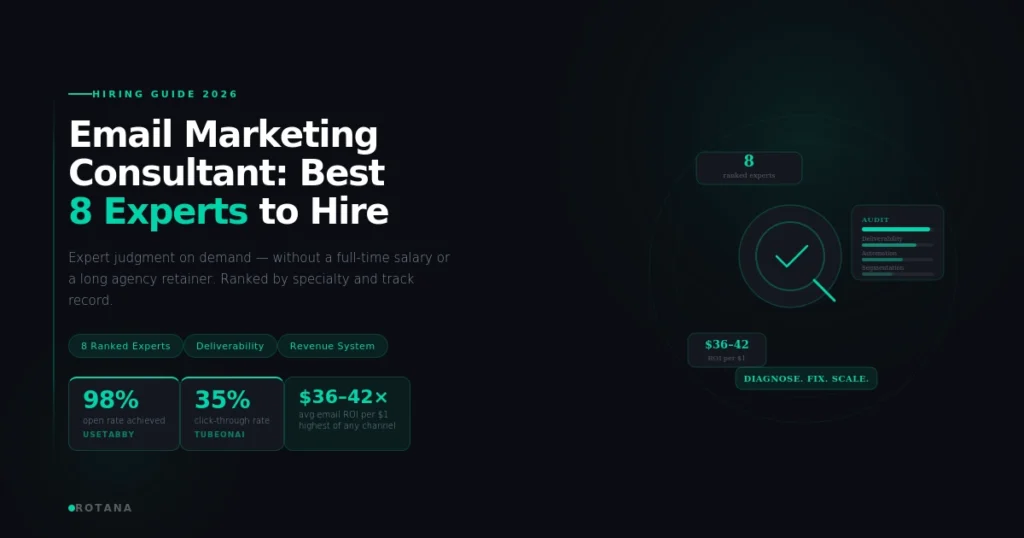
An email marketing consultant is an expert you hire to plan, fix or scale your email program without bringing on a full-time employee. They bring outside judgment and channel experience to a specific problem: low open rates, weak automation, poor deliverability or a list that does not convert. Email still returns $36 to $42 for every $1 spent, the highest of any channel, so a consultant who fixes a broken program often pays for themselves quickly.
I work as an email and growth consultant, so this is the job from the inside. People usually call me when email feels like it should work and does not. This guide explains what a consultant actually does, when hiring one makes sense, what it costs and how to pick the right one. I have kept the sales pitch out of it until the end.
What does an email marketing consultant do?
The core job
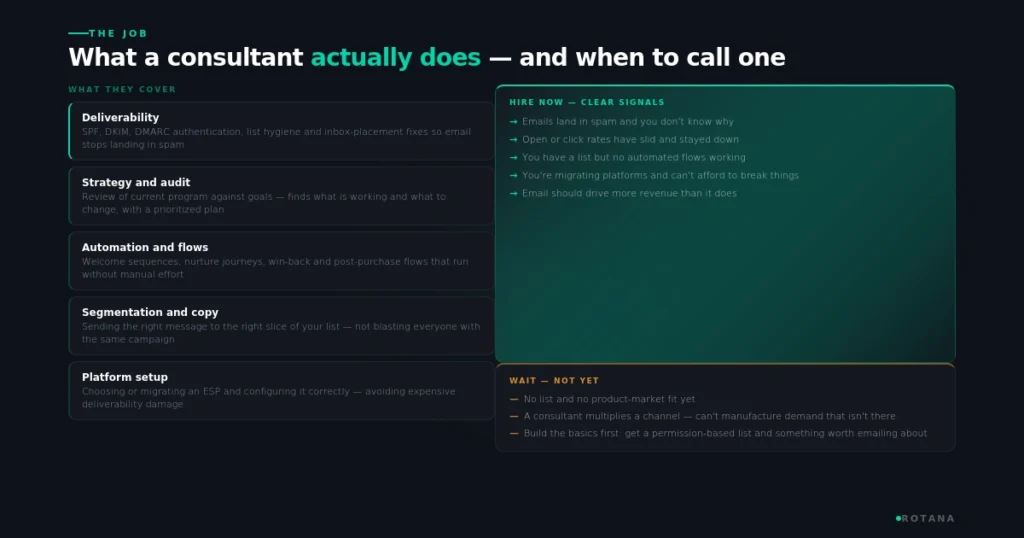
A consultant diagnoses before they prescribe. The first job is to find what is actually holding your email back. That usually means an audit of your deliverability, your list health, your automation flows and your segmentation. From there, a consultant builds the strategy and either executes it or guides your team to. The value is judgment. A good consultant tells you what is working, what is missing and what to do next.
Common areas they cover
The work varies by what you need, but it usually falls into a few buckets:
- Deliverability. Authentication with SPF, DKIM and DMARC, list hygiene and inbox-placement fixes so your email stops landing in spam.
- Strategy and audit. A review of your current program against your goals, with a prioritized plan.
- Automation and flows. Welcome sequences, nurture journeys, win-back and post-purchase flows that run without manual effort.
- Segmentation and copy. Sending the right message to the right slice of your list rather than blasting everyone.
- Platform setup. Choosing or migrating an ESP and configuring it correctly.
Consultant vs agency vs in-house
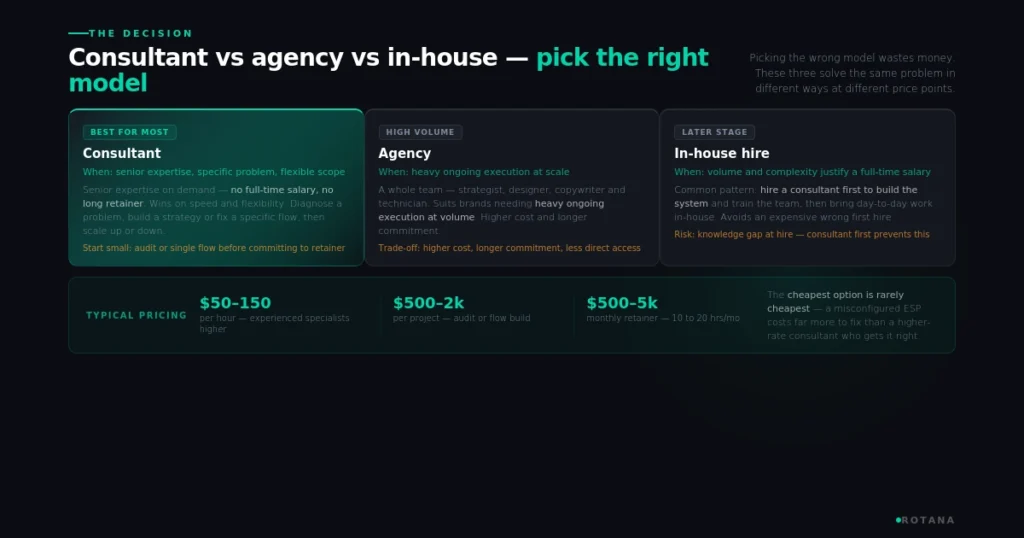
These three models solve the same problem in different ways. Picking the wrong one wastes money.
When a consultant fits
A consultant gives you senior expertise on demand, without a full-time salary or a long agency retainer. They win on speed and flexibility. You can bring one in to diagnose a problem, build a strategy or fix a specific flow, then scale the engagement up or down. This suits businesses that want expert judgment but do not need a full team executing every day.
When an agency fits
An agency gives you a whole team: strategist, designer, copywriter and technician. That suits brands needing heavy ongoing execution at volume. The trade-off is cost and commitment. If you want to compare specific firms, I ranked the options in my guide to the best email marketing agencies.
When in-house fits
An in-house hire makes sense once your send volume and complexity justify a full-time salary. The catch is the knowledge gap. Many brands hire a consultant first to build the system and train the team, then bring day-to-day work in-house later. That sequence avoids an expensive wrong hire.
How much does an email marketing consultant cost?
Typical rate ranges
Pricing depends on experience, scope and where the consultant is based. As planning ranges, not rules: email freelancers and consultants commonly charge $50 to $150 an hour, with experienced specialists in major markets at the upper end or beyond. Project fees for a defined piece of work like an audit or a flow build often run $500 to $2,000. Ongoing retainers for 10 to 20 hours a month typically land between $500 and $5,000, scaling with list size and complexity.
Why the cheapest option is rarely the cheapest
A low hourly rate can become expensive if the scope is unclear or the work is wrong. A consultant who misconfigures your ESP or violates its terms can tank your deliverability and cost you far more than their fee to fix. Judge value by the problem solved, not the rate. A higher rate is often cheaper when the consultant diagnoses the right issue fast.
When should you hire an email marketing consultant?
The clear signals
A few situations make the case obvious. Your emails land in spam and you do not know why. Your open or click rates have slid and stayed down. You have a list but no automated flows working for you. You are migrating platforms and cannot afford to break things. You know email should drive more revenue than it does. Any one of these is worth a consultant’s time.
When to wait
If you have no list and no product-market fit yet, a consultant is premature. Build the basics first. A consultant multiplies an existing channel. They cannot manufacture demand that is not there. Get a small permission-based list and something worth emailing about, then bring in expertise to scale it.
How to choose the right email marketing consultant
What to check before hiring
Look for proof, not promises. Ask for specific results they have produced, not vanity metrics. Confirm they understand deliverability, since that is where most programs quietly fail. Check that their experience matches your model, because B2B outreach and ecommerce retention are different skills. I cover the B2B side in B2B email marketing if that is your world.
Start with a small project
The lowest-risk way to test a consultant is a small, defined first project. An audit or a single flow build tells you how they think and work before you commit to a retainer. A good consultant welcomes this. If someone only wants a long contract sight unseen, treat that as a flag.
Email marketing consultants worth knowing in 2026
If you want names rather than a framework, here are eight email marketing consultants and experts I rate. Full disclosure first. This is my list and I have put myself in it. I led with the most globally established names, then added myself where I think the track record earns a place. Judge the fit for yourself, since the right consultant depends on your model and your stage.
| # | Consultant | Known for | Best for | Profile |
|---|---|---|---|---|
| 1 | Chase Dimond | Ecommerce email, $200M+ reported | DTC retention | chasedimond.com |
| 2 | Jordie van Rijn | Independent strategy, 13+ years | Impartial strategy advice | emailmonday.com |
| 3 | Riad Hasan | Email as a revenue system | Founders treating email as pipeline | riadhasan.com |
| 4 | Kath Pay | Author, strategy-first philosophy | Customer-centric teams | holisticemailmarketing.com |
| 5 | Chad S. White | Author of Email Marketing Rules | Evidence-based guidance | emailmarketingrules.com |
| 6 | Ian Brodie | Author of Email Persuasion | Coaches and service firms | ianbrodie.com |
| 7 | Dela Quist | Frequency and long-term value research | Data-driven strategy | delaquist.com |
| 8 | Jeanne Jennings | Optimization and testing | Test-driven brands | emailopshop.com |
1. Chase Dimond
Chase Dimond is one of the most recognized names in ecommerce email. A partner at the agency Structured, he reports driving over $200M in email-attributable revenue, a figure I present as his claim. He has built a following of hundreds of thousands across his channels. Best for ecommerce founders who want proven DTC retention thinking.
Website: chasedimond.com.
2. Jordie van Rijn
Jordie van Rijn is an independent email marketing consultant with more than 13 years of experience, based in the Netherlands. He has advised A-list brands including Unilever, KLM and Heineken, then founded the resource Email Vendor Selection. Entrepreneur magazine named him one of 50 online marketing influencers to watch. Best for brands wanting impartial strategy and platform-selection advice.
Website: emailmonday.com.
3. Riad Hasan
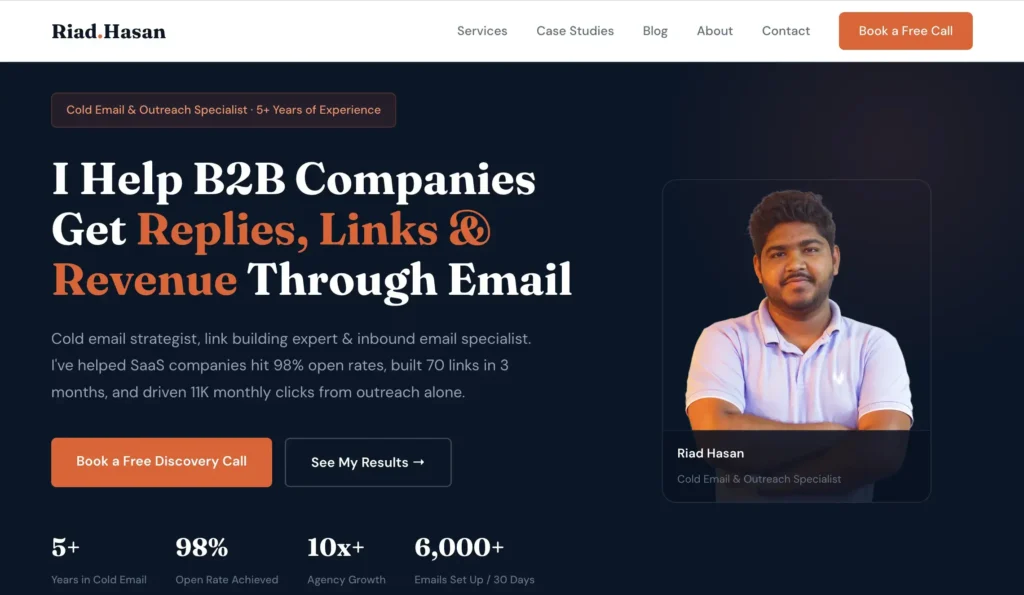
That one is me. I run Rotana, an SEO-led growth agency. I consult on email as a revenue system built on deliverability, tight segmentation and messages written for one specific buyer. My work includes a 98% open rate for UseTabby and a 35% click-through rate for TubeOnAI. Best for founders who want email treated as pipeline rather than broadcast.
Website: riadhasan.com.
4. Kath Pay
Kath Pay is the founder and CEO of Holistic Email Marketing and author of the book Holistic Email Marketing. Recognized as an Email Marketing Thought Leader of the Year by the Email Experience Council, she trains marketers worldwide. Best for teams wanting a strategy-first, customer-centric philosophy.
Website: holisticemailmarketing.com.
5. Chad S. White
Chad S. White is the author of Email Marketing Rules, widely treated as a definitive reference, plus a long-time research leader in the field. His strength is rigor and best-practice depth. Best for teams that want guidance grounded in research.
Website: emailmarketingrules.com.
6. Ian Brodie
Ian Brodie is the author of Email Persuasion, for years the best-selling email marketing book on Amazon. He focuses on email for consultants, coaches and professional-service firms rather than ecommerce. Best for solo experts and small firms selling high-value services.
Website: ianbrodie.com.
7. Dela Quist
Dela Quist is the CEO of Alchemy Worx and an internationally recognized email thought leader. He is known for research-led views on send frequency and the long-term value of an email list. Best for brands wanting a data-driven, contrarian take on email strategy.
Website: delaquist.com.
8. Jeanne Jennings
Jeanne Jennings is an email marketing strategist who runs a boutique consultancy, teaches at Georgetown University and serves as general manager of the Only Influencers community. Her focus is optimization and testing. Best for brands wanting a seasoned strategist with a test-driven approach.
Website: emailopshop.com.
What I bring as a consultant
My approach is simple. I treat email as a revenue system, not a sending habit. That means starting with deliverability and list health, then segmentation, then messages written for one specific reader. I have produced results like a 98% open rate for UseTabby and a 35% click-through rate for TubeOnAI by doing exactly that, tight targeting on a clean, well-configured program.
If your email should be doing more than it is, that is the problem I solve. You can see how I structure ongoing work through our cold email and drip campaign service. Book a call through the link on the site to talk through your specific situation.
Frequently asked questions
What does an email marketing consultant do?
An email marketing consultant diagnoses and improves a brand’s email program. They audit deliverability, list health, automation and segmentation, then build a strategy and either execute it or guide the in-house team. The core value is expert judgment: identifying what is holding email back and what to do next, rather than simply sending more campaigns.
How much does an email marketing consultant cost?
As planning ranges, email consultants commonly charge $50 to $150 per hour, with experienced specialists higher. Defined projects like an audit or flow build often run $500 to $2,000, while monthly retainers for 10 to 20 hours typically fall between $500 and $5,000. The right figure depends on scope, experience and the complexity of your list.
Is it better to hire a consultant or an agency for email marketing?
It depends on how much execution you need. A consultant gives senior judgment on demand with speed and flexibility, ideal for diagnosis, strategy or fixing a specific problem. An agency gives a full team for heavy ongoing execution at volume, at higher cost and commitment. Many brands hire a consultant first to build the system, then scale with an agency or in-house team.
When should I hire an email marketing consultant?
Hire one when email underperforms in a way you cannot fix yourself: emails landing in spam, declining open or click rates, no working automation, a platform migration or a sense that email should drive more revenue. Wait if you have no list or no product-market fit yet, since a consultant scales an existing channel rather than creating demand.
What should I look for in an email marketing consultant?
Look for documented results rather than promises, real deliverability expertise and experience that matches your business model. Ecommerce retention and B2B outreach require different skills, so match the specialist to your need. Starting with a small, defined project like an audit is the lowest-risk way to test fit before committing to an ongoing retainer.