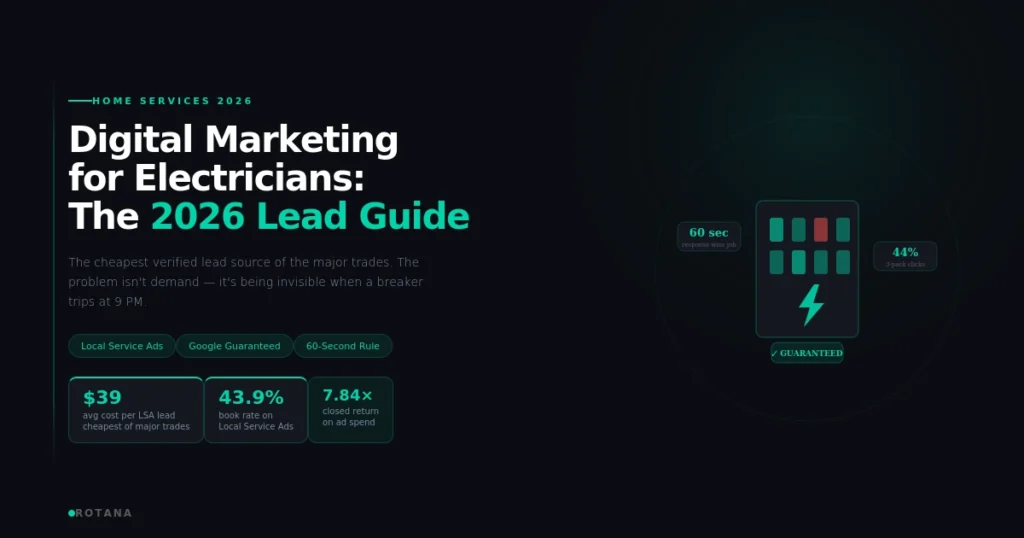
Digital marketing for electricians is the work of showing up at the top of local search when someone needs an electrician, proving you are licensed and trustworthy, then converting that high-intent search into a booked job. The economics are unusually good. Electrician Local Service Ads averaged about $39 per lead in 2026 with a 43.9% book rate and a 7.84x closed return on ad spend, the cheapest verified lead source of the major trades. The problem most electricians have is not demand. It is being invisible when a homeowner’s breaker keeps tripping at 9 PM.
I run an SEO-led growth agency, so I know electrician marketing rewards a specific stack: be first in local search, signal trust through licensing and reviews, then answer the phone before a competitor does. Most advice on this topic still reads like 2018, full of social media checklists and “build a brand” filler. The real lead-flow math in 2026 looks nothing like that. This guide breaks down the channels that book residential and commercial jobs, the high-margin niches hiding in plain sight and the speed-to-lead discipline that decides who actually wins the call.
Why electrician marketing is its own game
Two different businesses in one
An electrician runs two businesses that need different marketing. Residential service is high-volume, urgent and local: a tripped breaker, a dead outlet, a burning smell. Commercial work is lower-volume but far higher-value, with longer sales cycles and relationship-driven buying. A single commercial panel upgrade can be worth 10 to 20 times a residential service call, with lifetime value reaching $50,000 or more. Treating both with one generic campaign wastes money. The winning approach runs a fast, high-intent engine for residential and a separate, trust-and-relationship engine for commercial.
Trust and licensing carry extra weight
Electrical work is a safety decision inside someone’s home or business, so trust matters more than in almost any trade. Homeowners worry about competence, licensing and liability. That is why displaying your license prominently, such as “Licensed Electrician #[number],” on your homepage and service pages converts. It is also why the Google Guaranteed badge on Local Service Ads is so powerful for electricians: it signals license verification, insurance and background checks, with customer protection up to a set amount. Lead with safety and credentials, since that is what an anxious homeowner is screening for.
The channel stack that books jobs
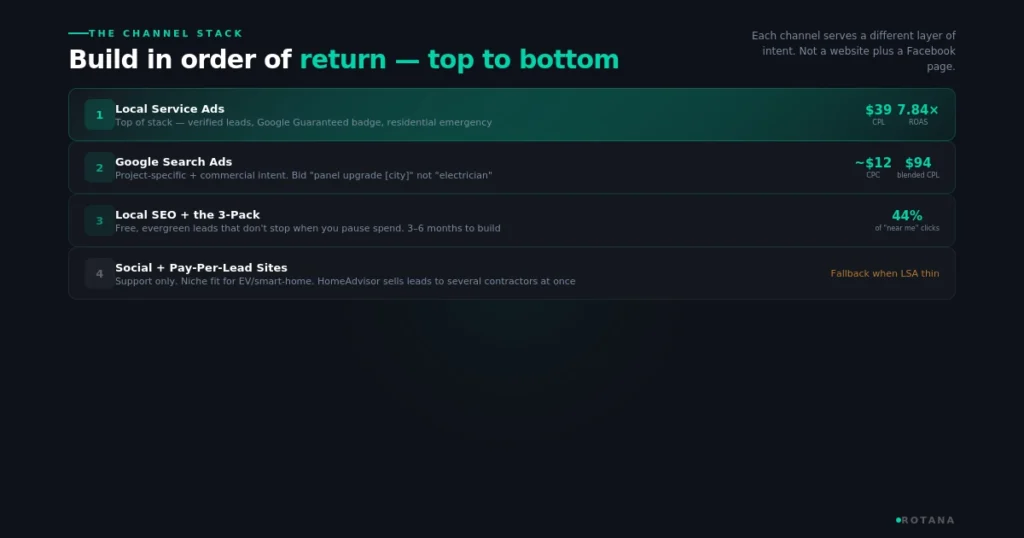
Electrician marketing is a stack of channels that each serve a different layer of intent, not a website plus a Facebook page. Build it in order of return.
Local Service Ads: the top of the stack
Local Service Ads sit above every other paid result, charge per verified lead and carry the Google Guaranteed badge. For residential service, this is where the highest-intent leads come from. The 2026 benchmarks are strong: roughly $39 average cost per lead, a 43.9% book rate, an average ticket near $1,826 and about 7.84x closed return on ad spend. For every dollar of LSA spend that became a booked job, contractors invoiced close to eight. If you run residential service and you are not using LSAs, you are paying retail for what your competitors get at wholesale.
Google Search Ads: capture project intent
Below LSAs sit standard Search Ads for queries LSAs do not cover well, especially project-specific and commercial work. Electrician clicks are not cheap, averaging around $12 in 2025 and climbing past $19 on terms like “commercial electrician near me,” with a blended cost per lead near $94. The discipline that makes the math work is bidding on high-margin intent like “panel upgrade [city]” or “EV charger installation [city]” rather than generic “electrician,” then using negative keywords aggressively. A counterintuitive move that beats the crowd: target problem-aware searches like “breaker keeps tripping” or “burning smell from outlet” where competition is thinner and intent is sky-high.
Local SEO and the 3-pack: free lead flow
Under the paid channels sit organic SEO and your Google Business Profile, which feed evergreen leads that do not stop when you pause spending. The Google Local 3-pack receives roughly 44% of clicks for searches like “electrician near me,” so ranking there is the durable prize. A complete Google Business Profile, consistent citations, steady reviews and dedicated service and city pages build that position over three to six months. This compounding visibility is the work I focus on through our SEO consultancy service.
Social and pay-per-lead sites as support
Facebook and Nextdoor work for specific niches like EV chargers and smart-home upgrades in affluent areas, but they lose to LSAs on emergency service. Pay-per-lead sites like HomeAdvisor sell the same lead to several contractors, so use them only as a fallback when LSA inventory runs thin. The order of priority matters: LSAs first, Search Ads second, local SEO underneath, social and lead sites as support.
The high-margin niches hiding in plain sight
Panel upgrades, EV chargers and generators
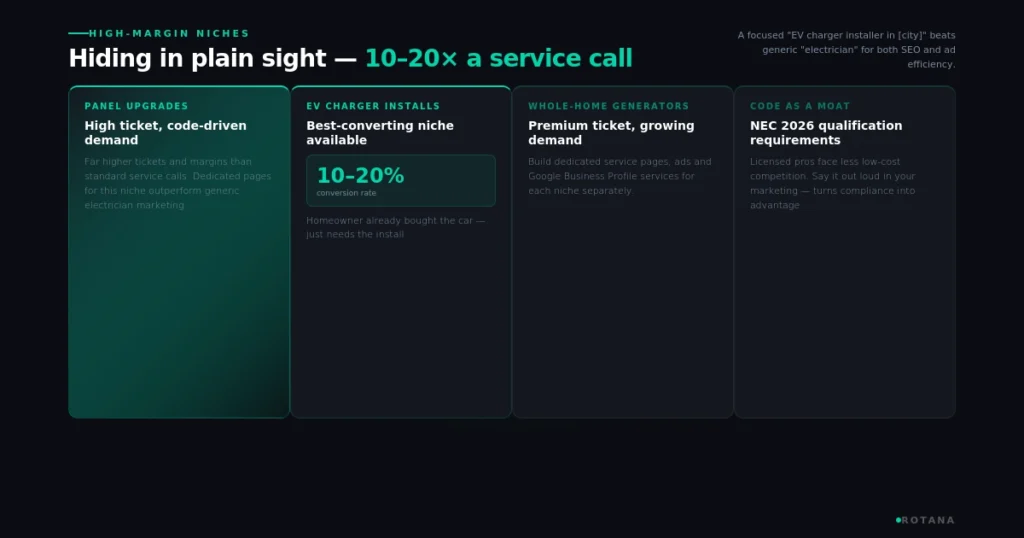
The most profitable opportunities sit under most electricians’ noses. Panel upgrades, EV charger installations and whole-home generators carry far higher tickets and margins than service calls. EV charger leads convert especially well, often 10% to 20%, because the homeowner already bought the car and just needs the install. Build dedicated service pages, ads and Google Business Profile services for each niche. A focused “EV charger installer in [city]” presence beats a generic “electrician” one for both SEO and ad efficiency, since the searcher has clear, high-value intent.
Use code and licensing as a moat
Regulatory shifts can create protected markets worth naming in your marketing. NEC 2026 qualified-installer requirements on some work mean licensed pros face less low-cost competition for it. Saying that out loud and emphasizing your licensing and code knowledge, turns a compliance requirement into a marketing advantage. For high-value, code-sensitive work, trust and qualification are the whole sale.
Speed to lead decides who wins
The 60-second rule
Getting the lead is maybe 30% of the job. The other 70% is answering before the homeowner calls the next electrician. Most leads go to whoever responds first and a large share of high-value electrical work is urgent: no power, a burning smell, a main that will not reset. Responding within 60 seconds lifts close rates dramatically and the first contractor to respond wins the job a large majority of the time. A $40 LSA lead that reaches voicemail is $40 wasted. Speed to lead is not a soft skill here. It is math.
Build a capture system, not hope
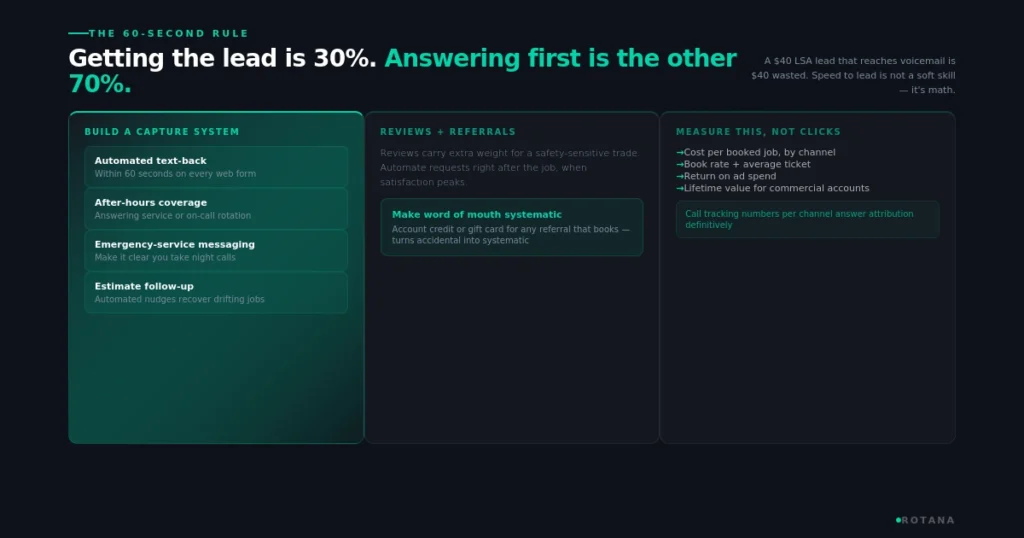
Make responsiveness systematic. Use automated text-back within 60 seconds on every web form, an answering service or on-call rotation for after-hours and clear emergency-service messaging so people know to call you at night. Automated follow-up on open estimates recovers a meaningful share of jobs that would otherwise drift to a competitor. If you are paying for LSAs or Search Ads and answering slowly, you are paying to send leads to the firm down the road.
Reviews, referrals and retention
Reviews drive ranking and trust
Reviews are both a local ranking factor and a conversion driver and for a safety-sensitive trade they carry extra weight. Automate review requests by text or email right after a completed job, when satisfaction peaks. Prioritize residential reviews for residential ranking. A steady flow of recent, specific reviews outperforms a stale pile, both for the algorithm and for the homeowner deciding who to trust inside their home.
Make word of mouth systematic
Electricians have always relied on word of mouth, but most leave it passive. Past customers are the highest-trust, lowest-cost leads you can get and a single satisfied residential customer often refers several more over the years. Run a simple referral incentive, such as account credit or a gift card for any referral that books and stay in touch with past customers through occasional email. Turning referrals from accidental to systematic is one of the cheapest growth levers available.
Measure cost per booked job, not clicks
The point is booked, profitable jobs, so measure what maps to them. Track cost per lead and cost per booked job by channel, book rate, average ticket and return on ad spend, plus lifetime value for commercial accounts. Use call tracking numbers per channel, which cost little and answer the attribution question definitively. Without attribution you are guessing on every budget decision. The electricians growing fastest in 2026 are not necessarily spending more. They capture a higher share of the leads they already generate, follow up on every estimate and make sure no call goes unanswered.
What I would do first
If you run an electrical business and want more jobs, start in this order. Claim and fully optimize your Google Business Profile, then build a steady review habit with automated requests. Launch Local Service Ads to capture residential emergency leads immediately. Add Search Ads for high-margin niches like panel upgrades and EV chargers. Build service and city pages for local SEO and the 3-pack. Fix speed to lead so every inquiry gets a response within a minute. Then track cost per booked job and double down on the channels that produce profitable work.
Electrician marketing rewards the business that shows up first, signals trust through licensing and reviews, then answers fastest. The system beats the spend. If you want that system built and tuned to your service area and your highest-margin work, that is the work I do at Rotana. The same local playbook drives my guides to digital marketing for contractors and solar marketing. Book a call through the link on the site.
Frequently asked questions
What is the best way for electricians to get leads online?
For residential service, Google Local Service Ads are the strongest starting point, since they charge per verified lead, sit at the top of results with a Google Guaranteed badge and averaged about $39 per lead in 2026 with a 43.9% book rate. Pair them with Search Ads for high-margin niches like panel upgrades and EV chargers, plus local SEO to win the free-flowing Google 3-pack over time. Fast response to every lead is what converts that visibility into booked jobs.
How much do electrician leads cost in 2026?
Local Service Ads averaged roughly $39 per lead in 2026, the cheapest of the major trades, with a 43.9% book rate and about 7.84x closed return on ad spend. Google Search Ads cost more, with clicks around $12 and a blended cost per lead near $94, climbing higher on commercial terms. The figure that matters is cost per booked job, not cost per lead, since a channel with pricier leads can still win if those leads close at higher value.
Should electricians market residential and commercial work differently?
Yes, because they are effectively two different businesses. Residential service is high-volume, urgent and local, suited to Local Service Ads and emergency-focused search. Commercial work is lower-volume but far higher-value, with longer cycles and relationship-driven buying, suited to targeted search and trust-building content. A single commercial project can be worth 10 to 20 times a residential call, so running separate engines for each, rather than one generic campaign, produces far better returns.
Why is speed to lead so important for electricians?
Because much electrical work is urgent and most leads go to whoever responds first. A homeowner with no power or a burning smell calls two or three electricians and hires the first to respond. Responding within 60 seconds lifts close rates substantially, while a lead that reaches voicemail is money wasted. Automated text-back, after-hours coverage and follow-up on open estimates turn responsiveness into a system, which is often the highest-return improvement an electrician can make.
What are the most profitable services for electricians to market?
High-ticket, high-margin work like panel upgrades, EV charger installations and whole-home generators outperforms low-value service calls. EV charger leads convert especially well, often 10% to 20%, since the homeowner already owns the car. Building dedicated pages and ads for each niche, such as “EV charger installer in [city],” beats generic electrician marketing for both SEO and ad efficiency. Code-sensitive work also benefits from emphasizing licensing, since requirements like NEC 2026 limit low-cost competition for qualified pros.