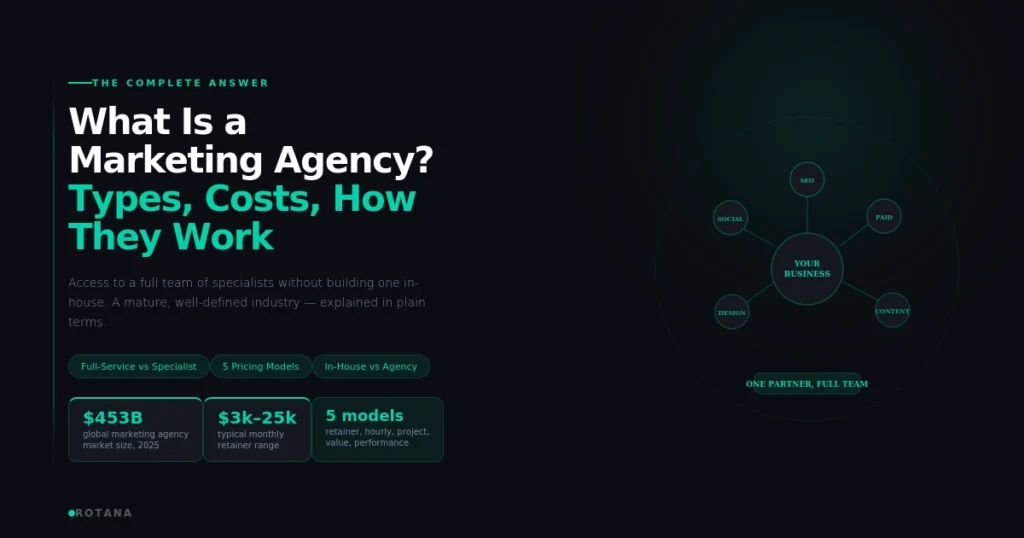
A marketing agency is an external company that businesses hire to plan and run their marketing, giving them access to a full team of specialists without building one in-house. Instead of employing a strategist, an SEO expert, a paid-media buyer, a designer and a copywriter directly, you contract one firm that already has all of them. The agency works across many clients at once, which is what lets it offer that range of expertise affordably. The global marketing agencies market reached roughly $453 billion in 2025, so this is a mature, well-defined industry.
I run a marketing agency, so I will explain how this actually works in plain terms: what an agency does, the types you will encounter, how they charge and how to decide whether hiring one beats building a team yourself. The goal here is clarity, since most articles on this either stop at a vague definition or only talk about price. This is the complete answer.
What does a marketing agency do?
The core function
A marketing agency develops and executes the work that gets a business found, chosen and remembered by its customers. Depending on the agency, that spans strategy, search engine optimization, paid advertising, content, social media, web design, creative production and analytics. The agency brings structured processes and cross-channel expertise that is hard to build internally in a short time. Because it works with many clients across industries, it carries collective experience that an in-house team of one or two people rarely has.
Why businesses hire one
Companies hire agencies for a few consistent reasons. Expertise: agencies have entire departments for different channels, plus they stay current on algorithm changes and platform updates that a small internal team cannot track. Speed: an agency already has systems, tools and people, so it can start within days, while building an in-house team takes months. Scalability: you can ramp effort up or down as needs change without hiring or firing. Fresh perspective: cross-industry experience surfaces ideas an internal team focused on one brand might miss.
The types of marketing agencies
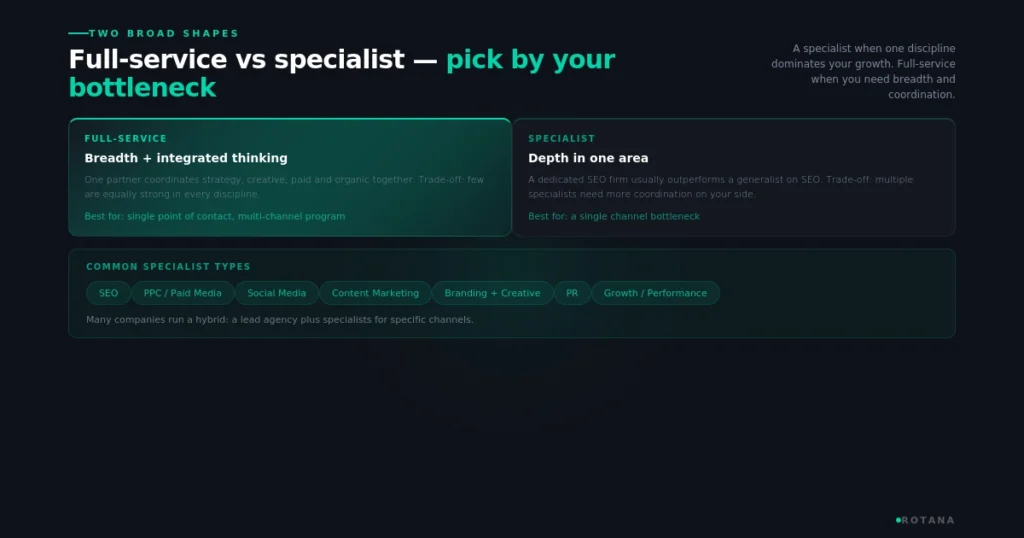
Not all agencies do the same thing. They fall into two broad shapes, full-service and specialist, with several common specializations.
Full-service agencies
A full-service agency offers broad capabilities across most marketing disciplines under one roof. The appeal is convenience and integrated thinking, since one partner coordinates strategy, creative, paid and organic together. The trade-off is that few full-service agencies are equally strong in every discipline. They suit businesses that want a single point of contact running a multi-channel program rather than managing several vendors.
Specialist agencies
Specialist agencies go deep in one area. Common types include SEO agencies, PPC or paid-media agencies, social media agencies, content marketing agencies, branding and creative agencies, PR agencies and growth or performance marketing agencies. The advantage is depth: a dedicated SEO firm will usually outperform a generalist on SEO. The trade-off is that using several specialists means more coordination on your side. Many companies run a hybrid, with a lead agency plus specialists for specific channels.
How to think about the choice
The right type depends on your need. If you want one partner for everything and value integration over maximum depth, full-service fits. If one channel is your bottleneck, like SEO or paid media, a specialist in that channel delivers more. A useful frame: pick a specialist when a single discipline dominates your growth and full-service when you need breadth and coordination across many.
How marketing agencies charge
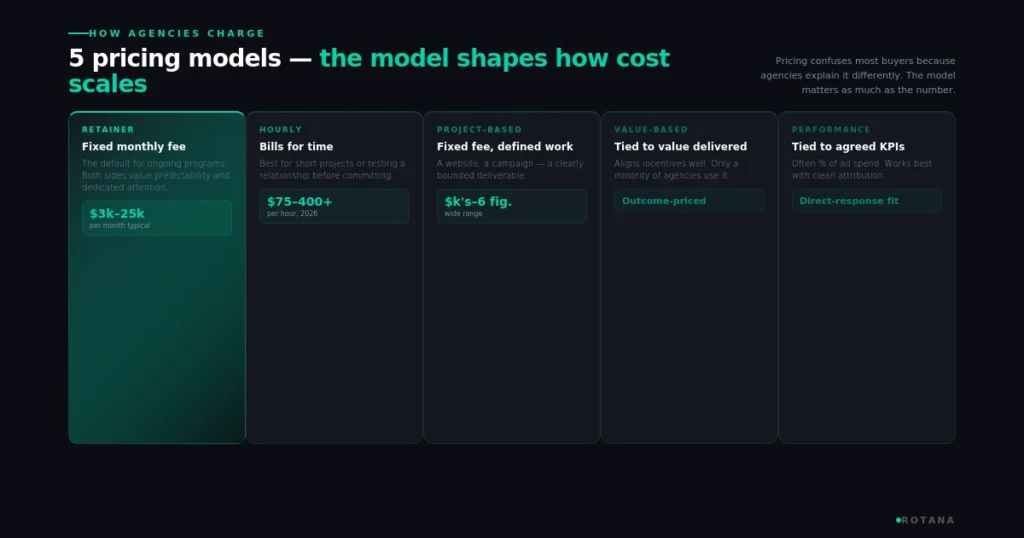
Pricing confuses most buyers because agencies explain it differently. There are five common models and the model matters as much as the number because it shapes how costs scale.
The five pricing models
Retainer: a fixed monthly fee for a defined set of work. It is the default for ongoing programs, used by most agency relationships because both sides value predictability and dedicated attention. Hourly: the agency bills for time, with 2026 rates typically running $75 to over $400 an hour, best for short projects or testing a relationship. Project-based: a fixed fee for a defined deliverable like a website or a campaign, ranging widely from a few thousand dollars to six figures. Value-based: the fee ties to the value delivered, which aligns incentives well but only a minority of agencies use it. Performance-based: fees tied to agreed KPIs, often a percentage of ad spend, which works best with clean attribution and direct-response channels. Hybrid models combine these, commonly a base retainer plus a bonus when campaigns beat targets.
What it actually costs
Real ranges help more than “it depends.” Most agency retainers run $3,000 to $25,000 a month depending on agency tier, services and your company size, with a $5,000 retainer covering perhaps 20 to 30 hours of work and $15,000 funding a multi-channel program with a dedicated team. By service, paid-media management and content programs often run a few thousand to tens of thousands monthly each. By business stage, local and small businesses commonly spend $1,000 to $5,000 a month, mid-market firms more and large enterprises $20,000 to $100,000 or more. As a benchmark, established companies allocate roughly 7% to 12% of revenue to marketing, growth-stage companies 12% to 20% and high-growth companies above 21%.
What every agreement should specify
Whatever the model, get the details in writing. A clear agreement specifies the deliverables or hours per month, the team members assigned to your account, the reporting cadence and metrics tracked, how scope changes are handled and the exit terms. Vague retainers lead to scope fights and unmet expectations, so this clarity protects both sides.
How agencies actually work
Onboarding and the relationship
An agency relationship starts with onboarding, where the team learns your business, audience, competitors and brand voice. Meaningful onboarding usually takes four to eight weeks, though quick tactical work can start sooner. From there, the strongest relationships run on clear briefs, regular check-ins, a single point of contact, shared metrics and prompt feedback. The biggest mistake clients make is insufficient briefing, since agencies cannot read minds and vague briefs produce vague work. Treat the agency as a partner, not a vendor fulfilling a ticket.
What good reporting looks like
A serious agency ties its work to business outcomes, not just activity. Reporting should connect spend to leads, pipeline or revenue rather than only clicks and impressions. If you cannot see what happened this month and what the plan is next month, that is a warning sign. The most expensive agency is the one that charges a modest fee and delivers nothing, while the cheapest is the one that costs more but generates many times its fee in revenue.
Agency, in-house or a hybrid?
The trade-offs
In-house teams offer deep brand alignment, full control and consistent focus, at a higher fixed cost and slower to build. Agencies offer specialist range and flexible scale at a lower variable cost, with less day-to-day brand immersion. A useful split: keep brand strategy, product marketing, customer insight and content direction in-house, then outsource specialized execution like paid media, SEO and creative production, plus surge capacity. Many businesses land on a hybrid, keeping core brand functions internal while an agency handles execution and overflow.
The fractional option
A third path has grown in 2026: fractional talent and a fractional-leader model. A fractional CMO sets strategy and holds agencies accountable, while specialized agencies handle execution. For many mid-sized companies this hybrid delivers better results than a single full-service agency at comparable or lower cost, because strategy and execution are each handled by the right kind of partner.
When hiring an agency makes sense
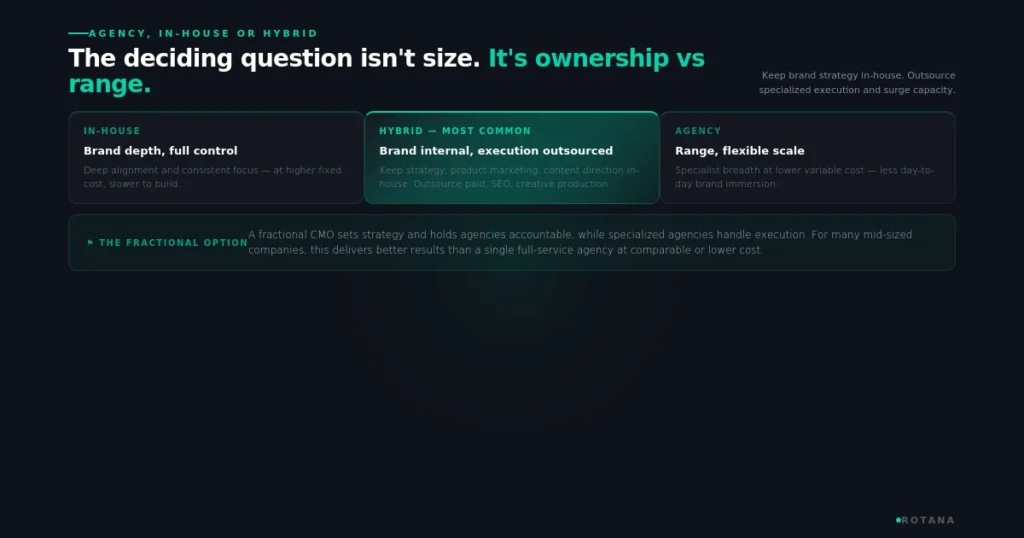
As a rough guide, smaller businesses almost always benefit from an agency, since one retainer buys a full team for the cost of a single hire. Mid-market companies often run a hybrid with an internal lead plus an agency for execution. Larger companies can justify full in-house teams but frequently retain agencies for specialized channels. The deciding question is not company size alone. It is whether you need ownership and brand depth or range and flexible scale.
How to choose a good agency
Green flags
The best signal is that an agency can articulate its process before you sign, name the specific people who will work on your account and tie its work to revenue rather than vanity metrics. A mid-tier boutique with proven case studies in your space often outperforms a large agency where your retainer is a rounding number and your account goes to junior staff. Ask for relevant results and references and start with a smaller scoped engagement to test fit before committing long term.
Red flags
Watch for agencies that say they “do everything” but will not specify what you get, that will not put hours, deliverables and assigned people in writing or that resist defining scope. Bait-and-switch on the team, where senior people pitch and junior people deliver, is common. If an agency markets itself as AI-powered, ask exactly what is automated, what a human strategist still does and how that split affects quality and turnaround. Vague answers are the warning. The work I do at Rotana through our SEO consultancy service is built on the opposite of that: a clear process and reporting tied to outcomes.
What I would tell a business owner
If you are weighing whether to hire a marketing agency, decide three things first. Name the outcome you need and the timeframe. Decide whether the need is ongoing or a defined project, which points you to a retainer or project pricing. Then choose between range and ownership: an agency for breadth and speed, in-house for control and brand depth or a hybrid for both. Match the agency type to your bottleneck, get scope and team in writing and judge any agency on results rather than promises.
A marketing agency, at its best, is a partner that brings a full team of specialists, structured processes and outside perspective to grow your business faster than you could alone. The wrong one drains budget on activity. The right one returns many times its fee. If you want to see how I think about this from the inside, my guide on how to start a digital marketing agency shows the model from the founder’s side and my roundup of performance marketing agencies shows what strong ones look like. Book a call through the link on the site.
Frequently asked questions
What does a marketing agency actually do?
A marketing agency plans and executes the marketing that gets a business found, chosen and remembered, giving you access to a full team of specialists without hiring them directly. Depending on the agency, that work spans strategy, SEO, paid advertising, content, social media, web design, creative and analytics. Because it serves many clients, an agency brings structured processes and cross-industry expertise that a small in-house team usually cannot match, along with the ability to scale effort up or down as needs change.
How much does a marketing agency cost?
Most agency retainers run $3,000 to $25,000 a month depending on agency tier, services and company size, though local and small-business packages can start around $1,000 to $5,000 and large enterprise engagements reach $40,000 to $100,000 or more. Agencies charge through five common models: retainer, hourly ($75 to $400+ an hour), project-based, value-based and performance-based, often blended into hybrids. The figure matters less than the value delivered, so evaluate cost against the revenue or pipeline the agency produces.
What are the different types of marketing agencies?
They fall into two broad shapes. Full-service agencies cover most disciplines under one roof, offering convenience and integrated thinking. Specialist agencies go deep in one area, such as SEO, PPC and paid media, social media, content, branding and creative, PR or growth and performance marketing. Specialists deliver more depth in their lane, while full-service agencies provide breadth and coordination. Many companies use a hybrid, pairing a lead agency with specialists for specific channels.
Is it better to hire a marketing agency or build an in-house team?
It depends on what you need. In-house teams offer deep brand alignment, full control and consistent focus at a higher fixed cost and slower to build. Agencies offer specialist range and flexible scale at lower variable cost, with less brand immersion. A common solution is a hybrid: keep brand strategy, product marketing and content direction in-house, then outsource execution like paid media, SEO and creative. Smaller businesses usually benefit most from an agency, since one retainer buys a full team.
How do I choose a good marketing agency?
Look for an agency that can explain its process before you sign, names the specific people who will work on your account and ties its work to revenue rather than vanity metrics. Ask for relevant case studies and references and start with a smaller scoped engagement to test fit. Watch for red flags: refusing to define scope, vague “we do everything” claims, bait-and-switch on the team or unclear answers about what is actually automated versus done by a human.