

Criminal defense marketing is the practice of getting your firm in front of people the moment they need a defense attorney, then converting that urgent search into a retained case. It is unlike any other legal marketing. Your prospect is in crisis. They were arrested last night or charged this morning. They are searching from a phone at an hour no office is open. Over 85% of people search online before hiring an attorney. For criminal defense, that search is immediate, emotional and local.
I run an SEO-led growth agency, so I see what separates the firms that capture these cases from the ones that watch them go down the street. It is rarely the biggest budget. It is the firm that shows up first, earns trust in seconds and answers the phone at 2 AM. This guide breaks down the system that does that, the channels that fit the urgency, the ethics rules you cannot break and the intake that turns a frantic call into a signed client.
Why criminal defense marketing is different
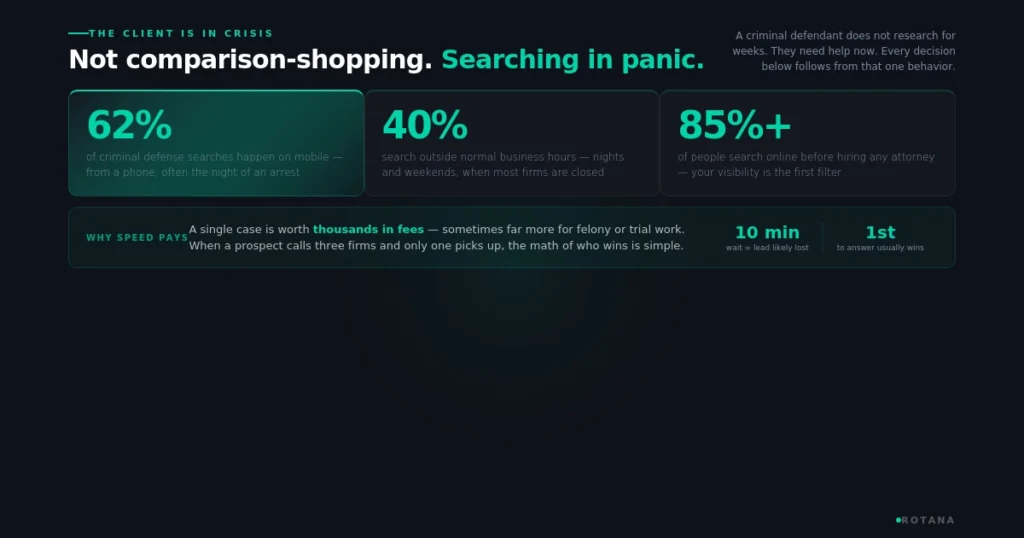
The client is in crisis, not comparison-shopping
Someone facing a personal injury claim might research for weeks. A criminal defendant does not. They need help now. Research shows about 62% of criminal defense searches happen on mobile. Roughly 40% of people facing charges search outside normal business hours. They are scared. They want to find a lawyer, trust that lawyer fast and call. That single behavior shapes every decision below. Your job is to be visible, credible and reachable at the exact moment of panic.
The economics reward speed
A single criminal case can be worth thousands of dollars in fees, sometimes far more for felony or trial work. That value means you can afford to compete for visibility that other practice areas cannot. It also means a lost lead is expensive. When a prospect calls three firms and only one picks up, the math of who wins is simple. Speed is not a nicety in this practice. It is the difference between a signed case and a missed one.
The channels that fit the urgency
Criminal defense marketing works as a system, not a single tactic. Each channel does a different job across the timeline of a case search.
Local Service Ads for instant, pay-per-lead visibility
Google Local Service Ads sit at the very top of the results with your reviews and a tap-to-call button. They run on a pay-per-lead model, so you pay for an actual contact rather than a click. You can dispute leads that fall outside your targeting. For criminal defense, where the searcher wants to call immediately, this format is hard to beat. Reported cost per lead runs roughly $150 to $250, which is reasonable against a case worth thousands. In markets with little LSA competition, these can fill an intake calendar fast.
Google Ads for immediate high-intent traffic
Paid search captures the person typing “DUI lawyer near me” right now. The catch is cost. Criminal defense keywords are among the most expensive on Google, with terms like “DUI lawyer” reaching $50 to $150 per click in competitive cities. That price demands tight management: precise geographic targeting, dedicated landing pages for each charge type and ad copy that respects bar rules. Run well, paid search produces cases within the first month. Run loosely, it burns the budget on unqualified clicks.
Local SEO for durable, lower-cost visibility
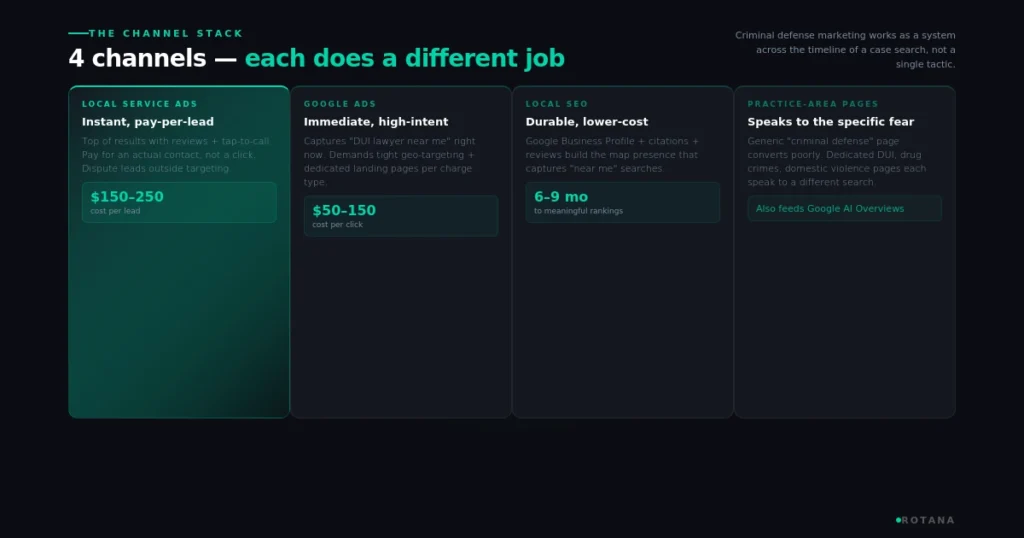
SEO is the long game that lowers your dependence on paid channels over time. For criminal defense, local SEO matters most. Google’s “near me” algorithm weighs your proximity to the searcher and your firm’s relevance to the local court system. A complete Google Business Profile, consistent citations and steady reviews build the map presence that captures “criminal lawyer near me.” Competitive markets take six to nine months of consistent work to see real ranking gains, so SEO is the asset you build while ads carry the early load.
Practice-area pages and educational content
A single generic “criminal defense” page converts poorly. Prospects want to see that you handle their specific charge. Dedicated pages for DUI, drug crimes, domestic violence, assault and federal cases each speak to a different fear and a different search. Educational content answering questions like what happens after an arrest builds trust and earns rankings, while staying inside ethics rules. This content also feeds Google AI Overviews, which increasingly answer legal questions before a click. Email keeps past clients and referral sources warm too, a topic I cover in email marketing for lawyers.
The ethics rules you cannot break
Criminal defense marketing operates inside strict state bar advertising rules. Breaking them risks discipline, not just a wasted campaign. The rules vary by state, so confirm your own, but the principles are consistent.
No guarantees or misleading claims
Most state bars prohibit guarantees about case outcomes, specific promises of results and testimonials that could mislead a prospect about their likely result. You cannot imply you always win. Your ad copy and landing pages must persuade without crossing into promises. You can describe your experience, your education and your certifications, which is where credibility legitimately comes from.
How to present results without violating rules
Your track record is your strongest asset, so present it carefully. Anonymize case results rather than naming clients. A line like “Possession charge dismissed, Travis County” communicates capability without exposing anyone. Data points such as “reduced from felony to misdemeanor” show tangible value. This approach keeps your proven results persuasive while staying inside the ethics boundary.
Reviews and reputation, done compliantly
Criminal defense clients are entrusting their freedom to you, so reputation weighs heavily. Reviews are both a trust signal and a ranking factor. Encourage satisfied clients to leave honest reviews, respond professionally to all of them and never incentivize reviews in ways your bar prohibits. Velocity and relevance matter more than a stale total. A handful of recent reviews mentioning specific charges outperforms a pile of old generic ones.
Intake is where cases are won or lost

Speed to lead decides the outcome
Marketing gets the phone to ring. Intake decides whether the caller becomes a client. A lead that waits ten minutes is often a lead lost, because a defendant in crisis simply calls the next firm. Aim to answer within minutes during the day and within the hour for form fills. After-hours coverage is not optional in a practice where 40% of prospects search at night. A live answer at midnight wins cases your competitors never knew they lost.
Build an intake system, not a voicemail
Treat intake as a designed process. Confirm urgency, jurisdiction and charge type. Capture the essentials. Move qualified callers straight to a consultation or a live transfer. Many firms blame marketing for poor conversion when the real gap is intake. Fixing intake is often the single highest-return move a firm can make, because it lifts the return on every dollar already spent on visibility.
Match marketing promises to intake reality
When your marketing promises one thing and your intake team says another, prospects feel it and trust drops. Align your messaging, your expectations and your intake scripts. A prospect who arrives expecting a free consultation should reach someone ready to provide exactly that. Consistency across the journey converts more of the leads your marketing worked to create.
Choose better cases, not just more leads
More calls is not the goal. Better cases is. Many firms run broad campaigns that produce volume but pull them toward work outside their ideal profile, which wastes intake time and dilutes positioning. The firms that win in 2026 are not the ones spending the most. They are the ones operating a system where visibility, messaging, intake and case selection work together. Targeted messaging and local SEO attract the people actively searching for the exact representation you want to provide. A focused strategy lets a smaller firm compete with a larger one by owning a clear niche, whether that is DUI defense, federal cases or a specific county.
What I would do first
If you run a criminal defense firm and you are starting from a weak position, do these things in order. Claim and complete your Google Business Profile, then start a steady review habit. Launch Local Service Ads to capture pay-per-lead calls immediately. Build dedicated pages for your top three charge types. Fix intake so every call is answered fast, day or night. Then layer in SEO and educational content for durable, lower-cost visibility over the following months.
Criminal defense marketing rewards the firm that shows up first, earns trust instantly and answers when it matters. The system matters more than the spend. If you want that system built and tuned to your market, that is the work I do at Rotana through our SEO consultancy service. The broader lead-capture mechanics sit in my guide to email marketing lead generation. Book a call through the link on the site.
Frequently asked questions
What is the best marketing channel for criminal defense attorneys?
For immediate cases, Google Local Service Ads and Google Ads work fastest, since they capture high-urgency searches the moment someone needs a lawyer. Local Service Ads are especially strong because they run on a pay-per-lead model with reviews shown at the top of results. For durable, lower-cost visibility, local SEO and practice-area content build over six to nine months. Most firms run a hybrid: paid channels for immediate flow plus SEO for long-term authority.
How much does criminal defense marketing cost?
Costs vary by market and channel. Criminal defense keywords are among the most expensive in Google Ads, with terms like “DUI lawyer” reaching $50 to $150 per click in competitive cities, while Local Service Ads report a cost per lead around $150 to $250. Against a single case worth thousands of dollars in fees, those figures can deliver strong returns when intake converts the leads. Set budgets against cost per retained case, not cost per click.
What can criminal defense lawyers not say in their marketing?
State bar rules generally prohibit guaranteeing case outcomes, making specific promises of results and using testimonials that could mislead prospects about likely outcomes. You also cannot make false or deceptive claims. You can describe your experience, education and certifications. You can also present anonymized, factual case results such as a charge being dismissed or reduced. Always confirm your own state’s rules, since they vary by jurisdiction.
How long does SEO take for a criminal defense law firm?
In competitive markets, expect six to nine months of consistent effort before meaningful ranking gains appear for terms like “criminal defense lawyer near me.” Local SEO can show earlier movement through a well-optimized Google Business Profile and reviews. Because SEO takes time, most firms pair it with Local Service Ads and Google Ads for immediate visibility, then lean more on organic search as rankings strengthen and reduce paid dependence.
Why is intake so important in criminal defense marketing?
Because criminal defendants are in crisis and rarely wait. A lead that is not answered within minutes often calls the next firm, so slow intake wastes the money spent generating the call. Roughly 40% of prospects search outside business hours, which makes after-hours coverage essential. Many firms blame marketing for poor results when the real issue is intake, so fixing response speed is frequently the highest-return improvement a firm can make.