
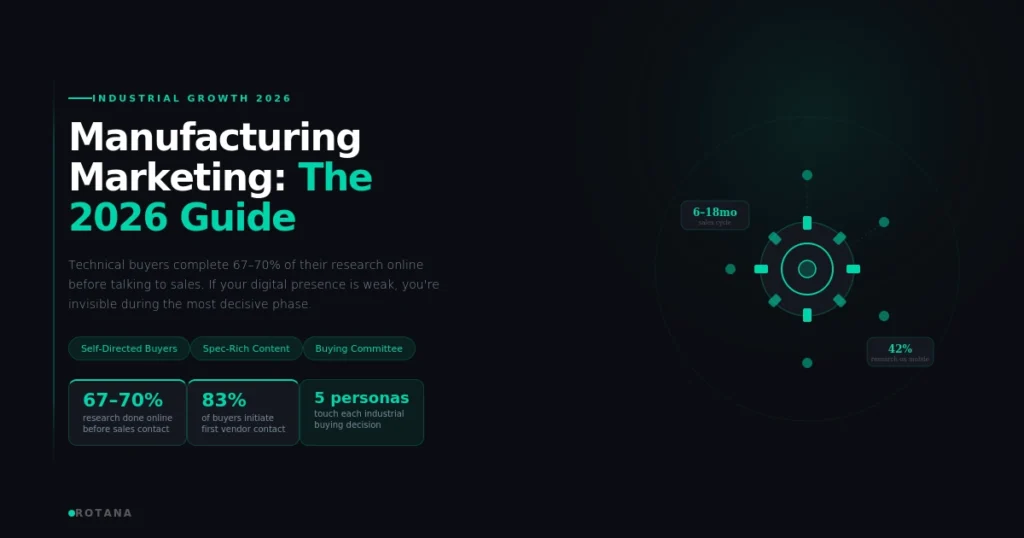
Manufacturing marketing is the practice of helping industrial companies get found, evaluated and chosen by technical buyers who research extensively before they ever contact sales. It has changed more in the last few years than in the prior twenty. Today a manufacturing buyer completes around 67% to 70% of their research online before speaking to a rep. If your digital presence is weak, you are invisible during the most decisive phase of a buying cycle that can run six to eighteen months.
I run an SEO-led growth agency. The industrial sector is where I see the widest gap between how buyers actually behave and how companies still market. The old model of a distributor network, a trade show circuit and a spreadsheet of leads is not dead. It is just no longer enough on its own. This guide lays out what works in 2026: how to reach self-directed technical buyers, how to market to the whole buying committee and how to measure marketing against pipeline rather than vanity metrics.
The buyer changed, so the playbook must change
Buyers research before they ever call
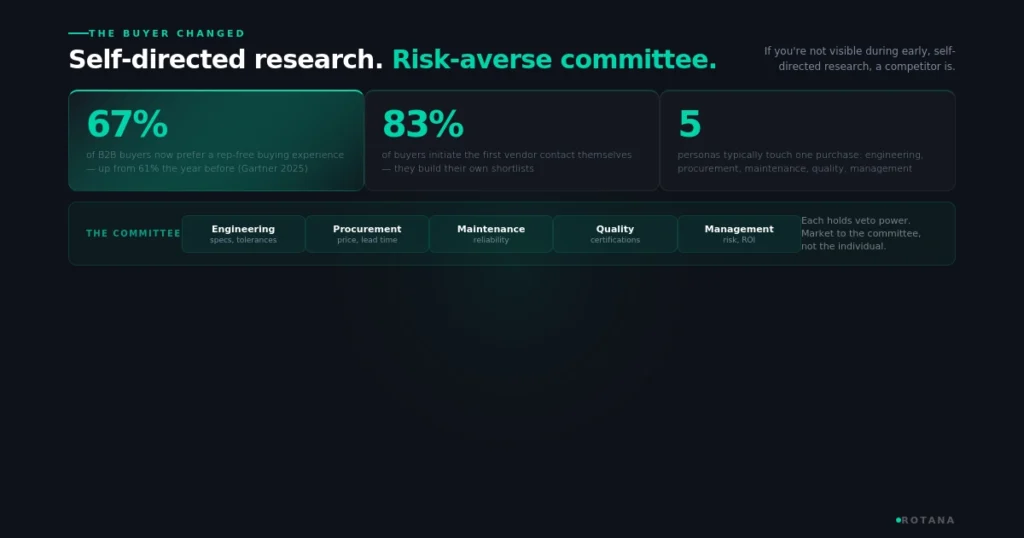
The single shift behind every trend in industrial marketing is the buyer. A 2025 Gartner survey found 67% of B2B buyers now prefer a rep-free buying experience, up from 61% the year before. Around 83% of buyers initiate the first vendor contact themselves. They build their own shortlists, evaluate suppliers on their own terms and reach out only when they are close to a decision. If your company is not visible during that early, self-directed research, a competitor is.
You are selling to a committee, not a person
A single industrial purchase rarely involves one decision-maker. In many cases a product touches five buyer personas: engineering, procurement, maintenance, quality and management. Each cares about something different. Procurement focuses on price, lead times and vendor reliability. Engineers need specifications, tolerances and performance data. Each of them holds veto power. The engineering manager may be your main contact, but procurement, finance and operations can all kill the deal. You have to market to the committee, not the individual.
Buyers are risk-averse, so reduce the risk
When budgets tighten, buyers do not get more adventurous. They gravitate toward the supplier that feels lowest-risk, which is usually the one with the clearest documentation, the strongest proof of performance and the simplest evaluation path. In an industry where the cost of a wrong decision is high, credibility beats creativity every time. Every element of your marketing should reduce perceived risk through proof, specifications and trustworthy messaging.
Your website is the primary sales tool now
Spec-rich content wins evaluations
Industrial buyers do not search for your brand. They search for what they need: “ISO certified sheet metal fabrication,” “CNC machined parts manufacturer,” “bulk industrial fasteners supplier.” Your product pages have to be built around those queries, not your internal catalog structure. The content that wins is spec-rich. Materials, tolerances, certifications, capacity, lead times. A page that simply says you make precision components gives a buyer nothing to evaluate. A page with full specifications lets them shortlist you before they ever make contact.
Self-service tools support the evaluation workflow
Buyers are selecting specifications, building bills of materials and shortlisting suppliers long before they speak to a rep. If your website cannot support that workflow, it becomes invisible during the first 70% of the decision. The features that separate a site that supports buying from one that merely advertises are configurators, spec selectors, CAD file libraries, ROI calculators and clear application documentation. A counterintuitive point worth noting: the right kind of friction can raise conversion. Forcing a specification confirmation or offering an engineer consultation at a moment of uncertainty builds confidence rather than creating a barrier.
Technical SEO is the foundation
None of that content ranks if the site is slow or poorly structured. Technical SEO is the base layer. Fast load times, clean structure, mobile responsiveness, since about 42% of B2B buyers use mobile during research. Local SEO matters too for regional or distributor-focused searches, including a well-maintained Google Business Profile. Building SEO content clusters around your product categories compounds search authority over time, which is far more durable than isolated blog posts. This is the work I focus on through our SEO consultancy service.
The channels that move industrial pipeline
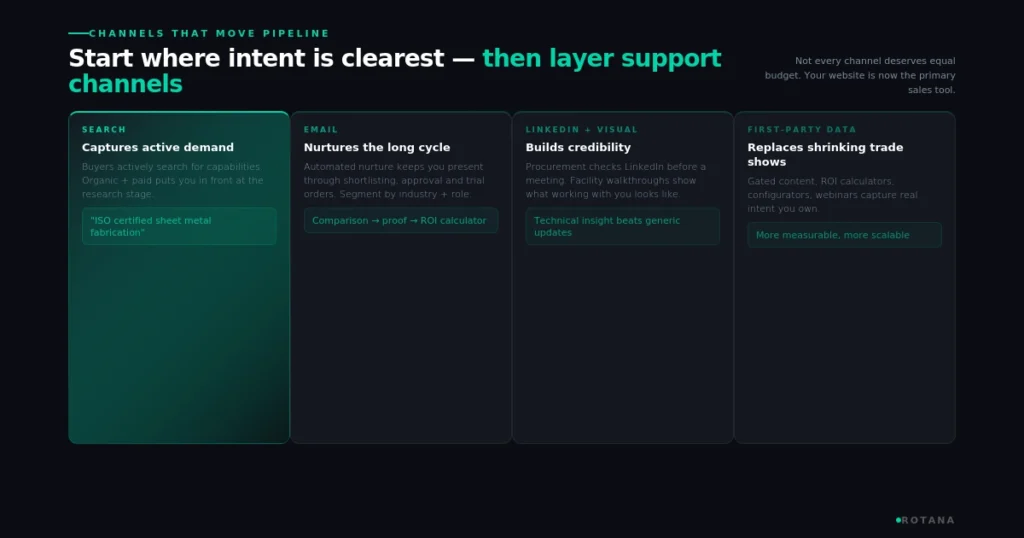
Not every channel deserves equal budget. Start where buyer intent is clearest, then layer in support channels.
Search captures active demand
Organic and paid search work because industrial buyers actively look for suppliers, capabilities and problem-specific solutions. Ranking for technical queries puts you in front of in-market buyers at the research stage. Paid search supports high-intent terms while organic visibility builds. Content that answers real buyer questions, like how to reduce downtime in conveyor systems, pulls in buyers your field reps would never have found.
Email nurtures the long cycle
Email matters more than most manufacturers think. In a cycle that runs many months, automated nurture keeps you present through shortlisting, internal approval and trial orders. Segment by industry, region and buyer type, since a maintenance engineer and a procurement lead need different messages. Progressive content flows that move from product comparison to technical proof to ROI calculator reduce friction at every stage. I cover the mechanics in depth in B2B email marketing.
LinkedIn and social build credibility
LinkedIn builds account awareness and credibility, especially when your team shares useful technical insight rather than generic company updates. Procurement managers check your LinkedIn before agreeing to a meeting. Visual platforms have a quiet role too. Facility walkthroughs, machinery running and quality-control footage show a buyer what working with you looks like, which moves the decision your way when they cannot visit your plant in person.
The shift to first-party data
Privacy regulation is making third-party industrial advertising less reliable. Manufacturers are shifting to first-party data sources: gated technical content, ROI calculators, webinars, configurators and diagnostic tools. These capture real intent from real buyers and feed a nurture program you own. As trade-show budgets shrink, that digital capture becomes the more measurable, scalable engine.
Content for the committee and the cycle
Map content to role and stage
Because a single product interests an engineer in one country and a procurement lead in another, build a content map by buying stage and role. Technical posts answer procurement questions. Case studies from similar clients reduce risk. Spec sheets and CAD files serve engineers. Application guides serve operations. The goal is to have an answer ready for every member of the committee at every stage, so the evaluation keeps moving toward you.
Enable your distributors
Many manufacturers sell through dealers, distributors and integrators. In 2026 those partner ecosystems become revenue engines when you enable them well. Distributor content templates let partners replicate your campaigns locally with editable copy, images and video. A contrarian point: many manufacturers should narrow their distributor roster in some segments. Fewer partners with better enablement and better data sharing can outperform a broad network with inconsistent execution.
Measure pipeline, not impressions
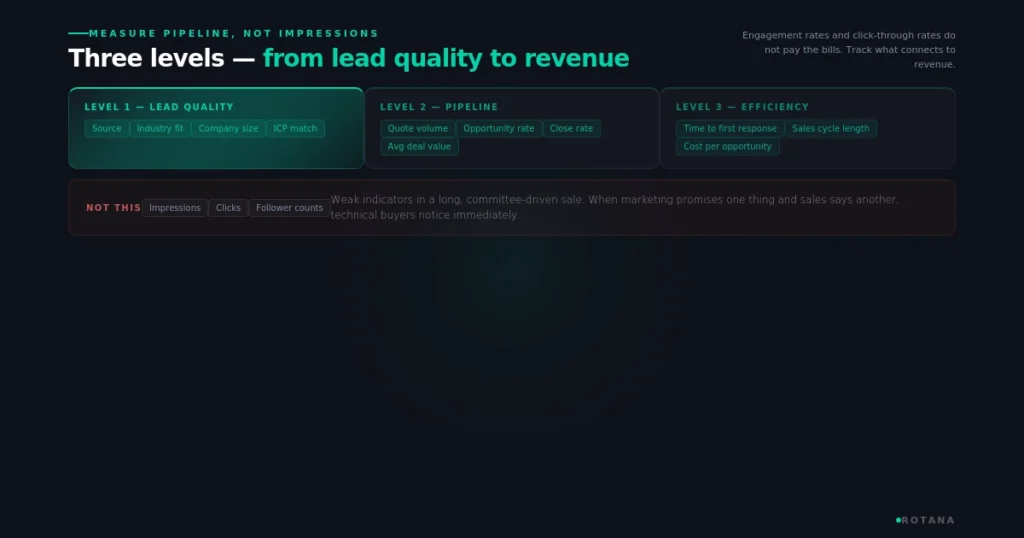
The fastest way to waste an industrial marketing budget is to measure the wrong things. Engagement rates and click-through rates do not pay the bills. Track metrics that connect to revenue: marketing-qualified leads, sales-qualified leads, pipeline contribution, customer acquisition cost and marketing-influenced revenue. Measure across three levels. Lead quality first: source, industry fit, company size and whether the lead matched your ideal customer profile. Then pipeline: quote volume, opportunity rate, close rate and average deal value. Finally efficiency: time to first response, sales cycle length and cost per qualified opportunity. Sales and marketing alignment is not optional here. When marketing promises one thing and sales says another, technical buyers notice immediately.
What I would do first
If you run a manufacturing company early in its digital transformation, start in this order. Rebuild your top product pages around the technical queries buyers actually search, with full specifications on each. Fix technical SEO so those pages can rank. Add one self-service tool, a configurator or an ROI calculator, to support evaluation and capture first-party data. Build a nurture email sequence for the long cycle. Then set up pipeline-based reporting so you measure what matters. Start with one channel, measure it, then expand.
Manufacturing marketing rewards the company that shows up early in the research, reduces the buyer’s risk and markets to the whole committee across a long cycle. Market leadership in many industrial categories is still up for grabs. The cost to claim it today is a fraction of what catching up will cost in three years. If you want that system built, that is the work I do at Rotana. The lead-capture foundation sits in my guide to email marketing lead generation. Book a call through the link on the site.
Frequently asked questions
What is manufacturing marketing?
Manufacturing marketing is the practice of attracting, educating and converting industrial buyers through digital and traditional channels suited to long, technical, committee-driven sales cycles. It differs from consumer marketing because buyers research extensively before contacting sales, multiple stakeholders influence each decision and the content must be specification-rich rather than emotional. The goal is to be visible and credible during the early research phase, then nurture the buyer through a cycle that often runs six to eighteen months.
How do manufacturers generate leads online in 2026?
The strongest sources are organic and paid search for high-intent technical queries, spec-rich product pages that support buyer evaluation, plus first-party data tools like configurators, ROI calculators and gated technical content. Email nurtures leads through the long cycle, while LinkedIn builds credibility with procurement and engineering. Because around 70% of the buying journey happens before a rep is contacted, the priority is being discoverable and useful during that self-directed research.
Why are manufacturing sales cycles so long?
Industrial purchases are high-value, technical and involve a buying committee of engineers, procurement, maintenance, quality and management, each with veto power. Buyers shortlist suppliers, confirm specifications, run internal approvals and often place trial orders before committing, which stretches cycles to six to eighteen months. Marketing cannot shortcut that process, but the right content reduces friction at each stage and keeps your company in the consideration set until the decision is made.
What content works best for industrial and manufacturing companies?
Spec-rich, technical content performs best: product pages with materials, tolerances, certifications and lead times, plus CAD files, application guides, case studies and self-service tools like configurators and ROI calculators. This content matches how technical buyers evaluate suppliers and feeds both search rankings and AI answer engines. Generic, brochure-style claims fall flat with engineers who need data, so depth and accuracy matter more than polish.
What marketing metrics should manufacturers track?
Track metrics tied to revenue rather than activity. Start with lead quality, including source and fit to your ideal customer profile. Then measure pipeline contribution, quote volume, opportunity rate, close rate and average deal value. Finally track efficiency through time to first response, sales cycle length and cost per qualified opportunity. Impressions, clicks and follower counts are weak indicators in a long, committee-driven sale, so they should never be the primary measure.