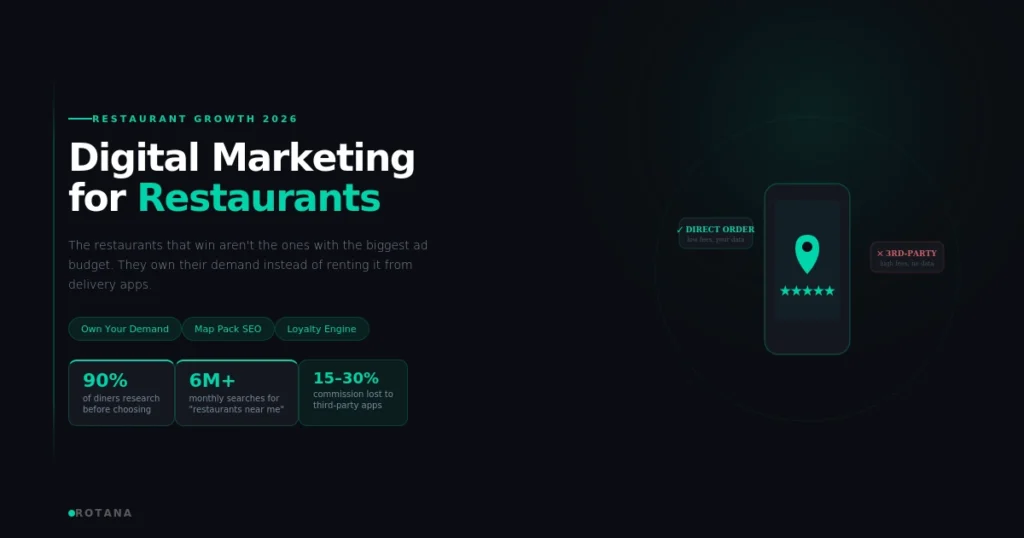
Digital marketing for restaurants is the work of getting found by hungry people nearby, turning that discovery into an order or a reservation, then bringing those diners back often enough to be profitable. It runs on local search, reputation and owned customer relationships, not billboards. Roughly 90% of diners research a restaurant before choosing where to eat and “restaurants near me” alone drives more than 6 million searches a month. The restaurants that win are not the ones with the biggest ad budget. They are the ones that own their demand instead of renting it from delivery apps.
I run an SEO-led growth agency, so I see independents hand 30% of every order to third-party platforms while their own Google listing sits half-finished. Restaurant marketing rewards focus and ownership. This guide covers the full system: local SEO as demand capture, the first-party versus third-party battle that decides your margins, reviews as a dual-purpose engine, the dine-in versus off-premise split and the loyalty that turns a first visit into a regular.
Why restaurant marketing is different
It is local, visual and decided fast
A diner choosing where to eat decides quickly, often on a phone, within a few miles of where they are. They eat with their eyes, scanning photos and reviews before they ever read a menu. That makes restaurant marketing intensely local and visual, where a complete Google listing with great photos and strong reviews beats a clever campaign. Speed matters too: a site that loads in one second converts roughly three times better than one taking five seconds, since a hungry person will not wait.
Marketing scales operations, it cannot replace them
The best marketing you can do is run a restaurant people genuinely want to talk about. Marketing amplifies the guest experience, it does not fix a slow kitchen or inconsistent food. Reviews, loyalty and word of mouth all compound on operational excellence, so the system below works only when the fundamentals are solid. Keep that order in mind: get the experience right, then make it visible.
Local SEO is demand capture
Win the Map Pack and Google Business Profile
Local SEO is not branding or awareness. It is demand capture, since someone searching “best tacos downtown” or “pizza open now” is deciding where to eat right now. Google dominates restaurant discovery, with a majority of diners finding restaurants there. Your Google Business Profile is the storefront: keep it complete with the right category, current hours, menus, strong photos and a direct ordering link, post updates regularly and respond to reviews. If you are not in the Map Pack for local food searches, you are invisible at the exact moment of decision. This local foundation is the work I focus on through our SEO consultancy service.
Make the website fast and the menu crawlable
Your website is the hub every ad, post and listing leads back to and often the first impression. It must load fast, work on mobile, show the menu as real crawlable text rather than a PDF and make ordering or reserving effortless. Use conversational, local language like cuisine plus neighborhood, since that is how people search. A clean, fast site that converts traffic into orders and into owned customer data, is worth more than any single campaign, since it works every day without ongoing spend.
Own your demand: first-party versus third-party
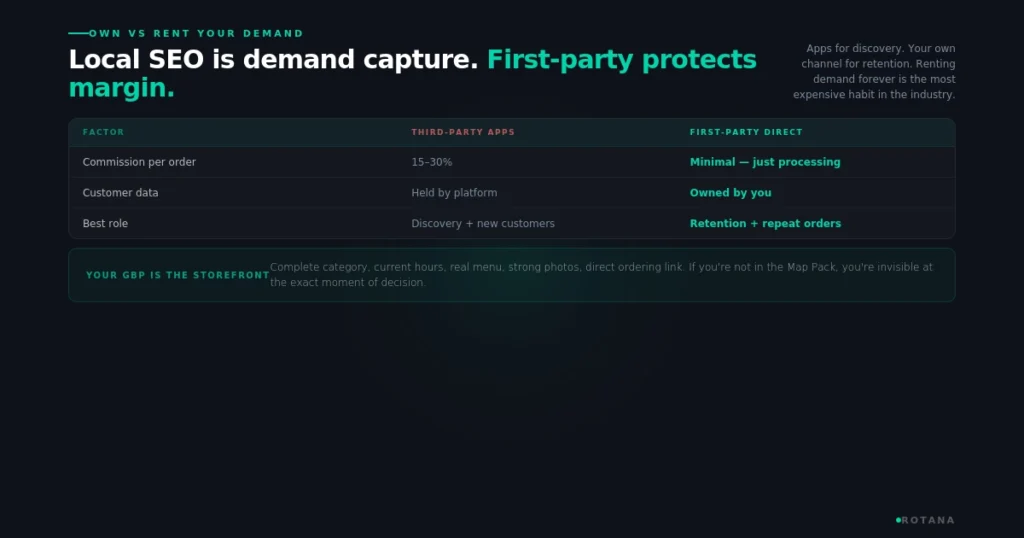
The defining strategic choice in restaurant marketing is whether you own your customer relationships or rent them. Third-party delivery apps drive discovery and volume but take a heavy commission and keep the customer data. Your own channels cost less per order and build a customer list you control. The smartest operators use both deliberately, as the table shows.
| Factor | Third-party apps | First-party (direct) |
|---|---|---|
| Commission per order | Roughly 15% to 30% | Minimal, just payment processing |
| Customer data | Held by the platform | Owned by the restaurant |
| Margin | Compressed by fees | Higher per order |
| Best role | Discovery and new-customer acquisition | Retention and repeat orders |
The winning play is to treat third-party marketplaces as a customer-acquisition channel, then move repeat business to your own direct ordering where margins are far better. Steer customers to direct channels with a prominent ordering link on your Google Business Profile and website, since commission fees quietly eat your margin year after year if you do not. Renting demand forever is the most expensive habit in the industry. Owning it is how independents out-earn their order volume.
Reviews are a dual-purpose engine
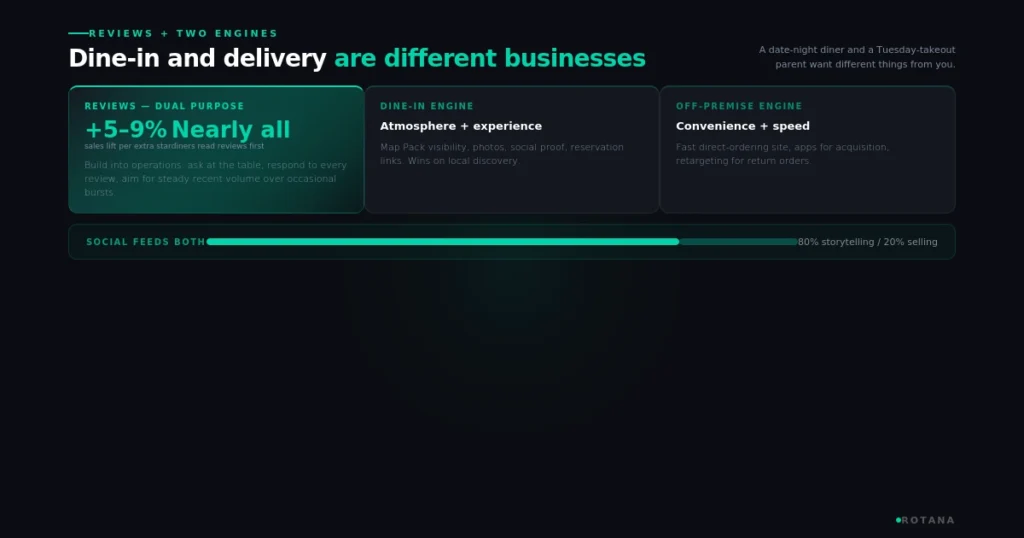
Reviews shape both whether you rank and whether a diner chooses you. Nearly all consumers read reviews before picking a local restaurant and academic research shows one additional star can lift sales 5% to 9% for an independent. Reviews also feed local rankings and the AI-generated answers diners increasingly see. Build review generation into operations: ask happy guests at the table or through a follow-up, respond to every review professionally and feature the best ones on your site and social. Aim for steady, recent volume rather than occasional bursts, since recency and quantity both signal trust to Google and to diners.
Run two engines: dine-in and off-premise
They are different businesses
Most restaurants market dine-in and delivery as one thing, which leaves money on the table. Dine-in and reservations reward atmosphere, experience and local discovery, so they lean on Map Pack visibility, photos, social proof and reservation links. Off-premise ordering, delivery and takeout reward convenience and speed, so they lean on a fast direct-ordering site, the apps for acquisition and retargeting. A diner choosing a date-night table and a parent ordering Tuesday takeout are different people with different needs, so give each its own message and path.
Social media feeds both
Short-form video on Instagram and TikTok is the easiest way to get discovered now, since people decide with their eyes and a majority use social to choose where to eat. You do not need a production team, just consistent clips of food being made and plated. Keep it culture over promotion, roughly 80% storytelling to 20% selling, since people follow personality, not ads. Social builds the awareness that feeds both your dining room and your delivery orders, then your website and listings convert that attention.
Loyalty is the profit engine
Acquiring a new diner keeps getting more expensive, so retention is where the profit is. Email and SMS are the most reliable repeat-visit engines, cheap to run and not hostage to social algorithms, with email returning a strong multiple on every dollar spent. A simple “we miss you” message to lapsed diners can reactivate a meaningful share of them. Capture customer data at every touchpoint, through online ordering, a sign-up incentive or the POS, then segment so each message feels personal. Points or visit-based rewards integrated into ordering create frictionless repeat visits. When loyalty, online ordering, website and messaging connect, you have a marketing ecosystem rather than scattered promotions. The owned-audience play is the same one I detail in my guides to restaurant email marketing and email marketing lead generation.
Paid ads, tightly targeted
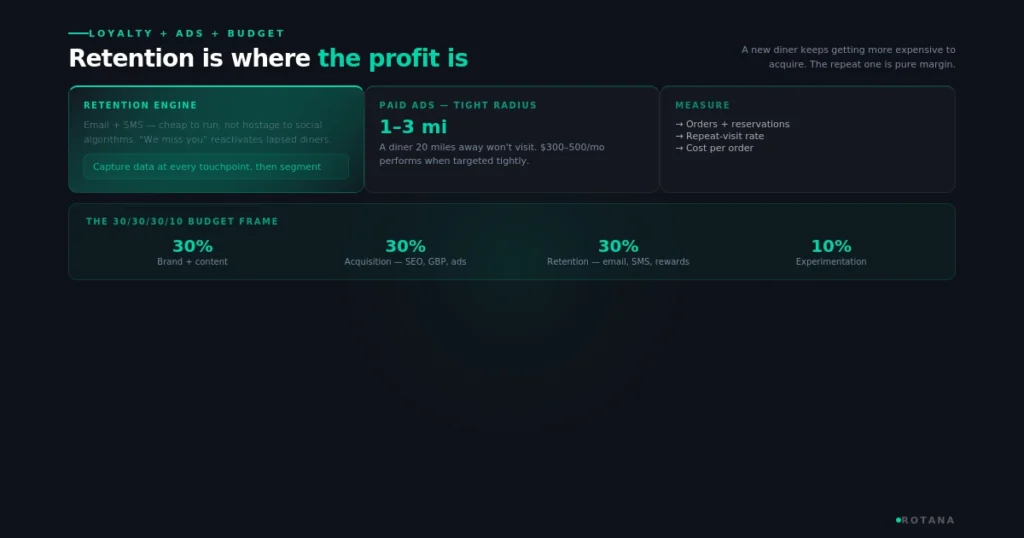
Paid advertising works for restaurants when it is focused, not sprayed. Google Ads captures high-intent searchers ready to eat, while Meta ads on Instagram and Facebook build awareness and promote events or specials to a local audience. The discipline is geography: draw a 1 to 3 mile radius around your location rather than running city-wide, since a diner 20 miles away will not visit. Even a modest $300 to $500 a month performs when targeted well and retargeting people who already visited your site converts far better than cold reach. Measure cost per order and adjust weekly.
Measure orders, reservations and repeat visits
The point is filled tables and profitable orders, so measure what maps to revenue, not vanity metrics. Track orders, reservations, repeat-visit rate, average order value and customer lifetime value, plus cost per order on paid channels. A useful budget frame is the 30/30/30/10 split: roughly 30% to brand and content, 30% to acquisition through SEO, Google Business Profile and ads, 30% to retention through email, SMS and rewards and 10% to experimentation. Set up basic analytics, watch which channels drive actual orders and reservations, then reinvest in what works. A restaurant that knows its cost per order and repeat rate makes far better decisions than one watching follower counts.
What I would do first
If you run a restaurant and want more orders, start in this order. Claim and fully optimize your Google Business Profile with the right category, photos, menu and a direct ordering link, then win the Map Pack. Fix your website to load fast and convert into orders and owned customer data. Build a steady review habit, since reviews drive both ranking and choice. Move repeat business off third-party apps onto your own direct ordering. Stand up email, SMS and a simple loyalty program for retention. Then run tightly targeted local ads and measure cost per order.
Restaurant marketing rewards the operator who captures local demand, owns the customer relationship and brings diners back. The system beats the spend and owning your demand beats renting it. If you want that system built and tuned to your market, that is the work I do at Rotana. Book a call through the link on the site.
Frequently asked questions
What is the best digital marketing strategy for restaurants?
Start with local SEO and an optimized Google Business Profile to capture diners searching nearby, since that is demand capture at the moment of decision. Pair it with a fast, conversion-focused website, a steady review habit and short-form social video for discovery. Then move repeat business onto your own direct-ordering channels and build email, SMS and loyalty for retention. No single tactic wins. The restaurants that grow run these as one connected system and own their customer relationships instead of renting them from delivery apps.
Should restaurants use third-party delivery apps or their own ordering?
Both, but with clear roles. Third-party apps like the major delivery platforms are strong for discovery and acquiring new customers, but they take roughly 15% to 30% commission and keep the customer data. Your own direct-ordering channel costs far less per order and builds a customer list you control. The smartest operators use apps to acquire new diners, then steer repeat business to direct ordering through a prominent link on their site and Google Business Profile, protecting margin that commissions would otherwise erode year after year.
How important are online reviews for restaurants?
They are critical. Nearly all consumers read reviews before choosing a restaurant and research shows one additional star can lift an independent restaurant’s sales by 5% to 9%. Reviews also influence local search rankings and the AI-generated answers diners increasingly rely on, so they work as both a ranking factor and a conversion driver. Build review generation into your operations by asking happy guests, responding to every review and aiming for steady recent volume rather than occasional bursts, since recency and quantity both build trust.
How much should a restaurant spend on digital marketing?
Budgets vary, but a useful frame is the 30/30/30/10 split: roughly 30% to brand and content, 30% to customer acquisition through SEO, Google Business Profile and ads, 30% to retention through email, SMS and loyalty and 10% to experimentation. On paid ads, even a focused $300 to $500 a month can perform well when targeted within a 1 to 3 mile radius. What matters more than the amount is measuring cost per order and repeat-visit rate, then reinvesting in the channels that actually drive orders and reservations.
How can independent restaurants compete with chains?
By doing what chains cannot: being genuinely local, authentic and fast. You only need to reach people within a few miles, so concentrate on local SEO, a complete Google Business Profile, strong reviews and short-form social video that shows your food and personality. Build direct-ordering and a loyalty program to own customer relationships and drive repeat visits at higher margins than chains achieve through volume. Targeted automation and personalized messaging let an independent build loyalty that a large chain’s one-size campaigns cannot match.