
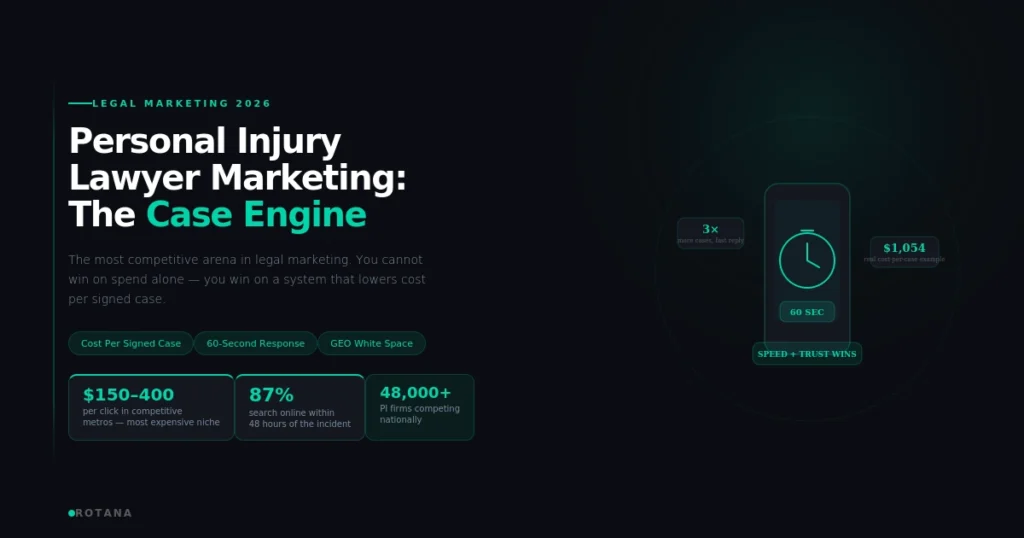
Personal injury lawyer marketing is the work of getting in front of accident victims at the moment they search, earning their trust fast, then converting that contact into a signed case at a cost the case value can absorb. It is the most competitive arena in legal marketing. Over 48,000 PI firms compete for a market worth tens of billions and in the biggest cities a single click on “car accident lawyer near me” can cost $150 to $400. The firms that win are not the ones spending the most. They are the ones who run a tight economic system and measure the only number that matters: cost per signed case.
I run an SEO-led growth agency, so I watch firms burn five figures a month on PPC with no idea which spend produces actual cases. PI marketing rewards discipline over budget. Roughly 87% of accident victims now begin their search online, most within 48 hours of the incident, so visibility at that moment is everything. This guide lays out the full case engine: the channels that compound, the real cost-per-case math, the intake leak that quietly wastes most of it, the case-type economics and the metric that should govern every decision.
Why personal injury marketing is its own arena
High value absorbs high acquisition cost
PI is unusual because the case values are large enough to justify expensive acquisition. A signed auto case can be worth tens of thousands of dollars, which is why firms tolerate $150-plus clicks that would bankrupt most local businesses. That same economics draws fierce competition, so the cost of every channel runs higher here than anywhere else in law. The implication is simple: you cannot win on spend alone, since a competitor will always outspend you. You win on a better-converting system that lowers cost per signed case.
Speed and trust decide the case
Accident victims are anxious, in pain and often shopping several firms at once. Two factors decide who they hire: how fast you respond and how much they trust you. Firms that reply to a new lead within about 60 seconds convert roughly three times more signed cases than those that wait even five to ten minutes. Trust comes from reviews, real case results presented compliantly and a credible, reassuring first contact. Speed plus trust beats budget, which is how a smaller firm with strong reviews and fast response outranks one spending ten times more.
The channels that compound
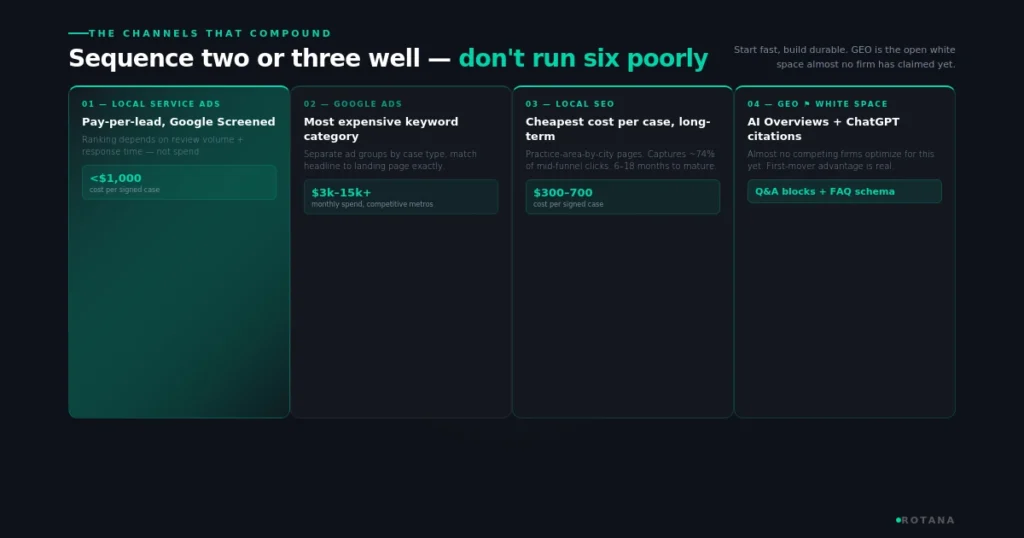
Six channels do the heavy lifting in 2026: Local Service Ads, Google Ads, local SEO and organic search, generative engine optimization and social ads. They compound when sequenced correctly, so running two or three well beats running six poorly.
Local Service Ads first
Local Service Ads sit at the very top of results with a Google Screened badge and charge per lead, not per click. For a frightened searcher, that vetted badge is reassuring and the pay-per-lead model protects budget. Two signals drive LSA ranking that most firms underinvest in: review volume and response time. Google tracks how fast you respond and rewards speed with better placement, which means faster response literally lowers your cost per lead. Start here for immediate cases while the slower channels build.
Google Ads and the cost reality
Standard Google Ads capture high-intent searches that LSAs do not cover, but PI is the most expensive keyword category in advertising. Clicks in competitive metros can exceed $150 to $400 for terms like “car accident lawyer near me,” with monthly ad spend commonly running $3,000 to $15,000 or more. The discipline that makes it work: separate ad groups by case type, match each ad’s headline to the landing page exactly and use negative keywords aggressively to filter out job seekers and people researching claims themselves. Without that structure, PPC drains money fast.
SEO as the cheapest long-term case source
Organic search produces the cheapest cost per case over time, capturing roughly 74% of clicks for mid-funnel PI queries. The architecture that ranks is specific: a dedicated page for each practice area in each city you serve, like “car accident lawyer in Phoenix,” plus informational content answering what victims ask early, such as how long a case takes or what a claim is worth. SEO takes 6 to 18 months in this competitive space, but it builds an asset that generates cases 24/7 at a fraction of paid cost. This compounding engine is the work I focus on through our SEO consultancy service.
GEO is the open white space
Generative engine optimization, getting cited in AI Overviews and tools like ChatGPT and Perplexity, is the biggest untapped opportunity in legal lead generation. Google’s AI Overviews now appear in a majority of PI-related searches, yet almost no competing firms optimize for them. Structuring content as clear question-and-answer blocks, adding FAQ schema and building real E-E-A-T signals positions your firm to be the one AI recommends. Moving early here is a first-mover advantage while rivals ignore it.
The real cost-per-case math
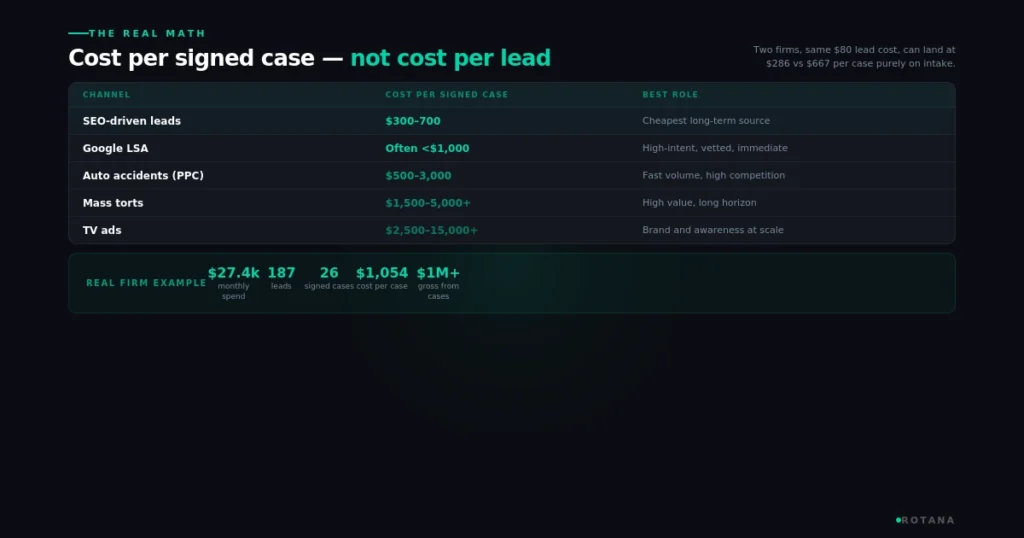
Cost per signed case, not cost per lead, is the only economic metric that matters. Two firms with identical lead costs can have wildly different case costs depending on how well intake converts. The figures below are rough industry benchmarks for cost per signed case by channel, useful for spotting where your mix is efficient and where it is bleeding.
| Channel | Typical cost per signed case | Best role |
|---|---|---|
| SEO-driven leads | $300 to $700 | Cheapest long-term case source |
| Google LSA | Often under $1,000 | High-intent, vetted, immediate |
| Auto accidents (PPC) | $500 to $3,000 | Fast volume, high competition |
| Mass torts | $1,500 to $5,000+ | High value, long horizon |
| TV ads | $2,500 to $15,000+ | Brand and awareness at scale |
The lesson in the table is that channels are not interchangeable. SEO and LSAs produce the lowest cost per case, which is why they anchor a healthy mix, while PPC and TV serve volume and brand at a higher price. A real example shows how case value absorbs cost: a Miami firm with an average case value of $42,000 spent $27,400 a month, generated 187 leads, converted 14% to retainers for 26 cases, landed a cost per signed case of about $1,054 and grossed over $1 million from marketing-sourced cases. The math pencils because PI values are large, but only when intake holds up.
Intake is the real leak
Most firms lose cases after the lead, not before
The biggest leak in most PI firms is not channel mix. It is intake. Marketing makes the phone ring, but a slow or sloppy intake process loses the case to a faster competitor. Two firms with the same $80 cost per lead can end up at $286 versus $667 per signed case purely on intake-to-retainer rate. That gap is the difference between a profitable firm and a struggling one and it costs nothing in ad spend to fix. Improving intake is the highest-return lever available.
Build intake like a system
Treat intake as core infrastructure. Answer every lead within 60 seconds, ideally with a live person trained to handle distressed callers with empathy. Track every lead through to signed retainer in a CRM so attribution is clean by channel. Follow up persistently on leads that do not convert immediately, since injured people often shop and stall. One firm tripled revenue from the same lead volume by fixing intake alone, without adding headcount. Marketing and intake are one system, not two departments.
Reviews and reputation across three channels
Most PI attorneys treat reviews as a passive outcome. The data says that is the wrong frame. Review volume, not rating, is one of the strongest predictors of Google Business Profile ranking for PI firms. The niche average sits around 4.6 stars, so nudging to 4.8 barely moves the needle while adding 40 more reviews does. Reviews feed three channels at once: LSA rankings, Google Business Profile visibility and referral trust, since a referred prospect checks your reviews before calling. Run review generation as a system, asking every satisfied client and aiming for steady velocity like 5 to 10 new reviews monthly rather than bursts.
Case-type economics
Not all PI cases carry the same value or cost, so treat the major types as distinct plays rather than one bucket. Auto accidents are high volume and the bread and butter of most firms, suited to LSAs and tightly targeted search. Mass torts carry high value but long horizons and demand heavier, more patient investment. Medical malpractice and truck accident cases are high value and worth dedicated practice-area pages and content. Build separate ad groups, landing pages and content clusters for each case type you pursue, since a person searching “slip and fall attorney” needs a page about that, not a generic homepage. Matching intent to a specific page lifts both ranking and conversion.
Respect the ethics rules
PI advertising operates under state bar rules. Include your firm name and location in ads, use disclaimers when showing past results and get client consent before publishing any testimonial. Most bars prohibit guaranteeing outcomes or making misleading claims about likely recovery. Rules vary by state, so confirm your jurisdiction’s requirements and have counsel review campaigns before launch. Compliant marketing is not just safer, it builds the credibility that converts anxious clients.
Measure cost per signed case, then sequence
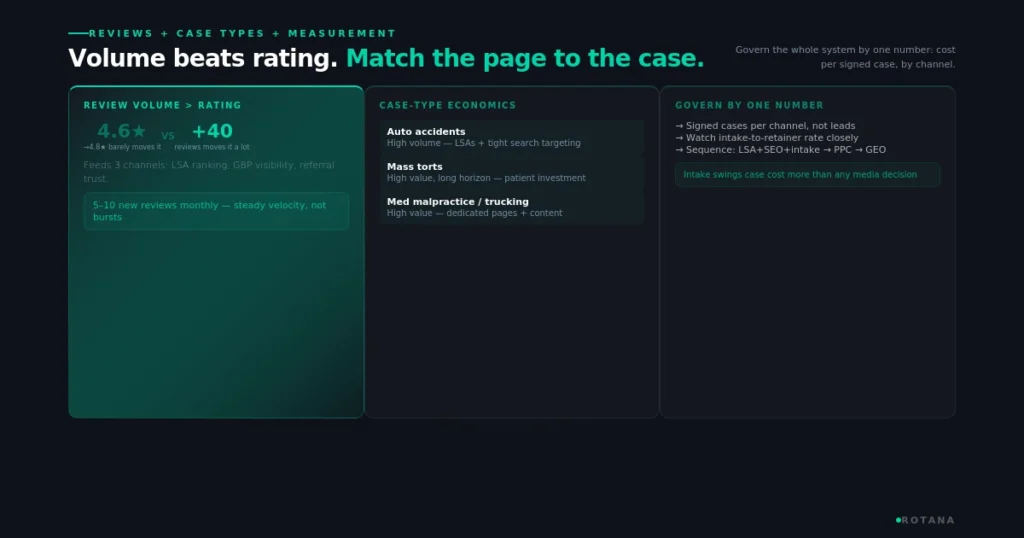
The whole system should be governed by one number: cost per signed case by channel. Track signed cases per channel, not just leads, since leads flatter the picture. Watch intake-to-retainer rate closely, because it swings case cost more than any media decision. Then sequence: start with LSAs plus local SEO plus tightened intake, add PPC for volume once the foundation holds, layer GEO early to claim the white space and treat SEO as the long-term equity that makes the whole system cheaper over time. Run two or three channels well before adding more.
What I would do first
If you run a PI firm and want more signed cases at a sustainable cost, start in this order. Fix intake so every lead gets a 60-second, human, empathetic response, tracked to signed retainer. Launch Local Service Ads and build review volume, since both feed ranking and trust. Build practice-area-by-city pages and early-question content for SEO. Add structured Q&A content for GEO before competitors do. Layer in tightly targeted PPC for immediate volume. Then govern everything by cost per signed case and invest where cases are cheapest.
Personal injury marketing rewards the firm that responds fastest, earns trust through reviews and runs a clean economic system. The system beats the budget every time. If you want that engine built and measured to cost per signed case, that is the work I do at Rotana. The same discipline drives my guides to family law marketing and immigration law firm marketing and the relationship side sits in my guide to email marketing for lawyers. Book a call through the link on the site.
Frequently asked questions
What is the best marketing strategy for personal injury lawyers?
The strongest approach runs Local Service Ads and local SEO with a tightened intake process first, then adds PPC for volume and GEO for AI visibility, all measured by cost per signed case. Because PI is the most competitive and expensive legal niche, discipline beats spend. Reviews and fast response feed both rankings and trust, while practice-area-by-city pages capture high-intent search. No single channel wins. The firms that grow run two or three channels well and fix the intake leak that wastes most marketing.
How much does it cost to get a personal injury case?
Cost per signed case varies widely by channel. Rough benchmarks are $300 to $700 for SEO-driven leads, often under $1,000 for Google LSAs, $500 to $3,000 for auto accident PPC, $1,500 to $5,000 or more for mass torts and $2,500 to $15,000 or more for TV. The figure that matters is cost per signed case, not cost per lead, since intake-to-retainer rate can double or halve the real cost. PI case values are large enough to absorb high acquisition costs when the system converts well.
Are Google Local Service Ads worth it for personal injury lawyers?
For most PI firms, yes. Local Service Ads sit above all other results with a Google Screened badge and charge per lead rather than per click, which reassures anxious clients and protects budget. They typically produce cost per signed case under $1,000. Ranking depends on review volume and response time more than spend, so a firm with strong reviews and fast intake can outrank bigger spenders. Treat them as one layer alongside SEO and PPC rather than a standalone solution, since paid leads stop when you stop paying.
Why is response time so important in personal injury marketing?
Because accident victims are anxious and often contact several firms at once, so the first to respond usually wins. Firms that reply to a new lead within about 60 seconds convert roughly three times more signed cases than those waiting even five to ten minutes. Response time also feeds Local Service Ads ranking, since Google uses it as a quality signal, meaning faster response lowers cost per lead. Intake speed is the highest-return improvement most PI firms can make and it costs nothing in additional ad spend.
How long does SEO take for a personal injury law firm?
Consistent case generation from SEO typically takes 6 to 18 months, longer in saturated metros like Los Angeles or Miami where firms have invested for years. Local SEO through an optimized Google Business Profile can show earlier movement. Because SEO compounds and produces the cheapest cost per case over time, most firms pair it with Local Service Ads and PPC for immediate cases, then lean more on organic search as rankings strengthen. Anyone promising top PI rankings in a few weeks is either misleading you or using risky shortcuts.