

Digital marketing for architecture firms is the work of making a firm’s expertise visible online so the right clients find it, trust it before the first call and bring projects worth winning. It is not posting pretty renderings and hoping. Most architecture firms still draw 60% to 80% of revenue from referrals, networking and word of mouth, which works until two key referral sources retire and inquiries drop 60% overnight. Clients now research firms online before contacting anyone, comparing portfolios, reading reviews and forming opinions long before they send an email. The firms growing in 2026 are not just the best designers. They are the ones whose expertise is easy to find.
I run an SEO-led growth agency, so I see the pattern: brilliant firms that are a best-kept secret, stuck in a feast-or-famine cycle because their pipeline depends on luck. Architecture marketing rewards visibility, positioning and a system, not applause metrics. This guide covers the full system: why a portfolio is evidence not strategy, the positioning that filters in the right clients, the website and SEO that most firms get wrong, the authority signals unique to this field and the pipeline metrics that actually matter.
Why architecture marketing is its own discipline
Long cycles, portfolio-driven, RFP-based
Architecture marketing operates on longer sales cycles, portfolio-driven decisions and often RFP-based project awards, which makes generic B2B lead-volume tactics a poor fit. A client does not hire after a single click. They shortlist, compare, ask around, revisit your site and test whether your expertise fits their exact project type, location and approval path. The job of marketing here is to build trust and credibility across that long consideration, so the firm is already pre-approved by the time a conversation starts.
A portfolio is evidence, not a strategy
A strong portfolio is essential, but it is evidence, not a marketing strategy. If your marketing says only “look at our work,” you are asking prospects to do the strategic thinking for you, connecting your past projects to their specific needs. The firms that win better projects do two things better than peers. They own a clear niche instead of presenting as capable of everything and they measure marketing against real pipeline movement rather than likes and impressions. Evidence supports a strategy. It does not substitute for one.
Positioning filters in the right clients
Niche beats generalist
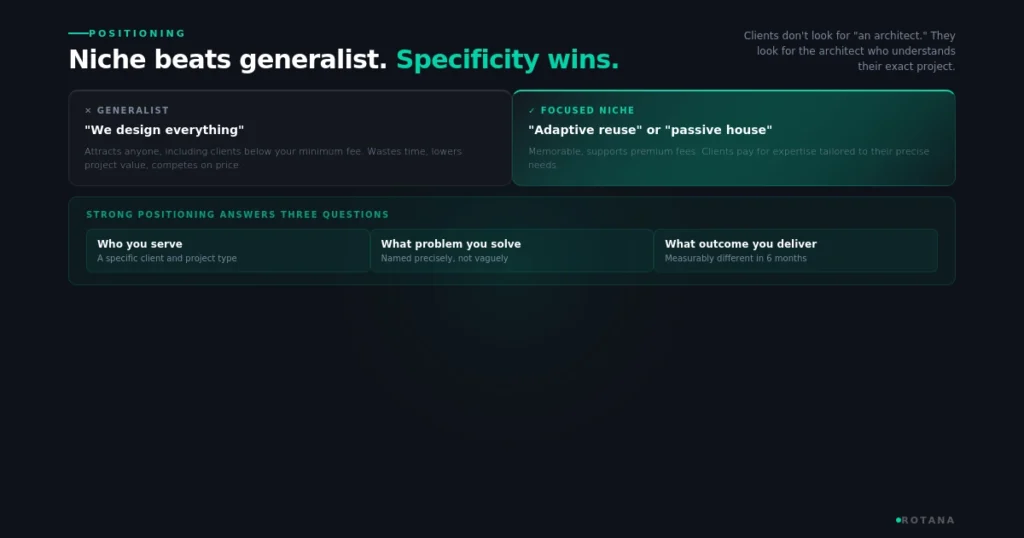
Without clear positioning, a firm attracts anyone who finds it, including clients with budgets far below its minimum fee, which wastes time and lowers project value. Specificity wins, since clients do not look for “an architect.” They look for the architect who understands their exact project, budget and taste. A focused niche, whether by project type like adaptive reuse or healthcare or by approach like passive house and sustainable design, makes the firm memorable and supports premium fees. Specialization lets you charge more because clients pay for expertise tailored to their precise needs.
Say what you do, for whom and the outcome
Strong positioning answers three questions clearly: who you serve, what problem you solve and what outcome you deliver. The more specific the answers, the easier every downstream decision becomes and the better your inquiries get. When every firm has a modern website and an Instagram feed, differentiation is what stops you from competing on price. Branding, your visual identity, voice and niche focus, is what makes one firm memorable and another forgettable. Positioning is the foundation the rest of the system is built on.
The website and SEO most firms get wrong
Beautiful but commercially weak
Architecture websites are usually built as digital portfolios: visually stunning, image-heavy and refined, yet terrible at the one thing that drives business, being found and converting. Many load 10 to 40 MB of uncompressed images, penalized under Core Web Vitals, with sites routinely taking 6 to 12 seconds on mobile when a one-second site converts far better. Treat your website as your best salesperson working 24 hours a day, not a gallery. It should explain what you do, who you serve, where you work and why your process matters, with a clear next step on every page rather than a contact link buried in the navigation.
Fix the technical foundation
Technical SEO is ranking infrastructure, not a nicety. Compress project images to modern formats like WebP or AVIF, lazy-load them and serve from a fast host, since speed is a business issue that directly affects conversions and rankings. Google indexes the mobile version first, so a site that breaks on a phone is a ranking problem. Add schema markup, which most architecture sites lack entirely, since structured data can lift click-through meaningfully. This technical and content foundation is the compounding engine and it is the work I focus on through our SEO consultancy service.
Optimize portfolio and location pages
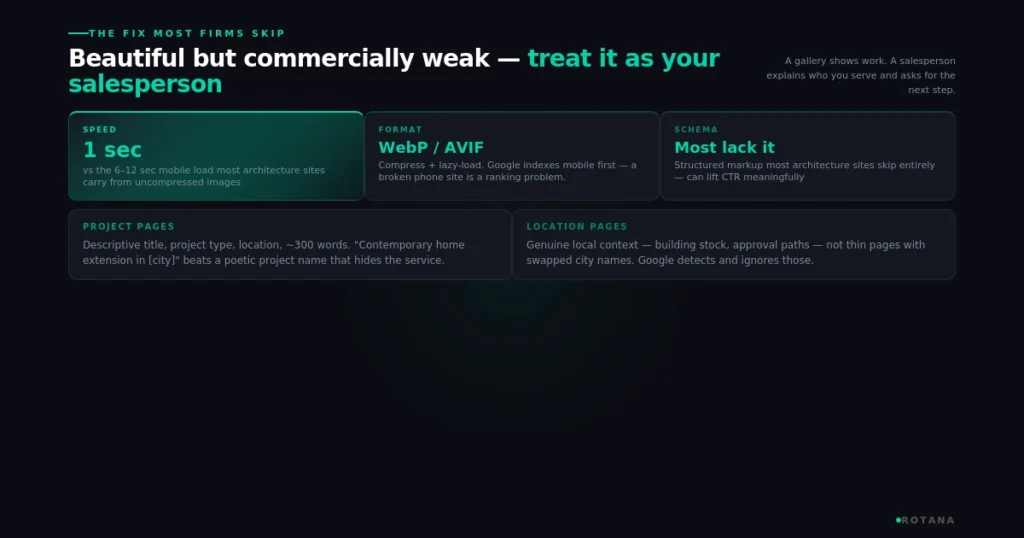
Each project page should carry a descriptive title, the project type and location, relevant keywords and enough editorial text, around 300 words, for Google to index it properly. Avoid poetic internal project names that hide the service, since a page about a “contemporary home extension in [city]” both ranks and matches how clients search. Properly optimized project photos also rank in Google Image search, driving targeted traffic to your portfolio. For firms serving several markets, build genuine location pages that tie your niche to local context like building stock and approval paths, not thin pages with swapped city names, which Google detects and ignores.
Authority signals unique to architecture
Awards, press and publications
Architecture is a credibility-driven field where your work is inherently newsworthy and visually compelling, which makes authority-building more natural than in most industries. Submitting completed projects to respected publications and entering awards generates authoritative press coverage and backlinks, two of the strongest ranking signals. Being shortlisted for or winning recognition improves trust, brand perception, search authority and referral confidence at once. These placements keep working over time, feeding your website credibility, social proof and email newsletter. The catch is documentation, so prepare strong photography, clear case studies and written project descriptions as part of the marketing process.
Thought leadership and the right platforms
Content that teaches positions a firm as an authority and builds trust before the first meeting. Beyond project photos, publish insight on your niche, your process and the questions clients ask, which also feeds SEO and AI visibility. On platforms, your firm’s website comes first and LinkedIn second, since prospects check it even when referred, while Instagram showcases visual work to build awareness over time. Generative engine optimization is an emerging edge: a growing share of developers and owners now ask AI tools to recommend firms, so structuring content with clear answers and authoritative citations positions you to be recommended while competitors ignore it.
Email and referrals working together
Email does not replace referrals, it strengthens them. Past clients, consultants, contractors and industry partners are far more likely to recommend a firm they keep seeing, so a regular newsletter sharing completed projects and insight keeps you top of mind through the long gaps between projects. A lead magnet like a planning checklist or a guide to a specific project type captures contact details from prospects who are not ready yet, then a simple automated follow-up nurtures them. Architecture’s long cycles make this nurture essential, since the right client may research for months before reaching out and the firm that stayed visible wins the call.
Measure pipeline, not applause
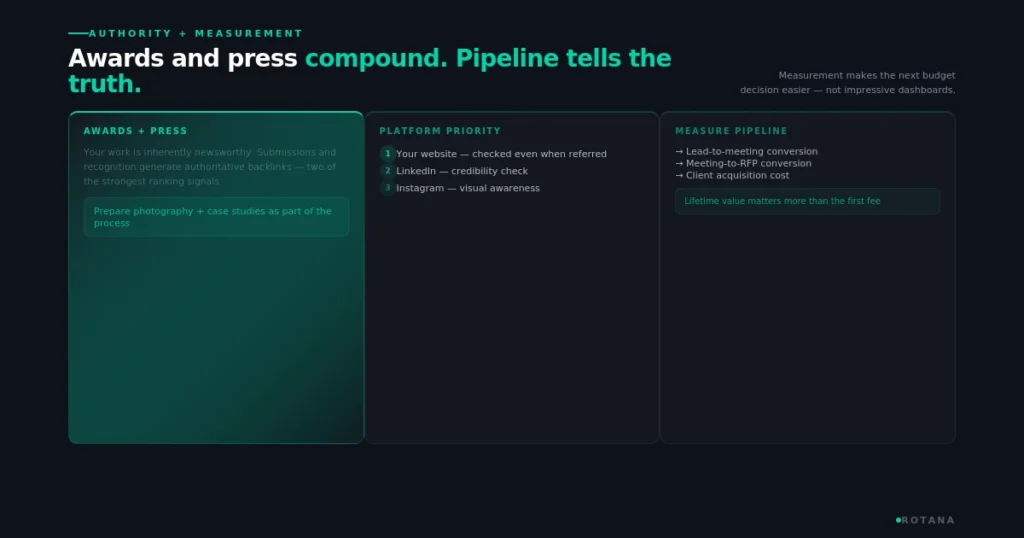
Marketing only matters if it moves the pipeline, so measure against real opportunity rather than likes and traffic. Track lead-to-meeting conversion to test whether inquiries and follow-up work, meeting-to-RFP or proposal conversion to test whether positioning attracts real opportunities and client acquisition cost to keep marketing grounded in commercial reality. Lifetime value matters more here than the first fee, since strong clients bring repeat phases, related sites and referrals, so a channel that looks expensive on first project may be the most valuable over time. The point of measurement is not impressive dashboards. It is making the next budget decision easier, which is why a clear ROI framework turns debates about aesthetics into decisions based on evidence.
What I would do first
If you run an architecture firm and want a predictable pipeline, start in this order. Sharpen your positioning until you own a clear niche and can say who you serve and the outcome you deliver. Rebuild your website to load fast, convert and explain your value, not just display images. Fix technical SEO and optimize each project and location page for how clients actually search. Build authority through awards, press and thought-leadership content. Use email to nurture prospects and feed referrals through the long cycle. Then measure pipeline movement and acquisition cost, not applause.
Architecture marketing rewards the firm that is visible, clearly positioned and run as a system rather than left to luck. The best-kept secret loses to the firm that is easy to find and trust. If you want that system built and tuned to your niche, that is the work I do at Rotana. The same B2B discipline drives my guides to manufacturing marketing and B2B email marketing. Book a call through the link on the site.
Frequently asked questions
What is the best marketing strategy for architecture firms?
The strongest approach combines clear positioning around a niche, a fast conversion-focused website, technical and content SEO and authority signals like awards and press, with email nurturing the long sales cycle. Because architecture decisions are portfolio-driven and run on long, RFP-based cycles, the goal is to build trust and visibility so the right client chooses you before the first conversation. Referrals still matter, but a firm that depends on them alone faces feast-or-famine cycles, which a structured marketing system replaces with a predictable pipeline.
Why do architecture firms need digital marketing if they rely on referrals?
Because referrals alone create an unstable pipeline. Most firms draw 60% to 80% of revenue from referrals, which works until key sources retire or the economy slows and inquiries dry up, sometimes dropping by more than half overnight. Clients now research firms online before contacting anyone, comparing portfolios and reviews, so a firm that is hard to find loses projects regardless of talent. Digital marketing turns visibility into a consistent source of qualified inquiries that supports referrals rather than replacing them, breaking the feast-or-famine cycle.
How long does SEO take for an architecture firm?
SEO for architecture firms typically takes three to six months to show consistent results, with social media able to generate inquiries faster but only with regular posting. SEO is a compounding asset rather than a switch, so firms that invest consistently build a lead-generation engine that outlasts any ad campaign and delivers the highest-quality, pre-qualified inquiries over time. Because the work is visual and newsworthy, architecture firms can build authority through press and awards faster than many industries, which accelerates the trust and backlinks that support rankings.
What should an architecture firm’s website include?
Beyond a strong portfolio, the site should clearly explain what the firm does, who it serves, where it works, why its process is valuable and how to take the next step, with clear calls to action on every page rather than a buried contact link. Technically it must load fast, work on mobile, use compressed modern image formats and include schema markup. Each project page needs a descriptive, search-friendly title, location and around 300 words of editorial text, since beautiful but commercially weak sites fail at being found and converting visitors into inquiries.
How should architecture firms measure marketing success?
Measure pipeline movement, not applause metrics like likes and traffic. Track lead-to-meeting conversion, meeting-to-RFP or proposal conversion and client acquisition cost to keep marketing tied to commercial reality. Lifetime value matters more than the first fee, since strong clients bring repeat phases, related sites and referrals, so judge channels by the quality of clients they attract over time. The purpose of measurement is to make the next budget decision easier, replacing debates about aesthetics with investment based on what actually generates qualified opportunities.