

Email marketing and SEO work together as a loop. SEO pulls in new visitors from search. Email captures them, brings them back, then sends engaged traffic to your pages that reinforces the rankings SEO built. The two are usually run by separate people in separate tools. Treated as one system, they compound. This guide explains the real mechanics, including the one claim almost every other article gets wrong.
I run SEO-led growth programs, so I see this connection from both sides. The link is real. It is also widely overstated. Let me give you the honest version, because the honest version is the one that actually helps you rank.
Does email marketing directly improve SEO?
The honest answer
No. Email does not directly affect your Google rankings. Google cannot crawl your email campaigns, so nothing you send is a ranking factor on its own. Any guide that tells you a newsletter directly lifts rankings is wrong. The value is indirect. That indirect value is substantial once you understand the mechanism.
Why the distinction matters
Getting this right changes how you use email for SEO. You stop trying to stuff keywords into emails for Google’s benefit, since Google never sees them. You start using email to do the one thing it does better than any channel: send a burst of engaged, trusting visitors to a page you want to rank. That behavior is what search engines notice.
How email marketing actually supports SEO
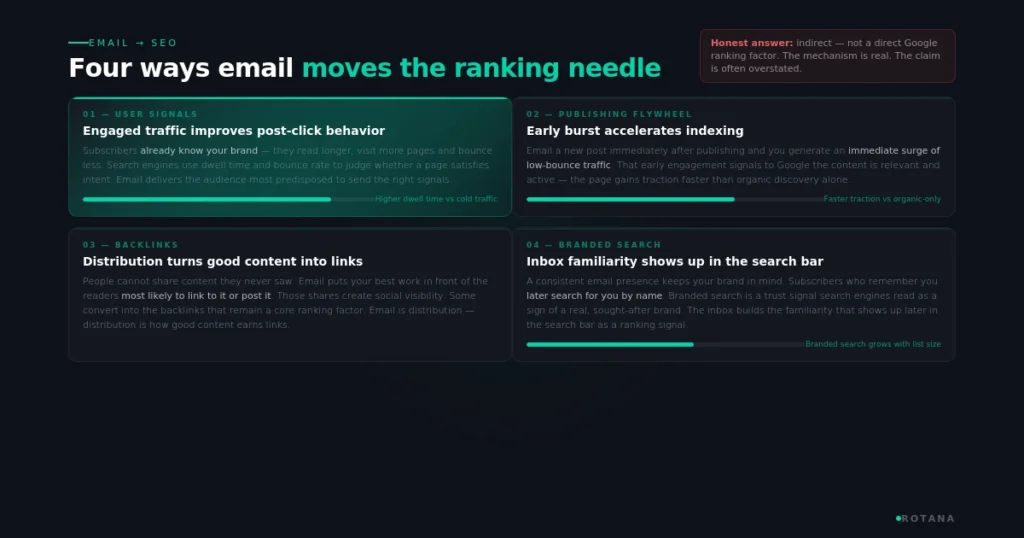
Email influences the signals search engines read after a visitor lands on your site. Here is how that works in practice.
It drives engaged traffic that improves user signals
Subscribers are not cold traffic. They already know your brand, so they read more thoroughly, visit more pages and leave less often. That means longer dwell time and lower bounce rates on the pages you send them to. Search engines use these post-click behaviors to judge whether a page satisfies intent. Email gives you an audience predisposed to send the right signals.
It creates a publishing flywheel
When you email a new post to your list right after publishing, you generate an immediate surge of low-bounce traffic. That early engagement signals to Google the content is relevant and active. The page gains traction faster than it would on organic discovery alone. Your list becomes a launchpad for every piece of content you want ranked.
It earns shares and backlinks
People cannot share content they never saw. Email puts your best work in front of the readers most likely to link to it or post it. Those shares create social visibility. Some convert into the backlinks that remain a core ranking factor. Email is distribution. Distribution is how good content earns links.
It grows branded search
A consistent email presence keeps your brand in mind. Subscribers who remember you later search for you by name. Branded search is a trust signal search engines read as a sign of a real, sought-after brand. The inbox builds the familiarity that shows up later in the search bar.
How SEO strengthens your email marketing
The loop runs both ways. A strong SEO practice feeds your email program too.
SEO content fuels your newsletter
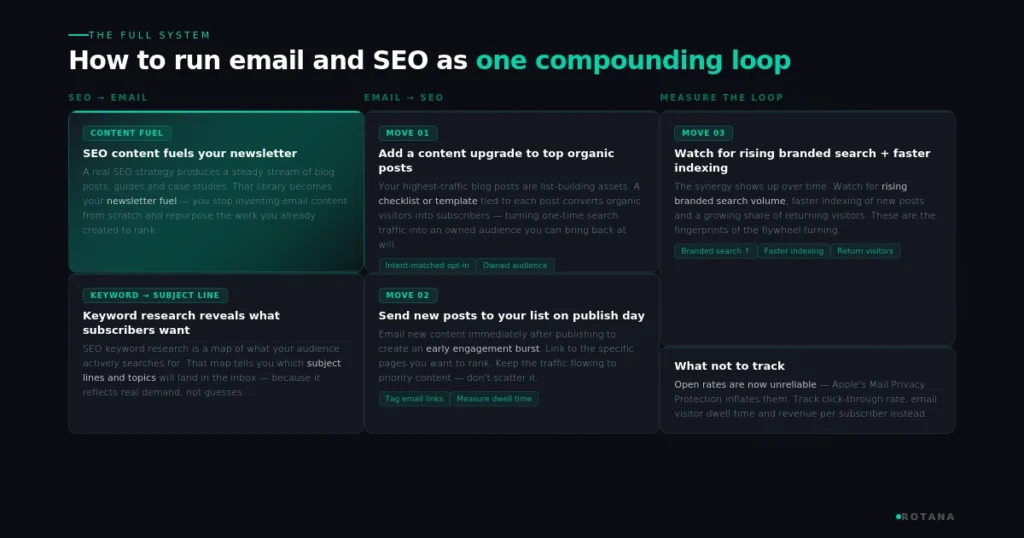
A real SEO strategy produces a steady stream of optimized blog posts, guides and case studies. That library becomes your newsletter fuel. You stop inventing email content from scratch. You repurpose the work you already created to rank. The same logic drives the journeys I covered in email marketing for nonprofits, where useful content carries the relationship.
Keyword research reveals what subscribers want
SEO keyword research is a map of what your audience actively searches for. That map tells you which subject lines and topics will land in the inbox, because it reflects real demand. Using your target keywords in subject lines aligns your email with the intent your audience already has.
How to run email and SEO as one system
Turn SEO traffic into subscribers
Your highest-traffic blog posts are list-building assets. Add a content upgrade to each one: a checklist or template tied to that exact post. This converts organic visitors into subscribers. It turns SEO traffic into an owned audience you can bring back at will.
Turn subscribers into ranking signals
Run the loop in reverse on every publish. Send new posts to your list quickly to create that early engagement burst. Link to the specific pages you want to rank. Keep the traffic flowing to your priority content rather than scattering it.
Keep the cadence right
Consistency beats frequency. A weekly or bi-weekly digest of your best search-optimized content works for most lists. Send too often and unsubscribes climb. Send too rarely and subscribers forget you. Watch engagement to find your audience’s sweet spot. If you want this loop built and managed, that is the work I do at Rotana through our SEO consultancy service.
How to measure the connection
Track the click-to-engagement path
Tag your email links so you can see email traffic separately in analytics. Then watch what that traffic does: time on page, pages per session, bounce rate. Compare email visitors to cold organic visitors. Email traffic should engage more deeply, which is exactly the behavior that supports rankings.
Watch the leading indicators
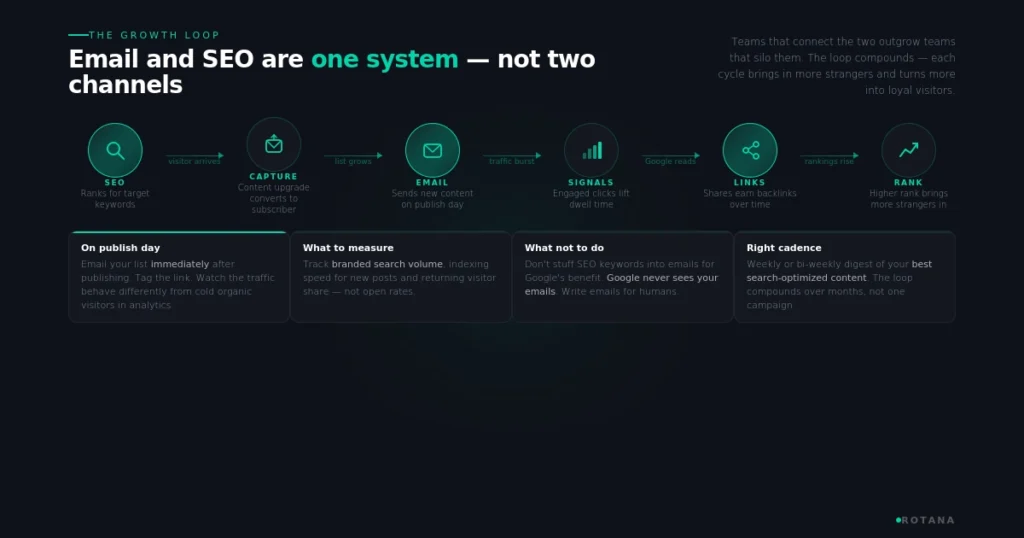
The synergy shows up over time, not overnight. Look for rising branded search volume, faster indexing of new posts and a growing share of returning visitors. These are the fingerprints of the flywheel turning. The same plain, direct measurement mindset applies across the board, including in regulated fields like email marketing for lawyers.
What I would do first
If you want email and SEO compounding, start with three moves this month. Add a content upgrade to your top three organic posts to convert that traffic into subscribers. Set up a publish-day email that sends your list to each new post. Tag your email links so you can prove the engagement difference in analytics.
Email and SEO are not two channels. They are one growth loop. SEO brings strangers in. Email turns them into an audience that comes back and feeds the rankings that bring in more strangers. The teams that connect the two outgrow the teams that silo them. Book a call through the link on the site if you want help wiring that loop together.
Frequently asked questions
Does email marketing help SEO?
Yes, indirectly. Email does not directly change your Google rankings, because Google cannot crawl email campaigns. It helps by driving engaged subscribers to your pages, which improves user signals like dwell time and bounce rate, accelerates indexing of new content, earns shares and backlinks and grows branded search. Those behavioral signals are what search engines read to judge whether a page deserves to rank.
Does Google crawl or read my emails?
No. Google does not access or index your email campaigns, so nothing you write in an email is a direct ranking factor. What Google does see is the behavior of users after they click an email link to your website. That post-click activity, such as longer time on page and lower bounce rates, is how email exerts its indirect influence on SEO.
Can I use SEO keywords in my email subject lines?
Yes, though not for Google’s sake. It is a smart move. Using your SEO keywords in subject lines aligns your email with the intent your audience already searches for, which lifts open and click rates. The benefit is engagement, not direct ranking, since the email itself is never crawled. Keyword research doubles as subject-line research.
How does SEO traffic help my email list?
SEO brings new visitors to your site. The most effective way to keep them is a content upgrade: a checklist or template tied to the post they are reading. This converts organic search traffic into email subscribers. Those subscribers can then be sent back to your content on demand, which turns one-time search visitors into a repeatable audience that supports future rankings.
How often should I email my list about new content?
A weekly or bi-weekly digest of your best search-optimized content works for most audiences in 2026. Quality beats frequency. Sending too often raises unsubscribes, while sending too rarely lets subscribers forget you. Monitor engagement metrics to find the cadence that keeps your list active without fatiguing it, then hold to it consistently.