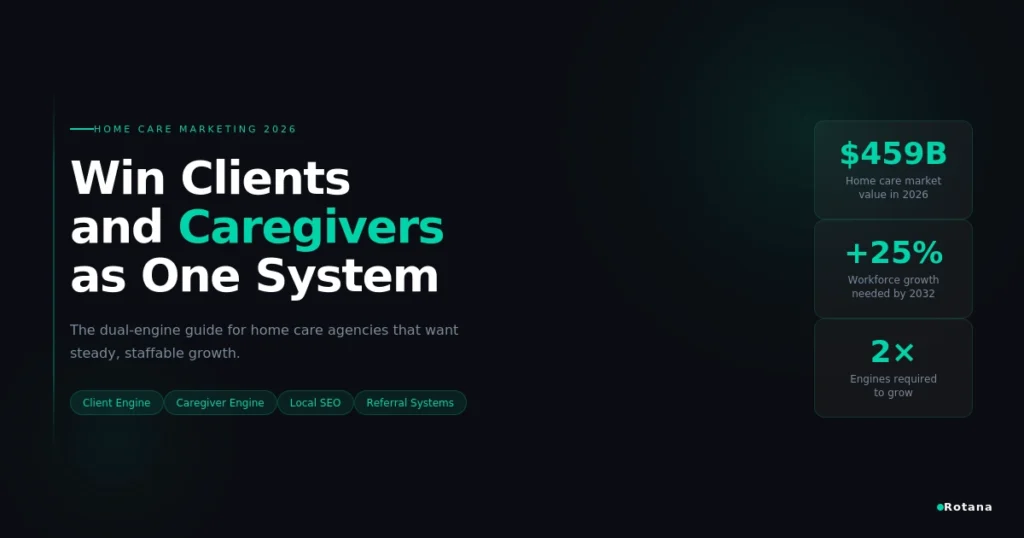
Home care marketing is the work of winning two audiences at once: the families who hire you and the caregivers who let you say yes when they call. That second half is what most guides miss. You can generate a flood of qualified inquiries, but if you have no caregiver to staff the case, every dollar of that marketing is wasted. Home care is the rare business where recruitment is growth marketing, not an HR afterthought. With demand climbing as the population ages and the home care market valued near $459 billion in 2026, the agencies that grow are the ones that market for clients and caregivers as one connected system.
I run an SEO-led growth agency, so I will say the thing the platitude-filled guides avoid: “get more reviews, build referral relationships, hire good caregivers” is not a strategy, it is a to-do list everyone already has. The agencies pulling ahead in 2026 run a real client engine and a real caregiver engine, both built on trust, local visibility and systems that compound. This guide covers both, plus the family-as-buyer dynamic that changes how you write everything, the referral channel done properly and the numbers that actually tell you if it is working.
A note on care, since this is a health and safety decision for a vulnerable person. Be honest in every claim, never overstate what your caregivers can clinically do and respect the trust a family extends when they invite someone into a loved one’s home. In this field, credibility is earned through clarity, not marketing language.
Home care is two marketing problems, not one
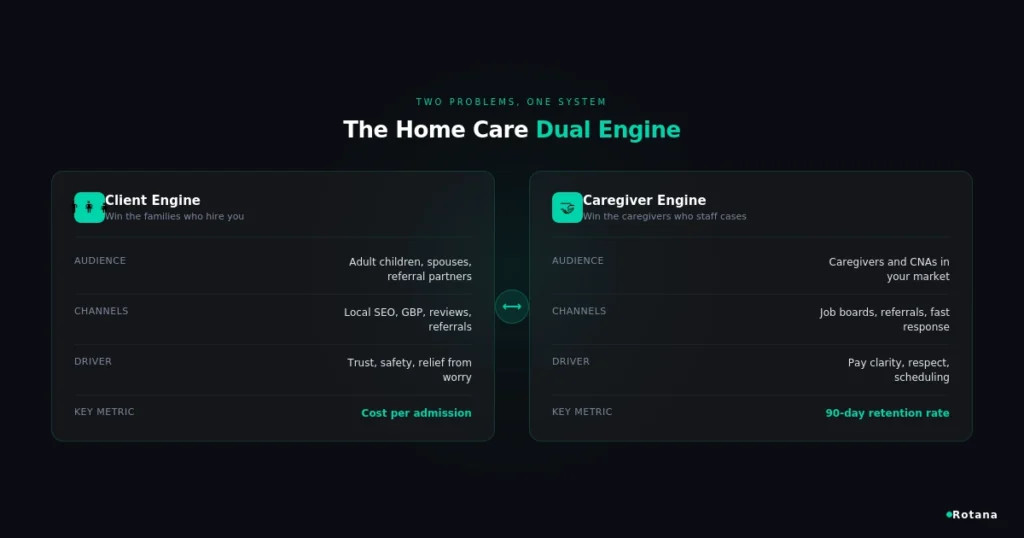
Treating home care marketing as client acquisition alone is the most common and most expensive mistake in the industry. A signed client you cannot staff becomes a declined case, a frustrated family and a referral source who stops calling. The two engines feed each other, so they have to run together.
| Factor | Client engine | Caregiver engine |
|---|---|---|
| Audience | Adult children, spouses, referral partners | Caregivers and CNAs in your market |
| Primary channels | Local SEO, Google Business Profile, reviews, referral sources | Job boards, employee referrals, social, fast application response |
| Emotional driver | Trust, safety, relief from worry | Pay clarity, respect, scheduling, recognition |
| Goal | Qualified inquiries that become admissions | Applicants who become retained caregivers |
| Key metric | Cost per admission, inquiry-to-admission rate | Cost per hire, 90-day retention, turnover rate |
Read the rest of this guide with both columns in mind. Every time you build a client-side asset, ask whether the caregiver side has the capacity to deliver on it.
The client engine: market to the family, not the patient
Understand who is really deciding
The senior rarely chooses the agency. The adult child does, often a daughter searching late at night after a parent’s fall or hospital stay, stressed and trying to make a careful decision fast. She is not searching your agency name. She types the problem: “home care agency near me,” “help for mom at home,” “caregiver for elderly parent,” “Alzheimer’s care at home,” “how much does home care cost.” Your content has to meet her at that exact moment, in plain language, answering the question rather than reciting your values. Marketing that speaks to the stressed family member, not the patient and not the search engine, is what earns the call.
Build a website that works as a digital front door
For many families your website is the first real impression and it has to answer four questions immediately: what you do, who you help, where you provide care and how to reach you. If a visitor has to dig, they leave and call the next agency. Build clear service pages for personal care, companion care, dementia and Alzheimer’s care, 24-hour care, respite care and post-hospital care, plus location pages for each community you serve. Cost clarity has become a prerequisite for trust rather than a nice-to-have, so address pricing honestly even if the answer is a range. Put click-to-call buttons, short forms and reviews on every page. This digital-front-door and local-search foundation is the work I focus on through our SEO consultancy service.
Win local search and your Google Business Profile
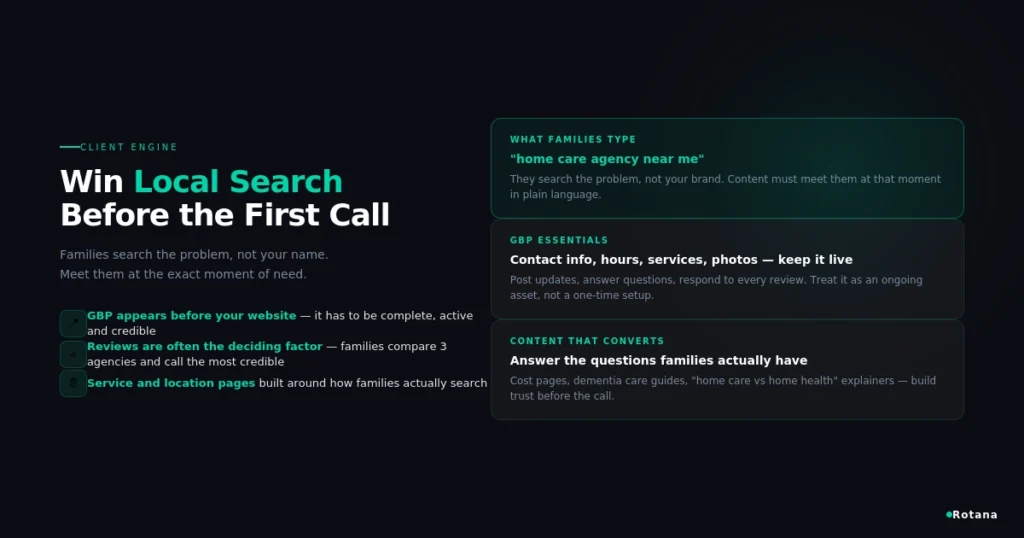
When a family searches for home care nearby, your Google Business Profile often appears before your website, so it needs to be complete, active and credible. Keep contact details, service areas, hours, services and photos accurate, post updates, answer questions and ask satisfied families for reviews. Reviews are frequently the deciding factor, since a family comparing three agencies calls the one that feels most credible and responding to reviews signals an attentive, engaged agency. Treat the profile as an ongoing asset, not a one-time setup.
Use content and video to build trust before the first call
Families often need education before they are ready to decide. Many do not know the difference between home care and home health, when 24-hour care is warranted or how companion care helps a lonely but independent parent. Content that answers those real questions, articles, guides and FAQs, builds trust while it builds rankings. Video does it faster, because home care is personal and families are inviting a stranger into a loved one’s home. Short, simple clips work: answer common questions, introduce the care team, explain what happens during a consultation. One video becomes a blog post, social clips and an email topic and it lets a family see who you are before they call.
Run referral relationships as a system
Online visibility matters, but referrals still drive a large share of home care admissions, since families trust a recommendation from a healthcare professional. Hospitals, rehab centers, discharge planners, elder law attorneys, senior living communities, hospice providers and physicians can all become partners. The mistake is treating this casually, because the “drop off donuts at discharge planning” approach that worked in 2015 fails in 2026, when hospital systems have compliance departments and preferred-provider lists. Run it as a system: choose target partners, keep a regular outreach schedule, track every conversation in a CRM, follow up consistently and bring genuinely useful resources like a safe-discharge or fall-prevention guide rather than sales materials. Relationship-based and organized beats sporadic every time. The biggest risk with referrals is dependence, so build owned channels alongside them rather than relying on a single source you do not control.
The caregiver engine: recruitment is growth marketing
The shortage is structural, so treat hiring like marketing
You cannot grow census without caregivers and the shortage is not easing. The Bureau of Labor Statistics projects the home care workforce needs to grow about 25% by 2032 to meet demand, a pace the industry is nowhere near hitting, while caregiver wages have risen roughly 23% since 2022 even as reimbursement has barely moved. Posting on a job board and hoping is not a recruitment strategy. Market your open roles with the same discipline you market to families: clear positioning, fast response to applicants, wage transparency and a steady pipeline rather than panic hiring when a case comes in.
Build a caregiver referral engine that actually works
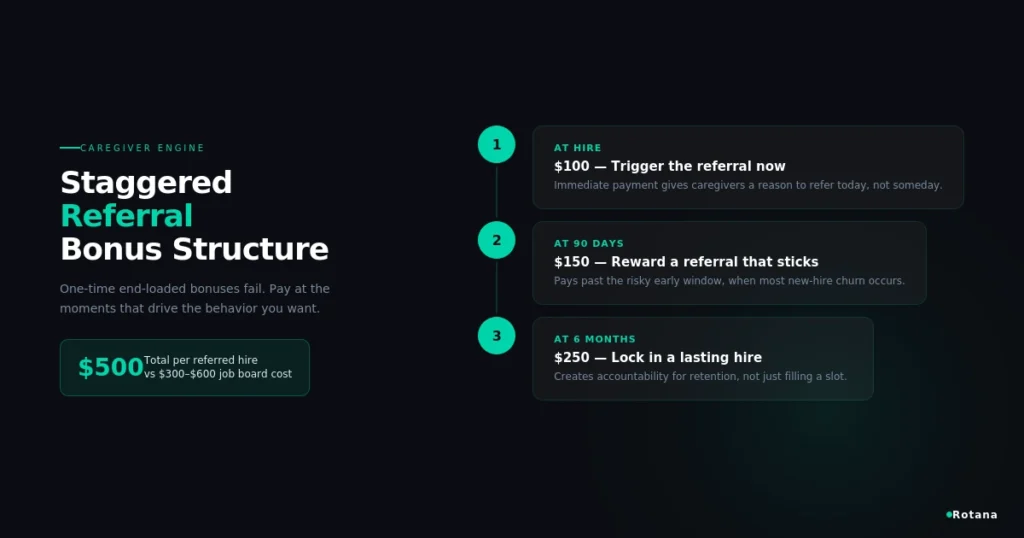
Your best caregivers know other good caregivers, but most referral bonuses are structured to fail because they pay everything at the end. A single $200 bonus after 90 days gives no reason to refer today. A staggered structure works far better: pay at the moments that drive the behavior you want.
- $100 at hire, which gets caregivers to actually make the referral now.
- $150 at 90 days, which rewards a referral that sticks past the risky early window.
- $250 at six months, which creates real accountability for a lasting hire.
At $500 total, that is still cheaper than the $300 to $600 many agencies spend per hire on job boards and a referred caregiver arrives pre-vetted by someone who already works for you. Pair it with wage transparency in your job ads, since the agencies hiding pay are usually the ones paying below market and applicants have learned to skip them.
Retention is cheaper than recruitment
Every 10% reduction in caregiver turnover is worth more than a 20% increase in applicants, once you account for the real cost of replacing someone: recruiting, onboarding, training, lost productivity during ramp-up and the disruption to the client. Retention is won on the things caregivers actually cite: consistent scheduling they can see two weeks out, genuine recognition rather than pizza parties, career pathways into senior caregiver and coordinator roles and stay interviews that ask current caregivers why they stay so you can do more of it. A retained caregiver is also a retained client, since families bond with consistent care, so the caregiver engine quietly protects the client engine.
Show up in AI search the right way
Families now use tools like ChatGPT and Perplexity to compare options and ask care questions before they ever call, so your content needs to be clear to both people and AI. The approach is the same good practice that helps families: use plain page titles, answer questions directly, state your services, locations and strengths specifically and add FAQs to important pages. Instead of “we provide compassionate care,” say exactly what that means, whether bathing, dressing, meal preparation, medication reminders, dementia support or overnight care. AI tools pull from content that is structured, specific and easy to summarize, which is the same content that helps a stressed family decide. There are no tricks here beyond being genuinely clear and useful.
Measure admissions and hires, not traffic
Marketing without tracking is guessing and in home care you track two funnels. On the client side, measure inquiries, consultations booked, admissions, inquiry-to-admission rate and cost per admission, with referral source attribution so you know which hospitals and partners actually send clients. On the caregiver side, measure applicants, cost per hire, 90-day retention and turnover rate. Ask every new inquiry and every applicant how they found you and record it in your CRM. The goal is not more traffic or more applications, it is more admissions you can staff and more caregivers who stay. An agency that knows both sets of numbers grows on purpose, while one watching only website traffic grows by luck. The owned-audience and nurture discipline behind this sits in my guides to email marketing and email marketing lead generation and the local-service playbook parallels my guide to digital marketing for contractors.
What I would do first
If you run a home care agency and want steady, staffable growth, work in this order:
- Optimize your Google Business Profile and build service and location pages for how families actually search.
- Rewrite your website to answer the four questions fast and speak to the stressed adult child, with honest cost information.
- Build a steady review habit, since reviews are often the deciding factor.
- Run referral outreach as a tracked system with useful resources, not donuts.
- Stand up a caregiver engine in parallel: staggered referral bonuses, wage-transparent ads and fast applicant response.
- Fix retention through consistent scheduling, recognition and career pathways, since it is cheaper than recruitment.
- Track admissions and hires, not traffic and invest where both funnels actually convert.
Home care marketing rewards the agency that wins families and caregivers as one system, markets to the family who is really deciding and treats recruitment as the growth lever it is. The system beats the spend. If you want that dual engine built and tuned to your market, that is the work I do at Rotana. Book a call through the link on the site.
Frequently asked questions
What is the best marketing strategy for a home care agency?
The strongest approach runs two engines at once: a client engine built on local SEO, an optimized Google Business Profile, trust-building content, reviews and systematic referral outreach and a caregiver engine built on staggered referral bonuses, wage-transparent ads and strong retention. The two are linked, since a client you cannot staff is a lost client. Because the family, usually an adult child, makes the decision, marketing should speak to their stress and need for trust and success is measured in admissions and hires rather than website traffic.
How do home care agencies get more clients?
They get found, build trust and make contact easy. That means ranking in local search through an optimized Google Business Profile and location pages, answering the real questions families search with clear content and video and earning steady reviews that act as the deciding factor. Referral relationships with hospitals, discharge planners and senior communities, run as a tracked system rather than casual drop-ins, drive a large share of admissions. Fast, warm response to every inquiry then converts that visibility into booked consultations and admitted clients.
How do you recruit and retain home care caregivers?
Treat recruitment like marketing. Use wage-transparent job ads, respond to applicants fast and build a caregiver referral program with staggered payments, such as $100 at hire, $150 at 90 days and $250 at six months, which beats a single end-loaded bonus and costs less than job-board hiring. Retention matters even more, since every 10% drop in turnover outweighs a 20% rise in applicants. Win it with consistent scheduling, genuine recognition, career pathways and stay interviews that surface why your best caregivers remain.
Who makes the decision when hiring home care?
Usually the family, not the senior. An adult child or spouse typically researches, compares and chooses the agency, often during an emotionally charged moment like a hospital discharge or after a fall. They are time-pressed, worried and looking for proof that an agency is reliable and safe before they call. This is why home care marketing should speak directly to the family member’s stress and need for trust, lead with clarity and honesty and make reviews, transparency and easy contact central rather than focusing only on the care recipient.
How much does home care marketing cost and how is it measured?
Spend varies by market and channel mix, but the discipline that matters is measuring two funnels rather than tracking traffic. On the client side, watch cost per admission and inquiry-to-admission rate by source. On the caregiver side, watch cost per hire and 90-day retention, noting that a referred caregiver at roughly $500 in staggered bonuses often costs less than the $300 to $600 per hire from job boards. Tracking how every inquiry and applicant found you tells you which channels to fund and which to cut.