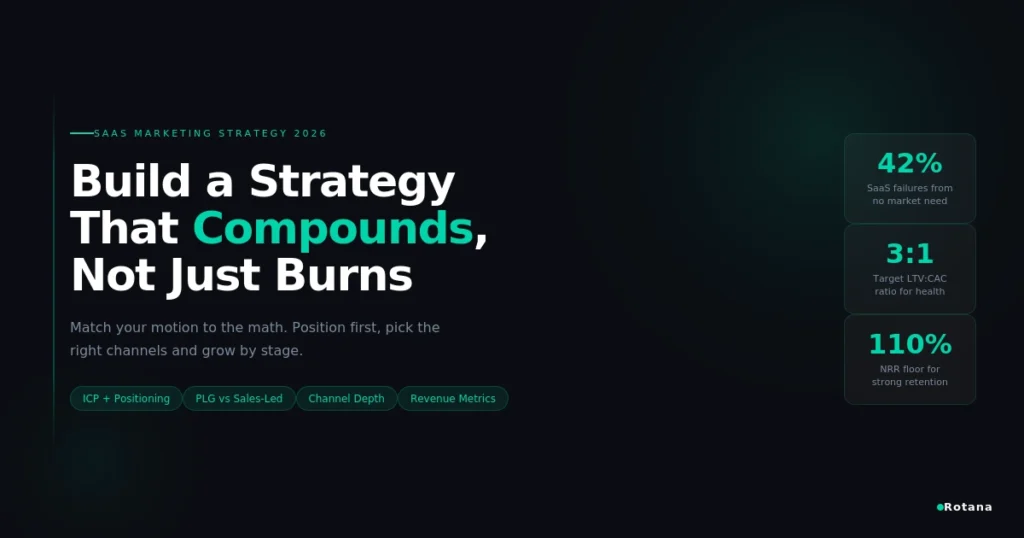
A SaaS marketing strategy is the system that matches how you acquire and keep customers to your price point, your buyer and your stage, then evolves as the company grows. It is not a channel list and it is not a campaign calendar. The distinction matters because most SaaS companies do not fail on product. Per CB Insights, roughly 42% of startup failures come from building something nobody needs and another 13% from a poorly executed go-to-market, which means the strategy was broken far more often than the software was. Getting this right is the difference between growth that compounds and runway that burns.
I run an SEO-led growth agency, so I have watched the same expensive pattern repeat: a team picks the motion that sounds impressive rather than the one its math supports, spends into it and accelerates its own failure. The most costly mistake in SaaS marketing is scaling a broken motion, because every dollar then amplifies the problem instead of solving it. This guide is about building a strategy that fits, in the right sequence: positioning first, the motion that matches your economics, a focused channel set, a stage-aware plan and the few metrics that actually predict revenue. For the broader execution system once the strategy is set, pair this with my guide to SaaS marketing.
What a SaaS marketing strategy actually is
A marketing plan drives awareness and demand. A SaaS marketing strategy is bigger: it is the cross-functional system, spanning product, marketing, sales and customer success, that turns a stranger into a paying, retained, expanding customer. Marketing is one channel inside it. A complete strategy answers five questions in sequence and the order is not optional:
- Who is the buyer? Your ideal customer profile.
- Why should they care? Your positioning.
- How do you reach and convert them? Your motion and channels.
- What do you charge? Your pricing model.
- What does success look like? Your metrics.
Teams that skip to channels before answering the first two questions are the ones that bleed money, because every downstream decision inherits the vagueness. Lock the foundation, then build outward.
Start with ICP and positioning
A vague ICP is the root of most failure
Every failed strategy shares one trait: a fuzzy ideal customer. “Any company that needs project management” is a wish, not an ICP. A sharp profile converts two to three times better than a broad one, because it sharpens your message, your channel choice and your roadmap at once. Define it across three layers: the firmographic (industry, size, stage, tech stack, geography), the buyer (title, seniority, budget authority) and the behavioral (what triggers their search, what they use now, what objections they raise). Do not guess these from a whiteboard. Validate them by interviewing real buyers, since the pattern that repeats across 8 of 15 problem-discovery conversations is your signal and the language those buyers use becomes your copy.
Positioning is what you say no to
Positioning is not a tagline. It is the deliberate choice of what space you own in the buyer’s mind and, just as importantly, what you decline to be. The test is the word “unlike”: if your positioning does not name what you replace and why you are different, it is a feature list, not a position. Useful frameworks include jobs-to-be-done, which frames the product around the customer’s real goal rather than features, category creation, which defines a new market instead of fighting in an existing one and resegmentation, which redraws the competitive map to favor your strength. Run any positioning through five quick tests: can a stranger understand it in five seconds, is it clearly different from the top three alternatives, does it name a real pain, is it believable at your stage and does it name a specific audience rather than “businesses.” Fail any one and rewrite before you touch channels.
Match the motion to the math, not the hype
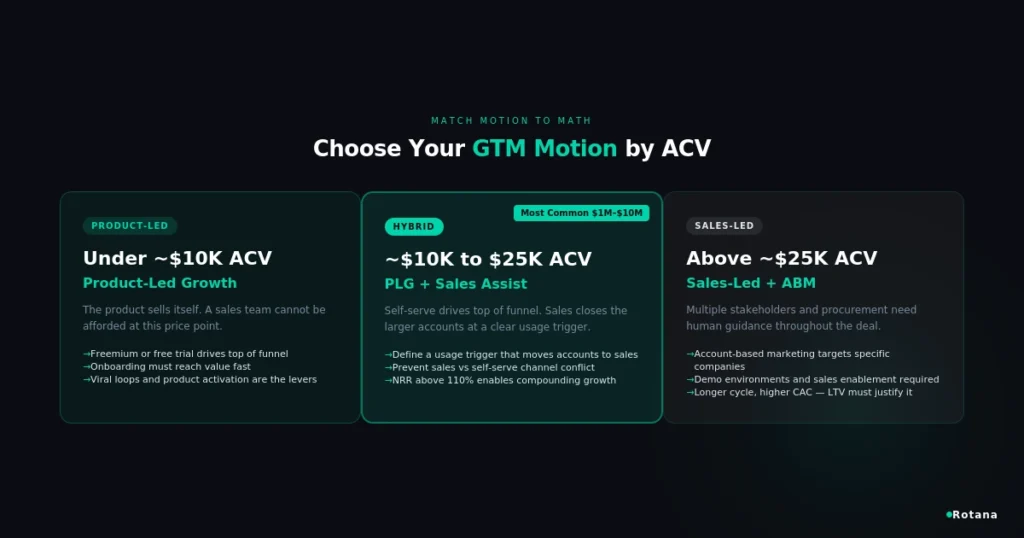
The single most consequential decision in a SaaS marketing strategy is the go-to-market motion and it should be driven by your annual contract value and product complexity, not by which motion is fashionable. A $50,000 enterprise contract sold through a self-serve funnel converts poorly and builds no relationship, while a 10-person sales team selling a $99-per-month tool will never reach positive unit economics. The economics decide.
| Annual contract value | Best-fit motion | Why it fits |
|---|---|---|
| Under ~$10K | Product-led growth | The product can sell itself; a sales team cannot be afforded at this price |
| ~$10K to $25K | Hybrid (PLG plus sales assist) | Self-serve drives top of funnel; sales closes the larger accounts |
| Above ~$25K | Sales-led with ABM | Multiple stakeholders and procurement need human guidance |
Most B2B SaaS companies between $1M and $10M ARR land on the hybrid, where users self-serve and a rep steps in when usage signals enterprise readiness. The danger in the hybrid is internal conflict, where sales competes with the self-serve channel for the same accounts, so define a clear trigger, usually a usage threshold, team size or a feature request, that moves an account from product-led to sales-assisted. Two non-negotiable rules sit underneath the table. First, validate product-market fit before scaling any motion, because adopting product-led growth before fit is the classic failure: teams build freemium tiers and onboarding flows when they should be doing founder-led sales to learn whether anyone wants the product at all. Second, the first 10 customers come from founder-led selling, not a funnel.
Choose one or two channels and go deep
This is where most SaaS companies bleed money: they try to be on every channel at once and end up mediocre everywhere. The 2025 B2B GTM benchmarks show no correlation between the number of channels a company uses and its growth rate, so execution depth beats breadth. Early-stage teams should master one or two channels before expanding, chosen by where the ICP actually is, whether they are in buying mode there and whether your team can execute well. Weight the choice toward channels that compound, like content, SEO and the product experience, over channels that rent attention, like paid ads that stop the moment you stop paying.
This is the part I work in directly, so I will be specific. Content and SEO are the strongest compounding motion for most B2B SaaS, with organic search driving a large share of pipeline and strong long-run returns, because the cost per acquired customer falls over time while paid rises. The right structure is topic clusters that own a problem space, not scattered keywords. On AI visibility, ignore the hype about secret tricks. Per Google’s own guidance, being recommended by AI tools is mostly just good SEO: publish genuinely useful content that answers the exact questions buyers ask, with clear structure and real FAQs and you become a source the AI cites. You do not need to fragment content or chase special markup. Write for the buyer first and the machine follows.
Sequence the strategy by stage
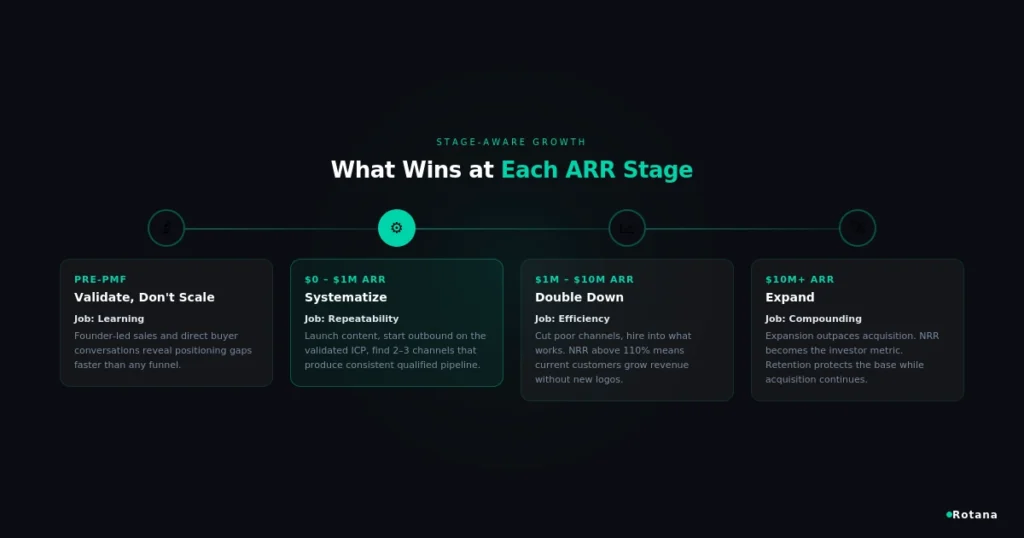
A SaaS marketing strategy is not a document you write once. What wins at $1M ARR fails at $10M, because the constraint moves from finding demand to scaling it efficiently to retaining and expanding it. Match your focus to your stage.
Pre product-market fit: learn
Before fit, the job is validation, not scale. Run founder-led sales and direct conversations, since they reveal positioning gaps faster than any funnel. Spending on a polished growth engine here just accelerates failure on an unproven product. The goal is evidence that a defined buyer has the pain you think they have.
Early stage, roughly $0 to $1M ARR: systematize
Take what founder-led selling taught you and systematize it. Launch content, start outbound built on the validated ICP and enable product-led signups if the product supports self-serve. The goal is to find two or three channels that produce consistent, qualified pipeline, then stop adding new ones.
Growth stage, roughly $1M to $10M ARR: double down
Cut the channels that have not performed after a fair test and hire for the motions that work, a content lead for SEO, an SDR for outbound, a product engineer for the PLG loop. Layer in partnerships and new segments and begin building expansion revenue from existing customers, since customer success becomes a growth engine here. Net revenue retention above 110% means your current customers grow your revenue even without new logos.
Scale, $10M ARR and beyond: expand
At scale, expansion outpaces acquisition as the efficient path to growth and net revenue retention becomes the metric investors watch most. Every marketing asset should serve multiple motions and account-based expansion plus retention protect the revenue base while acquisition continues. The strategy shifts from getting customers to growing them.
Measure the few metrics that predict revenue
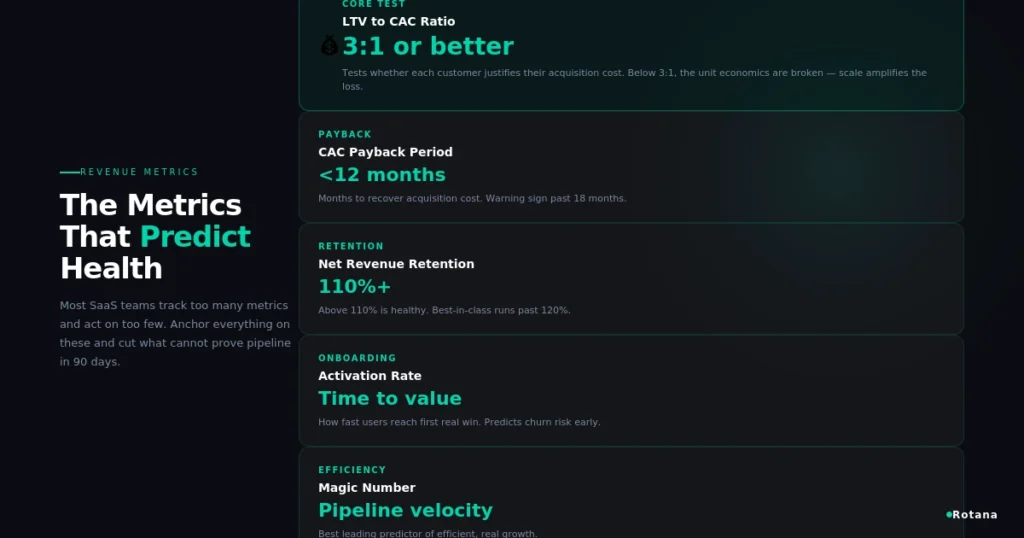
Most SaaS teams track too many metrics and act on too few. Pick one North Star for your stage: activation rate before fit, monthly recurring revenue through $1M, net revenue retention from $1M to $10M and capital-efficient ARR growth beyond that. Around it, watch the handful that actually predict health:
- LTV to CAC ratio: aim for 3:1 or better, the core test of whether each customer justifies its acquisition cost.
- CAC payback period: the months to recover acquisition cost, healthy under 12 and a warning sign past 18.
- Net revenue retention: above 110% is healthy and best-in-class runs past 120%, the metric that separates good SaaS from great.
- Activation rate and time-to-value: how many users reach the first real win and how fast, since onboarding influences a large share of churn risk.
- Pipeline velocity and the Magic Number: the best leading predictors of whether growth is both real and efficient.
Tie every dollar to one of these and run a real review cadence: monthly attribution checks that kill any channel which cannot prove pipeline influence after 90 days, a quarterly tactical review and an annual strategic one. Review immediately, not on schedule, when you see breakdown signals like declining win rates, rising CAC or climbing churn.
The expensive mistakes to avoid
Most SaaS marketing strategies fail in a few predictable ways and naming them is cheaper than living them:
- Scaling a broken motion. Spending more on a motion that has not proven unit economics amplifies the loss. Prove it small, then scale.
- Product-led growth before product-market fit. Freemium and onboarding flows do not fix a product nobody wants yet. Sell by hand first.
- Being everywhere. Mediocre presence on six channels loses to excellence on two. Depth wins.
- Treating the strategy as static. The motion and metrics that fit at $1M ARR are wrong at $10M. Revisit by stage.
- Optimizing vanity metrics. Traffic, signups and clicks flatter the picture while CAC rises and retention erodes. Anchor on revenue metrics.
- Copying a competitor’s motion with different math. Their ACV and buyer may justify a sales team or a freemium tier that yours cannot. Match the motion to your own economics.
What I would do first
If you are building or fixing a SaaS marketing strategy, work in this order:
- Define and validate a sharp ICP through real buyer interviews, then write positioning that passes the five tests.
- Choose your motion by the math: product-led under roughly $10K ACV, sales-led above $25K, hybrid in between.
- Confirm product-market fit before scaling any motion, using founder-led sales to learn.
- Pick one or two compounding channels where your ICP actually is and go deep before adding more.
- Set a North Star for your stage and instrument LTV:CAC, CAC payback and net revenue retention.
- Run monthly attribution reviews, kill what cannot prove pipeline and revisit the whole strategy as you cross each ARR stage.
A SaaS marketing strategy rewards the team that matches its motion to its math, goes deep on a few compounding channels and evolves the plan as it grows, rather than chasing the motion that sounds impressive. The strategy beats the spend. If you want that strategy built and tuned to your stage and economics, that is the work I do at Rotana through our content strategy service. The lifecycle and email layers sit in my guides to SaaS email marketing and B2B email marketing. Book a call through the link on the site.
Frequently asked questions
What is a SaaS marketing strategy?
A SaaS marketing strategy is the cross-functional system for acquiring, activating, retaining and expanding subscribers, built around the recurring-revenue model and matched to your price point, buyer and stage. It is broader than a marketing plan, spanning positioning, pricing, the go-to-market motion, channels and metrics working together. It answers who you sell to, why they buy, how you reach and convert them, what you charge and what success looks like, then evolves as the company grows from early traction to scale.
Should a SaaS company use product-led or sales-led growth?
It depends on your annual contract value and product complexity. Product-led growth fits products under roughly $10K ACV that deliver value quickly without training, since the product can sell itself. Sales-led growth fits products above about $25K ACV with multiple stakeholders and procurement. Most companies between $1M and $10M ARR run a hybrid, where users self-serve and sales engages on larger accounts at a defined usage trigger. Match the motion to your economics rather than to industry hype about either model.
How do you build a SaaS marketing strategy?
Start by defining and validating a sharp ideal customer profile through real buyer interviews, then write differentiated positioning. Choose your go-to-market motion based on ACV and complexity and confirm product-market fit before scaling it. Select one or two compounding channels where your buyers actually are, set a stage-appropriate North Star metric and instrument LTV:CAC, CAC payback and net revenue retention. Then run monthly reviews, cut what does not produce pipeline and revisit the strategy at each ARR stage, since what works at $1M fails at $10M.
What metrics matter most in a SaaS marketing strategy?
The metrics that predict health are LTV:CAC ratio at 3:1 or better, CAC payback period under 12 months and net revenue retention above 110%, with best-in-class past 120%. Supporting them are activation rate and time-to-value, which predict retention, plus pipeline velocity and the Magic Number for efficiency. Choose one North Star for your stage, such as activation before product-market fit or net revenue retention in growth stage and avoid vanity metrics like traffic and signups that rise while unit economics quietly worsen.
How long does it take to build a SaaS marketing strategy?
Building the strategy itself typically takes three to six months for an early-stage company, with a minimum viable plan possible in four to eight weeks for an agile team using product-led foundations. Refinement is ongoing rather than finished, since the strategy must evolve with each ARR stage and with market shifts. Enterprise-focused strategies take longer because they require sales enablement, demo environments and longer validation cycles. Treat it as a living system reviewed quarterly, not a document written once and followed forever.