
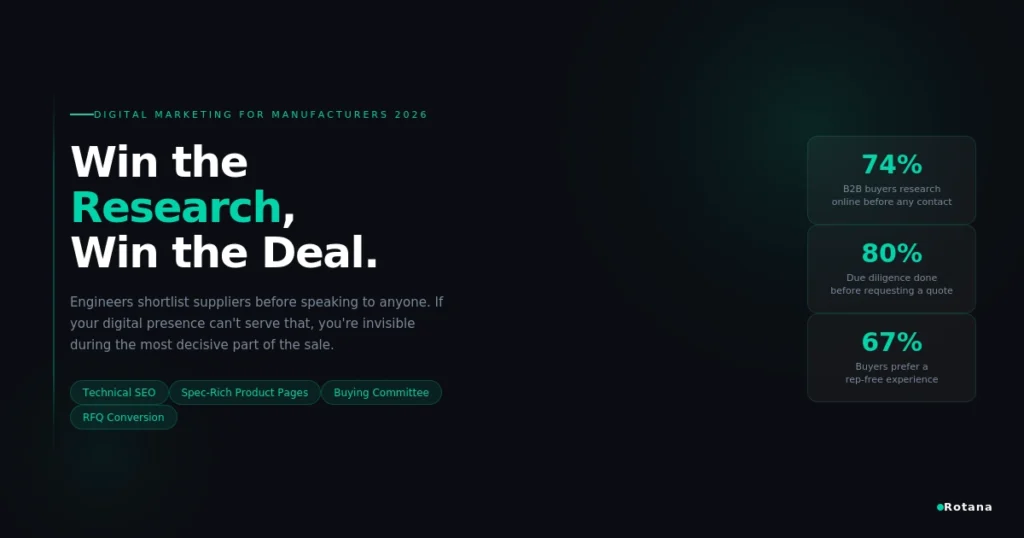
Digital marketing for manufacturers is the work of winning the buyer’s research before a salesperson is ever involved. The industrial buying journey has flipped. Engineers, plant managers and procurement teams now do most of their evaluation online, quietly and shortlist suppliers long before they contact anyone. According to Forrester, 74% of B2B buyers research online before speaking with a supplier and a 2025 Gartner survey found 67% now prefer a rep-free buying experience, up from 61% the year before. Site selectors and engineers complete up to 80% of their due diligence before requesting a quote. If your digital presence cannot serve that self-directed research, you are invisible during the most decisive part of the sale and no amount of sales effort later can recover it.
I run an SEO-led growth agency, so I will keep this focused on execution: the specific digital moves that put a manufacturer in front of technical buyers and convert them into quote requests. This is the digital layer of a broader discipline, so for the full picture including trade shows, distributor relationships and channel strategy, pair this with my guide to manufacturing marketing. Here I focus on the website, technical SEO, content and the channels that actually generate qualified inquiries.
Your product page is your most important asset
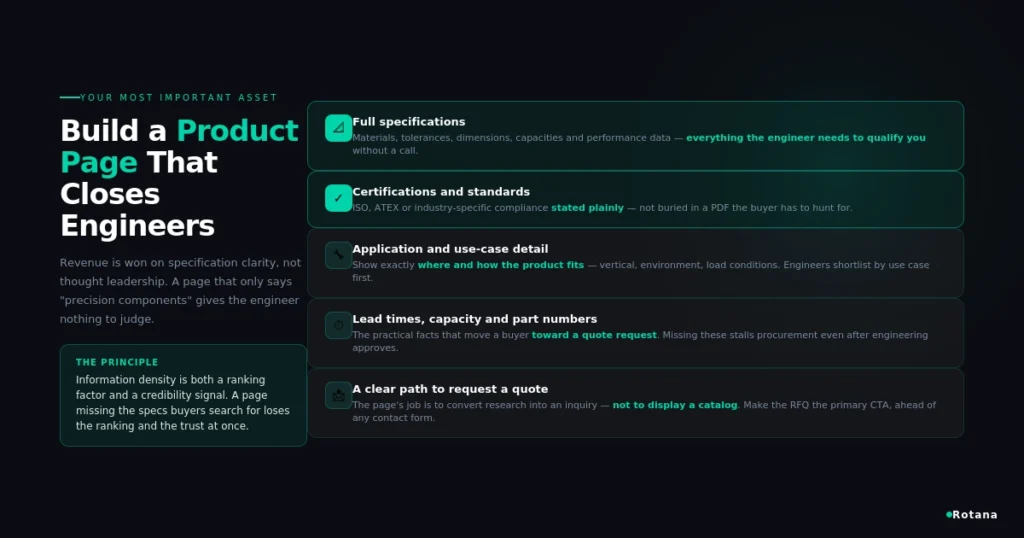
Here is the insight most manufacturers miss: in industrial marketing, the highest-value page is not the blog, it is the product page. Revenue is won on the clarity of your specifications, not on thought-leadership articles that lack technical depth. An engineer evaluating you wants materials, tolerances, certifications, capacity, dimensions and lead times and a page that only says you make precision components gives them nothing to judge. Information density is both a ranking factor and a credibility signal, since a page missing the specs buyers search for loses the ranking and the trust at once. Build every product page to answer a technical buyer completely:
- Full specifications, including materials, tolerances, dimensions, capacities and performance data.
- Certifications and standards, such as ISO, ATEX or industry-specific compliance, stated plainly.
- Application and use-case detail, showing exactly where and how the product fits.
- Lead times, capacity and part numbers, the practical facts that move a buyer toward a quote.
- A clear path to request a quote, since the page’s job is to convert research into an inquiry.
Structure these pages around the exact queries engineers type, like “CNC machined parts manufacturer” or “ISO certified sheet metal fabrication,” rather than around your internal catalog structure. The buyer’s language, not your org chart, decides how the page should be built.
Win technical SEO for how engineers actually search
Industrial SEO is a different craft from consumer SEO because the buyer is analytical and the search is specific. A consumer searches “buy running shoes,” while an industrial buyer searches “double-acting pneumatic valve with ATEX certification.” Ranking for those precise technical terms is how you reach buyers mid-evaluation. Work with your engineering team to gather the real terminology, synonyms and part-level language your customers use, then build spec-rich pages around it. Beyond the pages themselves, industrial search authority comes from sources general SEO ignores: listings in niche directories like Kompass and DirectIndustry, technical case studies and standards-based content that other industry sites and distributors want to link to and facility pages for each plant to capture regional searches. On AI search, the approach that works is the honest one Google itself points to: publish clear, verifiable, specific technical answers with real FAQ content and product data and AI assistants will cite you. There is no trick beyond being genuinely the most useful, specific source. This technical-search work is what I focus on through our SEO consultancy service.
Market to the whole buying committee
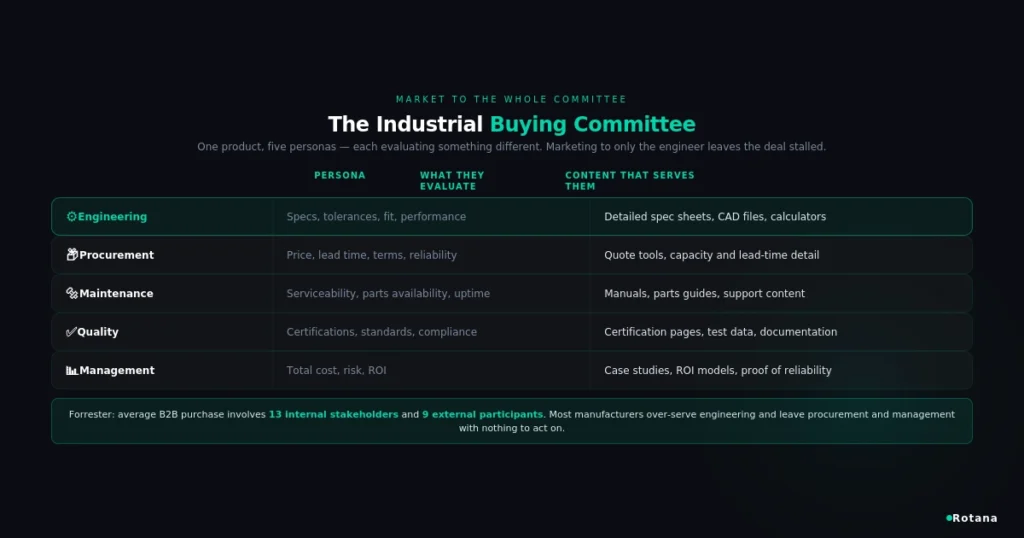
A single industrial product can involve many decision-makers and they do not all care about the same things. Research from Forrester puts the modern B2B purchase at an average of 13 internal stakeholders and 9 external participants and a single product often has five or more distinct personas evaluating it. Marketing to only the engineer or only the buyer, leaves most of the committee unconvinced. Map your content to the roles and the stage each is in.
| Persona | What they evaluate | Content that serves them |
|---|---|---|
| Engineering | Specs, tolerances, fit, performance | Detailed spec sheets, CAD files, calculators |
| Procurement | Price, lead time, terms, reliability | Quote tools, capacity and lead-time detail |
| Maintenance | Serviceability, parts, uptime | Manuals, parts guides, support content |
| Quality | Certifications, standards, compliance | Certification pages, test data, documentation |
| Management | Total cost, risk, ROI | Case studies, ROI models, proof of reliability |
Build a content map by role and buying stage, then look for the gaps. Most manufacturers over-serve the engineer with specs and leave procurement and management with nothing to act on, which stalls deals inside the committee.
Turn your website into a self-serve evaluation tool
Since most of the decision happens before a rep is contacted, your website has to let a buyer do real work alone. Industrial buyers now select specifications, build bills of materials and shortlist suppliers on their own and if your site cannot support that, you drop out early. The shift is large: US B2B digital channels now account for roughly 56% of total B2B revenue, up from 32% in 2020 and around 65% of industrial buyers order products online. The most valuable upgrades are not a simple buy button but product data, configurators, downloadable spec sheets and fast quoting. Make requesting a quote the primary action on every product page, ahead of a generic contact form and fix your conversion infrastructure before spending on ads, since traffic sent to a site that cannot convert research into an RFQ is wasted.
Use the channels that reach technical buyers
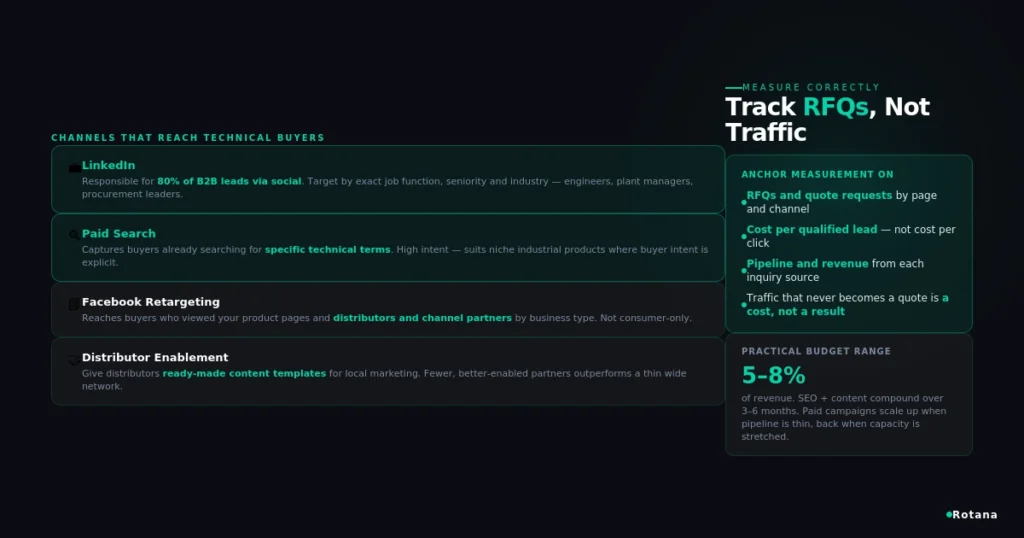
Beyond search, a few channels earn their place in industrial digital marketing. LinkedIn is the dominant B2B social platform, responsible for roughly 80% of B2B leads generated through social media, with a visitor-to-lead conversion rate that outpaces other networks and it lets you target by exact job function, seniority and industry. Paid search captures buyers already looking for specific technical terms, which suits niche industrial products with high intent. Facebook, which most manufacturers dismiss as consumer-only, works well for retargeting buyers who viewed your product pages and for reaching distributors and channel partners by business type. If you sell through distributors, give them ready-made content templates so they can market your products locally and consider the contrarian move some manufacturers are making: narrowing the distributor roster to fewer, better-enabled partners rather than spreading thin across a wide network. The nurture side of this connects to my guide on B2B email marketing.
Do not neglect brand and trust
Most manufacturers over-invest in bottom-of-funnel lead capture and under-invest in the brand and trust that make those leads convert later. That is a mistake the data exposes clearly. Forrester research indicates 92% of B2B buyers begin their journey with at least one vendor already in mind and 41% already have a preferred vendor before they start. When budgets tighten, buyers do not get more adventurous, they gravitate to the supplier that feels lowest-risk, which is usually the one with the clearest documentation, the strongest proof of performance and the simplest evaluation path. Brand awareness and visible proof are what put you in that preferred position before the evaluation even begins, so treat trust-building as demand generation, not decoration. The choice of an agency partner to build this sits in my guide to industrial marketing agencies.
Measure quote requests, not traffic
Around 67% of manufacturing marketers rate their own strategy as only moderately effective and the gap is rarely spend, it is direction. A goal like “more website traffic” is too vague to manage, because traffic that never becomes a quote request is a cost, not a result. Anchor measurement on qualified inquiries: RFQs and quote requests, cost per qualified lead and the pipeline and revenue those inquiries produce. Track which pages and channels generate real quotes, not just clicks, so you can move budget toward what fills the sales team’s pipeline. A practical budget is around 5% to 8% of revenue, with search and content compounding over 3 to 6 months and paid campaigns dialed up when pipeline is thin and back when capacity is stretched.
What I would do first
If you run a manufacturing company and want digital marketing that generates real quotes, work in this order:
- Rebuild your product pages to be spec-rich and structured around the technical terms engineers actually search.
- Fix your website so a buyer can evaluate, configure and request a quote without talking to anyone.
- Build technical SEO authority through niche directories, case studies and facility pages.
- Map content to every persona in the buying committee, closing the gaps beyond engineering.
- Invest in LinkedIn and brand-building proof, not just bottom-funnel lead capture.
- Measure RFQs and qualified pipeline by page and channel, then reinvest where quotes come from.
Digital marketing for manufacturers rewards the company that serves the engineer’s self-directed research, treats the product page as its hardest-working asset and measures success in quote requests rather than traffic. Winning the research wins the deal. If you want that system built for your business, that is the work I do at Rotana. Book a call through the link on the site.
Frequently asked questions
What is the best digital marketing strategy for manufacturers in 2026?
The strongest approach serves the buyer’s self-directed research, since most of the industrial decision now happens online before a rep is contacted. That means spec-rich product pages built around the exact technical terms engineers search, technical SEO authority, a website that lets buyers evaluate and request quotes on their own and content mapped to the whole buying committee rather than one persona. LinkedIn and brand-building proof support the process. Success is measured in quote requests and qualified pipeline, not website traffic, so budget follows the channels that actually produce inquiries.
Why are product pages more important than blogs for manufacturers?
Because industrial revenue is won on specification clarity, not thought leadership. When an engineer evaluates a supplier, they need materials, tolerances, certifications, capacity and lead times and a product page dense with that detail both ranks better and builds credibility. A blog article without technical depth does neither. Information density is a ranking and trust signal, so the page that fully answers a technical buyer’s questions outperforms one that speaks in vague marketing terms. Building spec-rich product pages around the queries buyers actually type is the highest-return SEO work most manufacturers can do.
How is industrial SEO different from regular SEO?
Industrial SEO targets specific, technical, multi-stage searches rather than broad consumer queries. A consumer searches “buy running shoes,” while an industrial buyer searches for something like “double-acting pneumatic valve with ATEX certification.” Ranking requires spec-rich pages built on the real terminology engineers and procurement teams use, authority from niche directories like Kompass and DirectIndustry, technical case studies that earn links and facility pages for regional visibility. The buying process spans weeks or months and involves many stakeholders, so the content must serve a committee and a long evaluation rather than a quick single-person decision.
Should manufacturers invest in LinkedIn?
Yes. LinkedIn is the dominant B2B social platform, responsible for roughly 80% of B2B leads generated through social media, with a visitor-to-lead conversion rate that outpaces other networks. Its real advantage for manufacturers is precise targeting by job function, seniority and industry, letting you reach the specific engineers, plant managers and procurement leaders in your buying committee. It works best as a credibility and presence channel, sharing project wins and technical expertise, rather than as a source of instant leads. Facebook complements it for retargeting product-page visitors and reaching distributors.
How do manufacturers measure digital marketing success?
By quote requests and qualified pipeline, not traffic. A goal of more website visits is too vague, since visits that never become inquiries are a cost rather than a result. Track RFQs and quote requests, cost per qualified lead and the pipeline and revenue those inquiries generate, along with which pages and channels actually produce quotes. This lets you shift budget toward what fills the sales team’s pipeline. A typical spend is 5% to 8% of revenue, with SEO and content compounding over months and paid campaigns adjusted to current capacity and pipeline needs.