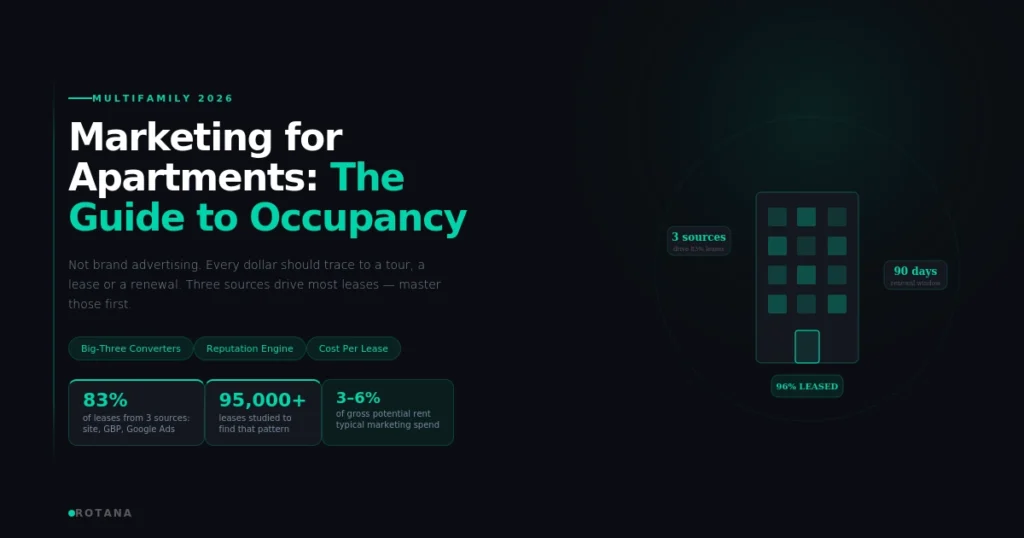
Marketing for apartments is the work of moving a renter from an online search to a signed lease, then keeping them long enough to renew, all measured against one number: occupancy. It is not brand advertising. Every dollar should trace to a tour, a lease or a renewal. Today’s renters start online, usually on Google and most form preferences before they ever contact a leasing office. A study of more than 95,000 leases found that three sources, community websites, Google Business Profiles and Google Ads, together accounted for 83% of all leases signed. Master those three and everything else gets easier.
I run an SEO-led growth agency, so I see properties pour budget into a dozen listing sites while the channels that actually convert sit half-optimized. Apartment marketing rewards focus, speed and reputation, not spread. This guide covers the full system: the renter-journey funnel, the big-three converters, reputation as a multiplier, virtual-first leasing, the often-ignored truth that pricing is marketing and the two playbooks you need depending on whether you are leasing up or stabilized.
Think in a renter-journey funnel
Awareness to tour to lease to renewal
Apartment marketing works best mapped to the renter journey rather than run as scattered tactics. The stages are awareness, where a renter discovers options, consideration, where they compare and tour, conversion, where they apply and sign and retention, where they renew and refer. Mapping each activity to a stage keeps messaging consistent and shows where leads leak. A property with strong traffic but weak leases has a conversion problem, not a traffic problem and the funnel view makes that obvious. Fix the stage that is actually broken instead of buying more leads.
The funnel does not end at move-in
The cheapest occupancy is the resident who renews. Retention sits inside the funnel, not outside it, since a renewal avoids the full cost of marketing, leasing and turning a unit. Treating move-in as the finish line is the most common and most expensive mistake in apartment marketing. The strongest operators work the back half of the funnel as hard as the front.
Master the big-three converters
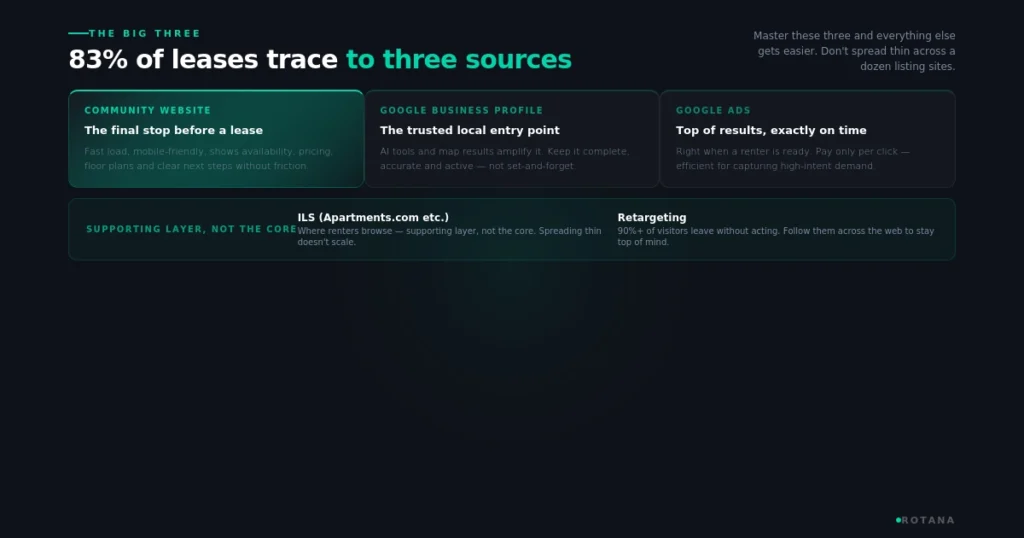
Community website, Google Business Profile, Google Ads
Because three sources drive the large majority of leases, they deserve the majority of attention. Your community website is the top conversion source and the final stop before a lease, so it must load fast, work on mobile and show availability, pricing, floor plans and clear next steps without friction. Your Google Business Profile is the trusted local entry point that AI tools and map results amplify, so keep it complete, accurate and active. Google Ads puts your community at the top exactly when a renter is ready and you only pay per click, which makes it efficient for capturing high-intent demand. Optimizing these three is the work I focus on through our SEO consultancy service.
Use ILS and retargeting with discipline
Internet Listing Services like Apartments.com place you where renters actively browse, but pouring resources into many ILSs at once fragments your budget and does not scale. Use them as a supporting layer, not the core. Retargeting matters because over 90% of website visitors leave without acting, so tailored ads that follow lost visitors across other sites, YouTube and email keep your community top of mind. The discipline is concentration: feed the channels that convert, support them with ILS and retargeting and stop spreading thin.
Reputation is the multiplier
Reviews outweigh ad copy
Prospects trust what residents say more than anything you write. Reviews shape both conversion and local search rankings and they increasingly feed the AI-generated answers renters now see. A property with 200 recent, consistent reviews reads as far more trustworthy than one with a handful of stale ones. The impact is measurable: review management that lifts a rating from 3.2 to 4.1 stars can roughly double organic traffic from a Google Business Profile and cut cost per lease. Most communities dedicate 5% to 10% of marketing budget to reputation for that reason.
Build a review and feedback engine
Make review generation systematic. Ask residents at natural high points, such as after a smooth move-in or a lease renewal, through a short email or a portal prompt. Just as important, capture feedback privately first so your on-site team can resolve a frustration before it becomes a public one-star review. Monitor and respond to every review, flag fraudulent ones and treat resident sentiment as live operational data. Reviews drive leases at the front of the funnel and renewals at the back, so the engine pays twice.
Pricing is marketing too
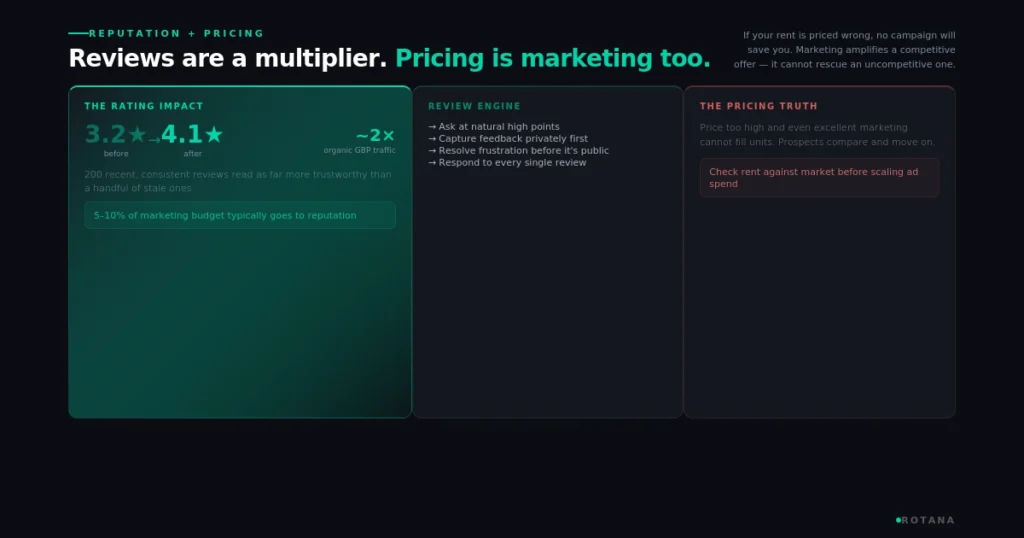
One uncomfortable truth most apartment marketing guides skip: if your rent is priced wrong, no campaign will save you. Revenue-management discipline is a marketing tool. Price too high and even excellent marketing cannot fill units, since prospects compare and move on. Price right and demand flows with far less marketing pressure. Before scaling ad spend on a struggling property, check the rent against the market. Marketing amplifies a competitive offer. It cannot rescue an uncompetitive one and spending more to push overpriced units just raises your cost per lease.
Win with virtual-first leasing
Tour before they talk
Renters now expect to explore a property on their own, on their phone, before speaking to anyone. A virtual-first leasing experience is a competitive necessity, not a nice extra. Listings with virtual tours convert from lead to lease at a meaningfully higher rate and visual content also helps your property surface in AI-powered search. Offer always-on virtual tours for every floor plan, high-quality video walkthroughs and self-guided in-person tours that let a renter explore without a leasing agent hovering. Removing pressure and friction from touring moves more prospects toward signing.
Speed to lead and smart follow-up
The renter who tours is not the renter who signs unless you respond fast. Speed to lead is a core challenge and automation solves much of it: a 24/7 chatbot captures and answers inquiries instantly and automated follow-up by SMS, email or the renter’s own channel nurtures prospects who are not ready yet. Good marketing brings the lead. Smart, fast follow-up signs the lease. A property that responds in minutes converts far more of the traffic it already pays for.
Two playbooks: lease-up versus stabilized
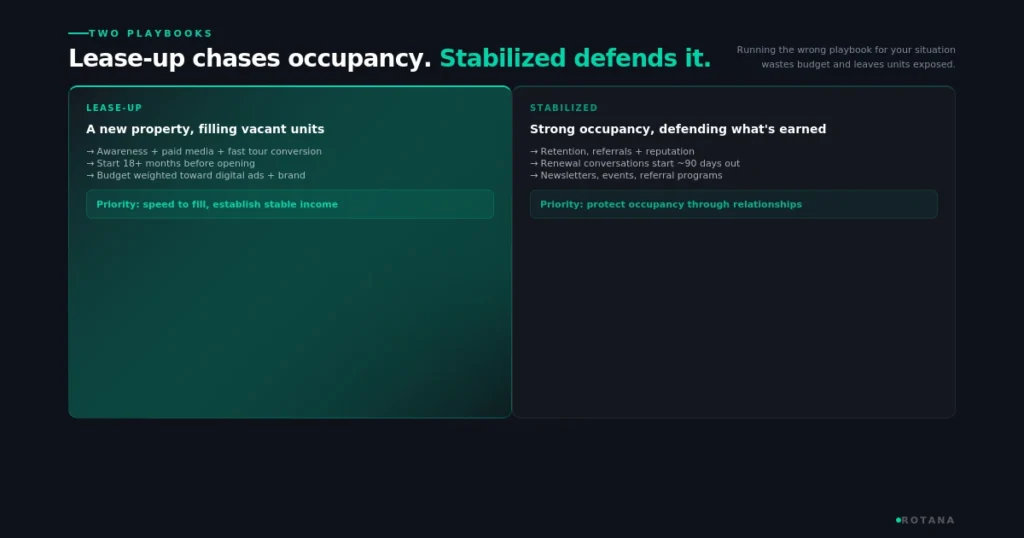
The lease-up playbook
A new property filling vacant units needs a different plan than a full one. Lease-up marketing introduces a brand and an experience renters have never seen, so it leans heavily on awareness, paid media and fast tour conversion to fill units quickly. Start early, often 18 months or more before opening, since starting late hurts the property’s whole trajectory. Budget weights toward digital ads and brand campaigns in this phase and the priority is speed: build awareness, generate qualified leads, convert them to leases and establish stable income.
The stabilized playbook
A property at strong occupancy shifts the budget toward retention, referrals and reputation, which keep occupancy high without overspending. Renewal campaigns should start the conversation around 90 days out, reminding residents why they love living there before they consider moving. Resident newsletters, community events and referral programs turn satisfied residents into renewals and into trusted new leads. Re-engaging cold leads with a “what’s new” update can revive interest at low cost. The stabilized property defends occupancy through relationships, while the lease-up chases it through awareness.
Measure occupancy and cost per lease
The point is filled units at a sustainable cost, so measure what maps to occupancy. Track occupancy and churn first, then cost per lead, cost per lease, lead-to-lease conversion and resident satisfaction through scores like NPS. Use call tracking and proper attribution so every lease traces to a source, then reallocate quarterly toward what works. Most communities spend roughly 3% to 6% of gross potential rent on marketing, but the percentage matters less than allocation: concentrate on high-intent demand capture, reputation and conversion. A property that knows its true cost per lease by channel makes far better budget decisions than one watching traffic alone.
What I would do first
If you market apartments and want higher occupancy, start in this order. Fix the big three before anything else: a fast, clear community website, a complete Google Business Profile and well-run Google Ads. Build a review engine, since reputation multiplies everything upstream. Check pricing against the market before scaling spend. Add always-on virtual tours and self-guided touring. Tighten speed to lead with a chatbot and automated follow-up. Then run the right playbook for your situation, awareness and paid for a lease-up, retention and referrals for a stabilized property and measure occupancy and cost per lease.
Apartment marketing rewards focus on the channels that convert, reputation that compounds and retention that protects occupancy. The system beats the spend. If you want that system built and tuned to your portfolio, that is the work I do at Rotana. The nurture and retention side sits in my guides to real estate email marketing and email marketing lead generation. Book a call through the link on the site.
Frequently asked questions
What is the best way to market an apartment community?
Concentrate on the three channels that drive most leases: a fast, conversion-focused community website, an optimized Google Business Profile and well-managed Google Ads, which together account for the large majority of signed leases. Support them with disciplined ILS listings, retargeting and a strong review engine. Then run the playbook that fits your situation, awareness and paid media for a lease-up, retention and referrals for a stabilized property. Reputation and fast follow-up multiply results across all of it, so they are worth prioritizing early.
How much should apartment communities spend on marketing?
Most communities dedicate roughly 3% to 6% of gross potential rent to marketing, though a 200-unit property often budgets a few hundred thousand dollars annually and lease-ups or highly competitive markets need more. The percentage matters less than allocation. Weight spending toward high-intent demand capture through the big-three converters, reputation management at around 5% to 10% of the marketing budget and conversion improvements. Track cost per lease by channel and reallocate quarterly, since concentrating budget on what converts beats spreading it thin across many listing sites.
Why are online reviews so important for apartment marketing?
Prospects trust resident reviews more than any ad copy and reviews shape both local search rankings and the AI-generated answers renters increasingly rely on. A community with 200 recent, consistent reviews reads as far more trustworthy than one with a few stale ones. The effect is measurable, with a rating improvement from 3.2 to 4.1 stars able to roughly double Google Business Profile traffic and lower cost per lease. Reviews drive leases at the front of the funnel and renewals at the back, so a review engine pays off twice.
What is the difference between lease-up and stabilized apartment marketing?
A lease-up fills a brand-new property, so it leans on awareness, paid media and fast tour conversion to fill units quickly, ideally starting 18 months or more before opening. A stabilized property at strong occupancy shifts budget toward retention, referrals and reputation to defend occupancy without overspending, with renewal conversations starting about 90 days out. The lease-up chases occupancy through awareness, while the stabilized property protects it through relationships. Running the wrong playbook for your situation wastes budget and leaves units exposed.
How do you reduce apartment vacancy through marketing?
Start by confirming rent is priced competitively, since no campaign fills overpriced units. Then concentrate spend on the big-three converters, add always-on virtual tours that lift lead-to-lease conversion and tighten speed to lead with a chatbot and automated follow-up so you convert the traffic you already pay for. On the retention side, run renewal campaigns 90 days out and a referral program to keep occupancy high. Measuring cost per lease by channel reveals where to reallocate budget for the biggest occupancy gain.