

Starting a marketing business means turning skills you already have into a service company that sells those skills to clients who need them. The path is more open than most people think. Small businesses need marketing help more than ever, yet most cannot afford a full agency or a senior in-house hire and that gap is exactly where a new marketing business thrives. You can start as a solo freelancer, a consultant or a small agency, often while still holding a job, since 55% of freelancers also work full-time. The hard part is not the idea. It is the sequence of decisions that turn expertise into a paying business.
I run a marketing business, so I will give you the practical version rather than the motivational one. The founders who build something real do not have more talent than the ones who stall. They have structure: a clear niche, a defined model, honest pricing and a repeatable way to win clients. This guide walks through that sequence, from choosing what kind of business to run, through landing your first clients, to scaling past the point where you do everything yourself.
Choose your business model first
Freelancer, consultant or agency
“Marketing business” covers three different models and choosing yours shapes every later decision. A freelancer sells execution, doing the work directly for clients and trading time for money. A consultant sells advice and strategy, diagnosing problems and guiding the fix, usually at higher rates. An agency builds a team to deliver work at scale, which raises revenue potential but adds management. Many founders begin solo as a freelancer or consultant, then grow into an agency once demand is proven. Pick the model that matches your strengths now, knowing you can evolve later.
Decide what you actually sell
Within your model, define the specific services you offer rather than “marketing.” Clear, packaged services make it easier for a client to understand what they are buying and easier for you to deliver consistently. A vague “we do marketing” offer is hard to price, scope and sell. Whether it is SEO, paid ads, content, social media or email, name it plainly. Specificity at this stage removes friction from every sales conversation that follows.
Niche down to stand out
Why specialists win
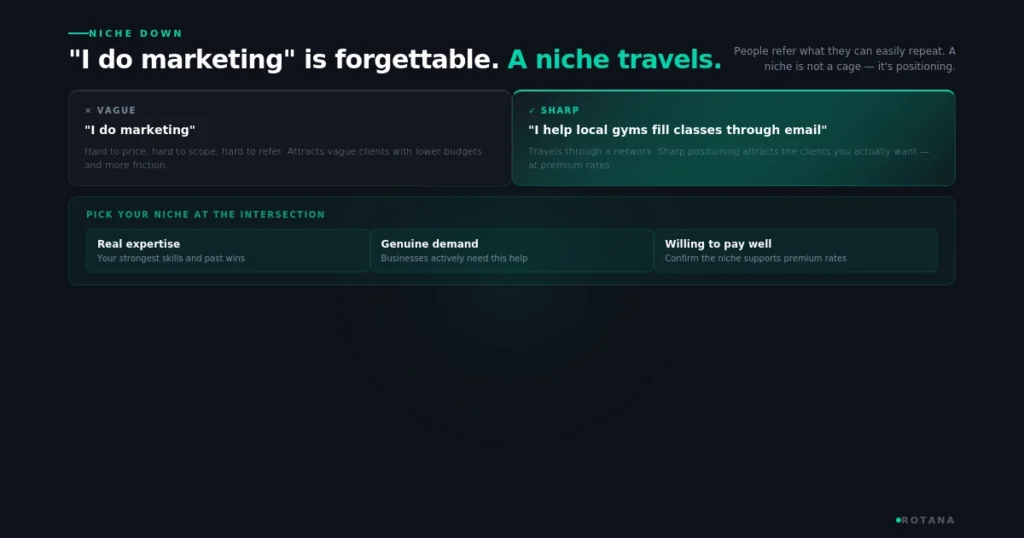
Trying to serve “any business that needs marketing” makes you vague and forgettable. Niching down does the opposite: it sharpens your message, makes referrals easier and lets you charge premium rates. Clients want a specialist, not a generalist who is master of none. A consultant who says “I help local gyms fill classes through email” travels much further than one who says “I do marketing,” because people refer what they can easily repeat. A niche is not a cage. It is positioning and in this business positioning is everything.
How to pick one
Choose a niche at the intersection of three things: your real expertise, genuine market demand and clients willing to pay well. List your strongest skills and past wins, check that businesses actively need that help and confirm the niche can pay premium rates. You can niche by skill, like SEO or paid social or by industry, like dental practices or B2B software. Both work. The familiarity you build serving one type of client becomes an edge that a generalist competitor cannot match, since you already speak their language and know their problems.
Define your positioning
Strong positioning answers three questions in your client’s own words. Who do you serve? Pick a specific type of organization or situation, not “mid-sized companies.” What problem do you solve? Clients do not buy services, they buy relief from a specific pain, so name it precisely. What outcome do you deliver? Describe what is measurably different for the client six months after working with you. The more specific your answers, the easier every downstream marketing decision becomes. Vague positioning attracts vague clients with lower budgets and more friction, while sharp positioning attracts the clients you actually want.
Set pricing that reflects value
The four pricing models
You have four ways to charge and they are not equal. Hourly is transparent but caps your income at the hours you can work, with marketing rates often running from around $40 an hour for a beginner up to $65 to $300 for an established expert. Project-based charges a fixed fee for a defined deliverable. Retainer is a fixed monthly fee for ongoing work and is the foundation of a stable business. Value-based ties your fee to the financial impact you create, often 10% to 20% of the value delivered and it is the most profitable once you can prove results. Price for the value you deliver, not the time you spend.
Avoid the underpricing trap
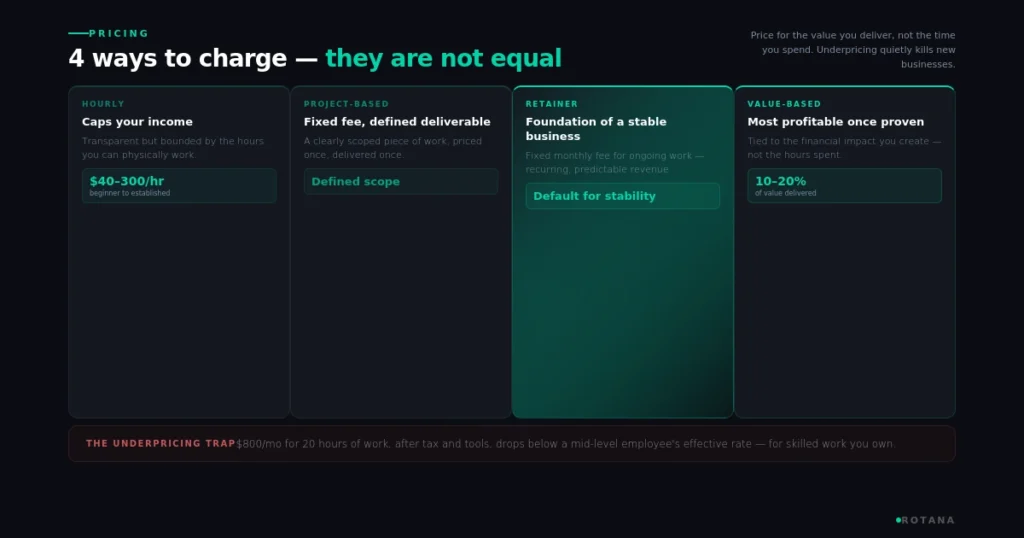
New owners routinely charge too little, which quietly kills the business. Take a client at $800 a month for work that eats 20 hours and after self-employment tax and tool costs your effective rate drops below that of a mid-level employee, for skilled professional work you own. Worse, budget-constrained clients are often the most demanding, compensating a low fee with heavy time requests. Start at a defensible rate, raise it as your proof grows and walk away from work that cannot be profitable. Pricing discipline protects both your income and your sanity.
Land your first clients
Start with the network you already have
Your first clients almost always come from people who already know you, so mine your existing network before spending on ads or cold outreach. Warm introductions convert far better than cold pitches. Tell former colleagues, managers and industry contacts that you now offer marketing help and be specific about who you serve, since a clear message is easy to pass along. One strong, specific message about the niche you serve will travel through a network far better than a broad claim about marketing in general.
Create proof when you have none
Clients hire those who can demonstrate results and a single strong case study can carry your entire first year. If you lack client results yet, create them: offer a discounted or small pilot project to a business in your niche, then document the outcome with real numbers. Gather short testimonials from anyone you have helped. Over time your portfolio becomes your most persuasive sales tool. Treat proof as a priority from day one, not something you hope to accumulate later, because evidence is what turns a cautious prospect into a client.
Build a simple, findable presence
Set up enough of a professional presence that prospects can find and vet you: a focused profile, a few posts about your niche and an active presence where your clients gather. Then send a small number of personalized outreach messages each week to businesses that fit your specialty. A marketing business that produces no marketing for itself is invisible to its best prospects, the people searching for exactly what you offer. Spend a couple of hours a week on your own visibility, the same content-led approach behind our content strategy service, since practicing what you sell is also your strongest proof.
Handle the business basics
Keep the operational setup lean at the start. In the United States, an LLC is the standard structure for a solo owner, with formation costing roughly $50 to $500 depending on the state and it provides liability protection. Put a solid contract in place for every engagement to protect the relationship and define scope. Track income and set aside money for taxes, remembering that net self-employment earnings of $400 or more require filing. You do not need perfect systems on day one. You need enough structure to operate professionally and protect yourself, then you refine as you grow.
Turn projects into retainers, then scale
Retention is the stable foundation
A pile of one-time projects is exhausting and unpredictable. The goal after a first engagement is to turn it into an ongoing relationship, since retained clients give a marketing business stable, recurring revenue. Many one-time projects become retainers when handled well and happy clients also bring referrals, the cheapest growth there is. Communicate clearly, deliver reliably, then ask satisfied clients whether colleagues could use the same help. Retention and referrals together build a business that does not start from zero every month.
Scale without burning cash
Once demand is steady, scale carefully. Document your repeatable processes, how you onboard, scope, run discovery and follow up, so the work does not live only in your head. To take on more without hiring too soon, outsource specific tasks to other freelancers, paying a contractor a portion of what you bill so your time goes to higher-value work. Delay full-time hires until revenue clearly supports them and trial contractors before committing. Systems and selective outsourcing let you grow capacity while protecting the margin that keeps the business alive.
Avoid the three common traps
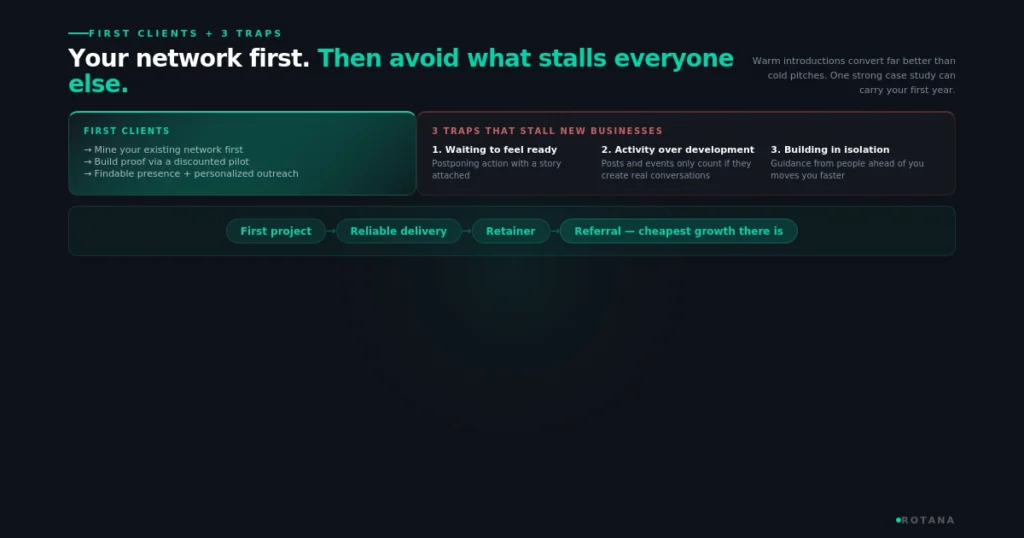
Three mistakes stall most new marketing businesses. The first is waiting until you feel ready, which is usually just postponing action with a story attached, since most real businesses started before the website was perfect or the confidence was full. The second is confusing activity with business development: posting on LinkedIn and attending events feel productive but only matter if they create real conversations with real buyers, so measure conversations, not content. The third is building in isolation, trying to figure everything out alone when guidance from people who have done it would move you faster. Start before you feel ready, chase conversations over activity and learn from others ahead of you.
What I would do first
If you want to start a marketing business, start in this order. Choose your model, freelancer, consultant or agency and name the specific services you sell. Pick a niche at the intersection of your expertise and real demand, then write positioning that names who you help and the outcome you deliver. Set value-reflecting pricing and refuse the underpricing trap. Mine your network for the first clients and create proof through a pilot if you must. Put a lean legal and contract setup in place. Then turn projects into retainers and scale through systems and outsourcing.
A marketing business rewards structure over hustle: a clear niche, a defined model, honest pricing and a repeatable way to win and keep clients. The founders who win are not the most talented, they are the most deliberate. If you want to see how I think about the agency version specifically, read my guide on how to start a digital marketing agency and for the positioning side, my piece on becoming an email marketing consultant. Book a call through the link on the site.
Frequently asked questions
How do I start a marketing business with no experience?
It is harder without experience but possible. Start by building real skills in one focused area, then create proof by working on your own presence, helping a friend’s business or offering a discounted pilot to one or two clients and documenting the results. A simple portfolio of even mock or pilot campaigns gives prospects something to judge. Most successful founders begin as freelancers or in-house marketers who already understand how the work functions, so gaining hands-on experience first, even on small projects, makes the launch far smoother.
How much does it cost to start a marketing business?
A marketing business is cheap to start compared with most ventures, since the main asset is your skill. In the United States, forming an LLC costs roughly $50 to $500 depending on the state and beyond that you need basic tools, a simple website and contract templates. Many founders start as a side business while keeping a job, which removes income pressure early. The real investment is time spent building proof and winning the first clients, not upfront capital, which keeps the financial risk low.
How do I get my first marketing clients?
Start with your existing network, since warm introductions convert far better than cold outreach. Tell former colleagues, managers and contacts that you now offer marketing help and be specific about who you serve, because a clear message is easy to refer. If you lack results to show, create them with a discounted pilot project for a business in your niche, then document the outcome with real numbers. One strong case study can carry your first year, so treat building proof as an early priority rather than an afterthought.
How much should I charge when starting a marketing business?
It depends on your model and proof of results, but avoid underpricing, which quietly kills new businesses. Marketing rates often run from around $40 an hour for a beginner to $65 to $300 for established experts, though hourly caps your income. Project, retainer and value-based pricing usually serve a business better, with value-based fees tied to the impact you create being the most profitable once you can prove results. Start at a defensible rate, raise it as your case studies grow and decline work that cannot be profitable.
Should I start as a freelancer, consultant or agency?
Most founders start solo as a freelancer or consultant, then grow into an agency once demand is proven. A freelancer sells execution and trades time for money, a consultant sells strategy at higher rates and an agency builds a team for scale but adds management overhead. Choose the model that fits your current strengths and goals, knowing you can evolve. Starting lean as a solo operator, often alongside a job, lets you validate demand and build proof before taking on the cost and complexity of a team.