
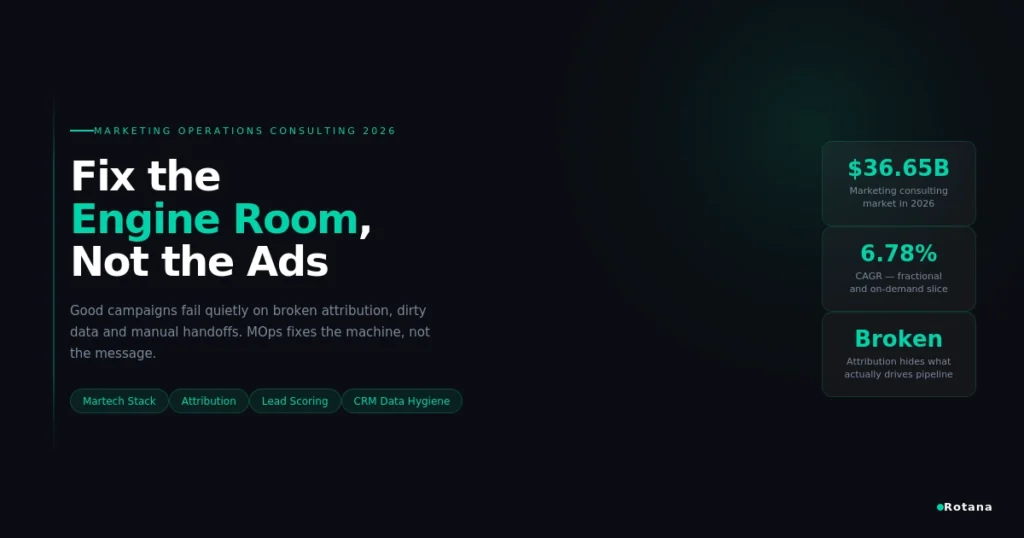
Marketing operations consulting is outside expertise that fixes the engine room of your marketing: the data, systems, processes and technology that decide whether your campaigns actually convert and whether you can trust a single number on your dashboard. It is not strategy work and it is not creative. A marketing operations consultant works on the machine itself, the CRM that talks to your automation platform, the attribution that reflects real sources, the lead scoring and routing that get the right lead to the right rep. Most companies that hire one do not have a strategy problem. They have an operations problem: good campaigns quietly failing on broken attribution, dirty data and manual handoffs.
I run an SEO-led growth agency, so I see this constantly. A company pours budget into demand generation, then loses half the return because leads sit unrouted, the dashboard cannot be trusted and the team spends its week copying data between tools by hand. The strategy was fine. The plumbing was broken. This guide covers what marketing operations consulting actually includes, how it differs from general marketing consulting, when you need it, the delivery models and their costs and how to choose the right one.
What marketing operations consulting includes
Marketing operations, often shortened to MOps, spans people, process and technology. A consultant in this field audits and rebuilds the parts that make marketing run efficiently and prove its return. The typical scope:
- Martech stack audit and optimization, untangling the six overlapping tools that do not talk to each other and making the stack work as one system.
- Marketing automation setup and cleanup, configuring or fixing platforms like HubSpot, Marketo or Salesforce so campaigns run reliably.
- CRM and data hygiene, cleaning the inconsistent, duplicated records that make every downstream report wrong.
- Lead scoring and routing, so the right lead reaches the right rep quickly instead of leaking out of the funnel.
- Attribution and reporting, building models that reflect actual sources so you can trust the numbers and act on them.
- Process and workflow design, replacing manual, error-prone handoffs with repeatable operations that scale.
- Sales and marketing alignment, connecting the two systems so pipeline is visible end to end.
The through-line is trust and efficiency. Good marketing operations mean you can believe your data, move campaigns faster and see clearly which spend produces pipeline.
Marketing operations consulting versus general marketing consulting
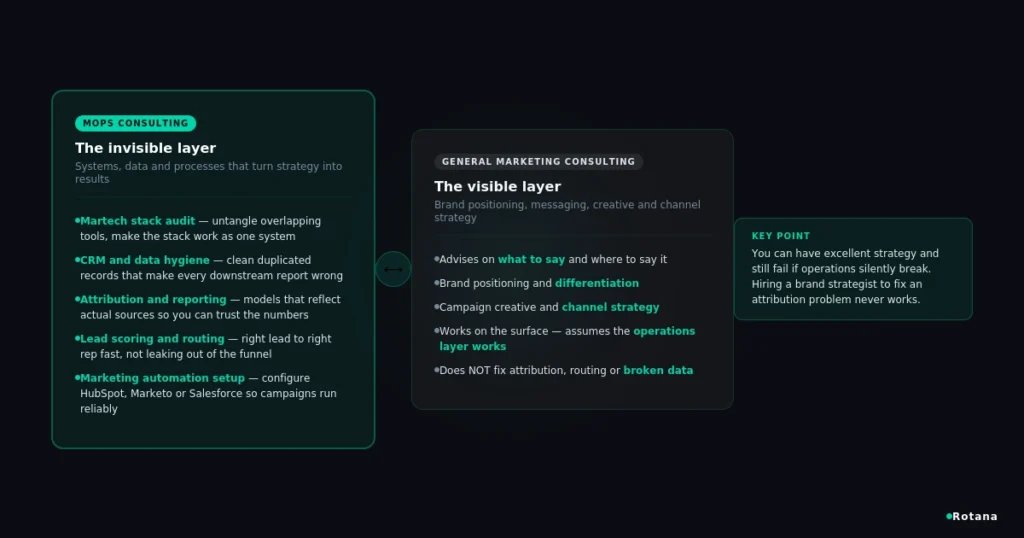
This distinction trips up a lot of buyers and getting it wrong wastes money. A general marketing consultant advises on the visible layer: brand positioning, messaging, campaign creative, channel strategy. A marketing operations consultant works on the invisible layer underneath: the systems, data and processes that turn that strategy into results. One tells you what to say and where to say it. The other makes sure that when you say it, the leads get captured, scored, routed and measured correctly. You can have the sharpest strategy in your market and still lose, because the operations layer silently drops the ball. That is why operations consulting exists as its own discipline and why hiring a brand strategist to fix an attribution problem never works.
When you need a marketing operations consultant
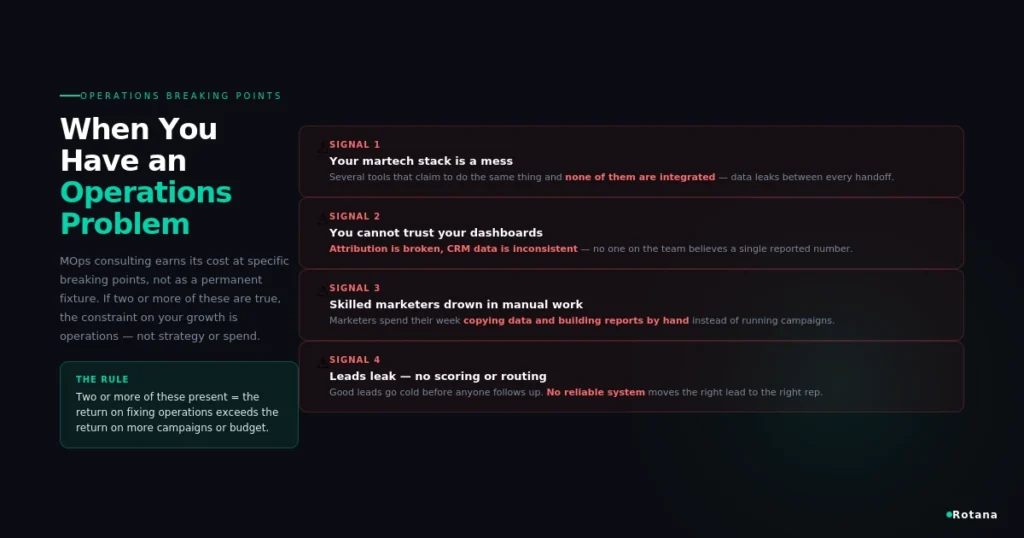
Marketing operations help earns its cost at specific breaking points rather than as a permanent fixture. The clearest signals that you have an operations problem:
- Your martech stack is a mess. You have several tools that claim to do the same thing and none of them are integrated.
- You cannot trust your dashboards. Attribution is broken, CRM data is inconsistent and no one believes a single reported number.
- You outgrew your old playbook. What worked at your last stage broke as you scaled and manual processes cannot keep up.
- Your team drowns in manual work. Skilled marketers spend their time copying data and building reports by hand instead of running campaigns.
- Leads leak. There is no reliable scoring or routing, so good leads go cold before anyone follows up.
If two or more of these are true, the constraint on your growth is operations, not strategy or spend and that is exactly what this work fixes.
The delivery models and what each costs
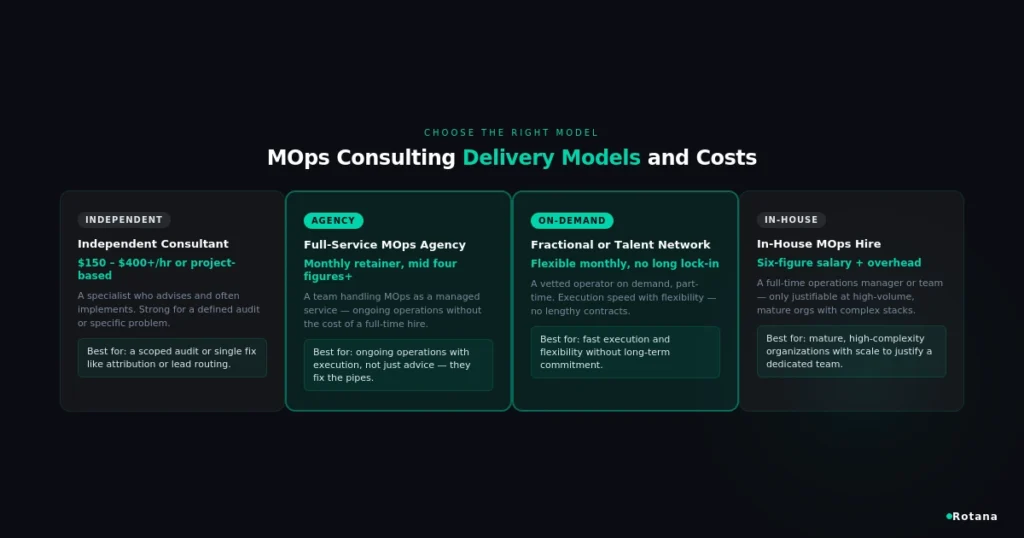
Marketing operations expertise comes in several forms, each with a different price and trade-off. The marketing consulting market overall is worth roughly $36.65 billion in 2026 and the fractional and on-demand slice is growing fastest, at a projected 6.78% compound annual rate, driven by companies that want results rather than meetings. The main options:
| Model | What it is | Typical cost | Best for |
|---|---|---|---|
| Independent consultant | A specialist who advises and often implements | $150 to $400+ an hour or project-based | A defined problem or audit |
| Full-service agency | A team handling MOps as a managed service | Monthly retainer, often mid four figures up | Ongoing operations without a hire |
| Fractional or talent network | A vetted operator on demand, part-time | Flexible monthly, no long lock-in | Execution speed with flexibility |
| In-house MOps hire | A full-time operations manager or team | Six-figure salary plus overhead | Mature, complex, high-volume orgs |
The important difference is not just price, it is whether you get advice or execution. A traditional consultant may hand you a framework and recommendations you then have to implement yourself, while agencies and on-demand operators roll up their sleeves and fix the pipes. For most companies with a real operations problem, execution matters more than another strategy deck, so favor a model that does the work rather than one that only diagnoses it. This decision mirrors the broader build-versus-buy question I cover in my guide to marketing management service.
How to choose the right one
Once you know you need operations help, match the partner to your situation with a few checks:
- Confirm platform expertise for your exact stack. A Marketo specialist is not automatically a HubSpot specialist, so make sure they know the tools you actually run.
- Buy execution, not just a report. Ask directly whether they implement the fixes or only recommend them and favor the ones who do the work.
- Insist on a revenue focus. The goal is trustworthy attribution and pipeline efficiency, not a tidier dashboard for its own sake, so tie the engagement to a pipeline outcome.
- Scope it tightly first. Start with an audit or a single fix like attribution or lead routing, prove the value, then expand rather than signing a long open-ended retainer.
Where this fits, honestly
A straight answer on where a growth agency like mine fits. Deep marketing operations work, the hands-on administration of Salesforce, Marketo or a complex martech stack, is a specialist function and for that you want a dedicated MOps consultant or a martech-focused firm. What we do at Rotana is the growth engine that sits on top of clean operations: SEO, content and demand generation that a trustworthy operations layer then captures and converts. The two are complementary. If your dashboards cannot be trusted, fix operations first, because pouring demand into a broken system wastes it. The same alignment logic runs through my guides to what a marketing agency is and B2B email marketing, where automation and operations decide whether the campaigns actually perform. If you want help with the growth side once your operations are solid, book a call through the link on the site.
Frequently asked questions
What is marketing operations consulting?
Marketing operations consulting is outside expertise that optimizes the systems, data, processes and technology behind marketing, so campaigns run efficiently and results are measurable. A consultant works on the engine of marketing rather than its strategy or creative, fixing things like martech stack integration, marketing automation, CRM data quality, lead scoring and routing and attribution. The goal is to make marketing trustworthy and efficient, so leaders can believe their dashboards, move faster and see which spend actually produces pipeline. It is a distinct discipline from general marketing or brand advisory.
What is the difference between marketing operations and marketing strategy consulting?
Strategy consulting advises on the visible layer, brand positioning, messaging, creative and channel choices, while operations consulting works on the invisible layer underneath, the systems, data and processes that turn strategy into results. A strategist tells you what to say and where. An operations consultant makes sure that when you run the campaign, leads are captured, scored, routed and measured correctly. You can have excellent strategy and still fail if operations silently break, which is why the two are separate disciplines that solve different problems.
When should a company hire a marketing operations consultant?
When operations, not strategy, is the constraint. The clearest signs are a messy martech stack of overlapping tools that do not integrate, dashboards no one trusts because attribution and CRM data are broken, an old playbook that broke as you scaled, skilled marketers buried in manual reporting and leads leaking because there is no reliable scoring or routing. If two or more of these are true, the return on fixing operations usually exceeds the return on more campaigns or budget, since a broken system wastes whatever you pour into it.
How much does marketing operations consulting cost?
Costs depend on the model. Independent consultants typically charge $150 to $400 or more per hour or a project fee for a defined scope. Agencies offering managed marketing operations usually work on monthly retainers starting in the mid four figures. Fractional and on-demand operators offer flexible monthly arrangements without long lock-in, while a full-time in-house operations hire runs a six-figure salary plus overhead. More important than the rate is whether you are buying execution or only advice, since a framework you have to implement yourself often costs more in the end.
Is marketing operations consulting worth it?
It is worth it when an operations problem is capping your growth, which is common once a company scales past its first playbook. Broken attribution, dirty data and manual handoffs quietly waste marketing spend and hide what actually works, so fixing them often unlocks more return than adding budget or campaigns. The value comes from trustworthy measurement, faster campaign execution and leads that stop leaking. If your dashboards are reliable and your systems run smoothly, you may not need it yet, but if you cannot trust your numbers, it usually pays for itself.