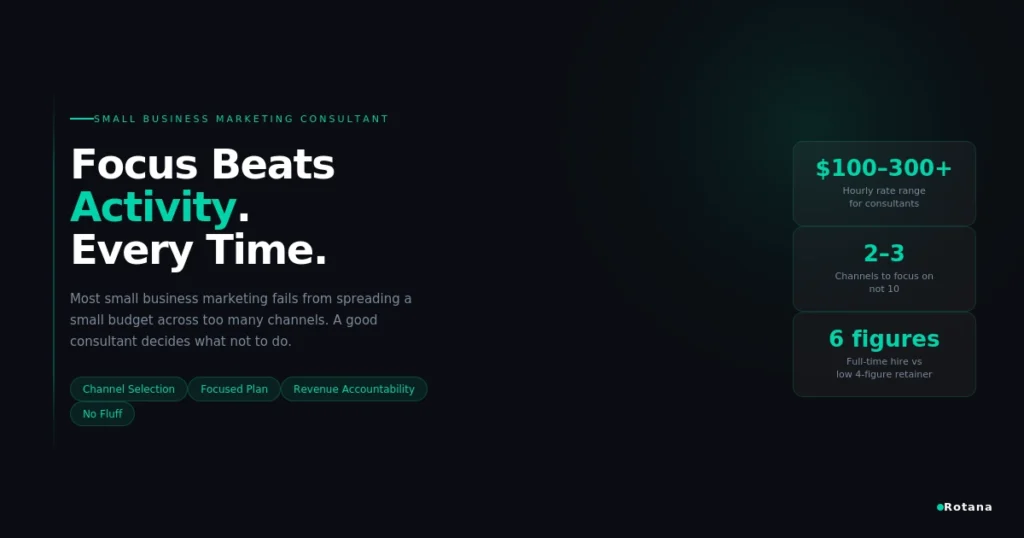
A small business marketing consultant is an outside expert who helps you plan and run your marketing without the cost of a full in-house team. The real job is narrower and more valuable than the usual description suggests. A small business cannot do everything, so the consultant’s most important work is deciding what not to do: which two or three channels deserve your limited budget and which to ignore. Most small business marketing fails not from a lack of tactics but from spreading a small budget across too many of them. A good consultant turns scattered activity into a focused plan tied to actual sales.
I run a growth agency, so I will be straight about where the value is and is not. A consultant who hands you a 30-page plan and disappears has sold you a document, not results. The ones worth paying give you focus and accountability: a short list of the right moves, help executing them and a number to judge them by. This guide covers what a small business marketing consultant actually does, how the option compares to an agency or a fractional leader, what it costs, when to hire one and how to choose.
What does a small business marketing consultant do?
A consultant starts by understanding the business, its customers, goals and current marketing, then builds a plan around the few things most likely to move revenue. The core work usually covers:
- Strategy and positioning, defining who you serve, what makes you different and the message that reflects it.
- Channel selection, choosing the two or three channels, whether SEO, local search, email, social or paid, that fit your customers and budget and dropping the rest.
- A practical plan, turning strategy into a sequence you can actually run rather than a wish list.
- Execution or guidance, either doing the work, coaching your team to do it or managing the freelancers who will.
- Measurement, tracking what each channel returns so budget shifts toward what works.
The thread running through all of it is focus. A consultant who understands small business economics protects your budget from the temptation to be everywhere and points it at the handful of moves that actually generate customers.
Consultant, agency, fractional CMO or DIY?
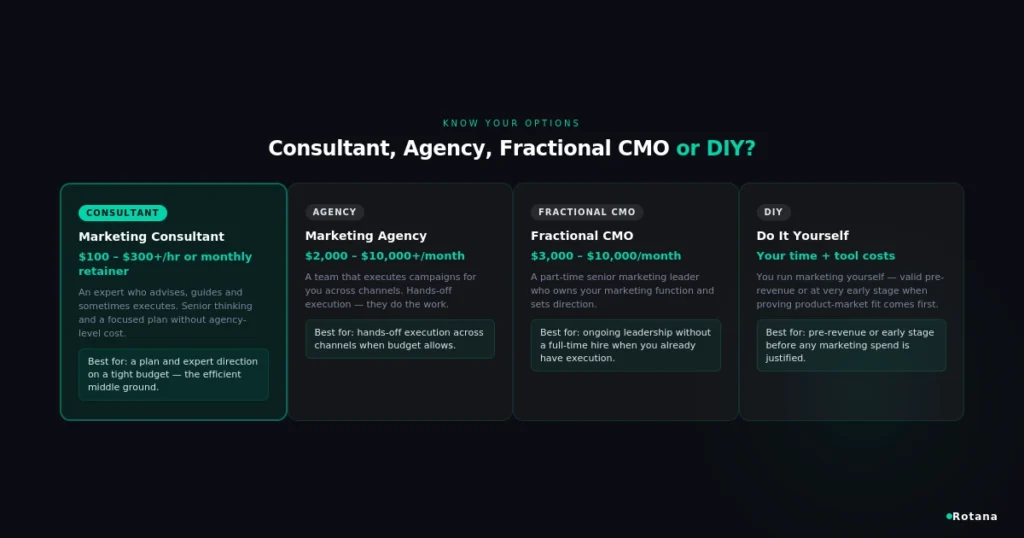
A consultant is one of several ways to get marketing help and the right choice depends on your budget, your stage and how much you want to do yourself.
| Option | What it is | Typical cost | Best for |
|---|---|---|---|
| Marketing consultant | An expert who advises and guides, sometimes executes | $100 to $300+ an hour or a monthly retainer | A plan and expert direction on a budget |
| Marketing agency | A team that executes campaigns for you | $2,000 to $10,000+ a month | Hands-off execution across channels |
| Fractional CMO | A part-time senior marketing leader | $3,000 to $10,000 a month | Ongoing leadership without a full-time hire |
| DIY | You run marketing yourself | Your time plus tool costs | Pre-revenue or very early stage |
The line between them is how much ownership you need. A consultant gives you a plan and direction and often works alongside you. An agency takes execution off your plate. A fractional leader owns the marketing function. For many small businesses the consultant is the efficient middle: senior thinking and a focused plan, without agency-level cost. The build-versus-buy decision behind this sits in my guide to marketing management service.
When a small business should hire a marketing consultant
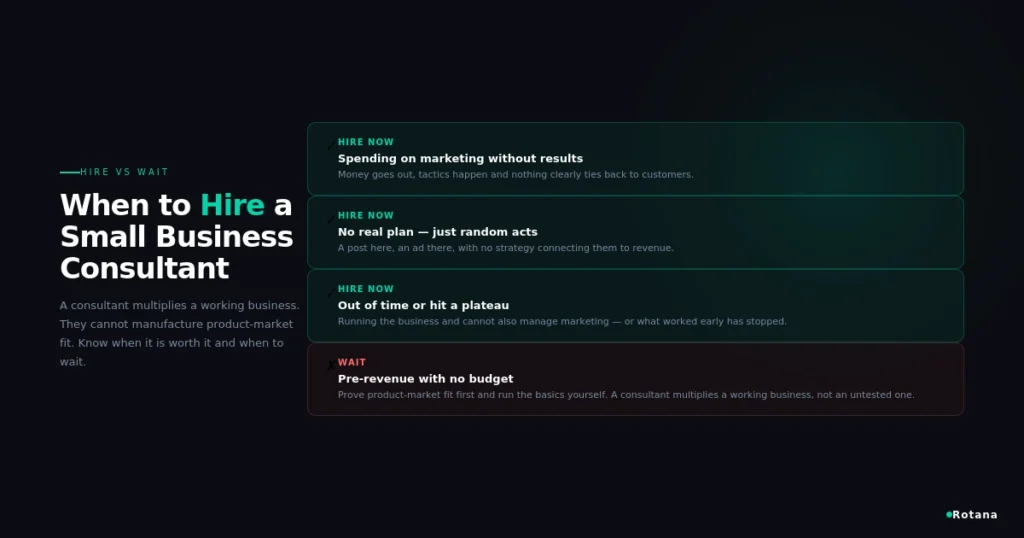
A consultant earns their fee at specific moments rather than all the time. The clearest signals to hire one:
- You are spending on marketing without results. Money goes out, tactics happen and nothing clearly ties back to customers.
- You have no real plan. Marketing is a set of random acts, a post here, an ad there, with no strategy connecting them.
- You are out of time. You are running the business and cannot also learn and manage marketing properly.
- You have plateaued. What worked early has stopped working and you need an outside read on why.
- You are launching or repositioning. A new product or market is worth getting right the first time.
There is also a time not to hire one. If you are pre-revenue with almost no budget or still testing whether anyone wants your product, spend your money proving demand first and run the basics yourself. A consultant multiplies a working business. They cannot manufacture product-market fit.
What a small business marketing consultant costs
Pricing varies by experience and model. Hourly rates commonly run $100 to $300 or more, with seasoned specialists higher. Many consultants also offer project fees for a defined piece of work or monthly retainers that for a small business often fall in the low four figures. Compared with an agency retainer or the cost of a full-time hire, which runs well past six figures a year with benefits and overhead, a consultant is a low-commitment way to get senior expertise. The figure that matters more than the rate is what the engagement returns, so judge it on cost per acquired customer and revenue influenced, not hours billed.
How to choose a small business marketing consultant
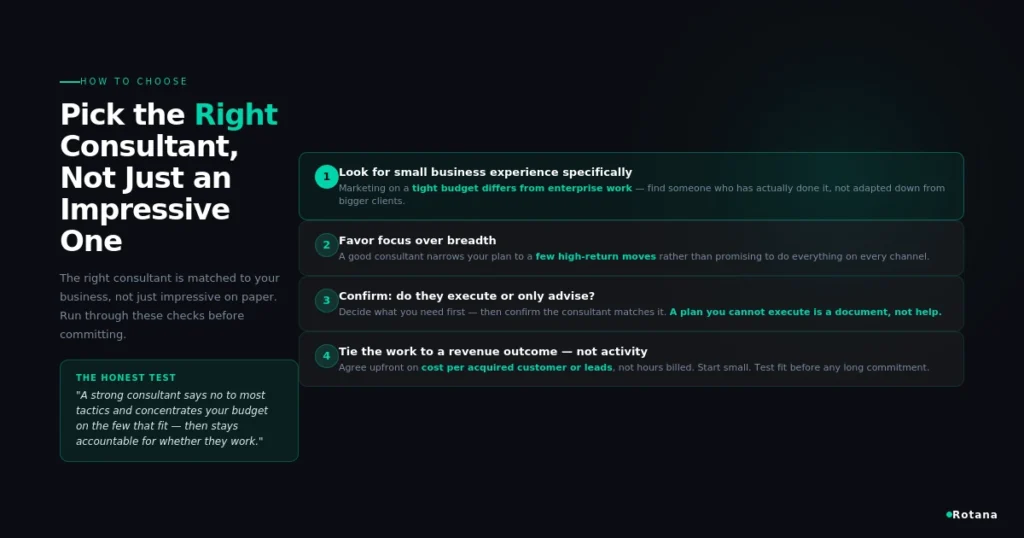
The right consultant is matched to your business, not just impressive on paper. Work through these checks:
- Look for small business experience. Marketing a small business on a tight budget is a different craft from enterprise work, so find someone who has done it.
- Favor focus over breadth. A good consultant narrows your plan to a few high-return moves rather than promising to do everything.
- Ask whether they execute or only advise. Decide if you need someone to do the work or coach your team and confirm the consultant matches that need.
- Tie the work to outcomes. Agree upfront on the business result you are measuring, such as leads or cost per customer, not activity.
- Start small and avoid lock-in. Begin with a short project to test fit before any longer commitment.
The honest test of a good consultant
Here is the simplest way to tell a strong consultant from a weak one. A strong one says no to most tactics and concentrates your budget on the few that fit your business, then stays accountable for whether they work. A weak one says yes to everything, hands over a generic plan padded with every channel and leaves the execution and the risk with you. You are buying focus and accountability, not a document. If a consultant cannot explain in plain terms which two or three things will move your revenue and why, keep looking.
Hiring a consultant is worth it when you need expert direction and focus without the cost of an agency or a full-time hire and when your business is far enough along that better marketing will actually compound. Focus beats activity. At Rotana we work with small and growing businesses as a growth partner and we will tell you honestly whether you need a consultant, an agency or simply to fix a few basics first. If that is the help you want, start with our SEO consultancy service. For related decisions, see my guides to what a marketing agency is and how to start a marketing business. Book a call through the link on the site.
Frequently asked questions
What does a small business marketing consultant do?
A small business marketing consultant helps you plan and run marketing without a full in-house team. They assess your business, customers and current efforts, define your positioning and choose the few channels most likely to generate customers on your budget. From there they build a practical plan and either execute it, coach your team or manage freelancers, while tracking what each channel returns. Their most valuable role is focus: deciding what not to do, so a limited budget goes to the moves that actually drive revenue rather than being spread thin.
How much does a small business marketing consultant cost?
Hourly rates typically run $100 to $300 or more, with experienced specialists charging higher. Many consultants also offer fixed project fees or monthly retainers that for small businesses often land in the low four figures. That is generally far less than an agency retainer or a full-time marketing hire, which costs six figures a year with benefits and overhead. Judge the cost by what it returns, measuring cost per acquired customer and revenue influenced rather than hours billed, since a focused plan should pay for itself.
Is hiring a marketing consultant worth it for a small business?
It is worth it when you are spending on marketing without results, have no real strategy, lack the time to run it well or are launching something new and when your business is established enough that better marketing will compound. A consultant brings senior expertise and, most importantly, focus, concentrating a limited budget on the few channels that work. It is not worth it if you are pre-revenue with no budget or still testing demand, in which case proving product-market fit and running the basics yourself comes first.
What is the difference between a marketing consultant and an agency?
A marketing consultant advises and guides, building your strategy and often working alongside you or your team, while an agency is a team that executes campaigns for you across channels. A consultant is usually the lower-cost, more strategic option, ideal when you need a plan and direction. An agency suits businesses that want execution taken off their plate. Some consultants also execute and some businesses use a consultant for strategy and an agency for delivery. The choice comes down to how much you want done for you versus guided.
How do I choose a small business marketing consultant?
Look for genuine small business experience, since marketing on a tight budget differs from enterprise work. Favor a consultant who narrows your plan to a few high-return moves rather than promising everything and confirm whether they execute or only advise, based on what you need. Agree upfront on the business outcome you will measure, such as leads or cost per customer and start with a short project to test fit before a longer commitment. The best sign is a consultant who can name the two or three things that will move your revenue and explain why.