
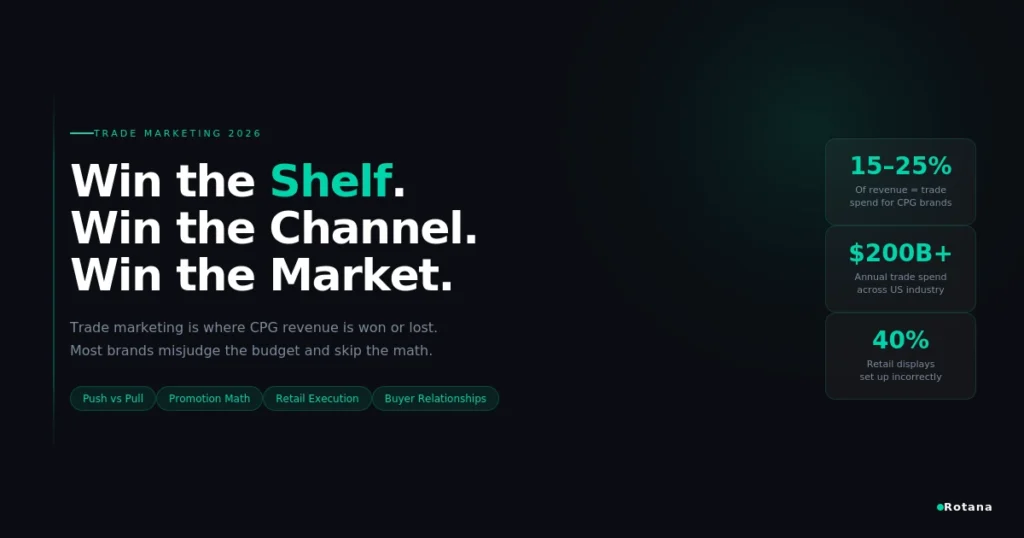
Trade marketing is the discipline of marketing to retailers, distributors and wholesalers, rather than to shoppers, so your product gets stocked, placed well and pushed through the channel. It is business-to-business marketing aimed at the people who decide whether your product earns four facings on the shelf or none at all. The shopper never sees it, but it often decides whether the shopper ever sees your product. For consumer packaged goods brands, this is where a large share of revenue is actually won or lost and it is also the budget most brands misjudge worst.
I run a growth agency, so I will name the thing that surprises people most about trade marketing: it is not a marketing cost in the usual sense, it is closer to a financial discipline. For a growing CPG brand, trade spend commonly runs 15% to 25% of revenue, frequently more than the entire consumer marketing budget and across the US industry it exceeds $200 billion a year, roughly 20% of gross sales and typically the second-largest line on the P&L behind cost of goods sold, according to Strategy& analysis. Spend that large with sloppy math quietly loses money. This guide covers what trade marketing is, how it differs from consumer marketing, the levers you actually pull, the promotion math that decides whether any of it pays off and how the shelf game is changing in 2026.
What is trade marketing?
Trade marketing generates demand at the channel level instead of the consumer level. Retailers and distributors are not just pipes that move your product, they are partners who decide what to stock, where to place it and which promotions to run, so you have to market to them as deliberately as you market to shoppers. The classic way to frame it is push versus pull. Consumer marketing pulls demand from the far end, getting shoppers to want your product. Trade marketing pushes the product through the channel by giving retailers and distributors a financial or operational reason to prioritize you over a competitor. Both matter, since a brand can have shoppers who genuinely want the product and still go nowhere because trade execution is thin and the product is not on enough shelves, placed well.
Trade marketing versus consumer marketing
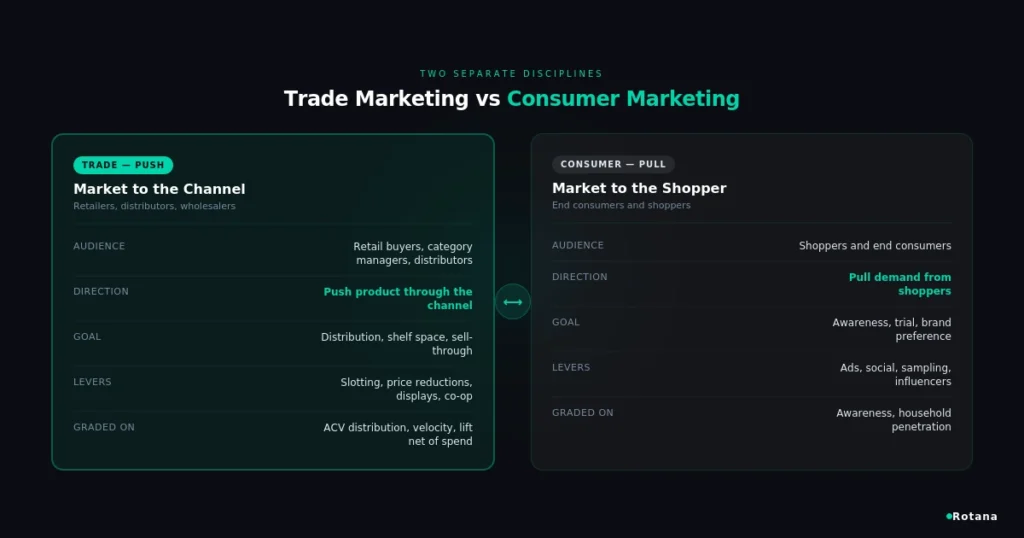
The most useful mental model is that these are two separate disciplines, with separate audiences, separate budgets, separate owners and separate scorecards. Treating them as one is how brands end up layering discounts on top of consumer promotions and eroding their own margins. The contrast:
| Dimension | Trade marketing | Consumer marketing |
|---|---|---|
| Audience | Retail buyers, category managers, distributors | The shopper or end consumer |
| Direction | Push product through the channel | Pull demand from shoppers |
| Goal | Distribution, shelf space, sell-through | Awareness, trial, brand preference |
| Typical levers | Slotting, price reductions, displays, co-op | Ads, social, sampling, influencers |
| Graded on | Distribution (ACV), velocity, lift net of spend | Awareness, household penetration |
The two have to work together. Build consumer demand and trade marketing gets easier, since retailers stock the brands shoppers already ask for, which is why a strong consumer brand is itself a trade asset. That demand-building side is the work I focus on through our content strategy service. Let them operate in silos and you get promotional overlap, disjointed messaging and weaker returns on both.
The levers of trade marketing
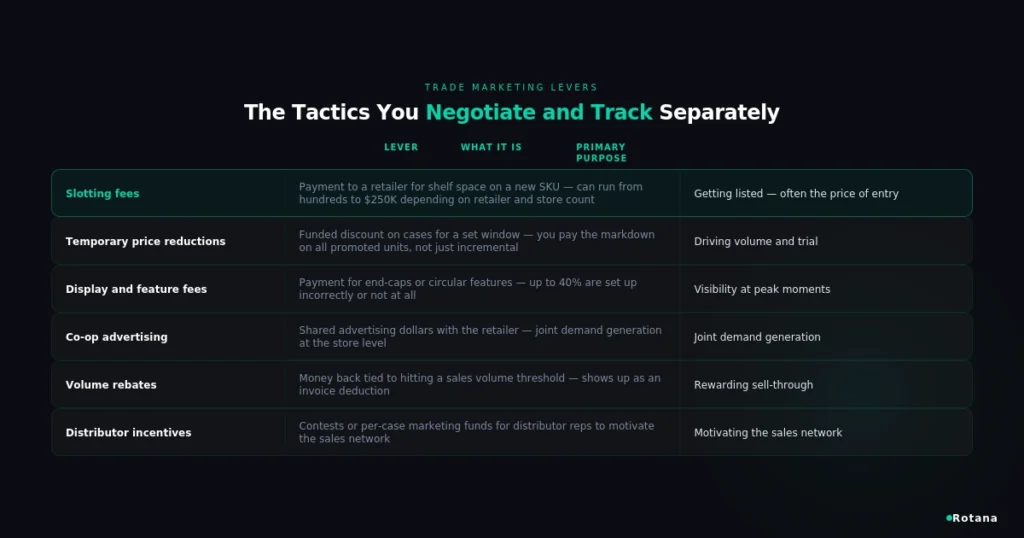
Trade marketing is a bundle of distinct tactics, each negotiated separately with a specific retailer or distributor and each one later shows up as a deduction against your invoices. Knowing what each lever does and what it costs, is the foundation of using them well.
| Lever | What it is | Primary purpose |
|---|---|---|
| Slotting fees | Payment to a retailer for shelf space on a new SKU | Getting listed, often the price of entry |
| Temporary price reductions | Funded discount on cases for a set window | Driving volume and trial |
| Display and feature fees | Payment for end-caps or circular features | Visibility at peak moments |
| Co-op advertising | Shared advertising dollars with the retailer | Joint demand generation |
| Volume rebates | Money back tied to sales volume hit | Rewarding sell-through |
| Distributor incentives | Contests or per-case funds for reps | Motivating the sales network |
Slotting fees alone can run anywhere from a few hundred dollars to $250,000 depending on the retailer, category and store count, which is why getting a new SKU into major retail distribution is one of the hardest things a CPG brand does. For brands that sell through distributors, a common structure is a per-case marketing fund, where the brand and distributor each contribute a set amount per case into a shared pool for local activation.
The promotion math that decides everything
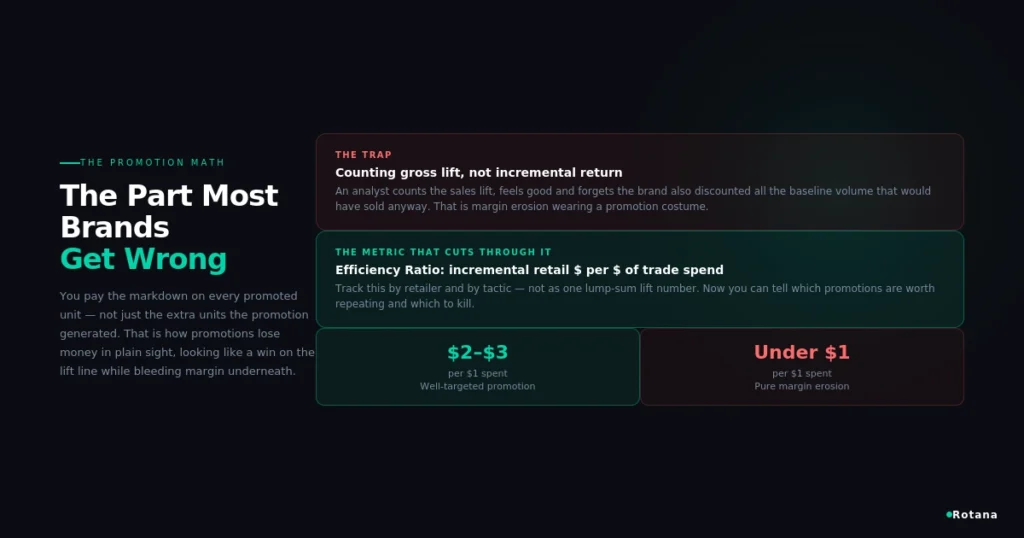
This is the part most brands get wrong and it is the difference between a promotion calendar and an actual promotion strategy. The trap is simple to fall into: when you fund a temporary price reduction, you pay the markdown on every promoted unit, not just the extra units the promotion generated. An analyst counts the sales lift, feels good and forgets that the brand also discounted all the baseline volume that would have sold anyway. That is how plenty of CPG promotions lose money in plain sight, looking like a win on the lift line while bleeding margin underneath.
The metric that cuts through this is the efficiency ratio: incremental retail dollars generated per dollar of trade spend. A well-targeted promotion on the right SKU might pull $2 to $3 of incremental sales for every $1 of trade spend, while a badly targeted one returns less than $1, which is just margin erosion wearing a promotion costume. Track that ratio by retailer and by tactic, not as one lump-sum lift number and you can finally tell which promotions are worth repeating and which to kill. To know any of this, you have to lay your sell-through data, from sources like SPINS or Circana, next to your trade spend, since sales data alone tells you what sold but never what the selling cost.
Execution is where budget quietly dies
A promotion approved on paper still has to happen correctly in the store and often it does not. According to NielsenIQ, up to 40% of retail displays are set up incorrectly or not at all, which wastes the display fee before a single shopper walks by. Display compliance monitoring, knowing whether what you paid for actually showed up at the store level, is one of the most overlooked parts of trade marketing. The brands that win treat execution visibility as seriously as the plan: what is in stock, what was ordered, what is happening in the field and whether the program is working store by store. A brilliant promotion plan with thin execution is just expensive paperwork.
Win the buyer relationship, not just the deal
Underneath the tactics sits the relationship and the brands that consistently earn shelf space treat retailers as partners with problems to solve rather than gatekeepers to push past. The structured version of this is joint business planning, where you sit with a retailer and align your programs to their strategic priorities. Come to those sessions prepared the way a partner would:
- Bring category insights and consumer data, not just a request for space and a discount ask.
- Show how your activations drive store traffic, increase basket size or grow category profit, since those are the retailer’s goals.
- Propose specific programs tied to their promotional windows and seasonal calendar, with the expected lift named.
Retailers want partners who help them win with shoppers. Consistent, well-executed promotions build trust and earn you priority, while late shipments and misaligned inventory erode it fast. Trade promotions are a relationship currency as much as a financial one.
How the shelf game is changing in 2026
Two shifts are reshaping trade marketing. The first is retail media networks. Platforms like Walmart Connect, Kroger Precision Marketing and Target Roundel have turned retailers into advertising businesses, letting brands target shoppers based on actual purchase data, which blurs the old line between trade marketing, shopper marketing and media buying. A modern trade plan increasingly has to account for the retailer’s media network as both a cost and an opportunity. The second is that trade promotion management has moved from a back-office settlement function to the engine of revenue growth management, with software for trade promotion optimization now predicting which promotions will yield the best return before the money is committed. Both shifts point the same way: trade marketing is becoming more data-driven and more central to how CPG brands actually grow.
Measure distribution, velocity and lift net of spend
Because trade marketing has its own job, it has its own metrics and they are not the awareness numbers consumer marketing lives on. Watch distribution, usually expressed as ACV, which measures how widely your product is available weighted by store size. Watch velocity, the rate of sell-through per store, since wide distribution with slow velocity gets you delisted. And watch promotional lift only after you net out the spend, using the efficiency ratio so you are measuring profit, not just movement. Many brands reach real shelf presence with no defined trade budget or tracking, focusing on consumer marketing while neglecting the spend that actually moves product at the point of purchase. The discipline that separates winners is simple to state and hard to do: fund the programs that prove an efficiency ratio above breakeven and cut the ones that do not.
What I would do first
If you run a CPG brand and want trade marketing that builds the business instead of just spending the budget, work in this order:
- Separate your trade and consumer budgets, with distinct owners and scorecards, so they stop cannibalizing each other.
- Connect your sell-through data to your trade spend, so every promotion can be judged on profit, not lift.
- Calculate the efficiency ratio by retailer and tactic, then repeat what clears $2 to $3 per dollar and kill what returns under $1.
- Build display and execution compliance checks, since paid programs that never run correctly are pure waste.
- Prepare for joint business planning with category insights that help the retailer win, not just an ask for space.
- Treat the retailer’s media network as part of the plan and keep building consumer demand so the shelf fight gets easier.
Trade marketing rewards the brand that treats the channel as a partner, runs its promotions on real math rather than lift alone and executes in the store as carefully as it plans on the slide. The math beats the gut feel. If you want help building the consumer demand that strengthens your trade position, that is the work I do at Rotana. The same B2B relationship and channel discipline runs through my guides to manufacturing marketing, B2B email marketing and ecommerce email marketing. Book a call through the link on the site.
Frequently asked questions
What is trade marketing?
Trade marketing is business-to-business marketing aimed at retailers, distributors and wholesalers rather than end consumers, with the goal of getting products stocked, well placed and pushed through the distribution channel. It works as a push strategy, giving channel partners a financial or operational reason to prioritize your product, while consumer marketing pulls demand from shoppers. For consumer packaged goods brands that sell through retail, trade marketing is where a large share of revenue is generated, since a product shoppers want still fails if trade execution keeps it off the shelf.
What is the difference between trade marketing and consumer marketing?
The key difference is direction and audience. Trade marketing pushes product through the channel by marketing to retail buyers, category managers and distributors and is graded on distribution, velocity and promotional lift net of spend. Consumer marketing pulls demand by marketing to shoppers and is graded on awareness and household penetration. They are typically separate budgets with separate owners and scorecards. Both must coordinate, since operating in silos leads to layered discounts and disjointed messaging that hurts returns on both sides.
How much do CPG brands spend on trade marketing?
For a growing CPG brand, trade spend commonly runs 15% to 25% of revenue, often exceeding the entire consumer marketing budget. Across the US industry, trade spending exceeds $200 billion annually, roughly 20% of gross sales and is typically the second-largest line on the P&L behind cost of goods sold, according to Strategy& analysis. Many founders over-index on consumer marketing and underinvest in trade, even though trade spend is what activates the retail distribution where revenue is actually generated.
What are the main trade marketing tactics?
The core levers are slotting fees paid for shelf space on new products, temporary price reductions that fund case discounts, display and feature fees for end-caps and circular placement, co-op advertising that shares ad dollars with the retailer, volume rebates tied to sales and distributor incentives that motivate the sales network. Trade shows and joint business planning sessions support the relationship side. Each tactic is negotiated separately with a specific retailer or distributor and later appears as a deduction against invoices, so each needs its own return justification.
How do you measure trade marketing effectiveness?
Measure distribution as ACV, which weights availability by store size, velocity as the rate of sell-through per store and promotional lift only after netting out the spend. The single most useful number is the efficiency ratio, incremental retail dollars per dollar of trade spend, where $2 to $3 signals a strong promotion and under $1 signals margin erosion. Importantly, a promotion’s real cost includes the markdown on baseline volume that would have sold anyway, not just the incremental units, which is why raw lift alone never tells you whether the spend paid off.