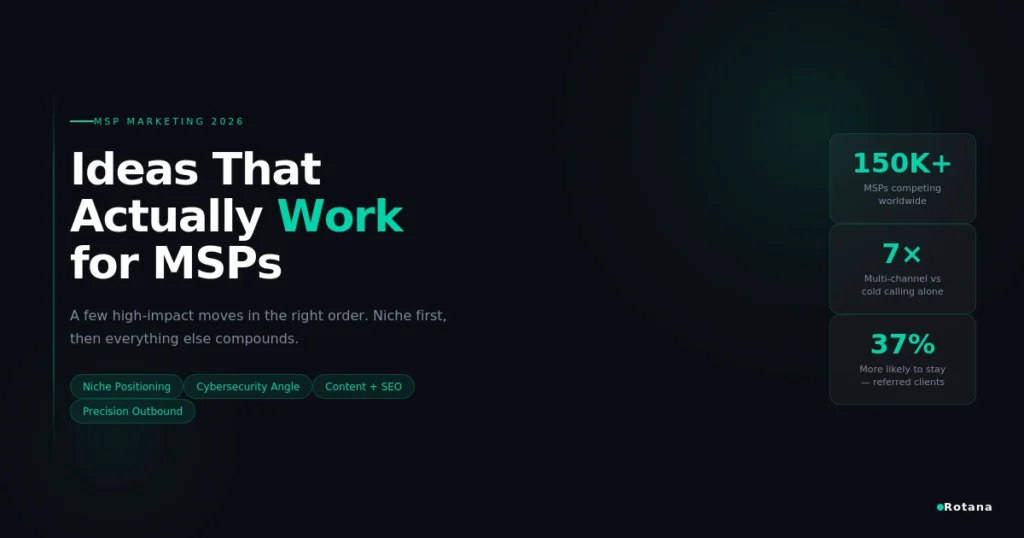
The best MSP marketing ideas are not a list of 30 random tactics. They are a few high-impact moves in the right order, starting with the one decision that makes every other idea work harder. Most managed service providers skip that decision and wonder why their marketing stalls. The market explains why it matters: industry estimates put more than 150,000 MSPs competing worldwide and the overwhelming majority sell an almost identical stack of Microsoft 365, cybersecurity, cloud and helpdesk. Your buyer gets four nearly identical MSP pitches a week. Standing out is not about more tactics. It is about being genuinely different, then marketing that difference consistently.
I run an SEO-led growth agency, so I will be honest about the pattern I see. An MSP owner decides to grow, hires someone to cold call, starts a LinkedIn page that reaches 47 followers, briefs an agency to “do some SEO,” and three months later concludes marketing does not work for MSPs. That is not a marketing problem, it is a sequencing problem: execution before foundation. The ideas below are ordered so the foundation comes first. Work them in sequence and the later ideas compound instead of fizzling.
Idea 1: Niche down, because it multiplies everything else
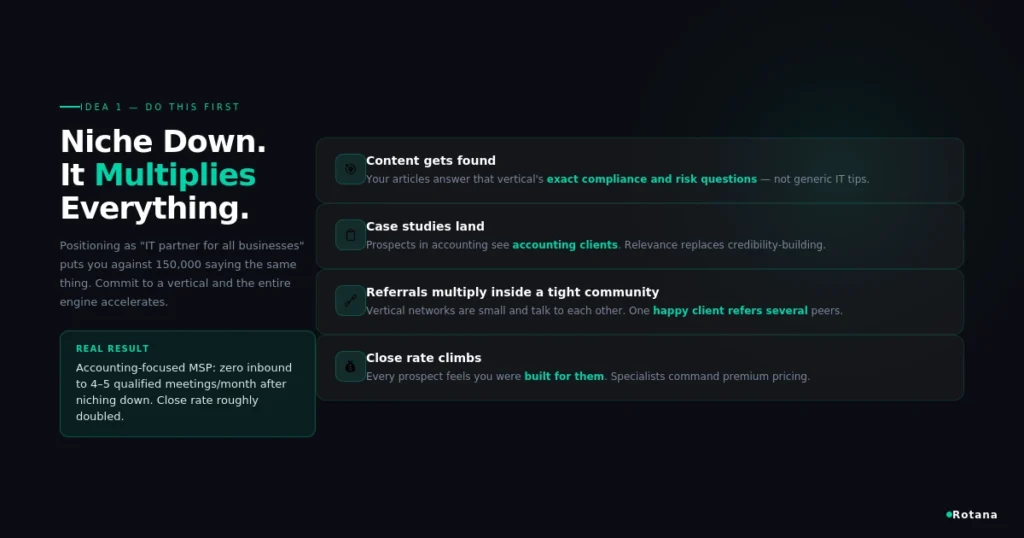
If you do one thing from this list, do this. Choosing a specific vertical or specialization is the single most powerful marketing decision an MSP can make and most refuse to do it out of fear of turning work away. That refusal is exactly the opportunity. When you commit to a niche, the entire engine accelerates: your content gets found because it answers that vertical’s exact questions, your case studies are relevant, your referrals multiply inside a tight community and your close rate climbs because every prospect feels you were built for them. Positioning as the “trusted IT partner for businesses of all sizes” puts you in direct competition with 150,000 others saying the same words.
Pick a niche where you already have wins, real demand and clients who can pay well, such as accounting firms, law practices, healthcare clinics or manufacturers. Specialists command premium pricing and earn trust faster. One MSP-marketing agency, Opollo, documented an accounting-focused MSP that went from zero inbound leads to four or five qualified meetings a month after narrowing to accounting firms and compliance, with its close rate on meetings roughly doubling because prospects arrived pre-qualified by the positioning. The niche is not a cage. It is the multiplier under every other idea here.
Idea 2: Sell cybersecurity and outcomes, not IT support
The MSPs winning in 2026 stopped selling “IT support” and started selling risk reduction and business outcomes. Cybersecurity is now the core differentiator, repositioning you from a help-desk vendor to a strategic partner who protects business continuity. Lead with a security-first, compliance-aware offer, since a law firm or medical practice feels the risk of a breach far more than it feels a slow laptop. Just as important, describe value in outcomes the buyer cares about, not technical specs. “Zero downtime during tax season” lands with an accounting firm. “99.99% uptime SLA” does not. The non-technical owner buying managed IT is buying peace of mind, so sell the absence of the disaster, not the configuration of the firewall.
Idea 3: Turn your website into a conversion machine
Your website is the landing zone for every other idea here, so a weak one means you pay to fill a leaking bucket. The average MSP site converts only about 2% of visitors and most fail on the same things: a generic headline, services described in tech jargon, buried social proof and a single high-commitment contact form. Fix these specifics:
- An outcome-focused headline above the fold naming who you serve and the result, not “Managed IT Services for Business.”
- Social proof in the first scroll, with client logos, review ratings or a concrete result before you ask for trust.
- Outcome-led service pages, each written like a landing page around the business problem it solves, with one clear call to action.
- Multiple low-friction conversion paths, including live chat, a visible phone number, a booking link and a low-commitment offer.
- Fast, technically sound foundations, with sub-three-second load, passing Core Web Vitals, mobile layout and clean structure.
On pricing, a “starting from” range paired with a custom-assessment call to action signals transparency without letting prospects self-select out before you can show value. This conversion and search foundation is the work I focus on through our SEO consultancy service.
Idea 4: Lead with a free assessment offer
The fastest way to turn interest into a conversation is a low-commitment offer that delivers real value first. A free IT or cybersecurity assessment, a compliance gap check or a downloadable security checklist converts far better than a “contact us” form, because it asks for a small yes and gives the prospect something useful in return. For a niche MSP, the assessment doubles as proof of expertise: a security review framed around a vertical’s specific compliance requirements shows the prospect you understand their world before they have spent a dollar. Make this offer the primary call to action across your site, ads and outreach, since it is the wedge that opens the relationship.
Idea 5: Make referrals and partnerships a system, not your only channel
Referrals are the most trusted source of MSP business and referred clients are meaningfully stickier, with one analysis finding customers referred by others are about 37% more likely to stay. The mistake is leaving referrals to chance and depending on them entirely, since a referral pipeline you do not control dries up without warning. Systematize it instead:
- Ask deliberately at moments of high satisfaction and build referral requests into your regular client communication rather than hoping they happen.
- Build partner relationships with complementary, non-competing providers, such as telecom or software vendors, for mutual cross-referrals.
- Offer co-managed IT to win larger clients with internal IT teams, a fast-growing wedge that competitors often ignore.
Treat referrals and partnerships as a reliable channel, then build inbound and outbound alongside them so no single source can sink your pipeline.
Idea 6: Build a content engine around your niche’s questions
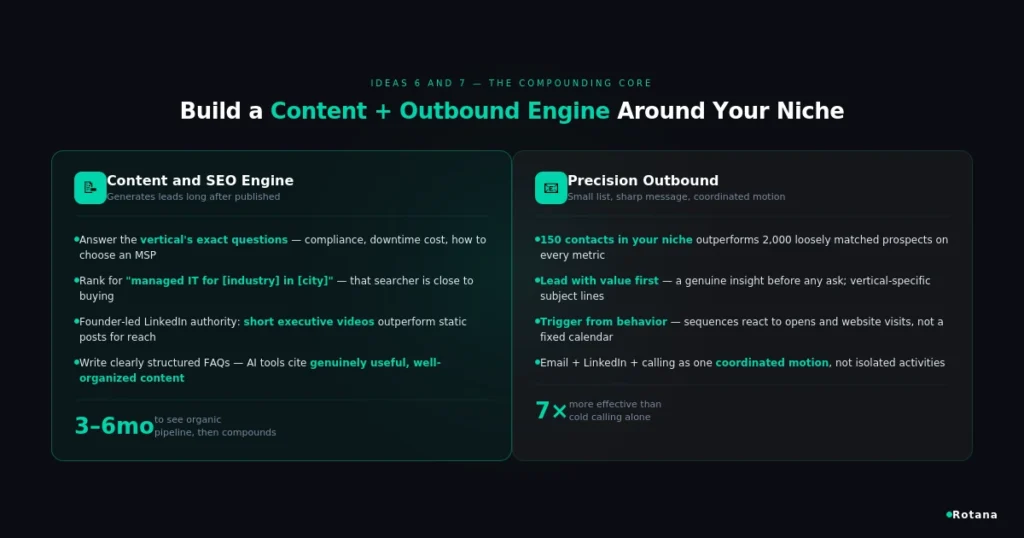
Content and SEO are the compounding core of MSP marketing, generating leads long after they are published and they reward the niche decision from Idea 1. Write the answers your specific vertical searches for: compliance requirements, the cost of downtime, how to choose an MSP, the security risks particular to their industry. Rank for high-intent local and vertical terms like “managed IT services for [industry] in [city],” since that searcher is close to buying. Thought-leadership content, deeper than a brochure, positions you as the authority. On AI search, ignore the hype about secret tricks. Per Google’s own guidance, being recommended by AI tools is mostly good SEO: publish genuinely useful, clearly structured content with real FAQs and you become a source AI cites. Pair the content with founder-led authority on LinkedIn, where short executive videos now outperform static posts for reach. This is the same compounding approach I apply for recurring-revenue businesses in my guides to SaaS marketing and SaaS marketing strategy.
Idea 7: Run precision email and coordinated outbound
The cold blast to a purchased list of 10,000 is dead. What works is the opposite: a list of 150 contacts in your exact niche outperforms 2,000 loosely matched prospects on every metric. Three principles make outbound work in 2026. Lead with value, so the first email offers a genuine insight before asking for anything. Trigger from behavior, so the sequence reacts to opens and website visits rather than a fixed calendar. And write subject lines that earn the open, naming the vertical and a real issue rather than “quick question.” The deeper lever is coordination: email, LinkedIn and calling working as one orchestrated motion rather than isolated activities. Opollo reports that across its programs a coordinated multi-channel approach was roughly seven times more effective than cold calling alone. The nurture discipline behind this is the same one I detail in my guide to B2B email marketing.
Prioritize the ideas by impact
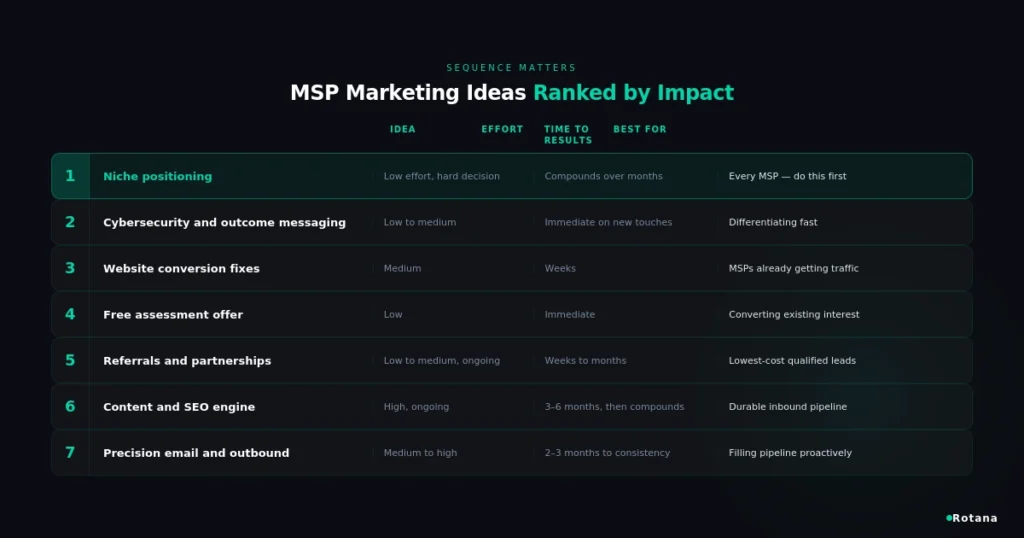
You cannot do all of this at once and you should not try. The table ranks the ideas by impact, effort and how fast they pay off, so you can sequence them to your situation.
| Idea | Effort | Time to results | Best for |
|---|---|---|---|
| Niche positioning | Low effort, hard decision | Compounds over months | Every MSP, do first |
| Cybersecurity and outcome messaging | Low to medium | Immediate on new touches | Differentiating fast |
| Website conversion fixes | Medium | Weeks | MSPs already getting traffic |
| Free assessment offer | Low | Immediate | Converting existing interest |
| Referrals and partnerships | Low to medium, ongoing | Weeks to months | Lowest-cost qualified leads |
| Content and SEO engine | High, ongoing | 3 to 6 months, then compounds | Durable inbound pipeline |
| Precision email and outbound | Medium to high | 2 to 3 months to consistency | Filling pipeline proactively |
Measure pipeline and clients, not traffic
The point is signed managed-services contracts at a sustainable cost, so measure what maps to them. Track assessment and consultation requests, which are the strongest inbound signals, plus marketing-qualified leads that actually match your ICP, lead-to-meeting rate, close rate and cost per lead. Watch client lifetime value, since the recurring-revenue model means a single won client is worth years of monthly revenue, which changes how much you can spend to acquire one. Many MSPs invest 5% to 10% of revenue in marketing. The number that should guide that spend is cost per signed client against lifetime value, not traffic or raw lead volume, since a channel that floods you with poor-fit leads is expensive even when the leads look cheap.
What I would do first
If you run an MSP and want a predictable pipeline, work the ideas in this order:
- Commit to a niche, since it multiplies every other idea and most competitors will not do it.
- Reframe your offer around cybersecurity, compliance and business outcomes rather than IT support.
- Fix your website to convert, with an outcome headline, visible proof and a free-assessment offer.
- Systematize referrals and build a few complementary partnerships, without relying on them alone.
- Build a content engine around your niche’s questions, supported by founder authority on LinkedIn.
- Layer in precision email and coordinated outbound once the foundation converts.
- Measure assessment requests, close rate and cost per signed client, then double down on what works.
MSP marketing rewards the provider that commits to a niche, sells security and outcomes and runs a few coordinated channels with patience, rather than chasing every tactic at once. Sequencing beats spending. If you want that engine built and tuned to your niche, that is the work I do at Rotana. Book a call through the link on the site.
Frequently asked questions
What is the best marketing idea for an MSP?
Niche specialization. Choosing a specific vertical or focus, such as accounting firms, law practices or healthcare, is the highest-impact MSP marketing decision because it multiplies everything else: content gets found, case studies become relevant, referrals multiply within a community and close rates rise because prospects feel you were built for them. Most MSPs refuse to niche out of fear of turning away work, which is exactly why it works for the ones who commit. Specialists also command premium pricing and earn trust faster than generalists.
How do MSPs generate leads in 2026?
Through a coordinated mix rather than any single tactic. The core ideas are niche positioning, a conversion-focused website with a free-assessment offer, content and SEO targeting high-intent vertical and local searches, systematic referrals and partnerships and precision email plus LinkedIn outreach. Referrals remain the most trusted source, but relying on them alone is risky. Coordinated multi-channel marketing substantially outperforms isolated tactics and content compounds over time, so the strongest pipelines combine outbound that fills meetings now with inbound that builds visibility for the future.
Why should an MSP focus on cybersecurity in its marketing?
Because it repositions you from an IT-support vendor into a strategic partner who protects business continuity, which is what buyers now fear losing most. Leading with security and compliance addresses the rising risk that owners feel acutely, especially in regulated verticals like healthcare, finance and law. It also justifies premium pricing and differentiates you from generalist competitors offering identical helpdesk and Microsoft 365 services. Framing your value around risk reduction and measurable outcomes, rather than uptime percentages, resonates far more with the non-technical decision-makers who sign managed-services contracts.
How much should an MSP spend on marketing?
Many MSPs invest 5% to 10% of revenue in marketing, with the right level depending on growth goals and how competitive the market is. More important than the percentage is where it goes and how you measure it. Because the managed-services model is recurring, a single signed client is worth years of monthly revenue, so the metric that should guide spend is cost per signed client against lifetime value, not cost per lead. That lens often justifies investing more in compounding channels like content and SEO than a lead-volume view would suggest.
How long does MSP marketing take to work?
It depends on the channel. A free-assessment offer and website conversion fixes can lift results within weeks and coordinated outbound typically starts producing meetings in two to three months. Content and SEO take longer, usually three to six months to gain traction, but they compound and become the most durable source of inbound leads. The most common reason MSP marketing fails is impatience, with owners pulling the plug at month three before the engine has built momentum, leaving most of the return unrealized.