

Starting a digital marketing agency in 2026 comes down to three things: pick a narrow problem you can solve, build a simple offer that produces measurable outcomes, then earn trust fast with clean reporting and clear communication. That is the short version. The longer version is what I learned building Rotana from nothing into a working agency. It is what this guide covers step by step.
I will be honest with you up front. The barrier to entry has never been lower, which means competition has never been higher. Anyone can register a business and call themselves an agency. What separates the ones that last from the ones that fold is not talent alone. It is structure: a clear position, a defined offer, pricing that protects margins and a way to find clients that does not rely on luck. Let me walk you through how to build that.
Step 1: Pick a niche before anything else
Why specialists beat generalists
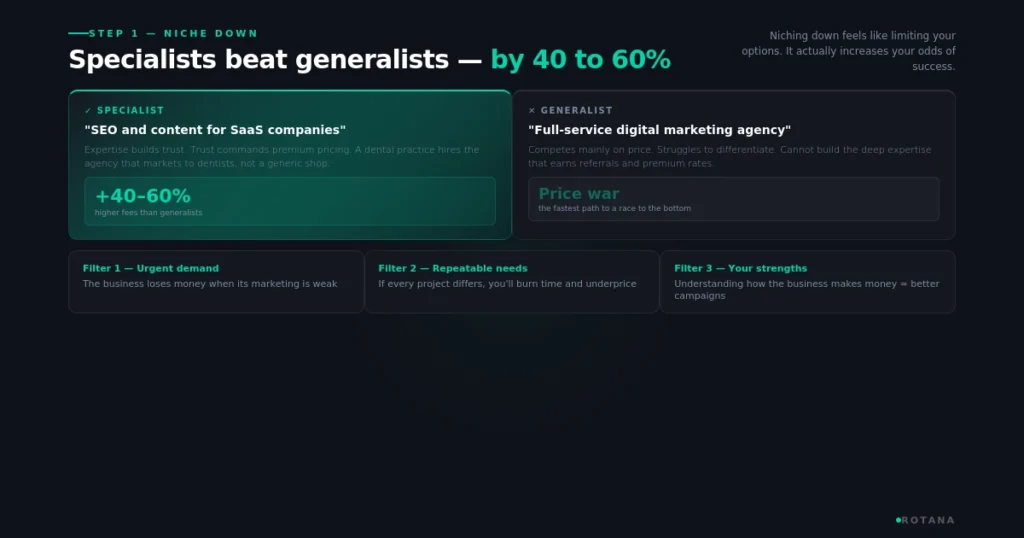
This is the decision that shapes every other one, so I am putting it first. The instinct of most new agency owners is to serve everyone with every service. That is the fastest path to competing on price and struggling to stand out. Specialists command meaningfully higher fees than generalists, often 40% to 60% more, because expertise builds trust and trust commands premium pricing. A dental practice is far more likely to hire an agency that markets to dentists than a generic “digital marketing agency.” Niching down feels like you are limiting your options. You are actually increasing your odds of success.
How to choose your niche
Pick a niche using three filters. First, urgent demand: the business should lose money when its marketing is weak. Second, repeatable needs: if every project is completely different, you will burn time and underprice the work. Third, your own strengths: if you understand how that business makes money, you will write better campaigns and ask better questions. Industries with budgets and a habit of paying for professional services, like law firms, medical practices, real estate and SaaS, are natural starting points. The strongest positioning combines an industry and a service, such as “SEO and content for SaaS companies.”
Step 2: Define your offer and services
Sell outcomes, not a service list
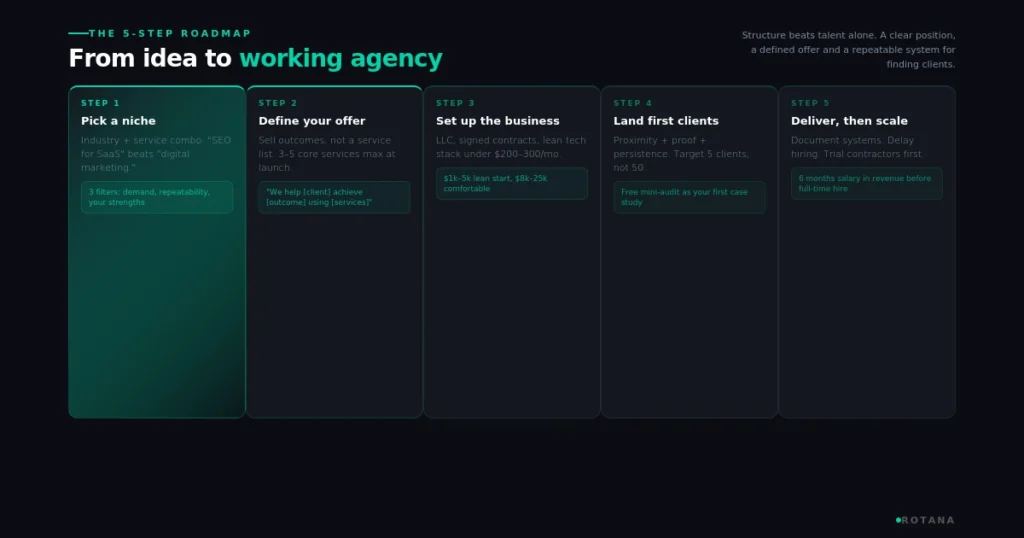
Clients do not buy SEO or ad management. They buy business outcomes: more qualified leads, lower acquisition cost, more booked consultations. Your offer is the outcome plus the method, explained in plain language. A clear way to frame it is to finish this sentence: “We help [specific client] achieve [specific outcome] using [small bundle of services].” That clarity makes everything downstream easier, from your website to your sales calls.
Start with three to five core services
Resist the urge to offer everything. Launch with three to five core services you can execute exceptionally, then expand only after you dominate the initial niche. Pick a point of entry too, the first service you sell because it has the fastest path to a visible result. For many new agencies that is local SEO, Google Ads lead generation or conversion-focused landing pages. Producing a measurable outcome within 60 to 90 days gives you the case study you need to win the next client.
Step 3: Set up the business properly
Legal structure and contracts
Get your legal and financial house in order from day one. An LLC is the common choice for agencies because it offers liability protection a sole proprietorship does not. Every client engagement needs a signed contract covering scope of services, payment terms, ownership of work product, a termination clause and confidentiality. This protects you legally and it builds trust with clients who expect to work with a real business.
The lean startup cost
You do not need much to start. A lean solo setup can begin for under $1,000 to around $5,000, covering business registration, a domain and website, plus a few core software subscriptions. A more comfortable runway of $8,000 to $25,000 adds professional branding and a few months of expenses as a buffer. The biggest investment at the start is your time, not your money. Keep fixed costs low and put every dollar toward landing your first client.
The starter tech stack
Keep tooling minimal early. You need analytics like Google Analytics and Search Console, an SEO tool such as Ahrefs or Semrush, a CRM, a project management platform and a way to manage contracts and invoices. Tools like HoneyBook or Dubsado handle contracts, invoices and onboarding in one place. The total early-stage tech stack should not exceed roughly $200 to $300 a month. Add service-specific tools only as client work requires them.
Step 4: Land your first clients
Proximity, proof and persistence
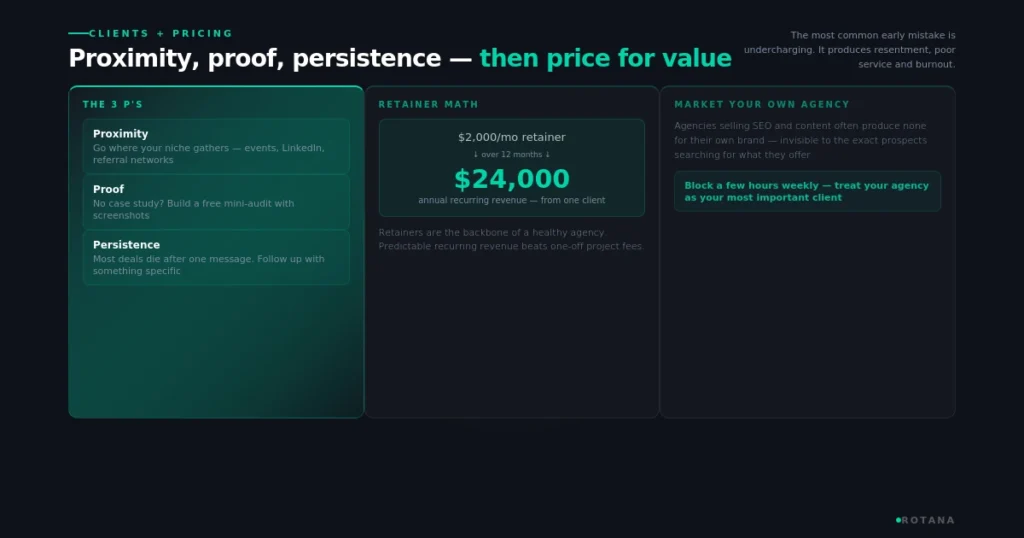
Your first clients come from three things. Proximity means going where your niche already gathers: local business events, industry groups, LinkedIn communities, partner networks and referral relationships. Proof means showing what you can do. If you have no case studies yet, build one. Create a mini-audit of a business in your niche that shows common problems and clear fixes, with screenshots and plain explanations. Persistence means following up. Most deals die because people stop after one message. Send a short, human note that shows you actually looked at the business, name one thing you noticed, then offer one clear next step like a 15-minute call.
Price for value, not for time
The most common early mistake is undercharging. New owners believe they must prove themselves before charging market rates, then resent the work for the money they earn, which produces poor service and burnout. Price for the value you deliver. Retainers are the backbone of a healthy agency because they create predictable recurring revenue. A client paying $2,000 a month for a year is worth $24,000 in annual recurring revenue. Project fees and value-based pricing have their place, but recurring retainers are what make an agency stable.
Market your own agency
Here is a trap I see constantly. Agencies that sell SEO and content produce none for their own brand, which makes them invisible to the exact prospects searching for what they offer. Block a few hours every week to market your own agency. Publish content for your niche, build case studies and show thought leadership. Treat your agency as your most important client. When I want to show prospects how I think about hiring help, I point them to my guide on the best email marketing agencies and what separates a good one.
Step 5: Deliver, then scale without chaos
Build repeatable systems
Once you sign clients, you need systems to deliver consistently. Document how you run each service so quality does not depend on memory or heroics. Clean reporting is part of the value you sell. If you cannot explain what happened this month and what you will do next month, clients leave. In 2026 clients also care more about privacy, consent and clean measurement, so set up tracking correctly and respect user choices from the start.
Hire and scale carefully
Scaling does not happen overnight. Hiring too fast is dangerous. The cost of a bad hire is enormous once you count salary, replacement and lost productivity. Delay full-time hiring until revenue clearly supports six months of that salary. Trial contractors first as potential full-time hires. White-label partners let you expand capacity without the overhead of employees. Many successful owners start as a side hustle for six to eighteen months, then transition to full-time once they have steady monthly recurring revenue covering their living expenses. That sequence de-risks the whole launch.
What I would do first
If you are starting now, here is the order I would follow. Choose one niche where you have real strengths and the clients have budgets. Define one clear outcome-based offer with a fast point-of-entry service. Register the business, set up contracts and assemble a lean tool stack. Build one strong case study, even a free or discounted first project, then use proximity, proof and persistence to land your first five clients, not your first fifty. Price for value with a retainer model. Then document your delivery so you can grow without chaos.
Starting an agency is less about a perfect plan and more about being useful, measurable and easy to work with. Choose a niche you understand, build a simple offer that solves a real problem, deliver through a repeatable system, then earn trust with honest communication. That is how agencies grow without burning out. It is exactly how I built Rotana. If you want to see how I structure client work, our SEO consultancy service shows the model. For a sense of who is worth learning from, my guide to the top email marketing consultants is a good start. Book a call through the link on the site.
Frequently asked questions
How much does it cost to start a digital marketing agency in 2026?
You can start lean for under $1,000 to around $5,000, covering business registration, a domain and website, plus a few core software subscriptions. A more comfortable runway of roughly $8,000 to $25,000 adds professional branding and several months of operating expenses as a buffer. The biggest early investment is your time rather than cash. Keeping fixed costs low and using white-label partners instead of early hires lets you direct most of your budget toward client acquisition.
Do I need experience to start a digital marketing agency?
Formal education is not required. No degree or certification is mandatory. What matters is demonstrable expertise and results in your chosen services. Two to three years of hands-on experience, even in-house at a company, gives you enough to start. One strong case study is worth more than a stack of certifications. If you lack experience, gaining a year or two at an established agency first gives you proven processes and connections before you launch your own.
Should I niche down or stay a generalist?
Niche down early. Generalist agencies compete mainly on price, struggle to differentiate and cannot build deep expertise. Specialists command 40% to 60% higher fees, attract ideal clients more easily and build reputation faster. Choose a niche with urgent demand, repeatable needs and a fit with your own strengths. The strongest positioning combines an industry and a service, which makes your messaging, website and sales conversations far sharper.
How do I get my first clients for a new agency?
Use proximity, proof and persistence. Proximity means going where your niche gathers, such as industry groups, LinkedIn communities and referral networks. Proof means building a case study even if your first project is free or discounted, then showing measurable results. Persistence means following up with short, personalized outreach that references something specific about the prospect’s business. Focus on landing your first five clients rather than chasing fifty, since early case studies and referrals fuel everything after.
How should a digital marketing agency price its services?
Price for the value you deliver, not the hours you spend. Monthly retainers are the backbone because they create predictable recurring revenue, while project fees and value-based pricing suit defined or high-value work. The most common early mistake is undercharging out of insecurity, which leads to resentment, poor service and burnout. Set a minimum price that covers your costs and a reasonable profit, then raise rates as your results and reputation grow.