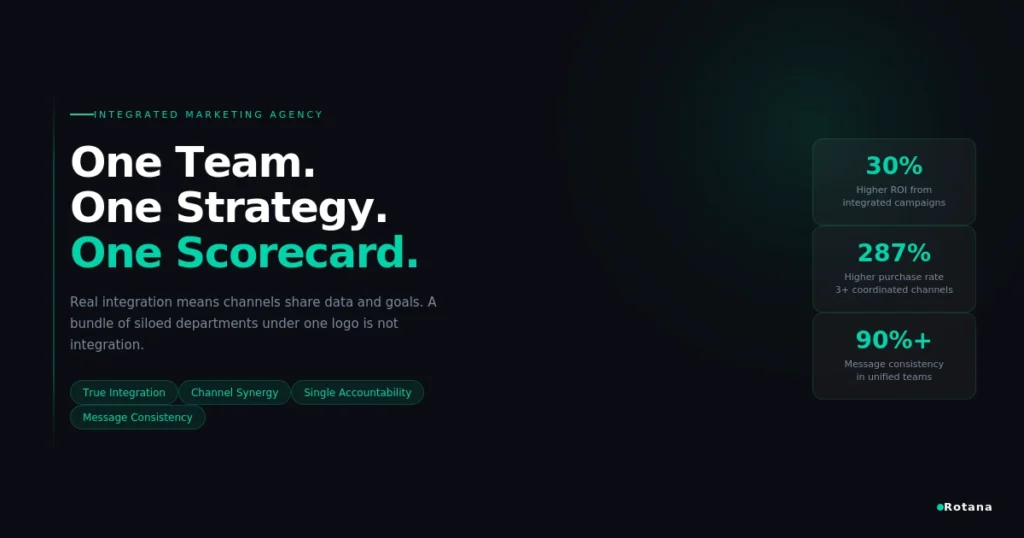
An integrated marketing agency runs all of your marketing channels, SEO, paid media, content, email, social, PR and creative, under one strategy and one team, so every touchpoint tells the same story instead of pulling in different directions. The problem it solves is the one most businesses feel as wasted budget: channels running in isolation, a message that shifts from the ad to the email to the landing page and three vendors each optimizing for a different scorecard. Pull those into a single coordinated program and the results compound. Integrated campaigns deliver up to 30% higher ROI than disconnected ones, according to Improvado’s analysis of integrated marketing communications and campaigns using three or more coordinated channels saw a 287% higher purchase rate than single-channel efforts in Omnisend’s research.
I run an integrated, SEO-led growth agency, so I will tell you the part most agency pages leave out: the word “integrated” is often a paint job. Plenty of agencies that call themselves integrated simply hold separate creative, media and analytics teams under one logo, each with its own leadership and metrics, which quietly rebuilds the silos you were trying to escape. This guide covers what a genuinely integrated agency is, how to tell real integration from a bundle, how the terms compare, what it costs, when you do not need one and how to choose.
What is an integrated marketing agency?
An integrated marketing agency is a single partner that manages your marketing channels as coordinated parts of one campaign rather than as separate services. Instead of handling only PR or only paid ads, it runs social, email, SEO, content, advertising and reporting together, keeping your brand message, look and goals aligned across every channel, online and offline. The model exists because buyers no longer move through one channel. They research across search, social, email and, increasingly, AI assistants before they ever talk to you, so a message that only holds together in one place loses them everywhere else. When the channels share data and messaging, each one makes the others stronger, which is the entire point of integration.
True integration versus a bundle: the test that matters
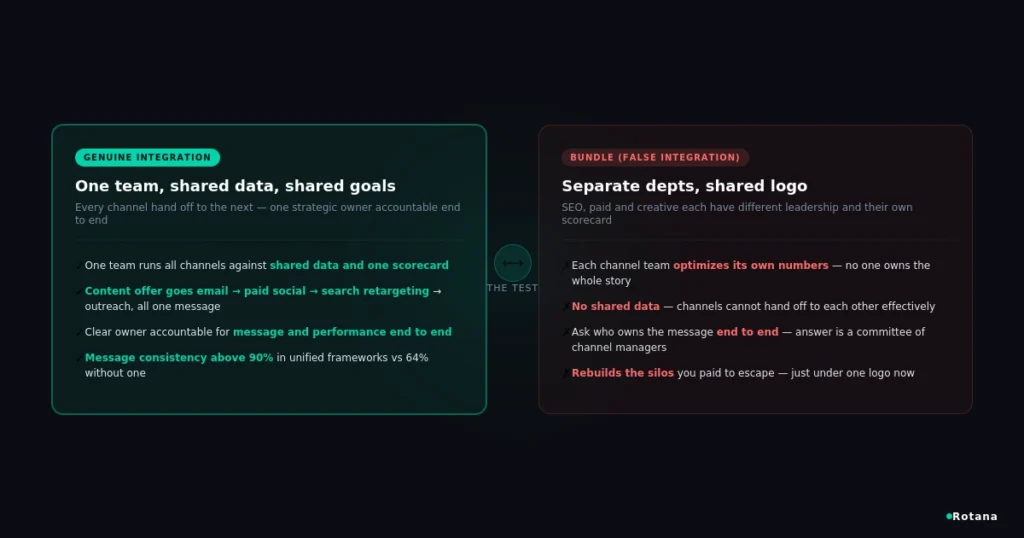
This is the distinction that decides whether you get the benefit you are paying for. A genuinely integrated agency runs one team against shared data and shared goals, so channels hand off to each other: a content offer goes out by email, gets amplified on paid social, retargeted on search and followed up by outreach, all carrying the same message. A bundled shop holds separate departments under one brand, each with its own leadership and its own scorecard, so the SEO team, the paid team and the creative team optimize their own numbers and no one owns the whole story. That is the silo problem wearing a new label.
The difference shows up in results. Teams working inside a genuinely unified framework held message-consistency scores above 90% in Improvado’s analysis, against 64% for teams operating without one. So when you evaluate an agency, run one test: ask whether there is a single strategy and a single scorecard for the whole program or a different lead and metric for each channel. Ask who owns the message end to end. If the answer is a committee of channel managers, you are buying a bundle, not integration.
Integrated, full-service, digital-only or specialist?
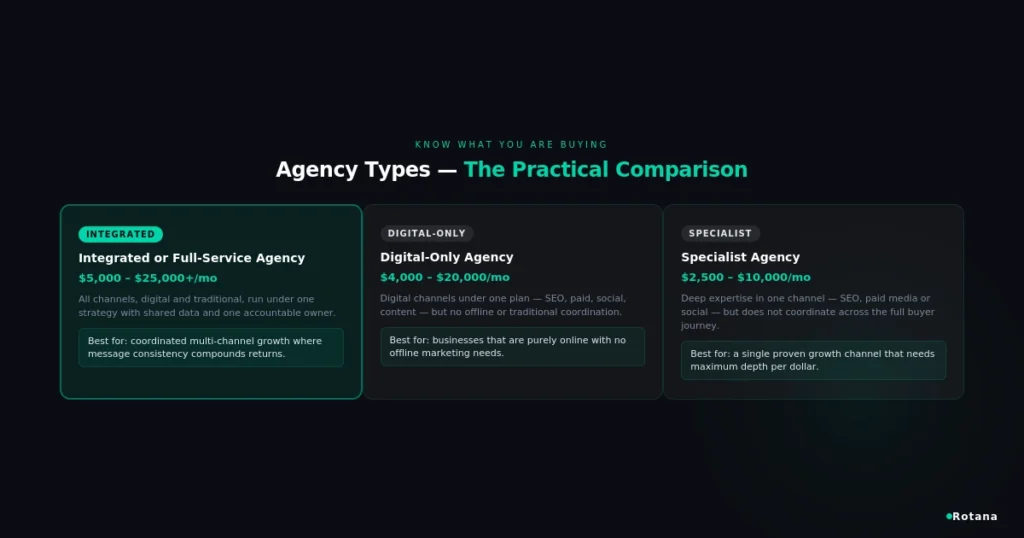
These terms get used loosely and the overlap confuses buyers, so here is the practical version. An integrated agency and a full-service agency broadly mean the same thing: all channels coordinated under one strategy. A digital-only agency runs digital channels alone. A specialist agency goes deep on a single discipline like SEO or paid media. None is better in the abstract. The right one depends on whether you have found your growth channel yet.
| Agency type | Scope | Typical cost | Best for |
|---|---|---|---|
| Integrated / full-service | All channels, digital and traditional, one strategy | $5,000 to $25,000+ a month | Coordinated multi-channel growth |
| Digital-only | Digital channels under one plan | $4,000 to $20,000 a month | Businesses that are purely online |
| Specialist | One channel, deep expertise | $2,500 to $10,000 a month | A single proven growth channel |
If you already know that one channel drives your growth, a specialist gives you more depth per dollar. If your growth depends on channels working together or you have not yet found the one that works, an integrated partner earns its cost by coordinating the whole.
What you actually gain from integration
The benefits are concrete rather than abstract and they stack:
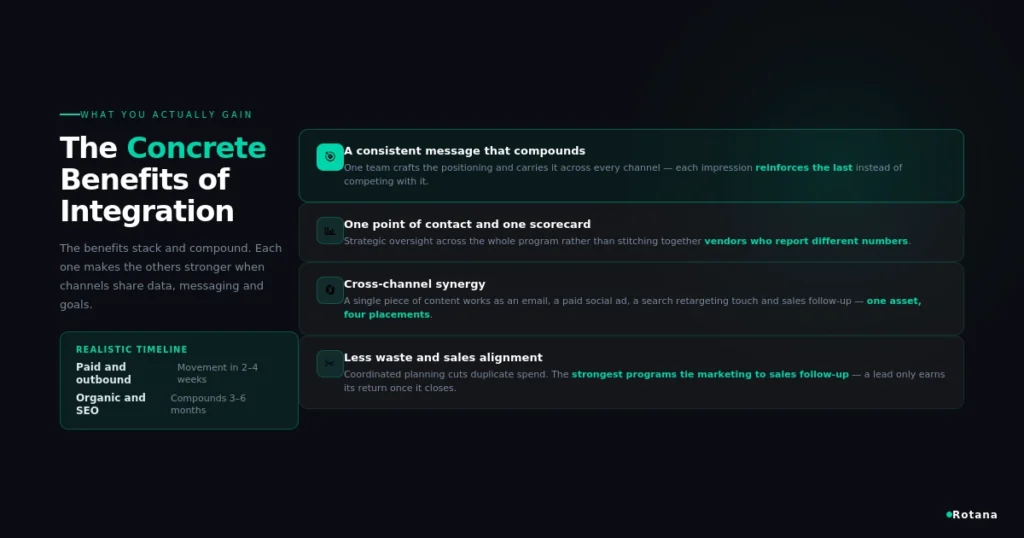
- A consistent message that compounds. One team crafts the positioning and carries it across every channel, so each impression reinforces the last instead of competing with it.
- One point of contact and one scorecard. You get strategic oversight across the whole program rather than stitching together vendors who report different numbers.
- Cross-channel synergy. Assets and audiences move between channels, so a single piece of content works as an email, a paid social ad, a search retargeting touch and sales follow-up.
- Less waste. Coordinated planning cuts the duplicate spend and overlapping tools that come with running several vendors at once.
- Sales alignment. The strongest integrated programs tie marketing to sales follow-up, because a lead only earns its return once it closes.
A realistic timeline blends fast and slow channels. Paid and outbound tactics usually show movement in two to four weeks, while organic channels like SEO compound over three to six months, so a good agency sets expectations for both rather than promising everything at once.
When you do not need an integrated agency
Here is the honesty that sales pages skip. Integration has real overhead: coordination meetings, cross-channel reviews, shared reporting. That overhead pays off at scale, but it can cost more than it returns in three situations. A very small team, one or two people, is usually better off picking two or three channels and running them well than paying for coordination it cannot use yet. A business with an undifferentiated, commodity offer gains little from message consistency, since consistency amplifies a message and there has to be a distinct one to amplify. And a company with a single proven channel that already drives growth will often get more from a specialist who goes deeper on it. Integration is a strong answer to the right problem, not a default for everyone.
How to choose an integrated marketing agency
Once you have decided integration fits, choose the partner with these checks:
- Run the integration test. Confirm one team, one strategy and one scorecard, not a set of channel departments under a shared logo.
- Ask who owns the message. There should be a clear strategic owner accountable for the whole program, not just per-channel managers.
- Check for measurement from day one. A strong agency stands up analytics immediately and reports in pipeline and revenue, not impressions or clicks.
- Match stage and vertical. Agencies are often built for a particular growth stage, industry or region, so relevant experience matters more than a long service menu.
- Insist on transparency. Clear reporting, plain-language reviews and no rigid long lock-in before the relationship is proven.
Integration is worth paying for when your growth depends on channels working as one system and you want a single accountable partner to run it, rather than a bundle of vendors optimizing separate numbers. Coordination is the product. At Rotana we work as an integrated, SEO-led growth partner, one team and one strategy across search, content and demand generation and we will tell you honestly when a specialist or a leaner setup fits you better. If you want that, start with our content strategy service. For the wider build-versus-buy picture, see my guides to what a marketing agency is, marketing management service and performance marketing agencies. Book a call through the link on the site.
Frequently asked questions
What is an integrated marketing agency?
An integrated marketing agency is a single partner that runs all your marketing channels, including SEO, paid media, content, email, social and PR, under one coordinated strategy and one team, so every touchpoint carries the same message. Rather than handling one discipline in isolation, it manages the channels as parts of one campaign, keeping brand messaging, creative and goals aligned across the buyer journey. The aim is consistency and compounding, since coordinated channels reinforce each other and deliver measurably higher return than disconnected, siloed efforts.
What is the difference between an integrated and a full-service agency?
In practice they mean the same thing: both run all marketing channels under one coordinated strategy rather than a single discipline. The more useful distinction is between either of those and a specialist or digital-only agency. A specialist goes deep on one channel like SEO or paid media and a digital-only agency covers digital channels alone. What matters more than the label is whether the agency truly integrates, running one team on shared data and goals or simply bundles separate channel departments under one brand, which recreates the silos you were trying to avoid.
How much does an integrated marketing agency cost?
Integrated and full-service agencies typically charge $5,000 to $25,000 or more per month, depending on scope, channels and the size of the program, often with a management fee on paid media. Specialist agencies focused on one channel usually run $2,500 to $10,000 monthly. The right figure depends on how many channels you need coordinated and how much execution the agency handles. Judge the cost against pipeline and revenue rather than the retainer alone, since coordinated programs are meant to lift return, not just add services.
Is an integrated marketing agency worth it?
It is worth it when your growth depends on multiple channels working together and you want one accountable partner running them, since integrated campaigns deliver up to 30% higher ROI than siloed efforts and coordinated multi-channel campaigns show far higher purchase rates. It is less worthwhile for a one or two-person team that cannot absorb the coordination overhead, for an undifferentiated product where consistency has no distinct message to amplify or when a single proven channel would benefit more from a specialist. Match the model to your situation.
How do I know if an agency is genuinely integrated?
Run one test: ask whether there is a single strategy and a single scorecard for the whole program or a separate lead and metric for each channel. A genuinely integrated agency runs one team against shared data and goals, with a clear owner accountable for the message end to end. A bundled agency holds separate creative, media and analytics departments under one logo, each optimizing its own numbers, which rebuilds the silos you wanted to escape. Unified teams also hold much higher message-consistency scores, so ask how they keep messaging aligned across channels.