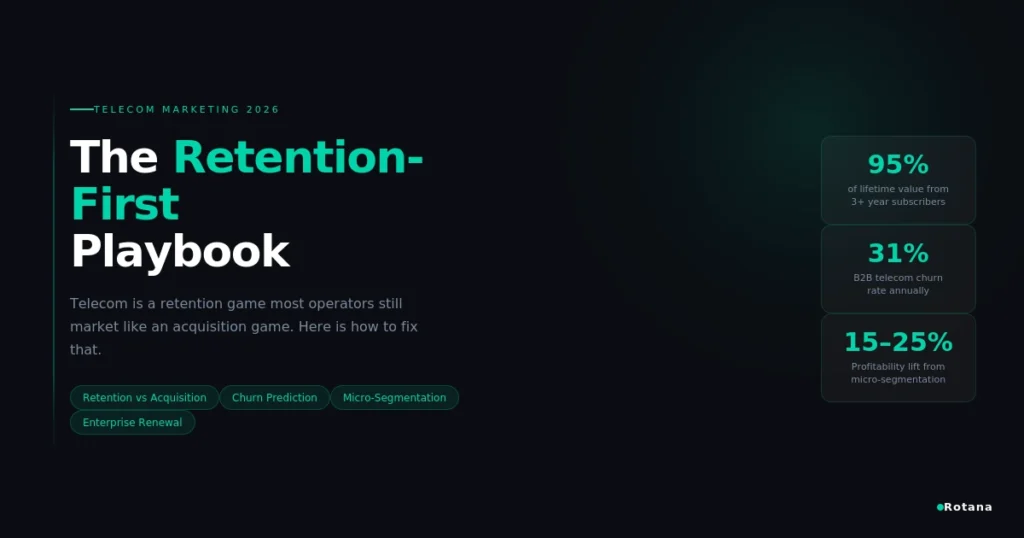
Telecom marketing is the work of acquiring and, more importantly, keeping subscribers in a saturated, high-churn market where the products have largely converged. The uncomfortable truth that should shape every telecom marketing budget is this: a carrier can add thousands of subscribers in a quarter and still lose ground, because customers rarely leave with a warning. They drift, taking lifetime value, referrals and brand equity with them. According to Simon-Kucher’s 2025 Global Telecommunications Study, 95% of lifetime customer value comes from subscribers who stay three or more years and those loyal customers make up 75% of the base while spending 7% more than newcomers. The math is blunt. Telecom is a retention game that most operators still market like an acquisition game.
I run an SEO-led growth agency, so I will say plainly what a lot of telecom marketing advice dances around. Leading every campaign with lower pricing, unlimited claims and generalized reliability language teaches buyers to compare on price and wait for the next discount, which turns marketing into a margin-eroding support function. In a category where services feel interchangeable, that is a losing game. This playbook covers the two engines you actually run, why differentiation now lives in experience rather than network specs, how to reduce the churn that quietly bleeds value, the acquisition that still matters and the metrics that should govern all of it.
Why telecom marketing is uniquely hard
Telecom sits in a rare bind: enormous demand, brutal competition and near-commoditized products. Global telecom spending reached about $1.375 trillion in 2025, roughly a quarter of the total ICT market with mobile data traffic up around 20% year over year, according to IDC. So demand is not the problem. The problem is that in saturated markets, network coverage, data allowances and device financing have converged to near-parity across major operators, which pushes price to the front of the buyer’s mind. The US alone has around 80 mobile network operators and virtual operators and switching is easy, so a dissatisfied customer always has somewhere to go. When everyone can credibly claim a fast, reliable network, “fast and reliable” stops being a differentiator and becomes table stakes.
Run two engines: consumer and enterprise
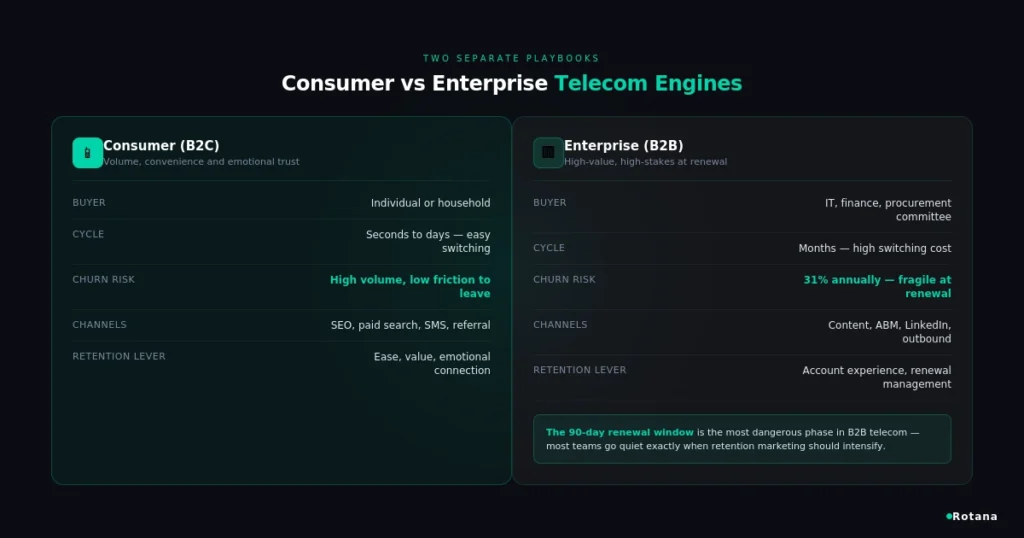
Consumer and business telecom look like one industry but behave like two and marketing them identically is a common, costly mistake. The churn dynamics, buying cycles and retention levers differ enough to demand separate playbooks.
| Factor | Consumer (B2C) | Enterprise (B2B) |
|---|---|---|
| Buyer | Individual or household | IT, finance, procurement committee |
| Cycle | Seconds to days, easy switching | Months, high switching cost |
| Churn dynamic | High volume, low friction to leave | Lower frequency, dangerous at renewal |
| Primary channels | SEO, paid search, SMS, referral | Content, ABM, LinkedIn, outbound |
| Retention lever | Ease, value, emotional connection | Account experience, renewal management |
The enterprise number worth committing to memory: B2B telecom churn averages about 31% annually, per CustomerGauge research, higher than most B2B sectors because of price pressure, competition from cloud communications like UCaaS and SD-WAN and procurement dynamics that make relationships fragile at renewal. In B2B, the contract renewal window is the most dangerous 90 days in the relationship, so retention marketing has to intensify exactly when most teams go quiet.
Differentiate on experience, not network specs
Here is the finding that should reshape most telecom messaging. J.D. Power’s 2026 research concludes that ease of doing business, resolving issues with minimal effort, is a stronger loyalty driver than network quality, price or rewards programs. When products converge, experience becomes the product. T-Mobile’s long climb to the top of both postpaid and prepaid satisfaction rankings came not from a points program layered on an adversarial relationship, but from systematically removing the sources of distrust customers hate: hidden fees, contract lock-in and unpredictable pricing. That is the real lesson for telecom marketing. Loyalty is earned by removing friction from the interactions customers dread, billing disputes, service issues, device upgrades and account changes, not by rewarding them for paying a bill they were already going to pay. Every minute a customer spends stuck in an IVR queue repeating their problem is a direct investment in their eventual churn.
Reduce the churn that quietly bleeds value
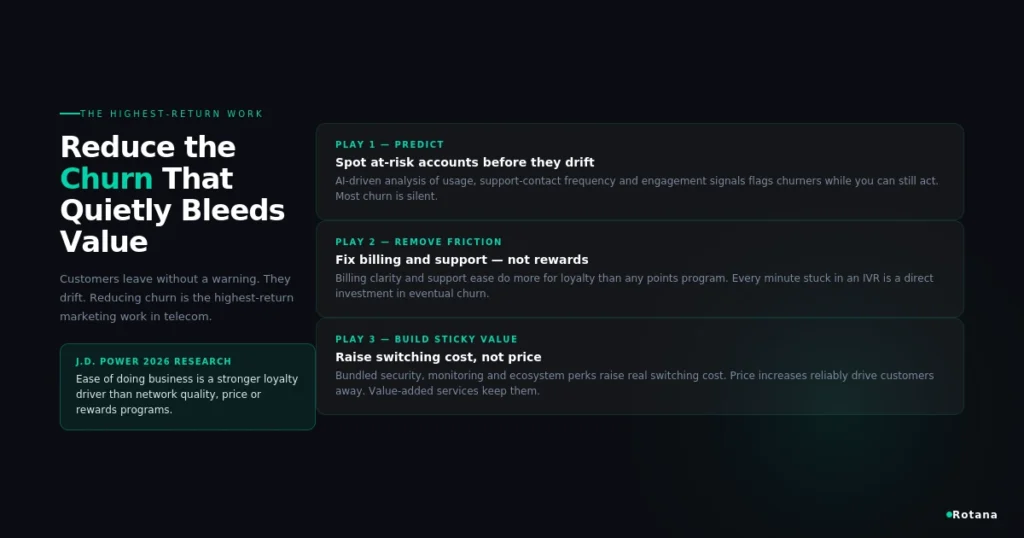
Because retention drives the economics, reducing churn is the highest-return marketing work in telecom and it starts with understanding why customers leave. The main drivers are consistent across the research:
- Poor network experience, which accounts for a large share of churn, with dropped calls and slow data pushing subscribers to switch.
- Confusing billing and hidden fees, which erode the trust that keeps a customer from shopping around.
- Weak customer service, where slow or repetitive support turns a fixable issue into a lost account.
- Weak value perception, where customers feel they are not getting their money’s worth even when the price is fair.
Three plays address these directly. First, predict churn before it happens, since customers leave quietly, so AI-driven analysis of usage, support-contact frequency and engagement signals can flag at-risk accounts while you can still act. Second, remove friction from the dreaded interactions, since fixing billing clarity and support ease does more for loyalty than any rewards program. Third, build sticky value rather than raising prices, since price increases reliably drive customers away, while value-added services like bundled security, monitoring or ecosystem perks raise the real switching cost. The recurring-revenue retention discipline here mirrors what I detail in my guide to SaaS marketing, where churn economics work the same way.
Acquisition that still matters, done with precision
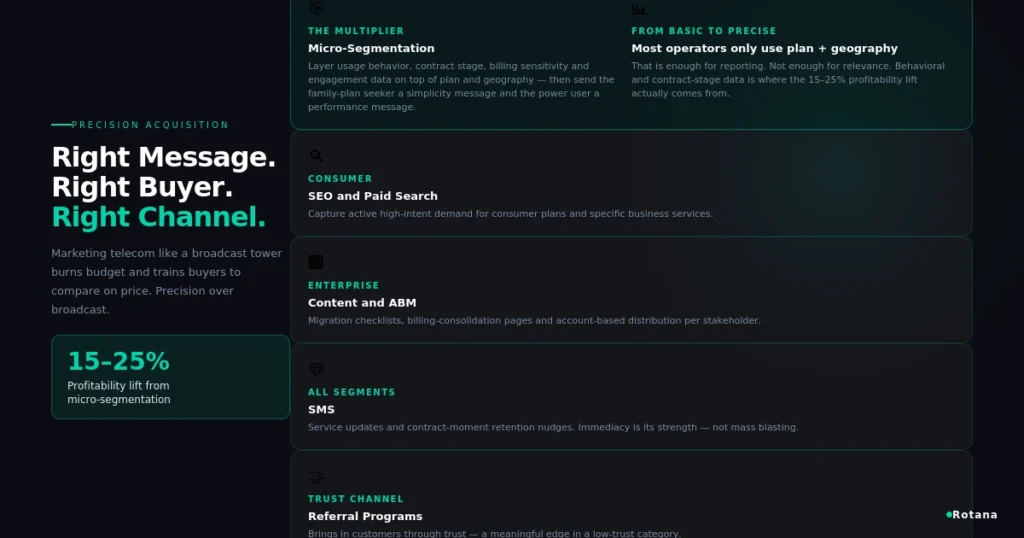
Retention comes first, but acquisition still funds growth and the winning approach is precision over broadcast. Marketing telecom like a broadcast tower, pushing the same offer to huge audiences, burns budget and trains buyers to compare on price. The better model routes the right message to the right buyer through the right channel. Match the channel to the buying motion:
- SEO and paid search capture active, high-intent demand, strongest for consumer plans and specific business services like managed voice or business internet.
- Content and ABM together win enterprise deals, where migration checklists, integration briefs and billing-consolidation pages reduce uncertainty and account-based distribution serves each stakeholder a relevant message.
- SMS earns its place for service updates, contract-moment retention nudges and warm follow-up, since immediacy is its strength, not mass blasting.
- Referral programs bring in customers through trust rather than pressure, a meaningful edge in a low-trust category.
The multiplier under all of it is micro-segmentation. Most telecom databases hold plan type and geography, enough for reporting but not for relevance. Layering usage behavior, contract stage, billing sensitivity and engagement data on top lets you send a family-plan seeker a message about simplicity and a power user a message about performance, rather than one generic “best network” claim to both. Telecoms could lift profitability by 15% to 25% through micro-segmentation, according to analysis cited by Eastwind, which makes it one of the highest-return investments in the category. This precision content and search work is what I focus on through our SEO consultancy service and the account-based side connects to my guide to B2B email marketing.
The enterprise renewal and expansion play
For B2B telecom, the account does not end at signature, it enters the phase where most of the value and most of the risk live. Since switching costs are high but renewal windows are fragile, treat the 90 days before renewal as a dedicated marketing motion, not a support handoff. Tie customer sentiment to account revenue, since a single high-value account can outweigh many small ones and act on detractors before they reach the renewal decision. Expansion is the other half: enterprise accounts grow through new sites, added services and upgraded connectivity, so account-based marketing should serve expansion messaging to existing customers rather than only pursuing new logos. The strategic frame for building this kind of motion sits in my guide to SaaS marketing strategy, which shares telecom’s recurring-revenue logic.
Measure churn, lifetime value and ARPU, not gross adds
Gross subscriber additions are the metric that flatters telecom marketing while hiding the truth, because they say nothing about the customers walking out the back door. Anchor measurement on the numbers that reflect real value. Track churn rate and retention rate by segment, since they determine whether growth is real. Track customer lifetime value, since the Simon-Kucher data shows nearly all of it comes from long-tenure subscribers. Track ARPU and its direction, watching whether you are growing revenue per user through value or shrinking it through discounts. And in B2B, track NPS tied to account revenue so you know which relationships to protect first. A carrier that manages to churn, lifetime value and ARPU makes far sharper decisions than one celebrating gross adds while its base quietly erodes.
What I would do first
If you lead telecom marketing and want durable, profitable growth, work in this order:
- Separate your consumer and enterprise engines, since they need different channels, cycles and retention levers.
- Shift budget bias from acquisition toward retention, matching where lifetime value actually comes from.
- Fix the friction customers hate, billing clarity and support ease, since experience now beats network claims on loyalty.
- Stand up churn prediction and act on at-risk accounts before they drift, especially near B2B renewals.
- Replace broad campaigns with micro-segmented messaging tied to behavior and contract stage.
- Measure churn, lifetime value and ARPU by segment and stop steering by gross adds alone.
Telecom marketing rewards the operator that keeps its best customers, differentiates on experience rather than specs and markets consumer and enterprise as the distinct businesses they are. Retention beats acquisition and experience beats price. If you want that system built and measured to the metrics that matter, that is the work I do at Rotana. Book a call through the link on the site.
Frequently asked questions
What is the best telecom marketing strategy in 2026?
The strongest approach leads with retention rather than acquisition, since around 95% of lifetime value comes from long-tenure subscribers. That means differentiating on experience and ease of doing business rather than network specs, predicting and preventing churn and building sticky value instead of raising prices. Acquisition still matters, done with precision through SEO, ABM and micro-segmentation rather than broadcast campaigns. Because consumer and enterprise telecom behave differently, the best strategy runs them as two engines and measures success by churn, lifetime value and ARPU rather than gross subscriber additions.
Why is customer churn so high in telecom?
Because the market is saturated, products have converged and switching is easy. When network coverage, data allowances and pricing look similar across operators, customers have little reason to stay and many alternatives to choose from. The main churn drivers are poor network experience, confusing billing and hidden fees, weak customer service and low value perception. B2B telecom churn averages about 31% annually and mobile runs near 20%. The core issue is that loyalty is low when the relationship feels adversarial and the product feels interchangeable, which is why experience and trust matter more than rewards.
How do telecom companies reduce customer churn?
By predicting it, preventing it and building switching costs. AI-driven analysis of usage, support contacts and engagement can flag at-risk customers before they leave, since most churn happens quietly. Removing friction from dreaded interactions like billing disputes and support delays does more for loyalty than points programs, because ease of doing business is a stronger loyalty driver than price or rewards. Value-added services such as bundled security or ecosystem perks raise real switching costs without the churn that price increases trigger. In B2B, intensifying retention around the renewal window is critical.
How is B2B telecom marketing different from B2C?
B2C telecom involves individuals making fast decisions with easy switching, so marketing emphasizes ease, value and emotional connection through SEO, paid search, SMS and referrals. B2B telecom involves committees of IT, finance and procurement over months-long cycles with high switching costs, so marketing emphasizes content, account-based marketing and outreach that reduces migration risk and translates technical value into financial logic. The retention dynamics differ too: B2C churn is high-volume and low-friction, while B2B churn is less frequent but concentrated dangerously around contract renewal windows.
What metrics matter most in telecom marketing?
The metrics that reflect real value are churn rate and retention rate by segment, customer lifetime value and ARPU, rather than gross subscriber additions, which hide the customers leaving. Lifetime value matters most because nearly all of it comes from long-tenure subscribers, so a marketing program that adds many easily-churning customers can look successful while destroying value. In B2B, tie Net Promoter Score to account revenue so you protect the high-value relationships first. Watching ARPU direction also shows whether you are growing through value or shrinking through discounts.