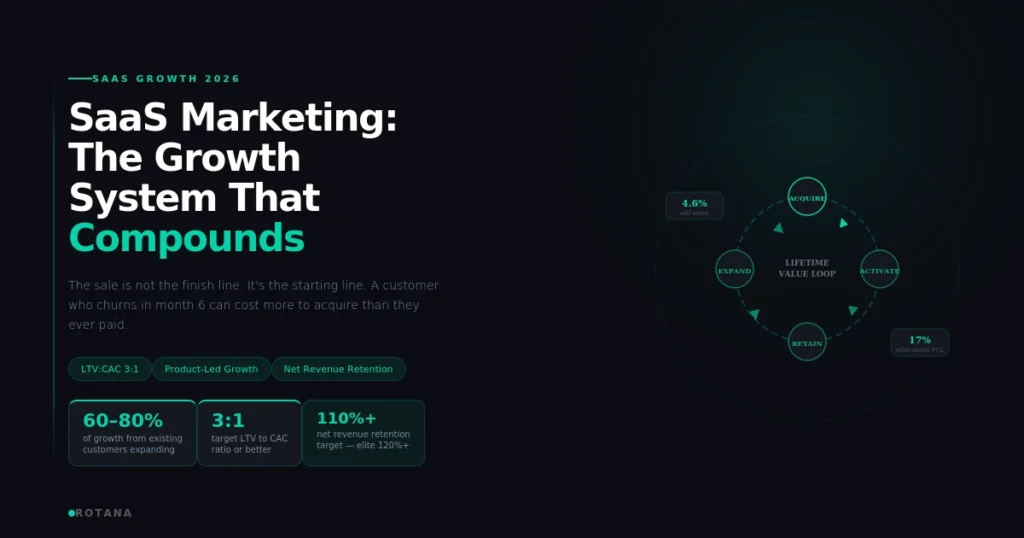
SaaS marketing is the work of acquiring, activating, retaining and expanding customers of a subscription software product, measured against lifetime value rather than a one-time sale. That single shift changes everything. In traditional business the sale is the finish line. In SaaS it is the starting line, because revenue is recurring and a customer who churns in month six can cost more to acquire than they ever paid. The discipline that wins in 2026 treats marketing as a compounding system, not a campaign and holds itself to a healthy 3:1 ratio of lifetime value to acquisition cost.
I run an SEO-led growth agency, so I care most about the part of SaaS marketing that compounds. Paid ads spike and stop. Content, product-led acquisition and retention build on themselves. The companies growing fastest in 2026 are not the ones spending the most on ads. They are the ones making the product the centerpiece of marketing and treating retention as half the job. This guide lays out the full system: the model, the channels, the metrics that matter and how to sequence it by stage.
Why SaaS marketing is different
Acquisition is only half the equation
Your product is intangible, your buyers are self-directed, a competitor can ship a rival feature next week and your revenue is recurring. That last point rewrites the playbook. Acquisition is only half the equation. Retention is the other half. For mature SaaS companies, 60% to 80% of growth comes from existing customers expanding their usage, not from new logos. The funnel is not a funnel at all. It is a loop, where activation and expansion feed back into growth.
The product is part of the marketing
In SaaS, near-zero distribution cost lets users self-serve through free trials and freemium tiers. That means marketing’s job extends inside the product: onboarding, activation and feature adoption. You are marketing within the product experience itself, a concept that barely exists in traditional B2B. The boundary between marketing and product blurs, which is why the best SaaS marketers obsess over the first session as much as the first click.
Build the foundation before the channels
ICP and positioning come first
Skipping this step is why most SaaS marketing produces vanity metrics with no revenue. Your ideal customer profile is not “B2B companies that need our solution.” That is marketing speak with zero targeting clarity. Define who you serve, the specific pain, the buying triggers and why you win, using behavior and product fit rather than just firmographics. Once the ICP and value proposition are sharp, every channel, message and campaign gets more efficient. A clear foundation is the difference between content that converts and content that just exists.
Pick your growth model
Product-led growth became table stakes by 2025, since nearly every SaaS company now offers trials or freemium. Differentiation in 2026 comes from pairing product-led growth with sales-assisted intelligence. The numbers explain why a hybrid wins: pure self-serve trials convert to paid at roughly 4.6%, while sales-assisted product-qualified-lead motions reach around 17%. Let the product drive low-touch acquisition, then add a human touch for high-value accounts showing strong usage. Developer and productivity tools lean heavily product-led, while regulated verticals like finance and HR stay largely sales-led, so match the model to your market.
The channels that compound
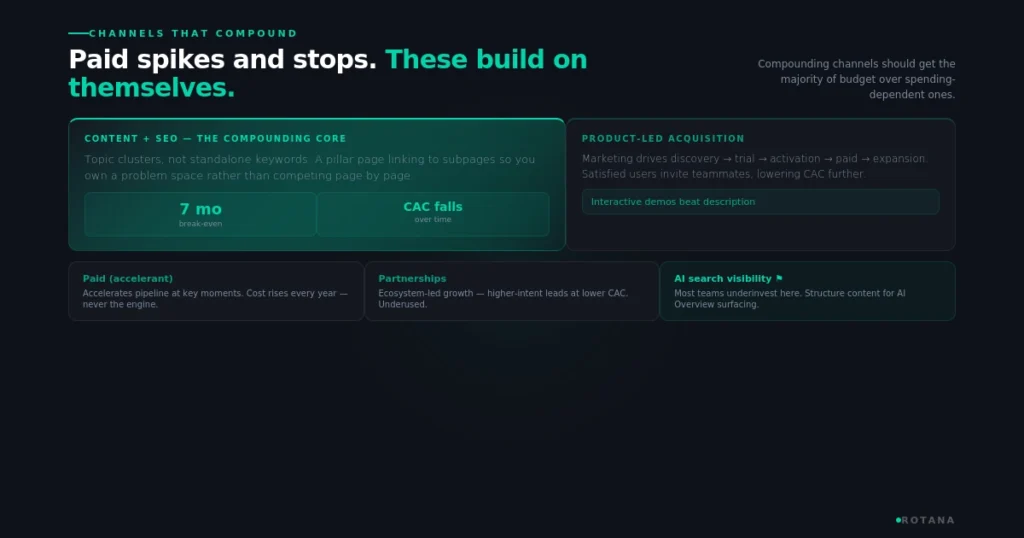
Not every channel deserves equal investment. Compounding channels should get the majority of the budget over spending-dependent ones.
Content and SEO: the compounding core
Content and SEO are foundational for most B2B SaaS because they compound. SEO has been measured at strong returns for SaaS with a break-even around seven months and unlike paid channels the cost per acquisition falls over time. The structure that wins is topic clusters, not standalone keywords: a pillar page on a core problem linking to subpages on related subtopics, so you own a problem space rather than competing page by page. This is the work I focus on through our content strategy service. Channel economics back the priority, with organic search acquiring customers at a fraction of the cost of paid search or paid social.
Product-led acquisition
In a product-led model, marketing drives the entire journey from discovery to trial signup to activation to paid conversion to expansion. The product does the heavy lifting, which lowers acquisition cost because satisfied users invite teammates and refer others. Interactive product content reinforces this. Letting buyers experience the product through interactive demos rather than reading about it has produced large lifts in conversion and engagement for companies that made the switch. The principle is simple: show the product working, do not just describe it.
Paid, partnerships and AI visibility
Paid channels still accelerate pipeline at key moments, but treat them as accelerants rather than the engine, since their cost rises every year. Two channels deserve more attention than most teams give them. Ecosystem-led growth through partnerships and integrations delivers higher-intent leads at meaningfully lower acquisition cost. And AI search visibility is the emerging channel most companies underinvest in: as buyers ask AI engines for recommendations, your share of those answers becomes a real acquisition source. Structure content with clear question headings and concise answers so it surfaces in AI Overviews, an approach I detail across my work on modern search.
The metrics that actually matter
Revenue metrics over vanity metrics
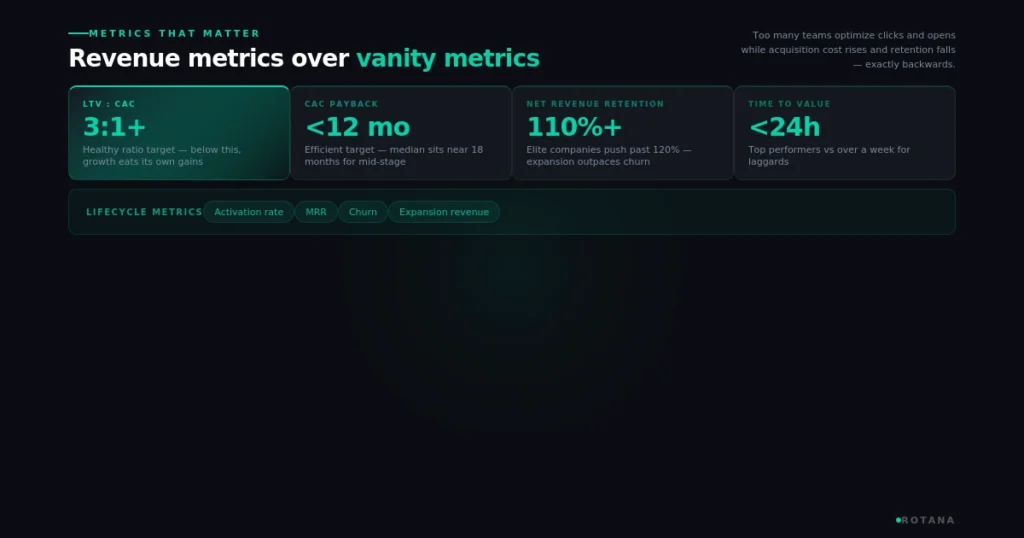
Vanity metrics do not pay salaries. Anchor on a small set tied to revenue. Lifetime value to acquisition cost should sit at 3:1 or better. CAC payback period, the months to recover acquisition cost, has stretched to a median around 18 months for mid-stage SaaS, with efficient companies targeting under 12. Net revenue retention above 110%, with elite companies past 120%, signals that existing customers expand faster than others churn. Too many teams optimize clicks and opens while acquisition cost rises and retention falls, which is exactly backwards.
The lifecycle metrics
Beyond unit economics, track the metrics that predict them. Activation rate measures how many users reach their first real value. Time to value measures how fast, with top performers under 24 hours rather than over a week. Faster activation shortens payback and lifts trial-to-paid conversion. Monthly recurring revenue is the heartbeat, churn is the early warning and expansion revenue from upsells and seat growth is where most mature growth hides. These metrics create accountability and replace opinion with data. Email is the workhorse that moves many of them, which I cover in depth in SaaS email marketing.
Retention and expansion: the real growth lever
Onboarding drives everything downstream
Since most growth in mature SaaS comes from existing customers, retention is the primary lever and it starts at onboarding. Get a user to their first win fast and they stick. Stall them and they churn before they ever see value. In-app walkthroughs, checklists and tooltips that speed users to the “aha” moment do more for revenue than another acquisition campaign. Marketing owns this stage now, alongside product and customer success.
Expansion is a marketing job
Expansion revenue, through upsells, cross-sells and seat growth, is the majority of growth potential and the section most SaaS playbooks leave out. Customer marketing, feature-adoption campaigns and in-app messaging triggers that surface the right upgrade at the right moment all drive net revenue retention. A message like noticing a team uses one feature heavily, then showing how a higher tier helps them scale, is expansion marketing in practice. This is where marketing protects and grows revenue you already won.
Sequence the system by stage
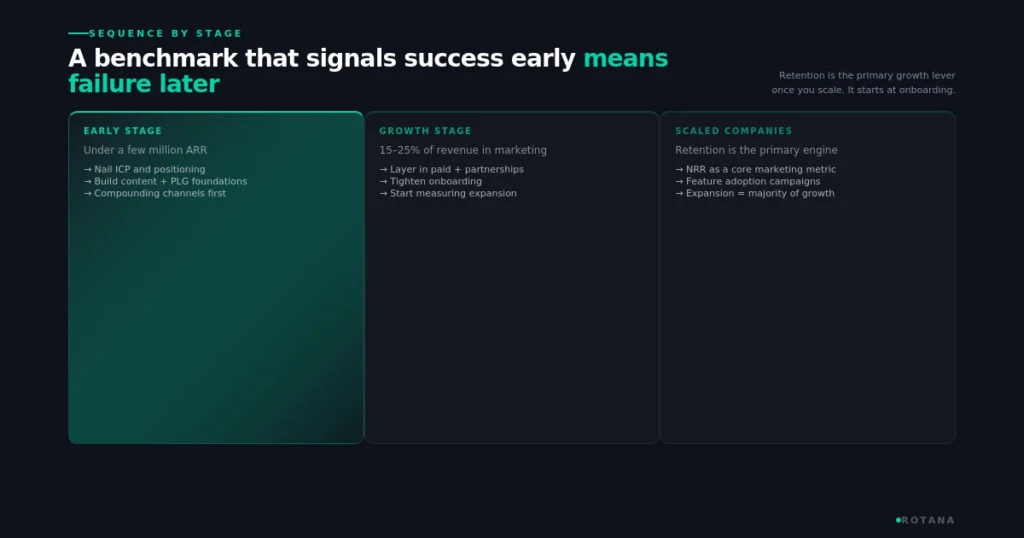
The right priorities depend on your stage, since a benchmark that signals success for an early product would mean failure for a scaled one. Early companies, under a few million in recurring revenue, should nail ICP and positioning, then build the content and product-led acquisition foundations that compound. Growth-stage companies should layer in paid and partnerships, tighten onboarding and start measuring expansion. Scaled companies should treat retention and expansion as the primary engine, with net revenue retention and feature adoption as core marketing metrics. Budget tracks this too, with growth-stage SaaS commonly investing 15% to 25% of revenue in marketing, weighted toward compounding channels.
What I would do first
If you are building a SaaS marketing engine, start in this order. Sharpen your ICP and positioning until your messaging is specific. Choose a growth model, usually product-led with a sales assist for high-value accounts. Build a content cluster around the core problem you solve, since it compounds. Fix onboarding so users reach value fast. Add partnerships and structure content for AI visibility. Then measure lifetime value to acquisition cost, payback and net revenue retention, not clicks and shift budget toward whatever compounds.
SaaS marketing rewards the company that makes the product the centerpiece, invests in channels that compound and treats retention as half the job. The fastest-growing teams are not outspending rivals. They are building an efficient engine that grows on itself. If you want that system built, that is the work I do at Rotana. The lifecycle-email layer sits in my guides to SaaS email marketing and B2B email marketing. Book a call through the link on the site.
Frequently asked questions
What is SaaS marketing?
SaaS marketing is the practice of acquiring, activating, retaining and expanding customers of a subscription software product, measured against customer lifetime value rather than one-time sales. Unlike traditional marketing, it focuses on the full lifecycle, since revenue is recurring and profitability depends on keeping customers well beyond the time it takes to recover acquisition cost. It also blurs into the product itself, since onboarding, activation and feature adoption are core parts of how SaaS companies grow.
What is the best marketing channel for SaaS?
Content and SEO for compounding returns, paired with product-led growth for efficient acquisition, form the strongest core. Content drives awareness at a falling cost over time, while the product experience converts through free trials and freemium. AI search visibility is the emerging channel most companies underinvest in and partnerships deliver high-intent leads at lower cost. Paid channels still accelerate pipeline but should be accelerants rather than the engine, since their cost rises each year.
How much should a SaaS company spend on marketing?
Growth-stage SaaS companies typically invest 15% to 25% of revenue in marketing, while early-stage companies sometimes spend a higher percentage on a smaller base to build traction. More important than the percentage is allocation: compounding channels like content, SEO and product-led growth should receive the majority of investment over spending-dependent paid channels. The discipline that keeps spending healthy is holding customer acquisition cost below one-third of lifetime value.
What metrics matter most in SaaS marketing?
The revenue metrics that matter most are lifetime value to acquisition cost (target 3:1 or better), CAC payback period (efficient companies aim under 12 months) and net revenue retention (above 110%, with elite past 120%). Supporting lifecycle metrics include activation rate, time to value, churn, monthly recurring revenue and expansion revenue. Vanity metrics like clicks and opens should never be the primary measure, since teams that optimize them often watch acquisition cost rise and retention fall.
What is product-led growth in SaaS?
Product-led growth is a model where the product itself drives acquisition, activation, conversion and expansion, usually through free trials or freemium tiers that let users experience value before buying. It became table stakes by 2025, so the edge in 2026 comes from pairing it with sales-assisted intelligence for high-value accounts. The data supports the hybrid, since pure self-serve trials convert to paid around 4.6% while sales-assisted product-qualified motions reach roughly 17%.