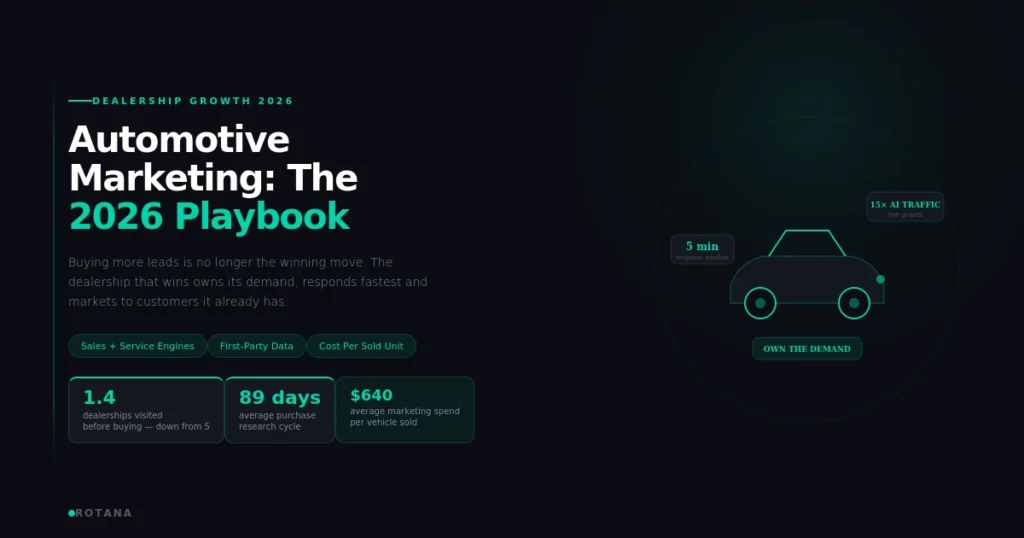
Automotive marketing strategies are the channels and systems a dealership uses to get found by in-market shoppers, convert them at the right moment, then keep them through years of service and the next purchase. The center of gravity has shifted. Buying more leads is no longer the winning move, because the dealership that wins is usually the one that owns its demand, responds fastest and markets hardest to the customers it already has. According to Cox Automotive research, 95% of car buyers start their research online and the average purchase cycle runs about 89 days, yet the typical shopper now visits just 1.4 dealerships before buying, down from five a decade ago. Almost the entire decision happens before anyone walks in.
I run an SEO-led growth agency, so I will be direct about where most dealership marketing leaks money. Stores pour budget into third-party leads that convert at 2% to 4%, while their Google Business Profile sits half-finished and their best buyers, past service customers, get ignored. The average dealership spends around $640 per vehicle sold on marketing and most of that is spent attracting strangers instead of converting the demand already in front of them. This playbook covers the full system: the two engines you actually run, local search, paid media, the AI-search shift, the speed problem that quietly loses sales, reputation, first-party data and the one number that should govern your spend.
What changed in automotive marketing
The last 18 months reshaped how car shoppers research and buy and the tactics that worked in 2024 are losing steam. Four shifts matter most in 2026:
- Shoppers ask AI, not just Google. Buyers under 40 increasingly ask ChatGPT, Gemini, Perplexity and Claude “what is the most reliable SUV under $40,000” instead of searching. Per Fullpath’s Auto Intelligence Index, traffic to dealership websites driven by AI tools rose 15 times year over year from 2025 to 2026.
- Third-party tracking is gone. Privacy rules and the death of third-party cookies broke the targeting that powered dealership ads for a decade, pushing first-party data to the center.
- Social rewards shares, not likes. Instagram’s algorithm now favors content people save and send to friends, which rewards useful, educational video over glamour shots of inventory.
- Speed expectations collapsed. Buyers expect a reply in minutes, not hours and they will tap “call” on a competitor before your voicemail finishes.
None of these are reasons to abandon the fundamentals. They are reasons to run the fundamentals better and add the channels that match how people actually shop now.
Run two engines: vehicle sales and service
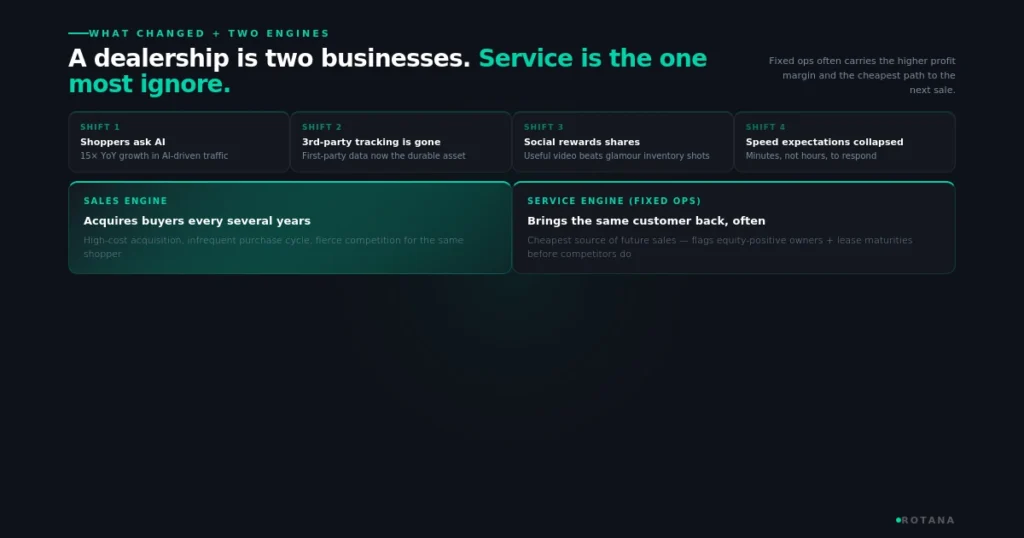
Here is the strategic split most “automotive marketing” advice ignores: a dealership is two businesses and they need different marketing. The sales engine acquires buyers for a purchase that happens roughly every several years. The service engine, fixed ops, brings the same customer back many times a year and often carries the higher profit margin. Treating marketing as a sales-only function leaves the most profitable, lowest-cost growth on the table.
Service customers are your cheapest source of future vehicle sales, because they already trust you and you already have their data. A service-to-sales program that flags equity-positive owners and lease maturities, then markets the right upgrade before a competitor does, converts at a fraction of the cost of a cold lead. Retention marketing to existing owners through service reminders, ownership-cost content and loyalty offers lowers acquisition cost and raises lifetime value at the same time. Build a sales engine to win new buyers and a service engine to keep them, then connect the two so service history feeds sales outreach. The dealerships that grow treat fixed ops as a marketing channel, not just a department.
Win local search first
For most dealerships, 60% to 70% of qualified leads originate from local search, so this is the foundation everything else sits on. When someone searches “Honda dealer near me” or “used trucks for sale in Dallas,” your Google Business Profile is the first impression and a fully optimized profile can lift dealership calls by 30% or more. Below the profile, your site needs model-specific landing pages and fast mobile load speeds, since a slow page loses an impatient shopper. This local and organic foundation is the work I focus on through our SEO consultancy service. The concrete moves:
- Complete every Google Business Profile field, including service hours, inventory categories and the Q&A section.
- Build model-specific landing pages targeting “[brand] dealer in [city]” and trim-level searches.
- Implement vehicle schema markup so live inventory can surface in search results.
- Create location pages for each city within your market radius, with genuine local detail.
- Keep mobile load speed under about 2.5 seconds, since most dealership traffic is mobile.
- Earn and maintain a steady flow of recent reviews, which feed local ranking directly.
Capture in-market buyers with paid media
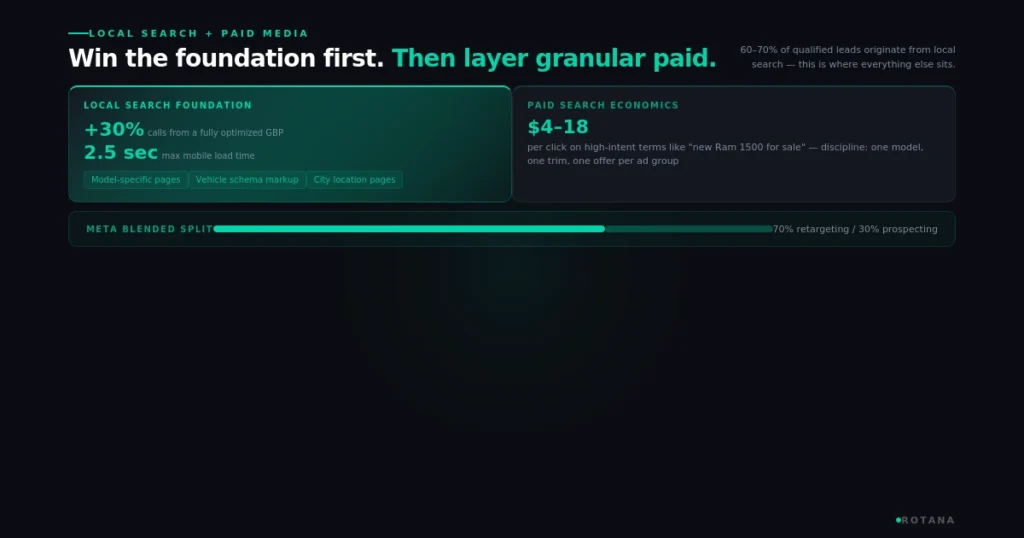
Paid search is the fastest way to reach buyers actively shopping and the economics work because intent is high. Automotive keywords like “new Ram 1500 for sale” or “Toyota Camry lease deals” carry costs per click between roughly $4 and $18, but the shopper typing them is close to buying. The discipline that makes it pay is granular structure: one model, one trim, one offer per ad group, with price and call extensions that cut friction. On social, Meta’s inventory ads serve live vehicle listings based on behavior and life events and lead forms that capture details inside the app can lift conversion meaningfully versus sending people to a landing page. A 70% retargeting and 30% prospecting split tends to deliver the best blended cost per lead. The tactics that separate efficient campaigns from wasteful ones are specific:
- Structure campaigns by new versus used, then make, model and trim, which raises Quality Score and lowers cost per click.
- Use dynamic search ads for used inventory, automatically matching ads to your live vehicle detail pages as stock turns over.
- Run VIN-level retargeting to re-engage a shopper with the exact vehicle they viewed within a few days of the visit.
- Add price and payment extensions showing lease or finance figures directly in the search result to cut friction.
- Set up call-only campaigns for high-intent mobile users searching after hours, plus separate campaigns for service-department leads.
The channels are not interchangeable, so it helps to see the economics side by side.
| Channel | Typical cost per lead | Best role |
|---|---|---|
| SEO and Google Business Profile | $30 to $80 | Cheapest, compounding local demand |
| Paid search | $80 to $200 | Fast capture of high-intent shoppers |
| Meta inventory and lead ads | Varies, mid-range | In-market plus 3 to 6 month buyers |
| Third-party lead providers | $150 to $300 | Fill gaps on slow inventory only |
The pattern to notice: your own channels produce the cheapest leads and third-party providers the most expensive, which is why owning demand beats renting it. First-party leads from your website and Google convert several times better than third-party leads, so use providers strategically rather than as your foundation.
Show up in AI search the right way
With AI-driven traffic to dealership sites up 15 times year over year, getting recommended by AI tools is now a real acquisition channel. The good news, straight from Google’s own guidance, is that there are no special tricks: optimizing for AI search is mostly just good SEO. You do not need to chunk content into fragments, rewrite pages purely for machines or chase special markup. You need genuinely useful content that answers the exact questions shoppers ask, clear local detail about your store and inventory and FAQ sections that resolve real buyer questions. Write the clear, complete answer to “best Toyota dealer in Phoenix” or “most reliable used SUV under $30,000,” and you become the source the AI cites. Most dealerships have not started, so moving early is a genuine first-mover advantage rather than a gimmick.
Fix the speed problem that loses sales
This is the most expensive leak in automotive marketing and it has nothing to do with your ad budget. Most dealerships do not have a lead problem, they have a handling problem. A buyer clicks your ad, taps “call,” and the phone rings eight times before going to voicemail. Another messages your page after hours and hears nothing until morning. In both cases you paid for the lead and lost the sale to whoever answered first. Speed to lead in 2026 is measured in minutes, not hours and the fix is a system rather than more spend:
- Auto-respond to every web lead within five minutes, then route calls to a live person and overflow to mobile so they avoid voicemail.
- Put clear “Call Now” and “Text Us” buttons on every inventory and landing page, tied to tracked numbers so you know which campaigns create real conversations.
- Use an after-hours agent or automation to engage the 11 PM Saturday shopper immediately instead of waiting for Monday.
- Run a structured nurture sequence across the 89-day cycle, since the dealership that stays in contact through the research period usually wins the sale.
Dealerships using multi-touch nurture see materially higher close rates on internet leads and improving follow-up can lift close rates without spending a dollar more on leads. The click is not the hard part. What happens after it is.
Turn reviews into a lead engine
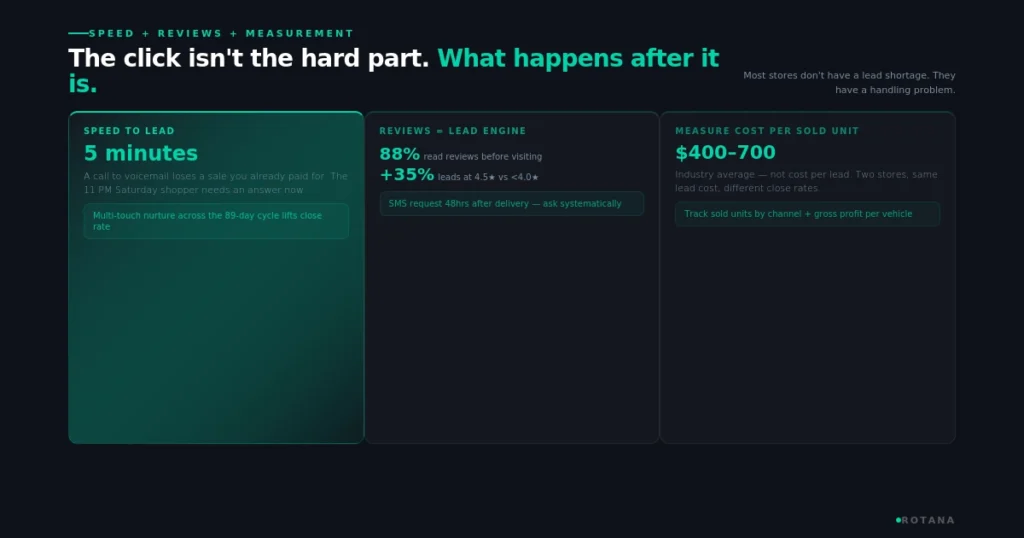
Reputation is not a vanity metric in automotive, it is a lead source. A 2026 Cox Automotive study found that 88% of car buyers read dealership reviews before visiting and stores with 4.5-star ratings and above receive 35% more leads than those below 4.0. The problem is that unhappy customers leave reviews on their own while happy ones rarely do, so you have to ask systematically. A post-purchase request triggered by SMS about 48 hours after delivery can generate several times more reviews than waiting passively. The system:
- Automate review requests by SMS 48 hours after every vehicle delivery and every service visit.
- Train service advisors to ask for a review verbally at pickup, when satisfaction peaks.
- Respond to every negative review fast, with a direct path to a manager, since prospects read your responses.
- Feature your best reviews on vehicle detail pages and inside nurture emails as social proof.
Because reviews feed local ranking, AI recommendations and buyer trust at once, a review engine pays off three times over.
Build on first-party data and retention
With third-party cookies gone, your own data is the durable asset. Unifying every touchpoint, website behavior, ad engagement, service visits, phone calls and trade appraisals, into a single customer profile lets you market to known customers with precision instead of targeting strangers. The shopper who serviced twice this year, browsed trucks last week and opened your inventory email yesterday is a conquest opportunity you can act on, but only if your systems connect those signals. This is also where retention marketing compounds: service customers, lease maturities and equity-positive owners cost far less to reach than cold prospects and carry higher lifetime value. The same owned-audience discipline drives my guides to email marketing lead generation and the long-cycle nurture in real estate email marketing. Owning the relationship, rather than renting attention, is the same lesson restaurants are learning in my guide to digital marketing for restaurants.
Measure cost per sold unit, not leads
Lead volume flatters the picture and hides the truth. The metric that should govern your budget is cost per sold unit, which averages roughly $400 to $700 across the industry, not cost per lead. Two stores with the same cost per lead can have very different costs per sold unit depending on how well they handle and close those leads. Track sold units by channel through a CRM, watch appointment rate and gross profit per vehicle and use call tracking so every sale traces to a source. Modern attribution should tie spend to showroom visits and sold units rather than impressions and clicks. A dealership that knows its true cost per sold unit by channel, plus the lifetime value of a retained service customer, makes far sharper budget decisions than one watching lead counts.
What I would do first
If you run a dealership and want a more efficient, higher-margin marketing system, work in this order:
- Fix speed to lead so every inquiry gets a response in minutes, with no calls going to voicemail.
- Fully optimize your Google Business Profile and build model and location pages for local search.
- Stand up a systematic review engine triggered after every delivery and service visit.
- Structure paid search and Meta inventory ads granularly, weighted toward retargeting.
- Build service-to-sales and retention marketing on unified first-party data.
- Publish genuinely useful content and FAQs so AI tools cite your store.
- Measure cost per sold unit and gross per vehicle, then shift budget to what sells cars.
Automotive marketing in 2026 rewards the dealership that owns its demand, answers fastest and markets to the customers it already has, not the one that simply buys the most leads. The system beats the spend. If you want that system built and tuned to your store and your market, that is the work I do at Rotana. Book a call through the link on the site.
Frequently asked questions
What is the best automotive marketing strategy for dealerships in 2026?
The strongest approach combines local SEO and an optimized Google Business Profile, granular paid search and Meta inventory ads, a fast speed-to-lead system and a systematic review engine, all built on first-party data. Because shoppers research online for about 89 days and visit only 1.4 dealerships, winning means being visible early, responding in minutes and nurturing through the cycle. No single channel wins. The dealerships that grow run these as one system and market hard to existing service customers, not just new leads.
How much does a car dealership lead cost?
Cost per lead ranges from about $30 to $80 for SEO-generated leads, $80 to $200 for paid search and $150 to $300 for third-party providers, which also convert at lower rates. The metric that matters more is cost per sold unit, which averages roughly $400 to $700 industrywide. Two dealerships with the same cost per lead can have very different costs per sold unit depending on follow-up and closing, so measure sold units by channel rather than raw lead volume.
How do dealerships show up in AI search results like ChatGPT?
By publishing genuinely useful content that answers the exact questions shoppers ask, with clear local detail about the store and inventory and real FAQ sections. Per Google’s guidance, optimizing for AI search is mostly good SEO, so there is no need to chunk content or chase special markup. With AI-driven traffic to dealership sites up 15 times year over year, early movers who create authoritative, citation-worthy local content establish an advantage while most competitors have not started optimizing for AI platforms at all.
Why is speed to lead so important for car dealerships?
Because buyers contact several stores and hire whoever responds first. Most dealerships do not have a lead shortage, they have a handling problem: a call that rings to voicemail or an after-hours message answered the next morning loses a sale you already paid for. Speed to lead is now measured in minutes and auto-responding within five minutes, routing calls to live staff and nurturing across the 89-day cycle lifts close rates substantially without any increase in ad spend.
How should dealerships market their service department?
Treat fixed ops as a marketing channel, not just an operations department. Service customers are your cheapest source of future vehicle sales, since they already trust you and you hold their data. Automate service reminders, market to lease maturities and equity-positive owners before competitors do and connect service history to sales outreach. Retention marketing to existing owners lowers acquisition cost and raises lifetime value, which is why the most profitable dealerships run a dedicated service engine alongside their vehicle-sales marketing.