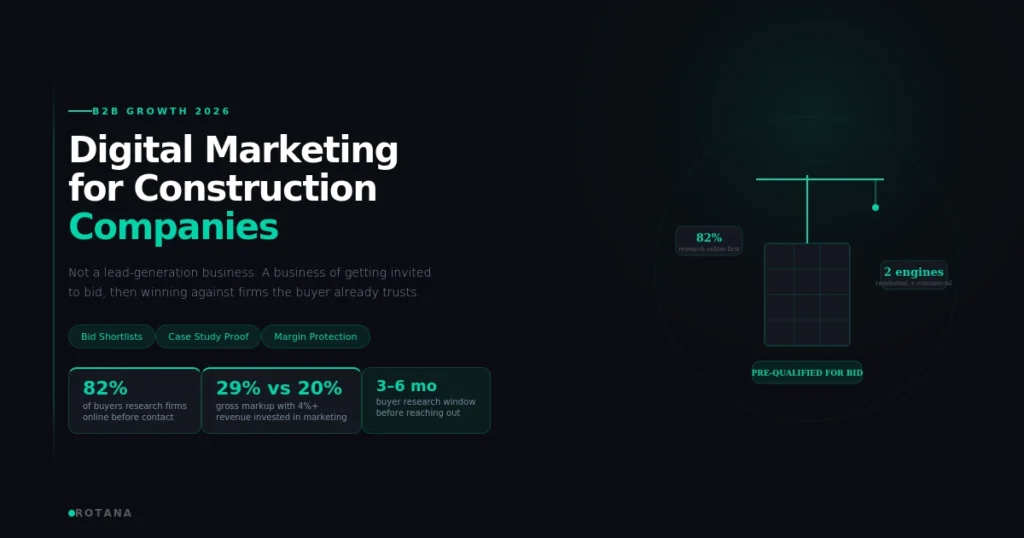
Digital marketing for construction companies is the system of search, content, reputation and relationship-building that gets your firm onto the shortlist before a project ever goes out to bid. That framing matters, because construction is not a business of generating leads. It is a business of getting invited to bid, then winning the bid against firms the buyer already trusts. By the time a developer or facility manager calls you, they have usually researched you, compared you and half-decided. According to Percepture’s 2026 analysis, 82% of construction buyers research firms online before making contact. Your digital presence is your pre-qualification and most firms are failing it without knowing.
I run an SEO-led growth agency, so I will be blunt about something the typical construction marketing guide avoids: more leads is the wrong goal. A pile of low-fit inquiries from price shoppers wastes your estimators’ time and drags your margins down. The real job is authority that filters in the right projects and filters out the lowest-bid crowd. This guide covers that system: why construction marketing differs from contractor marketing, the two engines you actually run, the proof that wins bids and the metric that should govern your budget.
Why construction marketing is different from contractor marketing
People use “construction” and “contractor” interchangeably, but the marketing is not the same and conflating them is why generic advice fails. A roofing contractor chasing residential leads runs a fast, local, high-volume game built on Local Service Ads and emergency search. A general contractor bidding a commercial build runs a slow, relationship-driven game built on reputation, case studies and getting on bid lists. The search behavior, decision timeline and proof requirements are completely different. If your firm does home-services trade work, my guide to digital marketing for contractors fits that motion better. This guide is about construction companies, especially the commercial and B2B side where projects run into six and seven figures.
The buyer researches for months
Construction is never an impulse purchase. Buyers research for three to six months before contacting a firm, comparing safety records, past projects, case studies and reviews and increasingly asking AI tools for recommendations. Roughly 61% of B2B buyers now prefer a rep-free buying experience, per Gartner’s 2025 research, meaning they want to learn everything they can before a salesperson is ever involved. If your firm is invisible during that long research phase, you are not on the shortlist when the buyer finally reaches out. Visibility shapes perception long before a bid is submitted.
Run two engines: residential and commercial
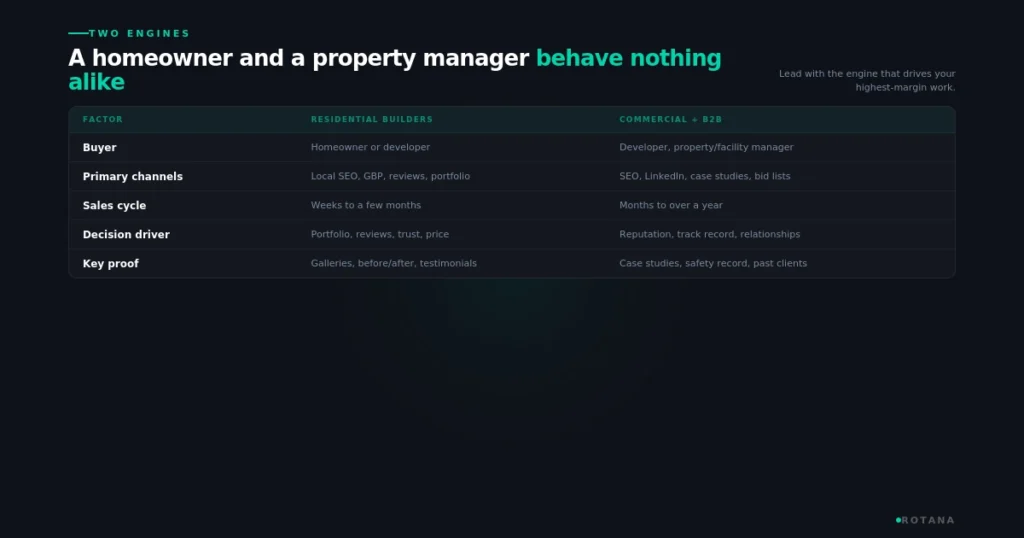
Most construction firms market one way to two very different buyers, which leaves money on the table. A homeowner choosing a custom builder and a property manager choosing a commercial general contractor behave nothing alike. They search differently, decide on different timelines and need different proof. The strongest firms run two distinct engines.
| Factor | Residential builders | Commercial and B2B contractors |
|---|---|---|
| Buyer | Homeowner or developer | Developer, property manager, facility manager |
| Primary channels | Local SEO, Google Business Profile, reviews, portfolio | SEO, LinkedIn, case studies, referrals, bid lists |
| Sales cycle | Weeks to a few months | Months to over a year |
| Decision driver | Portfolio, reviews, trust, price | Reputation, track record, relationships, capability |
| Key proof | Project galleries, before-and-after, testimonials | Case studies with results, safety record, past clients |
Name which engine matters most for your project mix, then build for it first. A firm split evenly between both runs both, but few firms are truly even, so lead with the engine that drives your highest-margin work.
The foundation: search visibility that filters for fit
Local SEO and Google Business Profile
For firms serving a defined geography, local search is where high-intent buyers start, with queries like “commercial general contractor in Houston” or “design-build firm in Dallas.” Your Google Business Profile is the anchor: keep it complete with the right category, current information, strong project photos and steady reviews. Build location-specific landing pages for each market and service you serve, since a page targeting the exact phrase a buyer types both ranks and converts. This local and organic foundation is the work I focus on through our SEO consultancy service.
Rank for high-intent, not broad terms
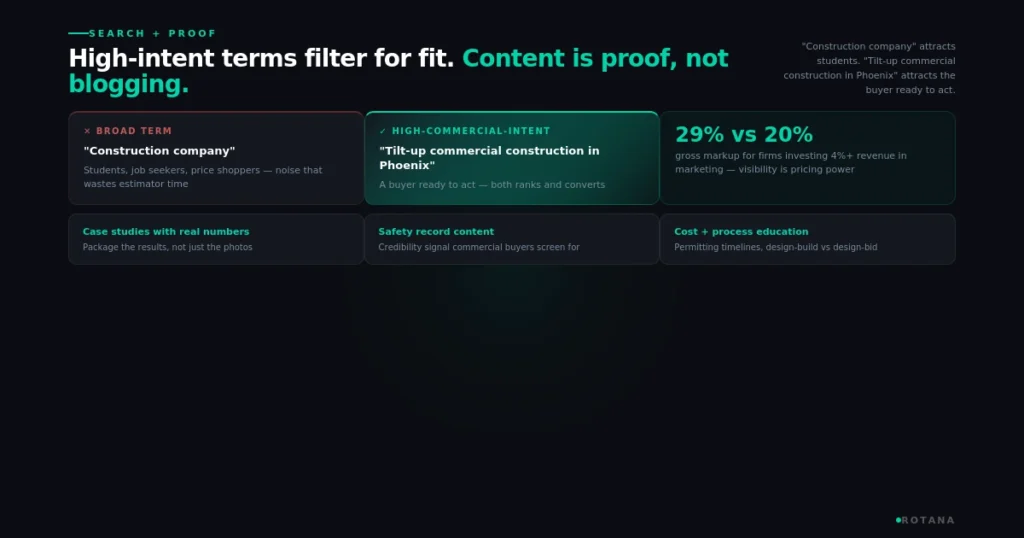
The firms that dominate search are not bidding on the word “construction.” They target specific, high-commercial-intent phrases that signal a buyer ready to act, then filter out the noise. A page built around “tilt-up commercial construction in Phoenix” attracts a qualified buyer, while “construction company” attracts students, job seekers and price shoppers. Authority positioning has a margin effect worth naming: when your firm ranks as the credible expert, you attract clients who prioritize expertise over the lowest bid. The SORCI 2026 report found that construction companies committing 4% or more of revenue to marketing achieve 29% gross markups versus 20% for those that do not. Visibility is not just lead flow. It is pricing power.
Proof is the content that wins bids
In construction, content marketing is not blogging for its own sake. It is proof, packaged so a researching buyer trusts you before the first call. The contractor who teaches first earns trust first and trust shortens the sales cycle. The formats that actually move construction buyers are specific:
- Project case studies with real numbers. Show the challenge, your solution and the measurable result, with photos and a timeline. “How we completed a 40,000 square foot warehouse renovation three weeks ahead of schedule” beats any list of services, because it is evidence a generic competitor cannot fake.
- Safety and risk content. Buyers fear delays, liability and a firm that cuts corners. Writing about OSHA compliance, jobsite safety protocols and how you handle inspections answers the fear directly and builds confidence.
- Cost and process education. Answer the questions buyers actually Google: cost per square foot for a commercial build, how long permitting takes, the difference between design-build and design-bid-build. Being the firm that explains the process earns the relationship.
If a buyer asks the same question twice, turn the answer into content. If the work is real, explain it. If the proof exists, package it. That is the whole content discipline in construction.
Reputation is as important as your portfolio
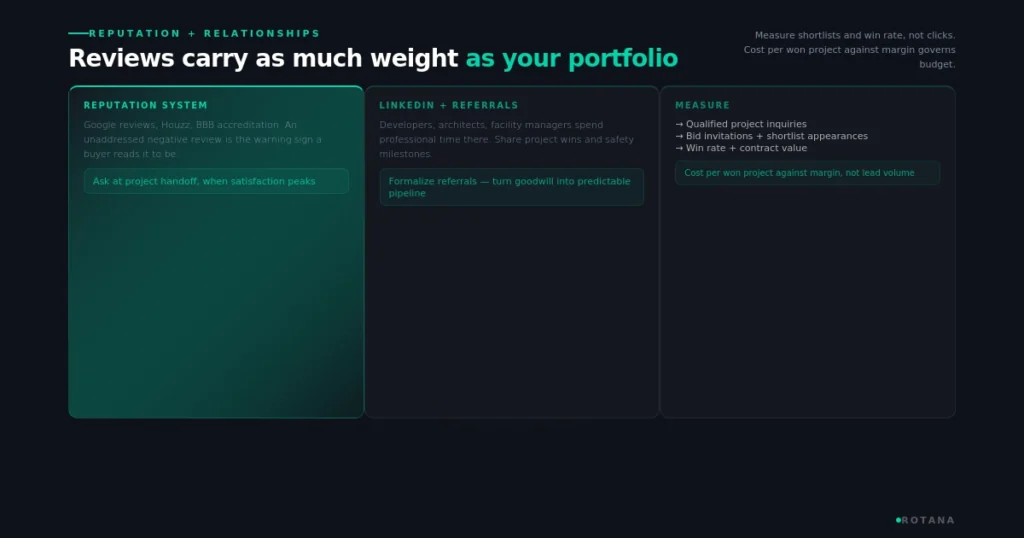
This is the channel most construction marketing guides skip and it is one of the most decisive. Your Google reviews, Houzz ratings and BBB accreditation now carry as much weight as your project portfolio. Reviews influence how Google ranks your firm in local search and how a buyer judges you before any conversation. Firms with a steady volume of recent reviews convert noticeably better than those with few. Make review generation systematic: ask at project handoff when satisfaction peaks, respond professionally to every review including the critical ones and treat an unaddressed negative review as the warning sign a buyer reads it to be. For the commercial side, named past clients and project references function as your reviews, so make them visible.
The commercial relationship layer
LinkedIn and referrals
For commercial and B2B construction, LinkedIn is the most effective social platform, since developers, architects, property managers and municipal decision-makers spend their professional time there. Share project wins, safety milestones and process insights from company leadership, then engage in the conversations where opportunities begin. Referrals remain one of the most reliable, highest-value channels in construction, so formalize them: a structured referral and past-client program turns goodwill into a predictable pipeline rather than leaving it to chance.
Connect offline touchpoints to a digital next step
Construction happens in the real world, but the buying research happens online, so connect the two deliberately. Put short, memorable URLs and review links on yard signs, trucks, brochures and trade-show booths. Industry events give the commercial side direct access to developers and decision-makers in a buying mindset, so follow up within 24 to 48 hours with a clear next step that points back to your digital proof.
Be present in AI search
Buyers now ask AI tools questions like “best design-build contractor for a mid-size office build” and act on the answer. Google AI Overviews are the default experience for a growing share of construction queries. The good news is that there are no special tricks: the same things that earn rankings, genuinely useful content that answers real buyer questions clearly, are what get your firm surfaced and cited in AI answers. Write the clear, expert answer to the question a buyer would ask and you become a source the AI quotes rather than a firm it skips.
Measure shortlists and won work, not clicks
The point is profitable projects, so measure what maps to them. Track qualified project inquiries, bid invitations and shortlist appearances, then win rate and contract value, rather than traffic and impressions that flatter the picture. Tie marketing spend to booked projects through call tracking and a simple CRM. Most construction firms invest 5% to 10% of revenue in marketing with the majority going to digital, though commercial-heavy firms often run leaner. The number that should drive your budget is cost per won project against project margin, not lead volume, since a channel that floods you with low-fit leads is expensive even when the leads look cheap.
What I would do first
If you run a construction company and want a more predictable, higher-margin pipeline, work in this order:
- Decide which engine drives your best work, residential or commercial and build for it first.
- Fix your Google Business Profile and build location and service pages targeting high-intent local terms.
- Build a steady review habit, since reputation now ranks alongside your portfolio.
- Package your best projects into case studies with real numbers, plus safety and cost-education content.
- For commercial work, activate LinkedIn and formalize referrals and past-client relationships.
- Track shortlists, win rate and cost per won project, then invest where the profitable work comes from.
Construction marketing rewards the firm that is visible during the long research phase, trusted through proof and positioned as the expert rather than the cheap option. The system protects your margin, not just your pipeline. If you want that system built and tuned to your project mix, that is the work I do at Rotana. The same B2B discipline drives my guides to manufacturing marketing and industrial marketing agencies. Book a call through the link on the site.
Frequently asked questions
What is the best digital marketing strategy for construction companies?
The strongest approach builds authority that gets your firm onto the shortlist before a project goes to bid. That means local and organic SEO targeting high-intent terms, project case studies and safety content as proof, a systematic review habit and for commercial work, LinkedIn and formalized referrals. Because buyers research for months before contacting a firm, visibility during that phase is what earns the bid invitation. The goal is not more leads but better-fit, higher-margin projects, measured by shortlists and win rate rather than traffic.
How is construction marketing different from contractor marketing?
They target different buyers with different behavior. A residential or home-services contractor runs a fast, local, high-volume game built on Local Service Ads, reviews and emergency search. A commercial general contractor runs a slow, relationship-driven game built on reputation, case studies and getting on bid lists, with sales cycles stretching past a year. The search behavior, decision timeline and proof requirements all differ, so applying generic contractor advice to a commercial construction firm or the reverse, wastes budget on the wrong channels.
How much should a construction company spend on marketing?
Most industry benchmarks suggest 5% to 10% of annual revenue, with the majority directed to digital channels, though commercial-heavy firms often invest a leaner 1% to 3%. For a mid-sized general contractor this often means a few thousand to over ten thousand dollars monthly. More important than the percentage is the return: the SORCI 2026 report found firms committing 4% or more of revenue to marketing achieve 29% gross markups versus 20% for those that do not. Measure cost per won project against margin rather than lead volume.
How long does SEO take for a construction company?
SEO in construction is cumulative, with initial traction often appearing within three to six months and authority strength building over 6 to 12 months depending on competition and how many firms compete in your geography. Paid search can accelerate visibility sooner, but it should amplify a strong organic foundation rather than replace it. Because SEO compounds and lowers cost per lead over time, while paid stops the moment you stop paying, the durable advantage comes from ranking organically for the high-intent terms your best buyers search.
Does digital marketing actually win construction bids?
Yes, indirectly but powerfully. Construction firms with a strong digital presence receive more bid invitations because they appear credible and established before the first conversation and 82% of buyers research firms online before making contact. Authority positioning also attracts clients who prioritize expertise over the lowest bid, which protects margin. Marketing rarely wins the contract by itself, but it determines whether your firm makes the shortlist and a firm that is invisible during the research phase is often eliminated before it ever gets to bid.