

The best dental marketing strategy is not the one that produces the most new patients. It is the one that produces the most profitable patients at a cost your practice can sustain, then keeps them for years. That distinction is where most practices lose money. They chase new-patient volume, celebrate a full new-patient count and never notice that acquisition costs are climbing while patients quietly leave the back door. The numbers are stark: acquiring a new dental patient costs roughly $300, while reactivating a dormant one costs about $12, a 26-fold difference reported in Patientdesk.ai’s 2026 dental acquisition research. Meanwhile the average practice retains only about 41% of patients and just 5% to 20% of new patients ever book a second visit. Most dental marketing is refilling a leaking bucket.
I run an SEO-led growth agency, so I will frame this the way I would for any practice owner: as economics, not tactics. This playbook covers the metric that should govern every dollar, how to stop the retention leak, the local-search foundation that compounds, what each channel actually costs per patient, why specialty procedures need their own funnels and how to track it all. A brief note first, since dental care is a health decision. Everything here is about acquisition, trust and reputation, never clinical claims. Market honestly, since a patient choosing a dentist is extending real trust and truthful, clear marketing is what earns it.
Measure cost per patient against lifetime value, not volume
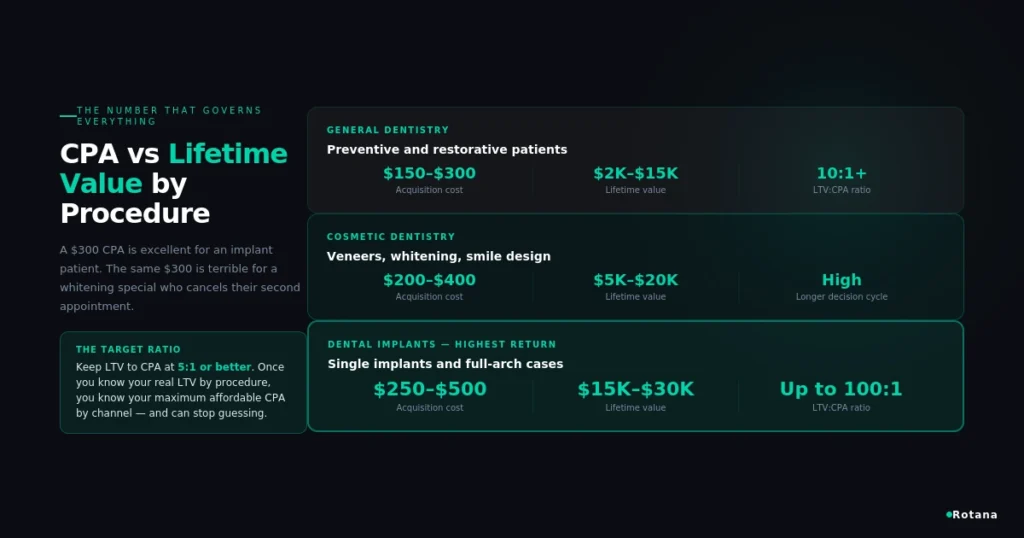
Cost per acquisition, the total marketing spend needed to seat one new patient, is the number that decides whether your marketing is profitable. But a CPA is meaningless on its own. It is only good or bad relative to what that patient is worth over their lifetime with your practice. A $300 CPA is excellent for a patient who accepts a $15,000 implant case and returns for years of hygiene. The same $300 is terrible for a patient who came in on a $99 whitening special and cancelled their second appointment. Set your ceiling from lifetime value, aiming to keep the ratio of lifetime value to acquisition cost at or above 5 to 1 and the whole strategy sharpens.
| Patient type | Acquisition cost | Lifetime value | Rough ratio |
|---|---|---|---|
| General dentistry | $150 to $300 | $2,000 to $15,000 | 10:1 or better |
| Cosmetic | $200 to $400 | $5,000 to $20,000 | High, longer cycle |
| Dental implant | $250 to $500 | $15,000 to $30,000 | Up to 100:1 |
Once you know your real lifetime value by procedure, you know your maximum affordable CPA by channel and you can stop guessing. The practice that manages to cost per patient against lifetime value makes far sharper budget decisions than one watching raw new-patient counts, which say nothing about profit.
Fix the retention leak before buying more patients
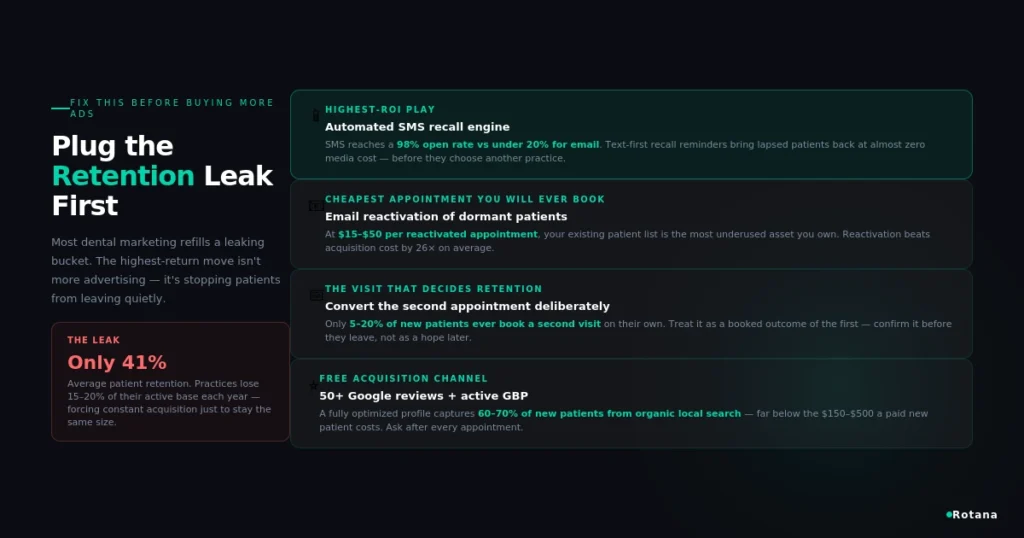
Given that reactivating a lapsed patient costs a fraction of winning a new one, the highest-return move in most practices is not more advertising. It is plugging the leak. With retention near 41% and practices losing 15% to 20% of their active base each year, a practice has to run hard on acquisition just to stay the same size. Reactivation and recall change that math. The plays that work:
- Build an automated recall engine. SMS recall messages reach a 98% open rate against under 20% for email, so text-first reminders bring lapsed patients back cheaply.
- Reactivate dormant patients by email. At $15 to $50 per reactivated appointment, this is the cheapest appointment you will ever book and your patient list is the most underused asset you own.
- Convert the second visit deliberately. Since only a fraction of new patients return, treat the second appointment as a booked outcome of the first, not a hope.
The email and reactivation side of this is exactly what I detail in my guide to dental email marketing, which turns your existing patient list into predictable recurring visits.
Win local search with your Google Business Profile and reviews
For a dental practice, local search is the single most valuable piece of digital real estate and most of it is free. A practice with 50 or more Google reviews and a fully optimized Google Business Profile routinely captures 60% to 70% of its new patients from organic local search at little to no cost per click, far below the $150 to $500 a paid new patient costs. Reviews are not a vanity metric here, they are a primary acquisition channel. Per BrightLocal’s 2026 survey, 97% of consumers read online reviews for local businesses and 31% now contact only practices rated 4.5 stars or higher, up from 17% a year earlier. The gap to exploit: 57% of patients rarely leave reviews on their own, yet 74% say they would if asked. So ask, systematically:
- Send a review request by SMS within about two hours of a completed appointment, when the experience is freshest.
- Follow up once by email if no review appears within 48 hours.
- Respond to every review, positive or negative, since prospects read your responses as a signal of how you treat people.
- Keep the profile active with photos, service listings, posts and a seeded Q&A section, which lifts calls at no media cost.
This local-search and reputation foundation is the work I focus on through our SEO consultancy service.
Know what each channel costs per patient
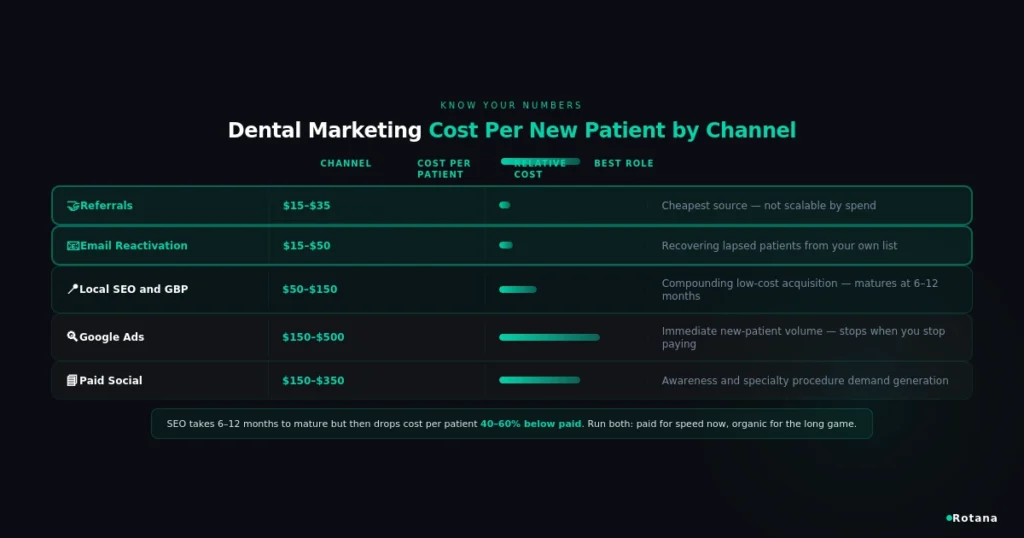
Different channels produce patients at very different costs and the winning mix depends on your goals and timeline. Your own channels compound and stay cheap, while paid channels deliver speed at a higher price that stops the moment you stop paying.
| Channel | Cost per new patient | Best role |
|---|---|---|
| Referrals | $15 to $35 | Cheapest, not scalable by spend |
| Email reactivation | $15 to $50 | Recovering lapsed patients |
| Local SEO and GBP (mature) | $50 to $150 | Compounding low-cost acquisition |
| Google Ads | $150 to $300, metro to $500 | Immediate new-patient volume |
| Paid social | $150 to $350 | Awareness and specialty demand |
On sequencing, use paid search for speed and SEO for durable cost. Google Ads can produce calls within 48 hours, while dental SEO takes 6 to 12 months to mature but then drops cost per patient roughly 40% to 60% below paid once rankings stabilize. Dental keyword clicks run about $3 to $12, with high-value procedures like implants reaching $15 to $25, so Local Services Ads with a Google Guaranteed badge, billed per lead, often outperform standard search ads for practices. Most practices should run both paid and organic: paid for volume now, organic for the long game.
Market specialty procedures as their own funnels
General dentistry acquisition has become commoditized, with everyone bidding on the same cleaning and exam keywords. The margin lives in high-value procedures and they behave differently enough to need their own marketing. An implant or full-arch patient carries a much higher lifetime value, a longer decision cycle and more research touchpoints before booking, so a generic “new patients welcome” campaign underserves them. Build dedicated funnels for implants, cosmetic and other specialty services, with their own landing pages, content answering the specific questions those patients ask and a higher affordable CPA justified by the larger case value. Treating a $20,000 implant prospect the same as a routine hygiene lead leaves the most profitable growth on the table.
Track every new patient’s source
Most practices allocate budget by gut feeling and it costs them. One two-location practice spending $8,500 a month across four channels assumed Google Ads drove most new patients, since that held most of the budget. After proper tracking, the picture flipped: their organic Google Business Profile produced 38% of new-patient calls, Google Ads 27%, direct mail 4% and $1,800 a month in Facebook ads produced almost no booked appointments. You cannot optimize what you do not measure. Ask every new patient how they found you, record it and watch cost per patient by source. Missed calls belong in this same discipline, since every unanswered call is a paid-for patient walking to a competitor, which is why 24/7 booking and fast call handling matter as much as the ads that generate the calls.
What I would do first
If you own a practice and want profitable, sustainable growth, work in this order:
- Calculate your lifetime value by procedure, then set a maximum affordable cost per patient by channel.
- Plug the retention leak with an automated recall and reactivation engine before increasing ad spend.
- Optimize your Google Business Profile and build a systematic review engine toward 50-plus reviews.
- Run paid search for immediate volume while local SEO matures underneath it.
- Build dedicated funnels for your highest-value procedures rather than one generic campaign.
- Track every patient’s source and shift budget to the channels with the lowest cost per patient.
Dental marketing rewards the practice that measures cost per patient against lifetime value, keeps the patients it already has and builds on the free local-search foundation before renting attention. Profit beats volume. If you want that system built and measured for your practice, that is the work I do at Rotana and it connects to my related guides on orthodontic marketing and healthcare marketing. Book a call through the link on the site.
Frequently asked questions
What is the best dental marketing strategy in 2026?
The strongest strategy measures cost per acquired patient against lifetime value rather than chasing new-patient volume and fixes retention before buying more patients, since reactivating a lapsed patient costs a fraction of winning a new one. Practically, that means an optimized Google Business Profile with 50-plus reviews as the low-cost foundation, paid search for immediate volume, dedicated funnels for high-value procedures and an automated recall engine. No single channel wins alone. Profitable practices run a measured mix and track cost per patient by source.
How much does it cost to acquire a new dental patient?
Cost per new patient varies by channel: roughly $15 to $35 through referrals, $50 to $150 through mature local SEO, $150 to $300 through Google Ads with competitive metro markets reaching $500 and $150 to $350 through paid social. The number that matters is cost per patient measured against lifetime value, which runs from around $2,000 for general dentistry to $15,000 to $30,000 for implant cases. A high acquisition cost is fine for a high-value procedure and wasteful for a low-value one, so judge it against what the patient is worth.
How much should a dental practice spend on marketing?
Most dental consultants recommend allocating 3% to 6% of gross annual revenue to marketing. For a practice generating $1 million a year, that is roughly $30,000 to $60,000 annually or $2,500 to $5,000 a month. Newer practices or those in competitive urban markets should lean toward the higher end to accelerate patient acquisition. More important than the percentage is how it is allocated: track cost per patient by channel and shift budget toward the sources producing profitable patients rather than spreading it evenly by habit.
Are Google reviews really that important for dentists?
Yes. Reviews function as a primary acquisition channel, not just a trust signal. Per BrightLocal’s 2026 survey, 97% of consumers read online reviews for local businesses and 31% now contact only practices rated 4.5 stars or higher, up from 17% the prior year. A practice with 50-plus reviews and an optimized Google Business Profile captures a large share of new patients from organic local search at very low cost. Since most patients will leave a review only when asked, a systematic request process is one of the highest-return moves available.
Should a dental practice use PPC or SEO?
Both, sequenced by need. Paid search produces patient calls within days, making it right for new practices or immediate volume, while SEO takes 6 to 12 months to mature but then drops cost per patient roughly 40% to 60% below paid once rankings stabilize. Established practices seeking lower long-term cost should invest in SEO and those needing immediate flow should start with paid. Most competitive markets call for both at once: paid search for speed while organic rankings and your Google Business Profile build the durable, lower-cost foundation underneath.