
Orthodontic marketing is the work of getting found by the two very different audiences who need braces and clear aligners, earning their trust through a high-value decision, then converting a consultation into a started case. It is not generic dental marketing. An orthodontist sells an elective, expensive, months-long treatment to a teenager’s parent on one hand and a self-conscious adult on the other, while fending off direct-to-consumer aligner brands and corporate chains. With an average case value near $5,800, a 10% lift in monthly conversions can add over $400,000 in annual production for a mid-sized practice, so the stakes per patient are high.
I run an SEO-led growth agency, so I see why some practices stay full while equally skilled ones sit quiet. By 2026 the referral-only model is gone. Research shows 78% of orthodontic patients begin their journey with online research and 91% of parents and adults now validate a word-of-mouth recommendation with a Google search before booking. If you are not visible and trustworthy at that moment, the patient picks a competitor. This guide covers the full system: the two-audience engine, local visibility, the Invisalign play, positioning against DTC aligners, the consultation that converts, the referral network and the one metric that matters.
A note first, since this is a health decision. Treat marketing claims with care. Show real outcomes honestly with documented patient consent, never imply a result is typical when it is not and keep clinical content accurate. Trust in orthodontics is earned through honesty, not hype.
Why orthodontic marketing needs two engines
Teens and parents versus adults
An orthodontic practice markets to two audiences who behave nothing alike. The first is the parent of a teenager, who searches “braces” and weighs cost, trust and convenience for their child. The second is the self-conscious adult, who searches “Invisalign” and weighs discretion, lifestyle and financing for themselves. “Invisalign” tends to attract adults ready to invest, while “braces” pulls a mix of parents and price-sensitive shoppers. Running one generic campaign for both wastes money. The practices that grow build two engines: a family-focused engine for teen braces and a lifestyle-focused engine for adult clear aligners.
Different messages, channels and pages
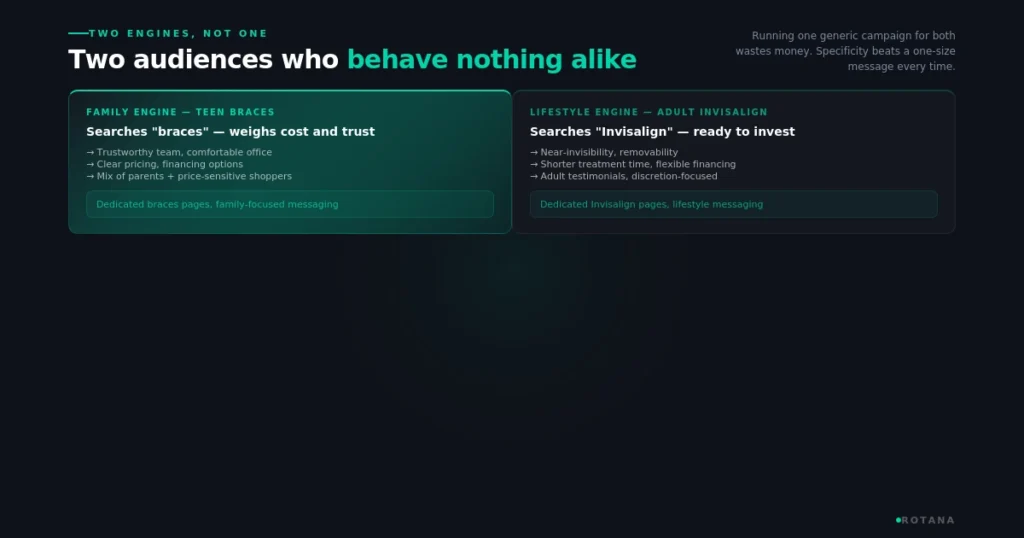
Each audience needs its own message, landing page and channel mix. Adults respond to the near-invisibility of aligners, the ability to remove them, shorter treatment times and flexible financing, ideally shown through testimonials from other adults. Parents respond to a trustworthy team, a comfortable office and clear pricing. Build dedicated pages for adult orthodontics and Invisalign separate from your braces pages, then match each ad and social campaign to the audience it serves. Specificity beats a one-size message every time.
Win local search first
The Map Pack and Google Business Profile
Most orthodontic searches are local and 45% include a specific geographic modifier like “orthodontist in [city].” Your Google Business Profile is the most important local asset. Set the primary category to “Orthodontist,” add “Invisalign Provider” status and list every service from Phase I interceptive care to surgical orthodontics. Keep name, address and phone consistent everywhere, post updates regularly and use professional photos plus a 360-degree office tour, since profiles with high-quality imagery see meaningfully higher click-throughs. A complete profile earns far more location visits than an incomplete one. Pay attention to local justifications, the snippets Google pulls from your site or reviews to prove you offer exactly what a searcher wants. This local foundation is the work I focus on through our SEO consultancy service.
Local SEO and content that answers real questions
Below the map, rankings go to practices with genuine topical depth. Target the phrases patients actually use: problem-based like “how to fix crowded teeth,” solution-based like “Invisalign versus braces cost,” and location-based like “orthodontist in [city].” Build an FAQ page answering the top questions your treatment coordinators hear and write problem-solution blog posts addressing real fears, such as whether clear aligners can fix an overbite. Practices publishing weekly educational content see significantly more organic traffic. Because Google now favors immediate answers, with most mobile searches ending without a click, securing the featured snippet for clinical queries builds authority before the patient even visits your site.
The Invisalign play
Build conversion pages, not information pages
Most practices treat Invisalign as another service on a list, add a generic page, then wonder why clear-aligner inquiries convert poorly. Invisalign has its own patient psychology and deserves its own approach. Send paid traffic to a dedicated landing page built specifically for Invisalign, not your homepage or a services overview. The page should open and close with Invisalign, handle the objections that stop bookings, then end with one clear call to action, ideally bookable online. Most practice Invisalign pages underperform because they explain what Invisalign is, information the patient already has, without creating momentum toward booking.
Handle the three objections head-on
Three concerns stop adults from booking clear aligners, so address each directly. Cost: give a range or a financing option rather than “contact us for pricing.” Timeline: be honest about how long different complexity levels take. Compliance: reassure them about wearing the aligners enough to get results. A page that answers these dissolves the hesitation that kills high-consideration decisions.
Market through the long consideration window

The clear-aligner consideration window can span six to twelve months. A patient who downloads your guide today might not book until spring. The practices that fill their Invisalign schedules never stop marketing to the patient who is just thinking about it, staying present across search, social and email through that whole window. This is also where Google Ads and Meta divide the labor: Google Ads captures the patient who already decided to search, while a Meta before-and-after photo creates demand in someone who was only scrolling. A balanced split between the two, often around 60/40 toward Google, produces the most consistent flow of consultations.
Position against direct-to-consumer aligners
The orthodontic landscape changed when direct-to-consumer aligner companies, dental service organizations and corporate chains entered. DTC brands compete on price and convenience, so do not try to out-cheap them. Compete on what they cannot offer: in-person clinical supervision, the safety of a licensed orthodontist monitoring the case and accountability if something goes wrong. Make that contrast explicit in your content. A patient weighing a mail-order aligner against your practice should understand exactly what professional supervision protects them from. Your expertise is the differentiator, so lead with it rather than hiding it behind a price war.
The consultation is where cases are won
Treat the consult as part of the funnel
Marketing books the consultation. The consultation books the case. Most orthodontists cringe at the word sales, yet failing to win the consult sends a pre-sold patient down the street. Treat the new-patient exam as the final, decisive stage of the funnel, not a separate clinical event. Even strong marketing loses momentum if scheduling feels clunky, communication is inconsistent or the consult experience falls short of what the marketing promised. Confirm appointments, reduce no-shows with reminders and make the experience reflect the credibility your marketing built.
Build a case-acceptance system
The practices that convert more starts create confidence at every stage. A simple, effective approach: assume the patient is pre-sold, pre-frame the common objections before they raise them and present one clear payment option rather than a confusing menu. Strong reviews, visible proof and a consistent experience all make it easier for a patient to say yes. Reviews are a core channel here, not an afterthought, so collect them systematically right after positive milestones. Screenshot great reviews into a digital “brag book” to share during consultations, which reassures the next prospective patient.
The referral network most practices underuse
Patient and dentist referrals
Even when a patient hears about you from a friend or a dentist, they still look you up before acting, so referrals and digital visibility reinforce each other. Two referral sources matter most. Patient referrals come from a great experience plus a simple, well-promoted incentive program, which can lift referral-based starts noticeably within months. Dentist referrals are a distinct, high-value channel: general dentists send patients who need orthodontic treatment. Build genuine relationships with local dentists, make referring easy and treat that network like the B2B channel it is.
Community presence that compounds
Community involvement creates connections that ad dollars cannot buy. Rather than putting your logo on every banner, choose two organizations that align with your values and target families, then get deeply involved. Speak about dental health at schools and parent groups, support causes you genuinely care about and build relationships with aligned local businesses. Authentic local presence builds the kind of word of mouth that feeds both patient and dentist referrals over time.
Supporting channels
Video, social and email
Video builds trust fast in orthodontics. A YouTube channel with treatment explanations, patient transformations and office tours, plus short-form transformations on TikTok and Instagram Reels, humanizes the practice and reaches younger audiences. Email keeps you connected: newsletters with oral-health tips, nurture sequences for undecided Invisalign prospects, appointment reminders and referral prompts all support retention and starts. The principle across all of them is consistency over volume, since thoughtful, regular content beats daily noise that no one engages with.
Measure cost per start, not leads
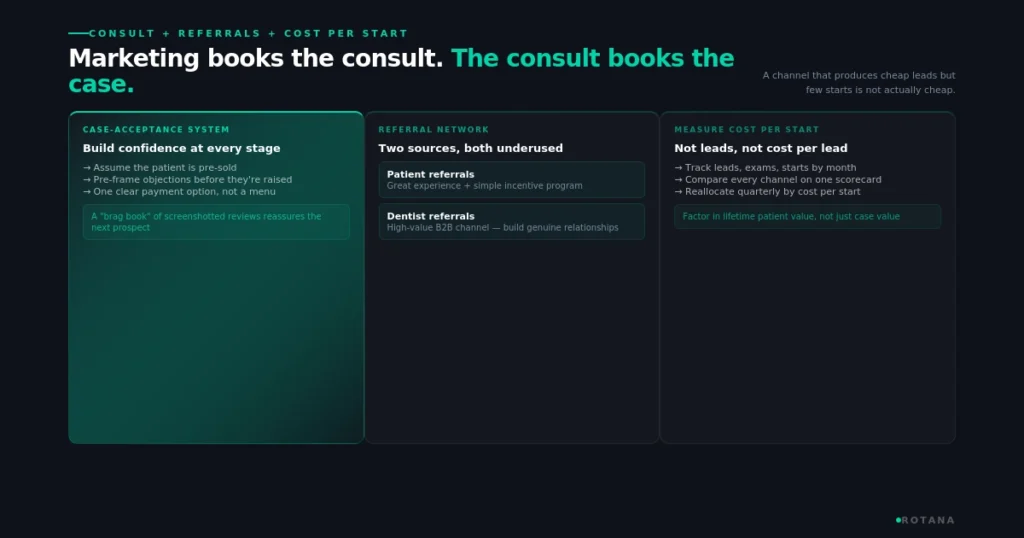
The goal is started cases at a sustainable cost, so measure what maps to starts. Track leads, exams and starts by month, then compare every channel, patient referrals, dentist referrals, local SEO, paid ads and community outreach, on the same scorecard. Reallocate budget quarterly based on cost per start, not lead volume, since a channel that produces cheap leads but few starts is not actually cheap. Factor in lifetime patient value, not just the immediate case. The practices that grow stop chasing whatever sounds trendy and invest in the channels that produce starts most efficiently for their specific market and audience mix.
What I would do first
If you run an orthodontic practice and want more starts, start in this order. Optimize your Google Business Profile for the Map Pack with the right primary category and Invisalign Provider status, then build a steady review habit. Split your marketing into two engines, teen braces and adult Invisalign, each with its own pages and messages. Build dedicated, objection-handling Invisalign landing pages. Position clearly against DTC aligners on supervision and safety. Fix the consultation into a real case-acceptance system. Strengthen the dentist-referral channel. Then measure cost per start and invest where starts are cheapest.
Orthodontic marketing rewards the practice that speaks to both audiences, wins local search, converts the consult and measures starts. The system matters more than the budget. If you want that system built and tuned to your market, that is the work I do at Rotana, with the same care for trust I bring to other health verticals. See my guides to dental email marketing and digital marketing for plastic surgeons. Book a call through the link on the site.
Frequently asked questions
What is the best marketing strategy for orthodontists?
The strongest approach runs two engines, one for teen braces aimed at parents and one for adult clear aligners, built on a foundation of local SEO and an optimized Google Business Profile to win the Map Pack. Add dedicated Invisalign landing pages, Google and Meta ads, a strong review habit and a dentist-referral network. No single tactic wins. The practices that grow run these as one system, convert the consultation well and measure cost per start rather than lead volume.
How do orthodontists get more patients?
They get found and they earn trust at the moment patients research. That means ranking in local search and the Map Pack through an optimized Google Business Profile, reviews and educational content, plus paid ads for immediate visibility. Because 91% of patients validate referrals with a Google search, digital visibility and word of mouth reinforce each other. Strengthening both patient and dentist referral channels, then converting consultations into starts, turns that visibility into booked treatment.
How should orthodontists market Invisalign?
Treat Invisalign as its own offering with its own dedicated landing page, not a line on a services list. The page should focus entirely on clear aligners, highlight benefits adults care about like discretion and removability and handle the three objections of cost, timeline and compliance directly. Because the consideration window can run six to twelve months, stay present across search, social and email throughout. Pair Google Ads, which captures active searchers, with Meta before-and-after content that creates demand.
How do orthodontists compete with direct-to-consumer aligner companies?
Not on price. Direct-to-consumer aligner brands compete on cost and convenience, so a practice should compete on what they cannot offer: in-person clinical supervision, the safety of a licensed orthodontist monitoring the case and accountability if problems arise. Make that contrast explicit in your content so a patient weighing a mail-order aligner understands what professional oversight protects. Leading with clinical expertise, rather than discounting to match, is how practices win patients who might otherwise choose a cheaper mail-order option.
What marketing metric matters most for orthodontic practices?
Cost per start, not cost per lead or lead volume. A channel that generates many cheap leads but few started cases is not actually efficient. Track leads, exams and starts by month, compare every channel on the same scorecard and reallocate budget quarterly toward the channels producing starts most affordably. Factor in lifetime patient value rather than just the immediate case value, since some channels bring patients worth far more over time. Starts at a sustainable cost are the real goal.