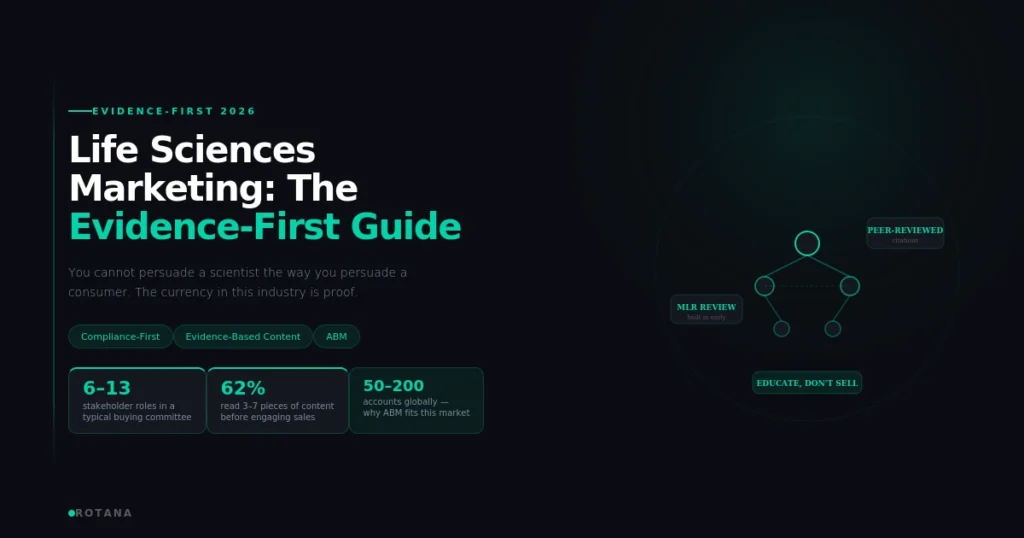
Life sciences marketing is the work of earning trust from skeptical scientific buyers, under heavy regulatory constraint, across a long committee-driven sale. That sentence contains the whole challenge. Your buyers hold PhDs and MDs, they are trained to distrust a marketing claim that lacks evidence and they research exhaustively before they ever speak to a salesperson. According to Demand Gen Report, 62% of B2B buyers in life sciences read three to seven pieces of content before engaging a sales rep and per Gartner, 61% of B2B buyers now prefer a rep-free experience. Your content is your first interview and this audience grades harder than any other in B2B.
I run an SEO-led growth agency, so here is the truth most life sciences marketing advice dances around: you cannot persuade a scientist the way you persuade a consumer. Slogans, hype and generic benefit claims do not just fail, they actively cost you credibility with people whose job is evaluating evidence. The currency in this industry is proof. This guide covers the system that works: who you are really selling to, the evidence-first content engine, compliance built in from the start, the channels that reach scientific buyers and how account-based marketing fits a market this small.
A note on care, since this is science and health adjacent. Every claim in life sciences marketing must be accurate and compliant. Cite verifiable data, reference peer-reviewed and primary sources and route promotional content through proper review. Inaccuracy here is not just a marketing miss, it is a regulatory and reputational risk.
Who you are really selling to
A skeptical, expert, multi-stakeholder buyer
Life sciences buyers are sophisticated, evidence-oriented and deeply skeptical of generic claims. A procurement professional, a clinical champion at a hospital system or a regulatory affairs lead will not be moved by benefit statements, they want specific verifiable data: clinical outcomes from peer-reviewed publications, process capability data, real regulatory track records. And they rarely buy alone. The buying committee often spans 6 to 13 roles, including scientists, procurement, quality assurance, regulatory and legal, each caring about something different. Your content has to satisfy several demanding readers at once, which is why clarity without oversimplification is the central craft of this field.
The sector is not one audience
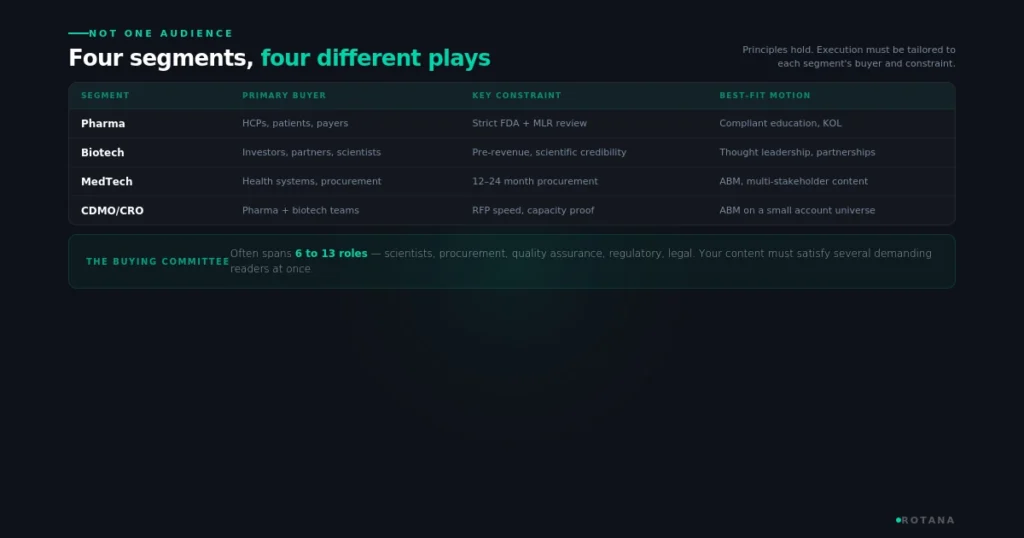
Life sciences spans pharmaceuticals, biotechnology, medical devices, diagnostics, contract research and manufacturing organizations and lab suppliers and a strategy built for one misfires for another. The principles hold, but the execution must be tailored to each segment’s buyer, buying motion and constraint.
| Segment | Primary buyer | Key constraint | Best-fit motion |
|---|---|---|---|
| Pharma | HCPs, patients, payers | Strict FDA and MLR review | Compliant education, KOL credibility |
| Biotech | Investors, partners, scientists | Scientific credibility, pre-revenue | Thought leadership, partnership building |
| MedTech | Health systems, procurement | 12 to 24 month procurement | ABM, multi-stakeholder content |
| CDMO and CRO | Pharma and biotech teams | RFP speed, capacity proof | ABM on a small account universe |
The evidence-first content engine
Lead with education, not promotion
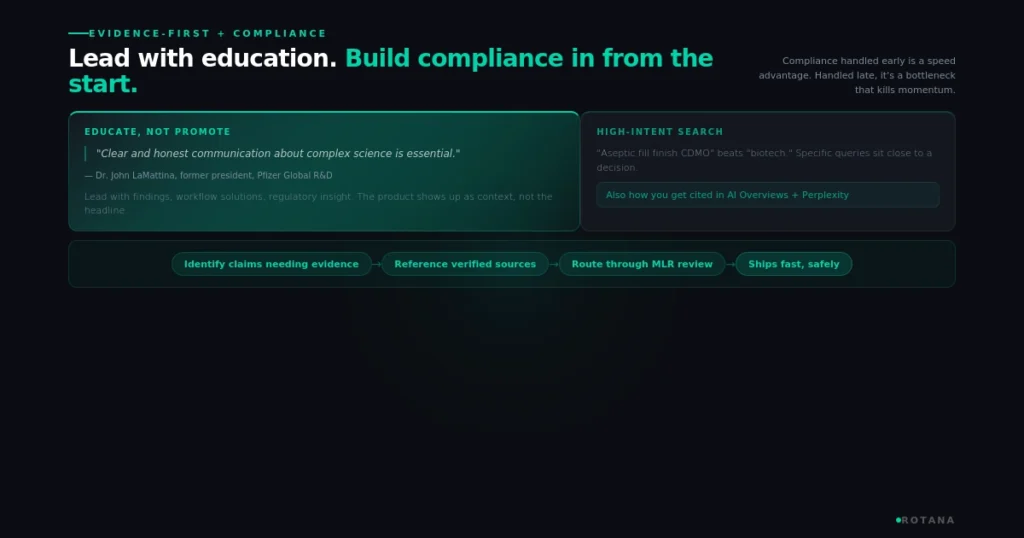
Because regulation limits what you can claim and the audience rejects being sold to, education is not a stylistic choice in life sciences. It is the strategy. As Dr. John LaMattina, former president of Pfizer Global Research and Development, put it:
“Clear and honest communication about complex science is essential.”
That is the whole brief. Lead with research findings, workflow solutions and regulatory insight and let the product show up as context rather than the headline. Blogs, case studies and whitepapers perform best, since they let you demonstrate expertise and cite evidence. When your audience resists being sold to, the move that works is to stop selling and start being genuinely useful.
Win the specific, high-intent search
Broad terms like “biotech” or “pharma” are brutally competitive and low-intent. The pipeline lives in specific, high-intent queries: “GMP-compliant contract manufacturing for biologics,” “aseptic fill finish CDMO,” “LIMS software for clinical laboratories.” These searchers know exactly what they need and sit close to a decision, so a content library targeting them generates qualified pipeline even at modest traffic volumes. This is also how you appear in AI search, where buyers now ask tools like Perplexity and Google AI Overviews nuanced questions such as the best aseptic fill-finish partner for a small biologics batch. Answer those precise questions clearly and you become the cited source. Building that high-intent content library is the work I focus on through our content strategy service.
Content compounds when it stays accurate
Most life sciences marketing collateral has a short shelf life because regulatory updates and product changes outdate it. Content built around durable scientific and process questions, rather than fleeting product claims, keeps working and compounding for years. That durability is rare and valuable in this industry, so favor evergreen educational depth over campaign-bound material wherever the topic allows.
Build compliance in from the start
In pharma and medical devices, much of what marketing produces must pass a medical, legal and regulatory review, the MLR process, governed by frameworks like the FDA, EMA, GMP and GLP. This affects timelines, creative freedom and the claims you can make. The mistake that wrecks programs is treating compliance as an afterthought that delays everything at the end. Build it into the workflow from the start: know which claims need evidentiary support, reference verified data and expert-reviewed sources and route content through approval before it ships. Compliance handled early is a speed advantage. Handled late, it is a bottleneck that kills momentum.
The channels that reach scientific buyers
LinkedIn and thought leadership
LinkedIn is the dominant platform for life sciences, since decision-makers spend their professional time there and targeted advertising can reach exact job titles and companies. Pair company leadership posting genuine thought leadership with targeted campaigns and active engagement in industry conversations. Thought leadership is not a nice-to-have here, it is a competitive advantage, because your audience attends conferences, reads journals and follows key opinion leaders. Positioning your experts alongside those trusted voices earns attention and, eventually, business. Thermo Fisher’s “Behind the Science” podcast is a strong model: it may not draw a mass audience, but it builds credibility with exactly the right one.
Email, webinars and events
Email remains effective when it is personalized, relevant and genuinely educational rather than promotional. Webinars and virtual events have become standard for distributing substantive content and capturing engaged, qualified audiences, especially when combined with on-demand follow-up. The same evidence-first discipline applies across these channels, which is the approach I detail in my guide to B2B email marketing. The technical, committee-driven nature of life sciences sits alongside the broader manufacturing and industrial playbooks in my guides to manufacturing marketing and industrial marketing agencies.
Account-based marketing for a small universe
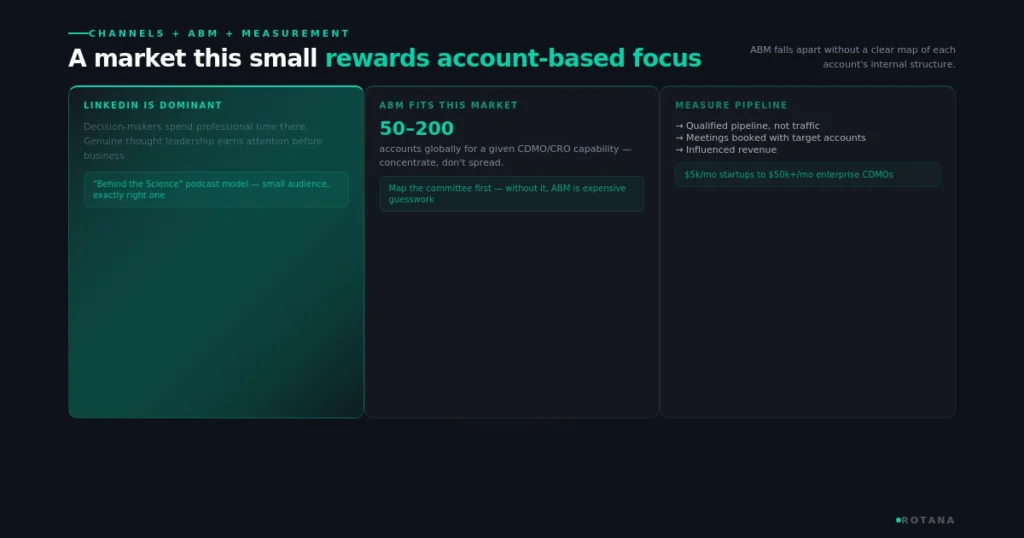
Account-based marketing fits life sciences almost perfectly and the reason is the size of the market. For a CDMO or CRO, the universe of potential pharmaceutical and biotech partners is often just 50 to 200 accounts globally for a given capability. With a market that small, concentrating resources on the highest-value accounts beats broad demand generation. ABM works especially well for specific situations:
- CDMOs and CROs targeting a defined, finite set of pharma and biotech partners.
- MedTech companies selling to health systems, where procurement runs 12 to 24 months across many stakeholders.
- Biotech and specialty pharma pursuing partnership and co-development deals.
But ABM falls apart without a clear map of each account’s internal structure, which is harder to chart in life sciences than most industries. Personalized campaigns reaching the three to five roles inside a single health system or pharma company can accelerate pipeline in ways broad marketing cannot, but only when you have done the work to map the buying committee first. Without that map, ABM becomes expensive guesswork.
Measure pipeline, not traffic
Traffic is nice and leads are better, but what leadership cares about is pipeline, meetings and revenue. Anchor measurement on qualified pipeline, meetings booked with target accounts and influenced revenue, not website visits or impressions. Demand generation in this industry also has a particular job: equip buyers with the materials they need to navigate internal approval, since the sale is committee-driven and your champion has to sell your case internally long after your last touch. Budgets span widely, from around $5,000 a month for startups to $50,000 or more for enterprise CDMOs and pharma divisions, so the discipline is to fund the channels that produce qualified pipeline and trim what only produces traffic.
What I would do first
If you market a life sciences company and want qualified pipeline, work in this order:
- Map your buying committee, the 6 to 13 roles in a typical deal and what each one needs to say yes.
- Build compliance into your content workflow from the start, not as a final-step bottleneck.
- Create an evidence-first content library targeting specific, high-intent search terms.
- Activate LinkedIn thought leadership from your genuine experts, supported by email and webinars.
- For a small account universe, layer in account-based marketing once the committee map exists.
- Measure qualified pipeline, meetings and revenue, then fund what produces them.
Life sciences marketing rewards the company that treats evidence as currency, builds compliance in early and educates a skeptical expert audience instead of selling to it. Trust and expertise are the whole game. If you want that system built and tuned to your segment, that is the work I do at Rotana. Book a call through the link on the site.
Frequently asked questions
What makes life sciences marketing different from regular B2B marketing?
Three things: the audience, the regulation and the sale. Buyers are scientists and clinicians who demand verifiable evidence and reject generic claims, so credibility and accuracy are the currency. Marketing in pharma and medical devices must pass medical, legal and regulatory review, which constrains claims and timelines. And the sale is long and committee-driven, often spanning 6 to 13 stakeholders. Standard B2B playbooks apply at the level of fundamentals, but the execution must adapt to an industry where trust and expertise, backed by data, decide everything.
What is the best marketing channel for life sciences companies?
For most life sciences companies, the strongest combination is SEO targeting specific high-intent terms, an evidence-first content library and LinkedIn for thought leadership and targeted outreach to decision-makers. Email and webinars distribute substantive content well and account-based marketing concentrates resources where the account universe is small. Because buyers research extensively before contacting a rep, the channels that build trust and demonstrate expertise, content and search above all, carry the most weight in earning meetings and pipeline.
How do you market to scientists and other technical buyers?
You educate rather than sell. Scientists are trained to evaluate claims against evidence, so generic benefit statements cost credibility. Lead with research, data and workflow solutions, cite peer-reviewed and verifiable sources and let the product appear as context rather than the headline. Respect the audience’s expertise by simplifying complex science without dumbing it down and satisfy the multiple stakeholders in the buying committee, each of whom cares about something different. The goal is to be genuinely useful to an expert, which earns the trust that eventually converts.
Why is compliance so important in life sciences marketing?
Because regulatory bodies like the FDA and EMA govern not just products but what you may say about them, how and when. In pharma and medical devices, marketing content typically passes a medical, legal and regulatory review before publishing. Claims of clinical efficacy without proper evidentiary support or inaccurate references to regulatory pathways, create real compliance risk. Building review into the workflow from the start keeps programs both safe and fast, while treating compliance as a final-step afterthought delays everything and undermines momentum.
Does account-based marketing work for life sciences?
Yes and it fits unusually well because the market is small. For a CDMO or CRO, the universe of potential partners may be only 50 to 200 accounts globally, so concentrating resources on the highest-value accounts beats broad demand generation. ABM works especially well for CDMOs and CROs, MedTech firms selling to health systems over long procurement cycles and biotechs pursuing partnerships. The catch is that ABM requires a clear map of each account’s buying committee, which is harder to chart in life sciences, so build that map before investing.