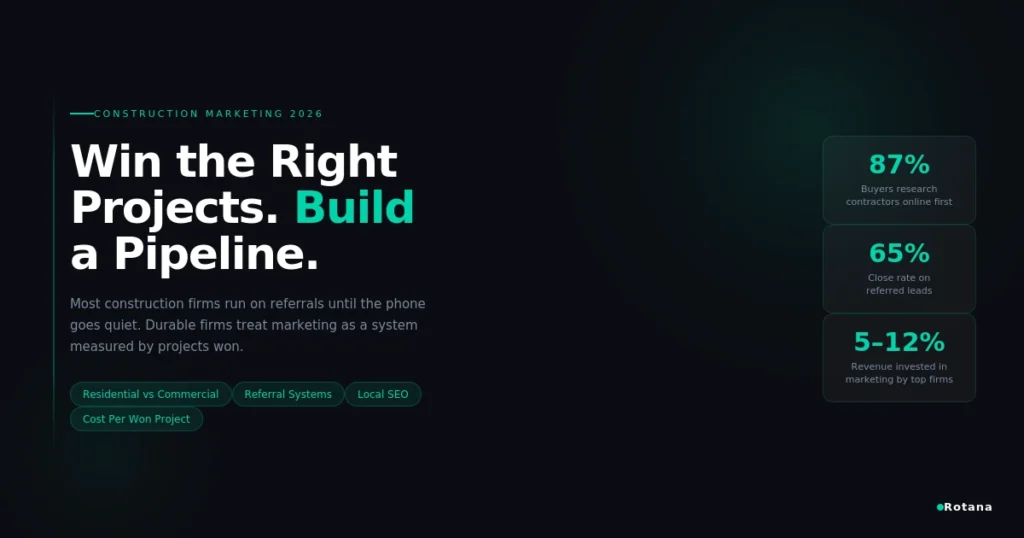
Construction marketing is how you win the right projects consistently, rather than taking whatever work happens to come through the door. Most construction firms do not really market at all. They run on referrals and word of mouth, which is a genuine strength right up until the day the best referral source retires, a major client finishes their last project or the market softens and the phone goes quiet. Referrals are powerful, but they are unpredictable and they do not scale on their own. The firms that grow steadily treat marketing as a system that produces a reliable pipeline, then measure it by the projects it wins, not the leads it counts.
I run an SEO-led growth agency, so I will start with the distinction that reshapes everything else: residential and commercial construction are two different marketing problems that need two different playbooks. Confuse them and you waste budget speaking to the wrong buyer in the wrong place. This guide covers that split, how to systematize referrals without depending on them, how to build owned demand, how to win commercial work and the numbers that tell you whether any of it is working. For the hands-on digital execution behind this strategy, pair it with my guide to digital marketing for construction companies.
Residential and commercial are two different problems
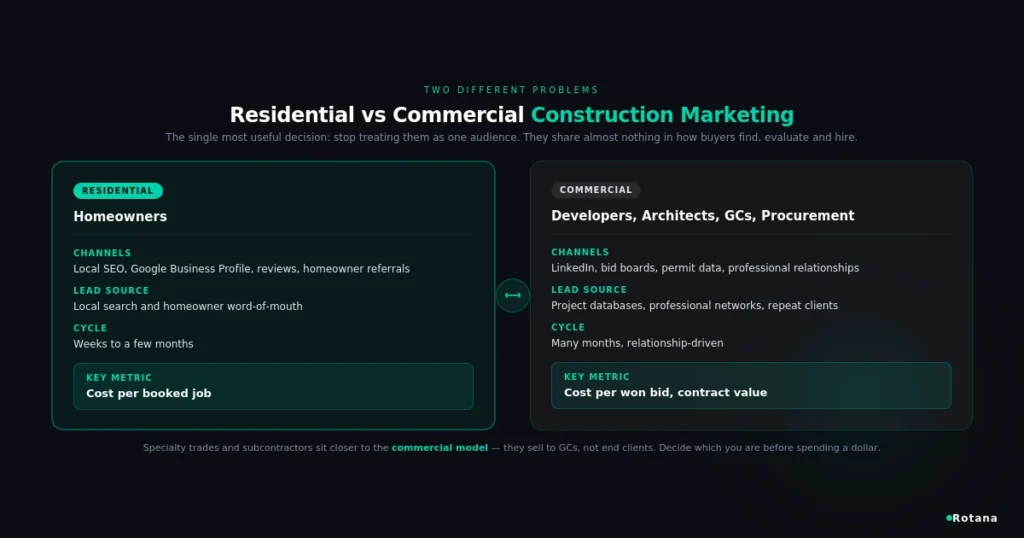
The single most useful decision in construction marketing is to stop treating it as one audience. A homeowner planning a kitchen remodel and a developer planning a multi-family build share almost nothing in how they find, evaluate and hire a builder. They need separate strategies, separate channels and separate messages.
| Factor | Residential construction | Commercial construction |
|---|---|---|
| Buyer | Homeowners | Developers, architects, GCs, property managers, procurement |
| Primary channels | Local SEO, Google Business Profile, reviews, referrals | LinkedIn, bid boards, permit data, relationships |
| Lead source | Local search and homeowner referrals | Project databases, professional networks, repeat clients |
| Cycle | Weeks to a few months | Many months, relationship-driven |
| Key metric | Cost per booked job | Cost per won bid, contract value |
Specialty trades and subcontractors sit slightly apart again, since they mostly sell to general contractors rather than end clients, which makes their marketing closer to the commercial, relationship-driven model. Decide which of these you actually are before you spend a dollar, because a roofer, a custom-home builder and a commercial subcontractor need very different pipelines.
Systematize referrals, but stop depending on them alone
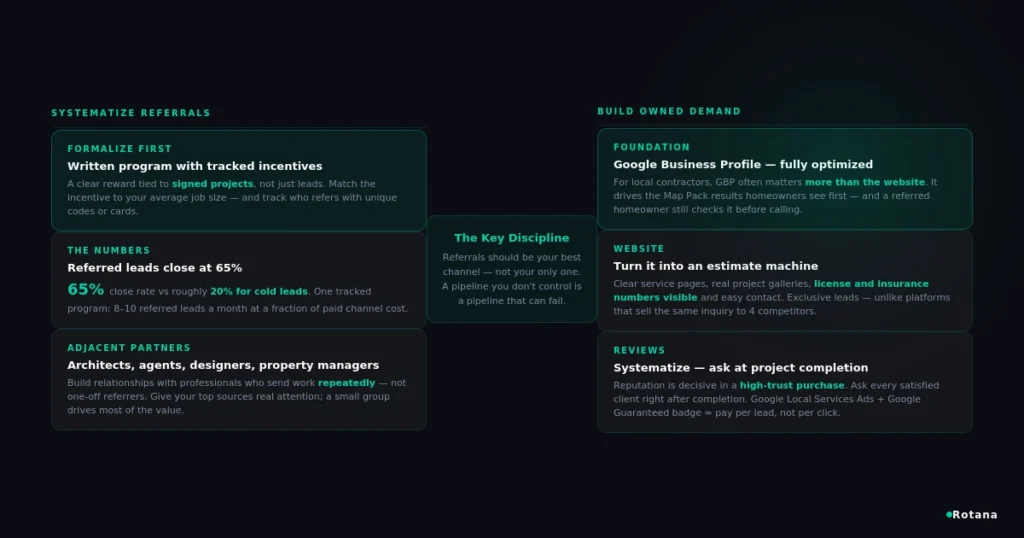
Referrals deserve their reputation. A referred prospect arrives pre-sold on your credibility, is not price-shopping and closes far more often than a cold lead. One general contractor’s referral program brings in 8 to 10 referred leads a month that close at 65%, against roughly 20% for cold leads, at a fraction of the cost of paid channels. So the first move is to formalize referrals rather than hope for them:
- Build a written referral program with a clear incentive tied to signed projects and match the reward to your average job size.
- Track who refers you with unique codes or cards, then give your top referrers real attention, since a small group usually drives most of the value.
- Build relationships with adjacent professionals, architects, real estate agents, designers and property managers, who send work repeatedly.
Here is the discipline that separates durable firms from fragile ones. A pipeline that depends entirely on referrals is a pipeline you do not control, so build owned demand alongside it. Referrals should be your best channel, not your only one.
Build owned demand you control
With 87% of buyers researching contractors online before making contact, your visibility in local search is now the foundation under everything, including referrals, since a referred homeowner still checks your reviews before they call. Owned channels like your website, Google Business Profile and reputation produce exclusive leads you do not pay per click for, unlike shared third-party platforms that sell the same inquiry to several contractors and force a price fight. The foundation to build:
- Optimize your Google Business Profile completely, since for local contractors it often matters more than the website and drives the Map Pack results homeowners see first.
- Turn your website into an estimate machine, with clear service pages, real project galleries, trust signals like license and insurance numbers and easy contact.
- Systematize reviews, asking every satisfied client right after project completion, since reputation is decisive in a high-trust purchase.
- Use Google Local Services Ads for residential demand, where the Google Guaranteed badge builds trust and you pay per lead rather than per click.
This owned-demand foundation is the local-search work I focus on through our SEO consultancy service and the channel-by-channel execution sits in my guide to digital marketing for contractors.
Win commercial work through relationships and early intelligence
Commercial construction runs on a different engine and the firms that win it get in early. Instead of waiting for a homeowner to search, commercial marketing is about discovering projects before competitors do and building the relationships that get you invited to bid. That means monitoring bid boards, permit data and project databases to spot planning-stage work early, which buys you time to understand scope, prepare documents and build the relationship before the request for proposal is even public. It means LinkedIn presence and outreach aimed at developers, architects, general contractors, property managers and procurement teams, sharing project wins and expertise that position you as a credible, serious partner. The architects and developers who specify and hire are the audience here, which is why my guide to digital marketing for architecture firms is a useful companion for understanding how that side of the industry chooses partners.
Measure cost per won project, not leads
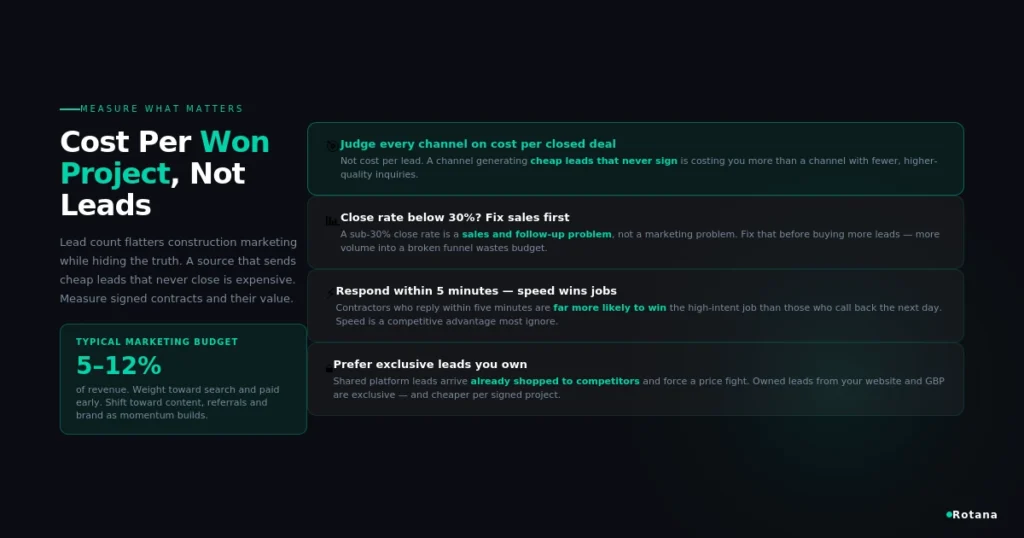
Lead count is the metric that flatters construction marketing while hiding the truth. What matters is signed projects and their contract value against what you spent to win them. A few disciplines make the difference. Judge every channel on cost per closed deal, not cost per lead, since a source that sends cheap leads that never close is expensive. If your close rate sits below about 30%, the problem is sales and follow-up, not marketing, so fix that before buying more leads. Respond fast, because contractors who reply within five minutes are far more likely to win the job than those who call back the next day. And prefer exclusive leads you own over shared platform leads that arrive already shopped to competitors. Most successful construction firms invest 5% to 12% of revenue in marketing, weighted toward search and paid early, then shifting toward content, referrals and brand as momentum builds.
What I would do first
If you run a construction firm and want a pipeline you control, work in this order:
- Decide whether you are marketing to residential, commercial or trade buyers and build the matching playbook rather than a generic one.
- Formalize your referral program with tracked incentives tied to signed projects.
- Build owned demand: an optimized Google Business Profile, a converting website and a systematic review engine.
- For commercial work, get early intelligence from bid boards and permit data and invest in relationships with architects and developers.
- Fix speed to lead so no inquiry waits, since fast response wins high-intent jobs.
- Measure cost per won project and close rate, then move budget toward the channels that sign contracts.
Construction marketing rewards the firm that markets to the right buyer with the right playbook, systematizes referrals without leaning on them alone and measures by the projects it wins rather than the leads it collects. A controlled pipeline beats a lucky one. If you want that system built for your firm, that is the work I do at Rotana. Book a call through the link on the site.
Frequently asked questions
What is the best construction marketing strategy in 2026?
The strongest approach starts by matching the playbook to your buyer, since residential and commercial construction need different channels and messages. From there it systematizes referrals with a tracked incentive program, builds owned demand through local search, an optimized Google Business Profile, reviews and a converting website and for commercial work adds relationships and early project intelligence from bid boards and permit data. Success is measured by cost per won project and contract value rather than raw lead count, so the pipeline stays profitable and under your control rather than dependent on any single source.
How is residential construction marketing different from commercial?
Residential marketing targets homeowners who search locally, read reviews and compare project photos, so it relies on local SEO, Google Business Profile, reviews and homeowner referrals over shorter cycles. Commercial marketing targets developers, architects, general contractors, property managers and procurement teams over long, relationship-driven cycles, so it relies on LinkedIn, professional networks and early intelligence from bid boards, permit data and project databases. The buyers, channels and timelines differ enough that using one strategy for both wastes budget. Specialty trades that sell to general contractors sit closer to the commercial model.
How much should a construction company spend on marketing?
Most successful construction firms invest 5% to 12% of annual revenue in marketing, with the level depending on growth goals and how competitive the market is. Newer firms building visibility from scratch often lean toward the higher end. More important than the percentage is allocation: weight spending toward search and paid channels early to build visibility, then shift toward content, referrals and brand as momentum grows. Judge the budget by cost per won project rather than cost per lead and move money toward the channels that actually produce signed contracts.
Are referrals enough to grow a construction business?
Referrals are the highest-quality lead source, closing far more often than cold leads and arriving pre-sold, so they should be systematized with a tracked incentive program. But depending on them alone is risky, because a referral pipeline is unpredictable and does not scale and it can dry up when a key source retires or the market shifts. The durable approach systematizes referrals and builds owned demand alongside them through local search, reputation and a converting website, so growth does not hinge on a channel you cannot control.
How do construction companies get commercial leads?
Commercial leads come from getting in early and building relationships, not from waiting on local search. Firms monitor bid boards, permit data and project databases to find planning-stage projects before competitors, which buys time to prepare and build rapport before a request for proposal goes public. They maintain a LinkedIn presence and outreach aimed at developers, architects, general contractors, property managers and procurement teams, sharing project wins and expertise to establish credibility. Repeat clients and professional relationships then compound, since commercial construction is a long, relationship-driven sale rather than a quick local transaction.