
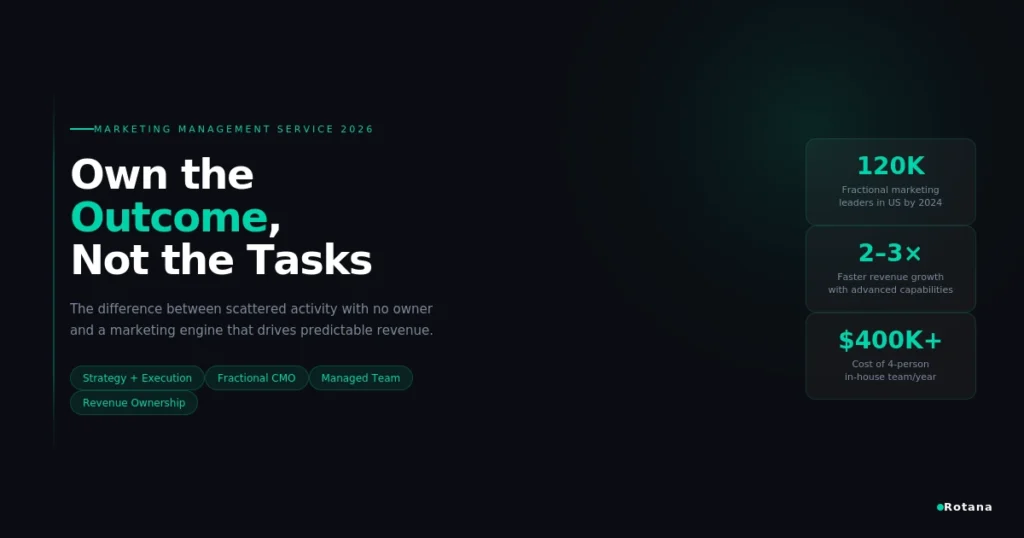
A marketing management service is an outside partner that runs your marketing function for you, covering the strategy, the planning, the execution and the reporting, instead of you building and managing a full team in-house. The core idea is not just getting marketing tasks done. It is having someone own the outcome. That distinction matters, because the most common complaint I hear from business owners is that they are already paying for marketing activity, an agency here, a freelancer there, yet no one owns the bigger picture and the results never match the spend. A good marketing management service closes that gap by taking responsibility for the whole function, not just a slice of it.
I run a growth agency, so I have an obvious interest here, which is exactly why I am going to give you the unbiased version, including when a service like mine is the wrong choice. Getting this decision right unlocks a marketing engine that drives predictable revenue. Getting it wrong means paying for activity that does not move the needle for months. This guide covers what a marketing management service actually includes, the models available, what each really costs, the honest failure mode of each and how to choose the one that fits your situation.
What a marketing management service includes
The term covers a spectrum, but a genuine marketing management service, as opposed to a single-channel vendor, owns most or all of the following:
- Strategy and positioning, defining who you serve, what makes you different and how marketing ties to revenue goals.
- Planning and budgeting, deciding which channels to run, in what sequence, at what spend.
- Execution across channels, running the content, SEO, paid media, email and social work, directly or through managed specialists.
- Measurement and reporting, tracking the metrics that matter and reporting them in plain language.
- Ongoing optimization, killing what does not work and reinvesting in what does.
What separates a real management service from a task vendor is ownership. A vendor does the thing you asked for. A management service owns whether the marketing works, which is a different level of accountability and the whole reason the model exists.
The models and what each really costs
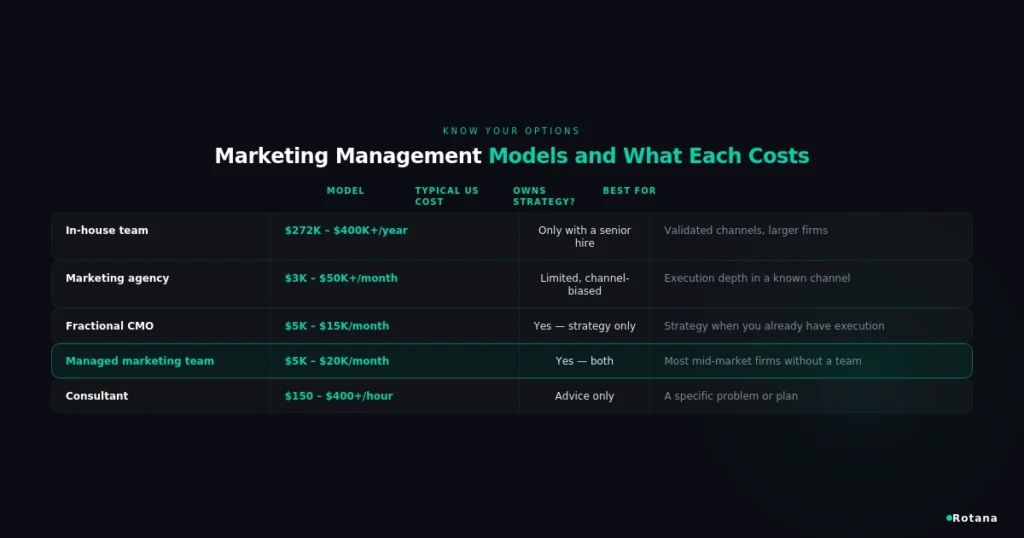
There is no single “marketing management service.” There are several models, each solving a different problem at a different price. The table lays them out honestly.
| Model | What it is | Typical US cost | Owns strategy? | Best for |
|---|---|---|---|---|
| In-house team | Full-time employees you hire and manage | $272K to $400K+ a year for four people | Only with a senior hire | Validated channels, larger firms |
| Marketing agency | External team running campaigns on retainer | $3K to $50K+ a month, plus 10 to 20% of ad spend | Limited, often channel-biased | Execution depth in a known channel |
| Fractional CMO | Part-time senior marketing leader | $5K to $15K a month | Yes, strategy only | Strategy when you already have execution |
| Managed marketing team | Fractional leader plus execution specialists | $5K to $20K a month | Yes, strategy and execution | Most mid-market firms without a team |
| Consultant | Advisor who delivers recommendations | $150 to $400+ an hour | Advice only, no ongoing role | A specific problem or plan |
For context on the in-house comparison, the average marketing team member now costs $80,000 to $100,000 a year in salary alone, so a four-person team runs past $400,000 before benefits, software and overhead, which is why outsourced management is often more cost-effective for equivalent expertise. The cost advantage is not universal, since a high-touch fully-managed relationship can exceed a lean in-house setup, but for most businesses without existing marketing leadership, a management service delivers senior capability faster and cheaper than building it.
The honest failure mode of each model
Every model works in the right situation and fails in the wrong one. The failure modes are what most sales pages hide, so here they are plainly. In-house fails when you hire before you know which channel will scale, since correcting a wrong hire costs another three to six months on top of the two to six months it took to hire. A marketing agency fails when it is channel-biased and you have not confirmed your channel, because a paid-media agency will recommend paid media and an SEO agency will recommend SEO and you pay to discover the wrong channel. A fractional CMO fails when there is no execution capacity underneath them, since strategy without execution is just a document that sits unrealised. A consultant fails when you needed ongoing ownership, not a report. Knowing the failure mode is how you avoid buying the wrong model for your situation.
The insight most buyers miss: separate strategy from execution
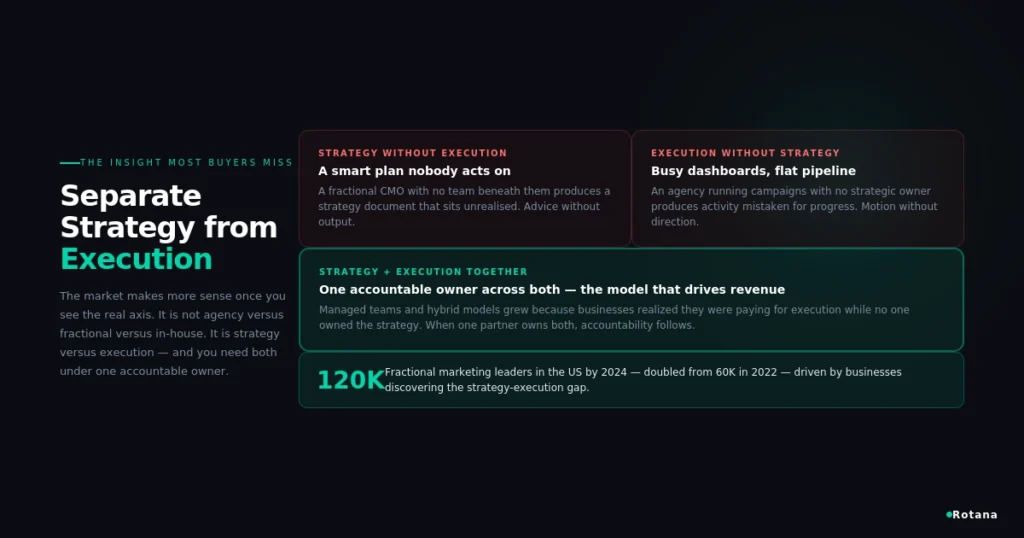
The whole market makes more sense once you see the real axis, which is not agency versus fractional versus in-house, but strategy versus execution. An agency runs campaigns. A fractional CMO runs your marketing function. Execution without strategy produces busy dashboards and flat pipeline, activity mistaken for progress. Strategy without execution produces a smart plan nobody acts on. The reason the managed-team and hybrid models have grown so fast is that they combine both under one accountable owner. The number of fractional marketing leaders in the US roughly doubled from 60,000 in 2022 to 120,000 in 2024, according to the Frak Conference State of Fractional Industry Report, precisely because businesses realized they were paying for execution while no one owned the strategy. When you evaluate any marketing management service, the first question is simple: does this owner control both the strategy and the execution or only one half?
When you actually need one
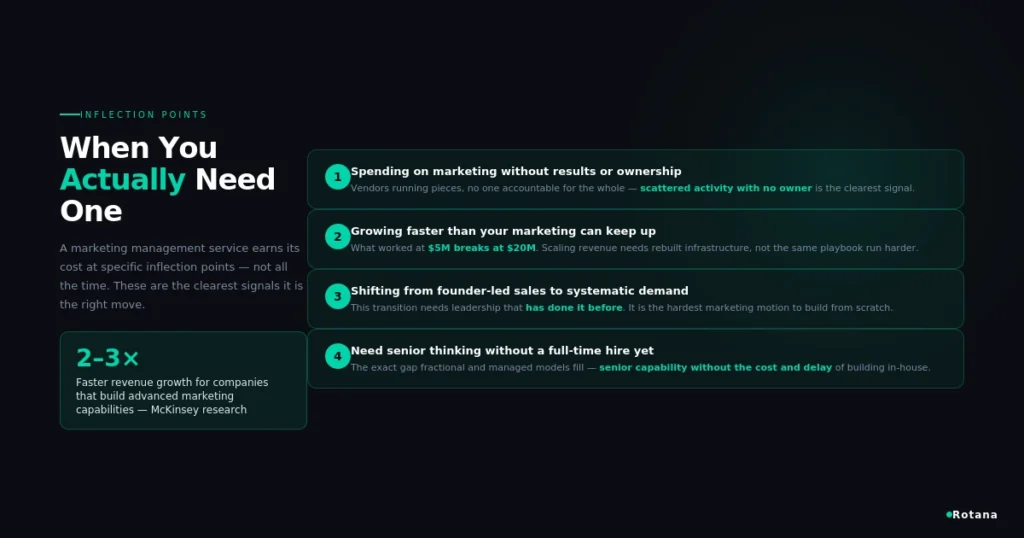
A marketing management service earns its cost at specific inflection points rather than all the time. The clearest signals:
- You are spending on marketing without results or ownership, with vendors running pieces and no one accountable for the whole.
- You are growing faster than your marketing can keep up, since what worked at $5M in revenue tends to break at $20M and needs rebuilt infrastructure.
- You are shifting from founder-led sales to systematic demand generation, a transition that needs leadership which has done it before.
- You cannot justify a full-time marketing leader yet, but you need senior thinking, which is the exact gap fractional and managed models fill.
Companies that build advanced marketing capabilities grow revenue two to three times faster than peers, according to McKinsey research, but most mid-market firms cannot assemble those capabilities in-house affordably. That is the whole case for a management service: senior capability without the full-time cost and the long build.
How to choose the right model
Match the model to your situation rather than to whichever provider pitched you last. Work through it in order:
- Confirm whether you have validated channels. If you already know what works and just need it run, an agency or in-house hire fits. If you do not, avoid locking into a single channel before you have data.
- Check whether you have execution capacity. If you have a team, a fractional CMO adds the missing strategy layer. If you have neither, a managed team gives you both.
- Decide who needs to own the outcome. If you need one accountable partner for the whole function, choose a model that owns strategy and execution together, not a task vendor.
- Pressure-test for bias and lock-in. Ask a prospective partner when they would tell you not to use them and avoid rigid long contracts before you have proof the relationship works.
- Match the cost to your stage. Pay for senior strategy early and scale execution as channels prove out, rather than over-hiring before you have evidence.
The build-versus-buy decision is one every growing company faces and it connects to understanding what an agency does in the first place, which I cover in my guide to what is a marketing agency and the different agency types in my guide to performance marketing agencies. If you are weighing this from the other side, as someone building the service, my guide to how to start a marketing business covers that path.
What I would do
If your marketing feels like scattered activity with no owner, do this. Name the outcome you need marketing to produce, then honestly assess whether you have validated channels and execution capacity. If you have both, add strategic leadership. If you have neither, a managed service that owns strategy and execution together is usually the most efficient path to results, without the cost and delay of building in-house. And whoever you choose, insist that one partner owns the whole function and reports to a real business metric, not a list of tasks completed.
This model is worth paying for when it takes ownership of whether your marketing works, not just whether the work gets done. Ownership beats activity. At Rotana we run marketing as a managed function for businesses that want one accountable partner across strategy and execution and we will tell you honestly if your situation calls for something else. If that is the gap you are trying to fill, that is the work I do, starting with our content strategy service. Book a call through the link on the site.
Frequently asked questions
What is a marketing management service?
A marketing management service is an external partner that owns and runs your marketing function, including strategy, planning, execution across channels and reporting, rather than you building and managing an in-house team. The defining feature is ownership of the outcome, not just completion of tasks. It ranges from a fractional marketing leader who sets strategy to a fully managed team that handles both strategy and execution, giving businesses senior marketing capability without the cost and commitment of full-time hires.
How much does a marketing management service cost?
Costs vary by model. A fractional CMO typically runs $5,000 to $15,000 a month, a boutique agency $3,000 to $15,000 and a full-service agency $10,000 to $50,000 or more, often plus 10 to 20% of ad spend. A managed marketing team combining strategy and execution generally falls in the $5,000 to $20,000 range monthly. For comparison, a four-person in-house team costs $272,000 to $400,000 or more a year in salary alone, which is why outsourced management is frequently more cost-effective for equivalent senior expertise.
Is a marketing management service better than hiring in-house?
It depends on your situation. In-house works when you have validated channels and need someone to own execution long-term, but hiring takes two to six months and locks you into one skill set before you may have channel data. A marketing management service delivers senior capability in one to two weeks, flexes as needs change and often costs less than a full team. For businesses without existing marketing leadership or proven channels, a managed service usually delivers results faster and more affordably than building in-house.
What is the difference between a marketing agency and a fractional CMO?
A marketing agency provides execution, running campaigns, content, paid media and other channel work. A fractional CMO provides strategic leadership, setting direction, prioritizing channels and owning marketing outcomes, typically part-time. The simplest way to put it is that an agency does things for you while a fractional CMO runs your marketing. Many businesses need both, which is why managed and hybrid models that combine strategy and execution under one accountable owner have grown quickly. The key is ensuring whoever sets strategy also owns accountability for results.
When should a business use a marketing management service?
The clearest signals are spending on marketing without results or clear ownership, growing faster than your current marketing can support, shifting from founder-led sales to systematic demand generation or needing senior marketing thinking before you can justify a full-time leader. These inflection points share a common thread: you need marketing capability and accountability that your current setup cannot provide. A management service fills that gap with senior expertise and ownership of the outcome, without the full-time cost and the months-long build of an internal team.